
How to Stay Cool on a Motorcycle in Hot Weather
This post contains affiliate links. As an Amazon Associate, we earn from qualifying purchases.
Staying cool on a motorcycle in hot weather requires managing three things: gear airflow, water intake, and ride timing. While sources like Calsci.com advise against maximizing wind above 98.6°F, others like Visordown and MCN recommend maximizing airflow with vented/mesh gear. For rides in hot weather, plan to stop roughly every hour for a break. At around 100°F, aim for about 0.5 quarts of water per hour, and consider wearing a vented jacket over a wet shirt or a technical base layer.
The 98.6°F line marks the point where your body’s cooling system flips. Below it, wind helps. Above it, wind hurts if you run out of sweat. This is why riders come off a 115°F highway feeling baked in a mesh jacket they thought would save them, which is a key lesson in how to stay cool on a motorcycle in hot weather.
What follows is the breakdown most articles skip: the physics, the real water numbers, the gear choice that changes above that temperature, and how to spot the difference between a hot day and a dangerous one, which is the core of how to stay cool on a motorcycle in hot weather. By the end, you’ll know how to read the heat, not just feel it.
Key Takeaways
-i- The 98.6°F (37°C) ambient temperature is the pivot point. Below it, maximize airflow. Above it, a conventional jacket with moderated vents often beats a mesh suit, which can cause convective heating once your sweat capacity is exhausted.
- Hydration isn’t optional; it’s math. At around 100°F, aim for 0.5 quarts of water per hour. At 115°F, that jumps to 1.5 quarts per hour to match potential perspiration losses.
- Your bike’s radiator can burn you. Calsci.com notes that at 115°F ambient, radiator discharge air could be 125°F or higher. Standard riding gear insulation may not be enough; direct exposure to air over 113°F can cause a second-degree burn in 1.7 hours.
- A wet cotton shirt under a jacket works. The Ohio Motorcycle Operator Manual’s DIY “swamp-cooler” method, a soaked long-sleeve tee under a vented jacket, uses evaporative cooling effectively and is a proven, low-cost tactic.
- Schedule stops before you need them. Plan to pull over roughly every hour for a five- to ten-minute break in the shade. Riding dehydrated impairs mental and physical abilities long before you feel thirsty.
The 98.6°F Threshold That Changes Everything
Forget “the hotter it is, the more wind you need.” That works until it doesn’t. The human body cools through evaporation, sweat pulls heat away as it vaporizes. When the air is cooler than your skin (98.6°F), wind boosts that process. But when ambient temperature climbs above 98.6°F, wind stops helping and starts heating you. Once the breeze uses up all your available sweat, more airflow increases convective heating, not cooling.
When ambient temperatures rise above 98.6°F, only evaporative cooling can work. Above 98.6°F, too much wind can cause convective heating once perspiration capacity is exhausted. In extreme heat, do NOT maximize wind against your skin; use a conventional suit with moderated airflow. , Calsci.com, citing basic physiology
This flips the standard summer gear advice on its head. A mesh jacket is fantastic for a 90°F day. On a 110°F highway, that same jacket can pump superheated air across your skin, drying you out and raising your core temperature. You’ll feel a dry, intense heat, not a cooling breeze.
The fix is to switch tactics while maintaining protection. A conventional textile jacket with adjustable vents allows you to manage airflow, which forms a buffer zone. The goal is enough air movement to aid evaporation without creating a convection oven. If you’re caught in extreme heat without a conventional jacket, the DIY fix is simple: slow down. Reducing your speed cuts the wind force and can lower the convective heating effect.
Gear That Works With the Heat, Not Against It
Good hot-weather gear, central to how to stay cool on a motorcycle in hot weather, manages moisture and airflow without sacrificing protection. It’s a system, not a single piece.
Start at the skin. A sweat-wicking base layer is essential. Cotton holds moisture and turns cold and clammy; a technical fabric or merino wool base layer pulls sweat away from your skin to aid evaporation. The Ohio motorcycle operator manual offers a brilliant low-tech alternative: the “motorcycle swamp-cooler.” Soak a long-sleeve cotton t-shirt, put it on, and wear your vented jacket over it. The evaporative cooling is significant, and it’s free.
Your outer layer is your climate control. For most summer riding, a well-ventilated mesh jacket or a textile jacket with large vents is the right call. Look for jackets with CE-rated armor that stays in place, cheap mesh often has foam pads that shift, leaving you unprotected. Many manufacturers build jackets with ventilation and armor placement in mind. Remember the 98.6°F rule: if the forecast soars past 100°F, a jacket with fewer, larger vents you can control might be smarter than a full-mesh suit.
| Gear Type | Best For Temperatures | Key Limitation |
|---|---|---|
| Full Mesh Jacket | Below 98°F (37°C) | Can cause convective heating above skin temperature; armor may shift. |
| Vented Textile Jacket | 85°F – 105°F (29°C – 40°C) | Offers airflow control; better protection than mesh but heavier. |
| Conventional Jacket (vents closed) | Above 105°F (40°C) in extreme, dry heat | Creates a buffer zone to moderate superheated airflow; relies on base layer for cooling. |
| Cooling Vest | Any temperature, high humidity | Effectiveness depends on water supply; stop-and-go traffic drains it fast. |
Don’t forget your helmet and gloves. A hot weather helmet with multiple intake and exhaust vents is worth the investment. Gloves matter too, ventilated summer gloves keep your hands from sweating and losing grip. For your overall strategy for summer riding gear, fit is everything. Baggy gear flaps and allows uncontrolled air in; well-fitting gear directs air through its intended vents.
The Hydration Math That Keeps You Alert
“Drink plenty of water” is useless advice. You need a number. Dehydration doesn’t just make you thirsty; it slows your mental and physical abilities and impairs your operation of the motorcycle. Your perspiration rate skyrockets in the heat.
Calsci.com notes a significant difference in hydration needs: at around 100°F, a hydration rate of about 0.5 quarts per hour is more typical, while at 115°F, you may need to consume 1.5 quarts of water per hour. , Calsci.com
Let’s put that in ride terms. As an example, Calsci.com calculates that riding 300 miles at 75 mph would take four hours. If the temperature is hovering around 115°F, you could need 6 quarts of water in that stretch. That’s a substantial volume of water to carry and consume. Your bike’s storage space and your bladder become real planning factors.
| Ambient Temperature | Estimated Hydration Need | What Happens if You Fall Short |
|---|---|---|
| ~100°F (38°C) | ~0.5 quarts per hour | Dehydration builds slowly; fatigue and clouded judgement set in after a couple of hours. |
| 115°F (46°C) | ~1.5 quarts per hour | Heat exhaustion can onset within an hour; perspiration stops, heart rate spikes, risk of heat stroke. |
How do you drink that much? A hydration bladder in a backpack or tank bag with a drinking tube is the only practical way. Stopping to unscrew a bottle every 30 minutes isn’t happening. The tube allows you to sip continuously, keeping up with your fluid loss. Electrolyte mixes help, but in extreme heat, water volume is the primary goal. Your first warning sign isn’t always thirst; dehydration can impair mental and physical abilities before you feel thirsty.
Where this goes sideways: Thinking you can “catch up” at the next gas stop. By the time you feel parched, you’re already significantly dehydrated, and your reaction time is compromised. Drink before you’re thirsty, on a schedule.
Ride Strategy: Timing, Stops, and Pace

Your route and schedule are cooling tools. If you have a choice, ride early in the morning or later in the afternoon. The temperature difference between the middle of the day and early morning or evening can be significant.
Plan your stops like refueling. The Visordown advice is solid: in hot weather, plan to stop roughly every hour. A five- or ten-minute break in the shade, helmet off, serves as a core temperature reset. Use this time to drink water, re-wet a cooling vest or your shirt, and check in with yourself.
Keep moving when you can. If you’re stuck, open your jacket vents fully, sip water, and consider shutting off the engine to reduce radiant heat from the motor. Once moving, a steady, moderate pace is better than a aggressive one. A relaxed pace saves your energy and allows you to identify hazards sooner.
Common mistake: Riding through the hottest part of the day to “make time.” You’ll lose more time to mandatory recovery stops than you save by pushing through. A start in the early morning generally beats a start at noon in summer.
This is where knowing your hot weather gear limits matters. If you’re on a naked bike, you’re getting full airflow. If you’re behind a large fairing, you might be in a still, hot bubble. Test what works for your bike.
Hidden Hazards: Radiator Burns and Heat Illness
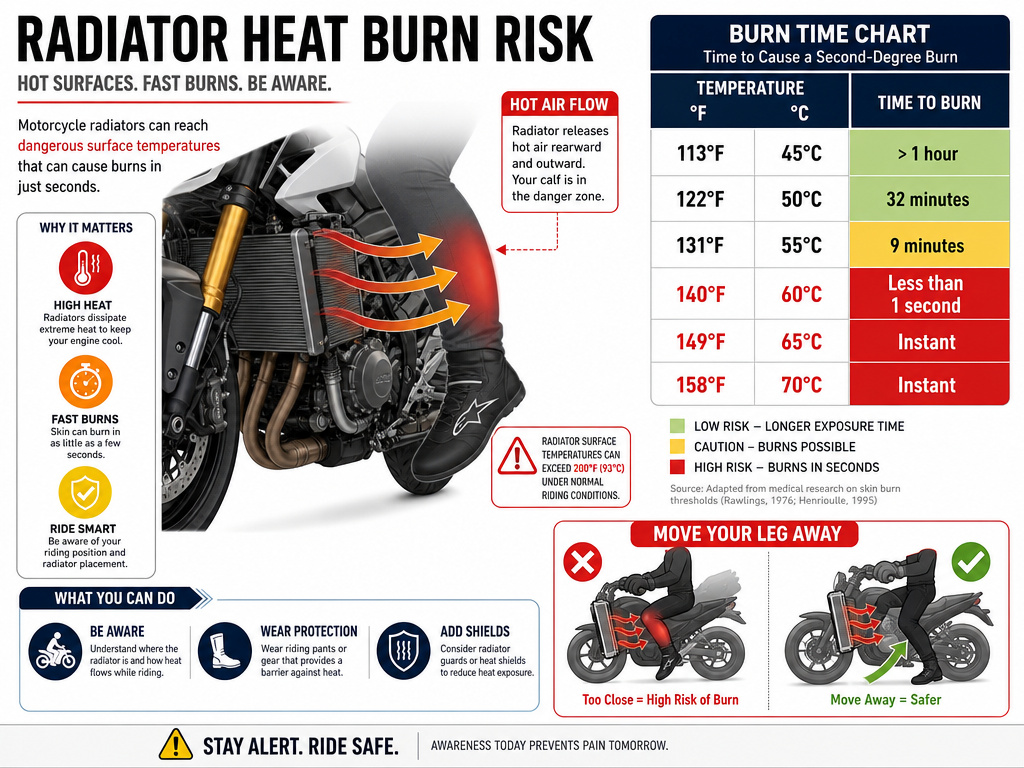
The heat you feel isn’t just from the sun. At 100°F ambient, radiator discharge air might be 140°F, cooling to 110°F before it hits your leg. At 115°F ambient, that discharge air could be 125°F or higher, directed right at your calf.
This isn’t a minor discomfort. National Burn Center data shows how fast damage occurs:
| Temperature | Time to Cause a 2nd-Degree Burn |
|---|---|
| 113°F (45°C) | 1.7 hours |
| 122°F (50°C) | 2 minutes |
| 131°F (55°C) | 11 seconds |
| 140°F (60°C) | 2 seconds |
The insulation provided by an Aerostich suit is not enough to protect against radiator discharge temperatures in excess of 113°F. , Calsci.com
If your leg feels unusually hot, not just warm, move it. Consider adding a heat-resistant layer if you ride a bike known for directing radiator heat at the rider.
Recognizing heat illness in yourself is critical. Recognizing the signs of heat illness, such as those for heat exhaustion, is critical. If you experience these, stop immediately. Get in the shade, drink water, and cool your skin. Heat stroke is a medical emergency. Your ride is over. Call for help.
The line between a hot ride and a dangerous one is thin. Paying attention to these specifics, the burn times, the hydration rates, the convective heating flip, is what separates a prepared rider from a vulnerable one.
How hot is too hot to ride a motorcycle?
The human body cools by sweating; evaporation takes body heat with it. Your normal body temperature is 98.6°F. When the air is cooler than your skin, wind helps cooling. But when ambient temperatures rise above 98.6°F, only evaporative cooling can work. Above this point, too much wind can cause convective heating once your perspiration capacity is exhausted. This is the difference between a hot day and a dangerous one. In extreme heat, do not maximize wind against your skin; use a conventional riding suit with moderated airflow instead. Your body’s ability to cool has a hard limit, and riding past it impairs your mental and physical abilities.
How to plan a route for maximum shade and airflow
Route planning is your first defense against heat. Ride early in the morning or later in the afternoon to avoid the hottest part of the day. Choose roads with natural wind channels and tree cover where possible. A more relaxed pace conserves energy and reduces fatigue. Remember that in extreme heat, the strategy for airflow changes; once the temperature exceeds 98.6°F, you need moderated airflow from a conventional suit, not maximum wind exposure. Plan your stops around this principle, aiming for regular breaks in shaded areas to let your body’s evaporative cooling catch up without the convective heating effect of constant high-speed wind.
Frequently Asked Questions
How hot is too hot to ride a motorcycle?
There’s no universal temperature limit. The risk depends on humidity, your gear, your hydration, and your acclimation. The physical pivot is 98.6°F (37°C), where wind cooling stops working. Practically, if you’re showing signs of heat exhaustion or struggling to concentrate, it’s too hot for you to ride safely, regardless of the thermometer.
Is a cooling vest worth it?
cooling vest can lower your perceived temperature by 6–12°C, as claimed for the BMW Cool Down Vest. They’re excellent for humid conditions or stop-and-go traffic where evaporative cooling from a wet shirt fails. The drawback is finite water supply and the added weight. For long, dry highway rides, a soaked shirt under a jacket often works as well.
Why shouldn’t I just ride in a t-shirt?
Wind against bare skin evaporates sweat too quickly, short-circuiting your body’s cooling process. Your body then sweats more, dehydrating you faster. The Ohio motorcycle operator manual notes this leads to faster dehydration and impaired riding ability. A layer between you and the wind, even a thin, wet one, manages the evaporation rate.
What about my bike overheating?
Check your coolant level before a hot ride. Most modern motorcycles are tested for extreme conditions, but sitting in traffic strains the cooling system. If your temperature gauge climbs into the red, shut off the engine if safe to do so. Overheating can cause vapor lock or damage, so keep moving when possible to maintain airflow through the radiator.
Before You Go
One rule cuts through the complexity: listen to your body, not the clock. If you feel a headache coming on, pull over. If your skin feels dry and hot, not sweaty, find shade. The numbers here, 0.5 quarts per hour, the 98.6°F threshold, the 1.7-hour burn time, are guides, not guarantees. Your individual tolerance is the final metric.
The goal is to manage heat so you can ride further, safer, and more comfortably. That means a vented jacket over a summer base layer, a hydration pack you’ll actually use, and a schedule that respects the sun. Choose and fit your summer motorcycle clothes for the ride you’ll take, not the one you wish you were on.
So pack the water, plan the early start, and trust the process. The heat is just another condition to ride through.
