
Waterproof vs Water Resistant Motorcycle Gear
This post contains affiliate links. As an Amazon Associate, we earn from qualifying purchases.
Waterproof motorcycle gear uses a sealed membrane, like GORE-TEX, eVent, or H2Out, to block water under pressure, measured by a water column rating (typically 10,000 mm or higher). Water resistant gear relies on a surface treatment (DWR) that beads light rain but fails under sustained pressure or immersion. For riding in real rain, waterproof is the only choice that keeps you dry for hours.
The difference isn’t just about staying dry. It’s about managing sweat and staying comfortable. A waterproof membrane that doesn’t breathe turns your jacket into a personal sauna, while a water-resistant shell that wets out under sustained pressure leaves you cold and miserable. Understanding waterproof vs water resistant motorcycle gear is key to making the right choice.
What follows: a breakdown of the lab numbers you actually need to trust, where gear fails in the real world, and how your riding style, adventure, sport, or touring, dictates which membrane technology makes sense when you compare a waterproof vs water resistant motorcycle gear. By the end, you’ll be able to read any product spec sheet and know exactly what you’re buying.
Key Takeaways
- Waterproof gear requires a membrane. Look for a laminated 3-layer construction or a quality removable liner; a surface coating alone is water resistant and will fail.
- Check the water column rating. Premium adventure gear like the Mosko Moto Boundary pushes 30,000 mm.
- Breathability is measured two ways. MVTR (moisture vapor transfer rate) matters, but air permeability (cfm) is what keeps you cool during active riding, a key feature highlighted by brands using eVent.
- Seams and zippers are the weak points. A high-rated membrane is useless if the stitching isn’t fully taped or the zippers aren’t water-resistant YKK Aquaguard.
- Your riding posture changes everything. A sport riding tuck directs water into a jacket’s front zipper; an upright adventure stance exposes the neck and shoulders. Choose gear built for your position.
What Do the Numbers Actually Mean?
You’ll see two numbers on a spec sheet: something like 20k/10k or 30k/10k. The first is the water column rating in millimeters. The second is the MVTR (Moisture Vapor Transfer Rate) in grams per square meter per 24 hours. They tell you two different stories.
The water column test is simple. They place a square of the fabric under a tube, fill it with water, and see how high the column gets before water pushes through. A rating of 10,000 mm indicates high resistance to water pressure.
A 10,000 mm water column rating equates to withstanding the pressure of a 10-meter (33-foot) tall column of water on a single square inch of fabric. This exceeds the force of heavy, wind-driven rain, making it a reliable benchmark for true waterproof performance in motorcycle gear.
But here’s where manufacturers disagree. The KTM POWERWEAR catalog defines its K-HYDRATECH membrane in three tiers: under 10,000 mm, 10,001–19,999 mm, and over 20,000 mm. GORE-TEX claims 28,000 mm. The Mosko Moto Boundary jacket, using eVent Expedition, claims 30,000 mm. That’s a spread, and it tells you the top-tier adventure gear is built for the worst conditions.
The second number, MVTR, measures breathability, how much moisture vapor (your sweat) can escape. A rating of 10,000 g/m²/24h indicates a high moisture vapor transfer rate. That sounds like a lot, but it’s a lab test under ideal conditions.
| Metric | What It Measures | Good Benchmark | Premium Benchmark | Real-World Meaning |
|---|---|---|---|---|
| Water Column | Hydrostatic pressure resistance | 10,000 mm | 20,000–30,000 mm | Handles prolonged, heavy rain and pressure from riding position. |
| MVTR | Moisture vapor (sweat) escape | 10,000 g/m²/24h | 10,000–20,000 g/m²/24h | Prevents sweat buildup during active riding; higher is better. |
| Air Permeability (cfm) | Airflow through the membrane | Often not published | 0.06 cfm (eVent) | Actively cools you; a feature highlighted by brands like Mosko Moto. |
This is the technical disagreement. Brands like GORE-TEX focus on the membrane’s pore-size science. Brands using eVent, like Mosko Moto, highlight air permeability, a measure of how much air flows through. Their Boundary jacket has an air permeability of 0.06 cfm. That’s a tiny amount, but it makes a difference when you’re working hard off-road and need the fabric to help dump heat, not just rely on vapor diffusion.
The Spidi H2Out membrane is rated 10k/10k and is designed specifically for motorcycling. The takeaway? Don’t just look for the biggest number. Match the technology’s strength to your riding. If you tour in cold rain, high water column is king. If you ride hard off-road, air permeability might save your comfort in your waterproof vs water resistant motorcycle gear.
The Construction Divide: Laminated vs. Drop-Liner
This is where the rubber meets the road. There are two ways to put a waterproof membrane in a jacket: laminate it between the outer shell and inner lining, or make it a separate, removable liner that drops inside. Your choice here decides how dry you stay and how well the gear breathes.
A laminated construction bonds the membrane permanently to the inner face of the outer shell. The Mosko Moto Boundary is a 3-layer laminate: 500D Stretch Cordura face, eVent membrane, and a backing cloth. The seams are then fully taped on the inside, creating a monolithic waterproof shell. There’s no separate liner to get misplaced or absorb moisture.
A drop-liner is a separate, removable inner jacket, usually with its own membrane. The Spidi Allroad jacket uses this system with its H2Out 10K/10K liner. The main shell is water-resistant, and you add the liner when it rains. The Alpinestars SMX Waterproof Jacket uses a fixed 2-layer membrane.
Common mistake: Assuming a drop-liner jacket is waterproof without the liner installed. The outer shell alone is only water-resistant. If you get caught in a downpour without the liner, you’re getting wet.
I used to trust the tags and skip my own testing. Now I run a hose over new gear before a real rainy ride. That habit has exposed more than one set of seams and zippers that leak. A drop-liner system passes only if the liner is correctly installed and the shell’s own seams are tight.
Here’s the honest take. For dedicated rain riding, a laminated jacket is superior. The protection is always there, and the breathability is more consistent because the moisture vapor has a direct path out. However, drop-liners offer versatility, you can remove them in dry cold for better airflow through a mesh shell.
Common Leak Points & How to Seal Them
The membrane could be rated for a 50-meter water column, and you’ll still get wet if the seams leak. Water finds the path of least resistance, and on motorcycle gear, that’s through stitches, zippers, and closures.
The big four leak points are: neck closure, front zipper, sleeve cuffs, and pit zips/vent closures. In a sport riding tuck, water runs down the tank and pools at the front zipper. If the external storm flap isn’t well-designed or the zipper isn’t waterproof, it seeps in. An upright adventure rider takes water directly on the chest and shoulders, testing the taped seams there.
Look for specific features that address these points:
- Main Zipper: A water-resistant YKK Vislon Aquaguard zipper, like on the Mosko Moto Boundary, has a rubberized coating that won’t clog with dirt. A cheap PU-coated zipper may fail over time.
- Neck Seal: A tall, stiff collar with a smooth inner lining and a hook-and-loop or snap closure is essential. A floppy collar allows drips from your helmet to run down your back.
- Cuff Closure: Adjustable hook-and-loop cuffs with a gusset seal around gloves. Simple elastic cuffs leak.
- Seam Taping: Fully taped seams are essential for waterproof gear. Look for brands that mention it.
Where this goes sideways: Ignoring the zipper on a drop-liner. If your waterproof liner has a standard front zipper, water can travel through the coil from the outside shell zipper, right into your chest. A storm flap on the liner itself is the fix.
Abrasion and wear degrade membranes and coatings. That’s why maintenance, reapplying a DWR (Durable Water Repellent) treatment to the outer shell, is part of the deal. It doesn’t make the jacket waterproof, but it makes the outer shell bead water, preventing it from soaking the shell and overloading the membrane.
Waterproof vs. Water Resistant By Riding Style
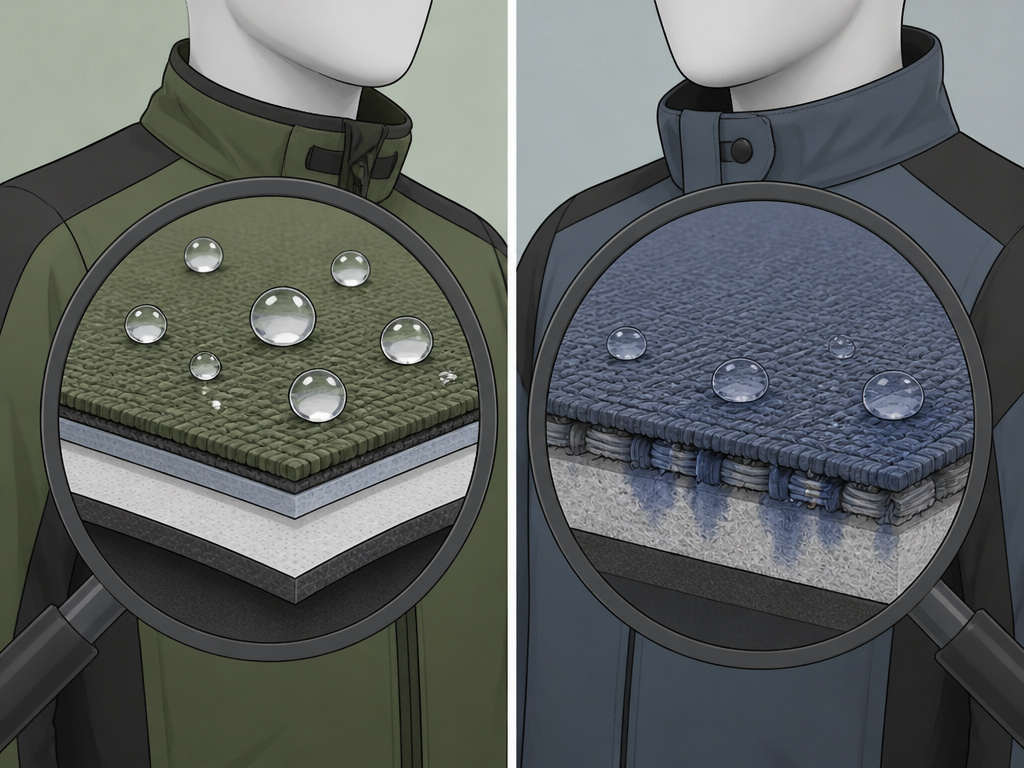
Your bike and how you ride it should pick your gear. The demands of a sportbike tuck are different from an adventure bike’s upright stance, which are both different from a cruiser’s relaxed posture. The “best” gear is the gear that fits your physical scenario.
Adventure & Dual-Sport Riding: Adventure & Dual-Sport Riding: You need high waterproofing and breathability for varied conditions. You also need extreme durability.
- Pick: Laminated 3-layer construction with a high water column (20,000 mm+) and air permeability. The Mosko Moto Boundary (30k/10k, 0.06 cfm) is built for this.
- Why: The fabric must be durable and keep you dry during prolonged rain.
Sport & Performance Riding: The riding tuck focuses water on the chest and thighs. You need a close fit to prevent flapping material from creating leak points, and often want integration with an airbag system.
- Pick: A streamlined, laminated jacket often with a fixed 2-layer membrane for reduced bulk. The Alpinestars SMX Waterproof Jacket is a example, designed to be Tech-Air 5 airbag compatible.
- Why: A 2-layer membrane can offer protection with less bulk. Seam placement and zipper flaps must be designed for a leaned-forward posture.
Touring & Commuting: The priority is all-day comfort, versatility across seasons, and often, value. You may face hours of predictable interstate rain.
- Pick: A drop-liner system or a highly breathable laminated jacket. The Spidi Allroad with its removable H2Out liner is a classic here, offering a 3-in-1 solution.
- Why: Versatility. You can use a mesh or textile shell in dry weather for maximum ventilation, and add the waterproof liner only when needed. For the commuter, a drop-liner system offers versatile waterproof protection.
Short Trips & Urban Riding: If your rides are under an hour and you can avoid rain, water-resistant gear can be sufficient. It’s lighter, more packable, and often more stylish.
- Pick: A softshell or textile jacket with a DWR treatment. The Alpinestars SMX jacket‘s outer shell, for example, has a DWR treatment on its water-resistant membrane.
- Why: You’re trading absolute protection for convenience and comfort. For a sudden summer shower, a DWR will bead water long enough to get you home or under cover. You are not buying all-day storm protection.
Certifications & What They Guarantee
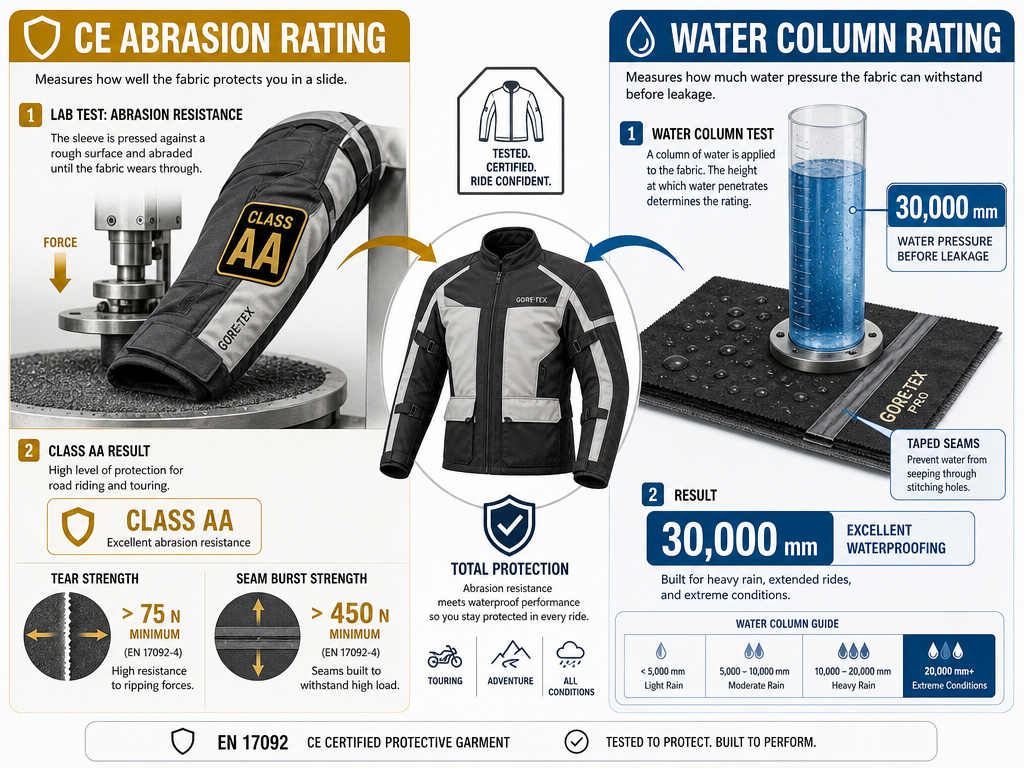
Beyond marketing claims, a certification is a verified promise. For motorcycle gear, the CE certification for abrasion resistance and the water column rating are the two that matter most for waterproofness.
The CE standard for motorcycle clothing (prEN 17092) rates jackets from Class A (lowest) to Class AAA (highest) based on abrasion resistance, seam strength, and tear resistance. A CE Class AA rating, like on the Mosko Moto Boundary and Spidi Allroad, means the jacket has survived rigorous lab abrasion tests. It doesn’t mean waterproof, but it does mean the shell protecting your membrane is tough enough to do its job in a slide.
Worth knowing before you start: A CE Class A jacket, like the Spidi Traveler 2 H2Out, meets a lower abrasion standard. It may still have a great waterproof membrane, but the outer fabric might not hold up as well in a crash. The waterproofing and the protection are separate concerns.
The water column rating itself isn’t a “certification” in the same way, it’s a test result. However, reputable brands publish these results from independent labs. When you see 30,000 mm, it’s not a marketing guess. It’s a measurable performance fact.
There’s no single “waterproof certification” to look for. You must look at the combination: a brand, a published water column rating, mention of fully taped seams, and quality hardware. That’s the trifecta.
How to Test & Maintain Your Gear
Your new jacket has a 20,000 mm rating. Great. That rating assumes perfect, new condition. Road grime, body oils, sunscreen, and general wear degrade performance. You need to test it and keep it up.
The Home Test: Before your first long ride in the rain, do a controlled test. Put the jacket on, go outside, and have someone spray you with a garden hose on a gentle shower setting for 5-10 minutes. Focus on the shoulders, chest, and sleeves. Pay attention to the feel, cold spots indicate water penetration. Check the inside seams for dampness. This isn’t about flooding the gear; it’s about simulating steady rain.
Maintenance is Non-Negotiable: The outer shell’s DWR treatment wears off. When water stops beading and instead soaks into the face fabric (called “wetting out”), it’s time to refresh it.
- Wash the jacket according to label instructions, using a technical gear cleaner (not regular detergent).
- While still damp, apply a DWR spray or wash-in treatment specifically for waterproof gear.
- Tumble dry on low heat. The heat helps reactivate and distribute the DWR.
This process does not make a water-resistant jacket waterproof. It restores the water-repellent finish on the outer fabric of a waterproof jacket, which takes pressure off the membrane underneath. A soaked outer shell can overwhelm even a membrane with condensation.
Storage Matters. Never store your gear crumpled in a damp heap. Hang it in a cool, dry place. A moldy liner is a ruined liner. For long-term storage, make sure it’s completely dry inside and out.
Frequently Asked Questions
Should I get waterproof or water-resistant motorcycle gear?
If you ride in rain intentionally or for more than 30 minutes, get waterproof gear. Water-resistant gear is for light, brief showers you can avoid. The difference is between staying dry and getting damp.
What is the best waterproof riding gear for motorcycles?
There is no single “best.” For adventure riding, look at laminated 3-layer jackets like the Mosko Moto Boundary. For sport riding, consider streamlined options like the Alpinestars SMX Waterproof. For touring versatility, a system jacket like the Spidi Allroad with a removable H2Out liner is excellent. Match the gear to your riding style.
What does 10k/10k mean on a jacket?
It means the fabric has a water column rating of 10,000 mm and an MVTR (breathability) rating of 10,000 g/m²/24h. The first number is waterproofing; the second is breathability. It’s a common benchmark for good performance motorcycle gear.
Can you re-waterproof a motorcycle jacket?
You can restore the Durable Water Repellent (DWR) finish on the outer shell with a specific spray or wash-in treatment, which helps water bead off. You cannot repair a damaged or delaminated internal waterproof membrane; that is a permanent failure.
Why do I still get wet in a waterproof jacket?
Three reasons: 1) The outer shell has “wetted out” and overwhelmed the membrane with condensation. 2) Water is entering through leak points (neck, zipper, cuffs). 3) The moisture you feel is sweat, not rain, because the jacket’s breathability is insufficient for your activity level.
The Bottom Line
Forget the label. Look at the construction and the numbers. A laminated 3-layer jacket with a water column rating over 10,000 mm and fully taped seams is your ticket to staying dry.
Trust the ride, not the marketing. That means matching the technology to your reality. If you’re an adventure rider sweating up a hill, prioritize air permeability. If you’re a tourer facing highway deluges, maximize water column. If you’re a fair-weather commuter, a good DWR-treated water-resistant jacket is a practical choice.
One final, essential rule: always put your rain gear on before the rain starts. Once water gets inside, even the best membrane can’t get it out. Your comfort, and your safety, depend on staying dry from the first drop.
