
One Piece vs Two Piece Motorcycle Rain Suit: How to Choose
This post contains affiliate links. As an Amazon Associate, we earn from qualifying purchases.
In the one piece vs two piece motorcycle rain suit debate, a one-piece suit eliminates the waist gap for guaranteed dryness in heavy rain, while a two-piece set offers modular convenience and easier packing. For most riders, the choice isn’t about which is better, but which matches how they ride: daily commuters and variable-weather riders lean two-piece; long-distance tourers and heavy-rain warriors go one-piece.
That gap at the waist is the whole argument. A one-piece suit seals it shut. A two-piece suit relies on an overlap you have to manage. The difference is the practical line between arriving dry and arriving damp. This guide walks the specs, the real-world trade-offs, and the specific models that prove each side’s point.
What follows: the waterproofing numbers that matter, a direct comparison of convenience and use cases, a sizing guide that cuts through the confusion, and the one rule for staying dry that every rider misses the first time.
Key Takeaways
- A one-piece suit wins on pure waterproof integrity by eliminating the waist gap, the most common leak point in a downpour at speed.
- Two-piece sets offer modular versatility; you can wear the jacket or pants independently. Sources differ on their best use case: ProductFind highlights this versatility, while EatHealthy365 says they are best for daily commuting, weekend trips, and unpredictable weather.
- Always ensure your rain suit fits over your armored riding jacket and pants. Sources disagree on sizing: Motorcycle Gear Canada advises sizing up from your normal clothing, while Bikebiz states manufacturers account for gear so you should buy your normal size.
- Look for taped or welded seams and a full storm flap over the main zipper; without these features, no fabric rating keeps you dry.
- For infrequent use or tight budgets, a budget one-piece suit often makes more financial sense than replacing individual pieces of a worn two-piece set.
The Waterproofing Showdown: One-Piece vs Two-Piece
The technical difference: A one-piece motorcycle rain suit provides a continuous, seam-sealed barrier from neck to ankle. A two-piece suit relies on a critical overlap at the waist, where the jacket must be tucked over the pants’ waistband to form a waterproof seal. This overlap is the system’s weakest point under sustained hydrostatic pressure from road spray and heavy rain.
The numbers tell the story in the one piece vs two piece motorcycle rain suit debate. The Alpinestars Hurricane Rain V2 Suit carries a waterproof rating of 4,000 mmH2O and a breathability rating of 6,000 g/m²/24h. That’s a specific, measurable threshold for how much water pressure the laminated textile can withstand before it wets through. A two-piece suit like the Tourmaster Defender uses a polyurethane-backed nylon shell with sealed seams, but its rating depends on that waist overlap holding.
In a tucked riding position, road spray hits that overlap zone directly. Water finds the path of least resistance. If the jacket rides up even an inch, the seal breaks. A one-piece suit removes that variable.
But does that mean two-piece suits leak? Not if you manage the overlap correctly. The rule is simple, and most riders get it backwards: you must tuck the jacket hem over the outside of the pant waistband. Tucking it inside creates a channel that funnels water straight into your layers. Do it right, and a two-piece set like the Nelson-Rigg Solo Storm can handle a proven 50-mile ride in a “major gully washer,” as documented in a Rider Magazine test.
| Waterproofing Factor | One-Piece Suit | Two-Piece Suit |
|---|---|---|
| Primary Weak Point | None (continuous barrier) | Waist overlap |
| Seam Integrity | Taped/welded seams throughout | Taped seams on individual pieces |
| Best For | Sustained heavy rain, long-distance touring | Variable conditions, commuting |
| User-Dependent | Low (zip and go) | High (requires proper tucking) |
A one-piece suit’s waterproofing is built into its design. A two-piece suit’s waterproofing is a procedure you have to execute correctly, every time you put it on.
Convenience, Packing, and When You’ll Actually Use It
If waterproofing were the only metric, the debate would be over. It isn’t. Convenience decides what you’ll actually carry and use.
Common mistake: Buying a rain suit for the worst-case storm you imagine, rather than the drizzle you actually ride in most often. The gear you leave at home because it’s a hassle is the gear that fails you.
A one-piece suit is faster to deploy in a surprise downpour. You step into it, zip up, and you’re sealed. That’s the theory. In practice, wrestling a one-piece suit over bulky boots and a jacket on the roadside is its own kind of hassle. A trick from that same Rider Magazine test: putting a plastic bag over your boot first makes the pants slide on more easily.
Where the two-piece suit truly wins is modularity and packing. You can wear just the rain jacket on a misty morning. The Spidi Touring Two Piece is marketed as being “wearable separately or together.” For a daily commuter, that’s a real advantage. When the sun comes out, you can stow the jacket in a saddlebag without dealing with a full suit.
Packing size matters if you tour with limited luggage space. The REV’IT! Pacific 2 H2O one-piece packs into a pouch approximately 10” long and 6” in diameter. A two-piece set’s jacket and pants can often be compressed into smaller, separate bundles, giving you more flexibility in a packed top case.
So which is more convenient? It depends entirely on your scenario. . Sources disagree on one-piece convenience: ProductFind says they are well-suited to shorter commutes where you can pull them on quickly, while EatHealthy365 notes they are harder to put on and best for long-distance touring. . All-day variable weather: A two-piece suit allows you to adapt without putting on the full suit. . Touring with tight luggage: Two-piece packs more efficiently. . Quick gas-stop deployment: One-piece has fewer steps.
The convenience scores flip based on your ride. That’s why the “best” motorcycle rain suits are a type matched to a pattern.
Sizing, Fit, and the Exhaust Problem Nobody Mentions
Sizing rain gear is the second most common mistake, right after buying the wrong type. This is where sources directly disagree.
Both, in their way. You must buy a size that fits over your gear. Some brands cut their rain gear with that room built in. Others don’t. The universal rule: always try it on while wearing your regular riding jacket and pants. Sit on your bike in the showroom. Reach for the bars. If the sleeves ride up to expose your wrists, or the pants pull up at the ankle, you need a larger size.
Where this goes sideways: Buying a one-piece suit if you’re taller than average. The retailer expert for the REV’IT! Pacific 2 H2O explicitly advises taller riders to opt for a separate jacket and pant instead, as the one-piece proportions may not accommodate a longer torso.
Fit is about safety and material survival, not just keeping water out. A loose, flapping suit catches wind, buffeting you at highway speeds. More critically, a baggy pants leg can drape onto a hot exhaust.
This is the exhaust problem. Waterproof fabrics are rarely heat-resistant. The Tourmaster Defender pants have polyester overlays on the seat and inner legs. If your suit lacks these panels, a single contact with the pipe on a hot day can melt a hole, ruining the suit and potentially dripping molten material.
When evaluating motorcycle rain suit pros and cons, add “inner leg protection” to your checklist. It’s a small spec that prevents a catastrophic failure.
How to Actually Stay Dry: The Details That Make the Difference

Waterproof ratings and suit types set the stage, but the details execute the performance. Ignore these, and you’ll get wet in any suit.
1. Seams and Zippers
No taped or welded seams means it’s not truly waterproof. Turn the garment inside out. You should see strips of tape covering every stitch line. The main zipper needs a storm flap, a generous piece of material that covers it, secured by Velcro or snaps.
2. Adjustability
Look for adjusters at the cuffs, waist, hem, and ankles. Velcro cuffs must cinch tight over your gloves. An adjustable collar seals out rain running down your neck. These aren’t comfort features; they are sealing points.
3. Visibility
Rain means low light. Your suit should be a bright color like hi-viz yellow or orange, with large panels of reflective material. The REV’IT! Pacific 2 H2O uses 3M Scotchlite reflective material. Black rain suits are a terrible idea, no matter how cool they look.
4. Storage and Care
Good suits include a storage bag. The Alpinestars Hurricane includes a compact storage roll bag. Store your suit clean, dry, and loosely folded, never crammed wet into a ball. This preserves the waterproof coatings and seam tape.
Putting it all together: a high-rated suit with poor cuffs will leak. A well-sealed suit in black is hard to see. The best motorcycle rain gear balances all these details.
Specific Models: What to Look For in Each Camp
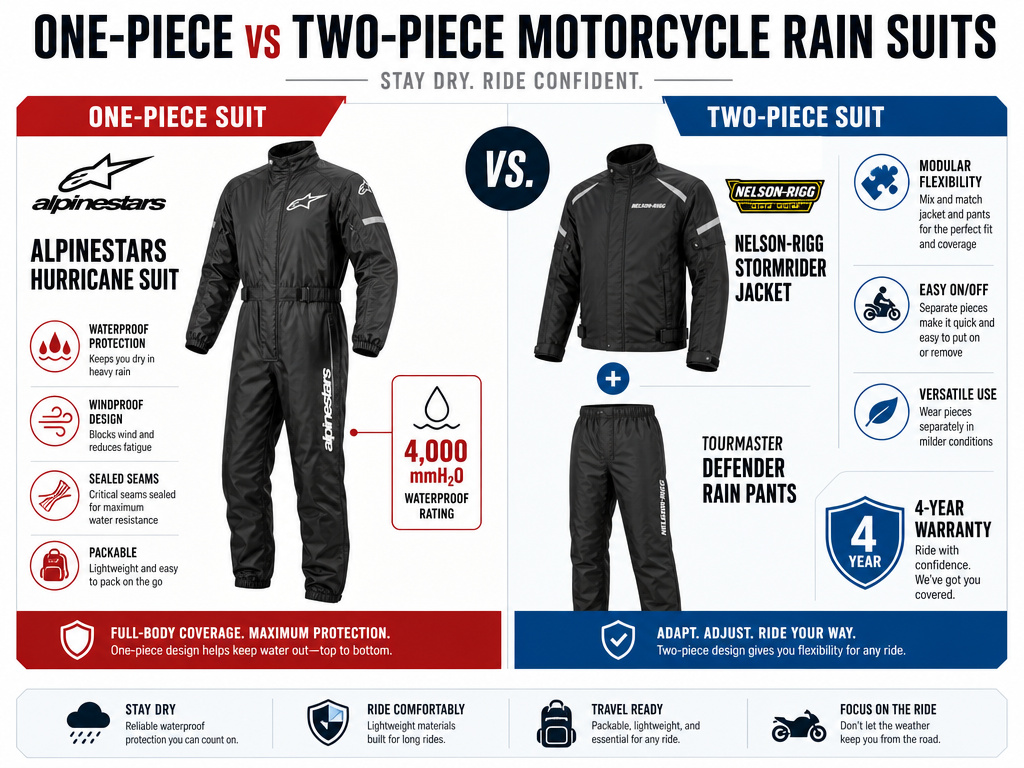
You need names, not just categories. Here are specific models that exemplify the strengths of each type, drawn from manufacturer specs and verified reviews.
One-Piece Suits: The Seal-Tight Barrier
. Alpinestars Hurricane Rain V2 Suit: The benchmark. 4,000 mmH2O waterproof rating, 6,000 g/m²/24h breathability, taped seams, and a compact storage bag. The Alpinestars Hurricane Rain V2 Suit’s recorded weight ranges from ~660g to 728g. This is the suit for riders who face prolonged, heavy rain. . REV’IT! Pacific 2 H2O Rain Suit: PVC-free polyester Oxford with PU coating, EN343 certified. Features a long front zipper past the crotch and a built-in water gaiter in the lap. Packs small. Note the retailer’s fit advice for taller riders. . Dainese ULTRALIGHT RAIN Suit: Marketed as ultra-lightweight with fully waterproof fabric and reflective inserts. The choice when minimal packed size is a top priority.
Two-Piece Suits: Modular Flexibility
. Nelson-Rigg Solo Storm: Polyester oxford shell with PU backing and electronically taped seams. The jacket has an adjustable back vent and a stuff pouch; the pants have a heat-resistant inner leg layer and a non-slip reinforced seat. Proven in a 50-mile downpour. . Tourmaster Defender: Polyurethane-backed nylon with sealed seams, the patented Aqua-Barrier hood, and a 4-year warranty. Pants have overlays on seat/inner legs, removable suspenders, and leg stirrups. A robust choice for serious tourers. . Tourmaster Shield: A PVC-coated poly shell option with a full-length, two-way zipper. The Tourmaster Shield offers a wide sizing range from 2XS to 4XL. Rider reviews note it’s best for light to moderate rain, not heavy downpours.
Your pick depends on your threat level. For guaranteed dryness in the worst weather, look to the one-piece specs. For everyday versatility, the two-piece designs offer more options, like pairing a dedicated rain jacket with your existing waterproof pants.
Long-Term Value and the Replacement Equation
Rain gear wears out. How it wears out changes the cost equation.
A two-piece set has a long-term advantage most buyers miss: if the jacket wears out first, you replace only the jacket. You’re not buying a whole new system. This modular replacement can save money over years of use.
A one-piece suit is a single unit. A torn sleeve or a worn-out zipper usually means replacing the entire suit. However, for riders who only need rain gear a handful of times per year, a budget one-piece option often comes out ahead financially. The initial cost is lower, and the infrequent use means the suit may last for seasons before replacement is an issue.
When comparing total cost, factor in how often you’ll ride in the rain, and whether you’re likely to damage one piece more than the other (jackets often wear faster from sun exposure and abrasion against gear).
Think of it as insurance. A two-piece set is modular insurance. A one-piece suit provides full coverage. Your riding habits dictate the premium.
Cost / Value Comparison
Your budget and riding habits define the value. For riders who only need rain gear a handful of times per year, a budget one-piece suit often provides the best financial outcome. It’s a single purchase that offers a continuous barrier from neck to ankles. The long-term advantage of a two-piece set is modularity; if the jacket wears out first, you only replace the jacket. This versatility, where jacket and pants can be worn independently, can extend the life of your investment. Consider how often you’ll use it and whether you need the flexibility to wear just the jacket on a damp day.
Frequently Asked Questions
What is the main advantage of a one-piece motorcycle rain suit?
The main advantage is the elimination of the waist gap. A one-piece suit provides a continuous, seam-sealed barrier from your neck to your ankles, which is the most effective design for keeping water out during heavy, sustained rain or long-distance touring.
Are two-piece rain suits actually waterproof?
Yes, quality two-piece suits with taped seams and proper storm flaps are waterproof. Their performance relies on correctly overlapping the jacket over the pants at the waist to create a seal. If this overlap is managed properly, jacket hem over the pant waistband, they can perform very well, as proven in real-world tests through downpours.
How should I size my motorcycle rain suit?
You must size your rain suit to fit over your regular armored riding jacket and pants. The safest method is to try the suit on while wearing all your riding gear. Check for adequate sleeve and pant length in your riding position. Some sources advise sizing up from your street clothes; others say to buy your normal gear size, as suits are cut for layering. The try-on test overrules any general rule.
Can I wear a rain suit over my regular motorcycle gear?
Absolutely, and you should. Rain gear is designed as an outer shell layered over your protective riding jacket and pants. It is not a replacement for the abrasion resistance and impact protection of your primary gear. A rain suit’s job is to keep water out, not to protect you in a crash.
What features are non-negotiable for true waterproofing?
Two essential features are taped or welded seams and a full storm flap over the main zipper. Without taped seams, water will seep through the needle holes in the stitching. Without a storm flap, water will channel through the zipper teeth. High waterproof fabric ratings are irrelevant if these two construction details are missing.
Is a bright-colored rain suit really necessary?
In rain conditions, which reduce visibility for all road users, a bright-colored suit with reflective panels is a significant safety advantage. Hi-viz yellow, orange, or silver make you more visible to other drivers. Black rain gear, while it may look appealing, blends into wet, grey road environments and is not recommended.
The Bottom Line
The one piece vs two piece motorcycle rain suit decision doesn’t have a universal winner. It has a right answer for your garage.
If your rides are long, your weather is predictable, and staying dry is essential, a one-piece suit like the Alpinestars Hurricane Rain V2 is your tool. It builds the seal into its design.
If you commute daily, face variable skies, and value the option to wear just a jacket, a two-piece set like the Nelson-Rigg Solo Storm is the smarter play. Its waterproofing requires your diligence, but it rewards you with flexibility.
One rule overrides both: put your rain gear on before the rain starts. A suit can’t keep water out if you’re already wet. That’s the mistake every rider, including me, has made exactly once.
