
Types of Motorcycle Gloves: The Standards That Define Them
This post contains affiliate links. As an Amazon Associate, we earn from qualifying purchases.
Types of motorcycle gloves are defined by their intended use, on-road or off-road, and the certification standards that prove they work. On-road gloves follow EN 13594:2015, which sets two performance levels (1 and 2) for abrasion, tear strength, and impact protection. Off-road gloves may use a selective application of that standard and achieve a PASS rating, not a numbered level. The glove you need depends on where you ride, not just the materials or features listed on the tag.
That distinction between on-road and off-road is a legal classification printed on the glove’s official certificate. An on-road standard assumes higher speeds and harder surfaces. An off-road PASS rating is based on an assessment adapted to off-road use. Mix them up and you’re wearing gear tested for a different environment than the one you’re in.
What follows: the breakdown of the standards, the real performance numbers they demand, the direct conflict between manufacturers on replacement timelines, and the one storage mistake that permanently wrecks a glove’s protection.
Key Takeaways
- The EN 13594:2015 standard applies to protective gloves for motorcycle on-road use and defines two performance levels, with Level 2 being the higher protection tier. However, some manufacturers like Leatt use a selective application of the standard for off-road gloves, which achieve a PASS level instead of a numbered level.
- Off-road specific gloves like the Leatt Glove Moto 3.5 Lite achieve a PASS level under a selective application of the standard and are marked NOT for use on tarmac.
- Certified gloves must cover at least 50 mm beyond the wrist and have a wrist strap that resists 35 N of force to stay on in a slide.
- Manufacturers disagree on lifespan: Leatt recommends replacement every 3 years, while Richa sets a 5-year peremption period from first use.
- Never store gloves in an airtight container like a plastic bag; compression and moisture will degrade the impact material faster than time.
The On-Road Standard: EN 13594:2015
Forget leather versus textile for a second. The first question is: are these gloves meant for the street? If the answer is yes, then the European Standard EN 13594:2015 is the rulebook. This document, titled “Protective gloves for motorcycle riders – Requirements and test methods,” applies specifically to on-road use. It’s not a guideline. It’s the testing protocol that gives a glove its CE certification for pavement.
The standard specifies minimum mechanical thresholds. For example, the palm material must resist abrasion for at least 2.5 seconds on a test machine, and the strongest layer must have a tear strength of no less than 40 Newtons. The wrist closure isn’t just for looks, it must resist a pull force of 35 N and have at least 30 mm of adjustment.
These are the baseline a lab verifies before a glove can be sold as protective equipment in the EU. The EN 13594:2002 standard mandates that gloves must provide coverage to at least 50 mm beyond the wrist joint. That extra length is what keeps the cuff from rolling up your arm if you slide.
The whole point is to create a predictable level of safety you can’t judge by touch alone. A thick leather palm might feel safe, but without meeting the abrasion test time, it could shred faster than a certified thinner material. The standard moves the guesswork from your hands to a controlled machine.
What Are the Two Performance Levels in EN 13594:2015?
EN 13594:2015 provides two performance levels: 1 and 2. This scale represents a trade-off between protection and mobility. Level 1 is the standard pass. Level 2 represents increased protection over Level 1.
Think of Level 2 as the heavy-duty option. For most street riders, a well-made Level 1 glove is the target. The KTM Tourrain WP Gloves, for instance, are certified to Level 1. Their certificate explicitly states the higher level available is 2, but these gloves achieved Level 1.
| Performance Level | Protection Focus | Typical Trade-off |
|---|---|---|
| Level 1 | Meets all minimum requirements for abrasion, tear, seam strength, and impact. | Balance of protection and dexterity. |
| Level 2 | Exceeds Level 1 thresholds for increased protection. | Often heavier, stiffer, or less flexible. |
The “KP” marking on a certificate, like on the Richa Mid-Season Glove, means it includes certified Knuckle Protection as an additional property beyond the basic level. That’s a specific feature you can look for.
The Off-Road Exception: PASS Level and Limited Use
Here’s where the clear line gets blurry, and you must read the fine print. Some gloves are CE-certified but not for the road. The Leatt Glove Moto 3.5 Lite is a perfect example. Its user manual states it is certified for “OFF-ROAD conditions only” and is “NOT intended for use on Tarmac / Road surfaces.”
How can it be certified? Through what Leatt calls “selective application of applicable parts” of EN 13594:2015 and the general standard EN 21420:2020. Instead of the full battery of on-road tests, an off-road glove is assessed with an “analogue method adapted to off-road use.” The outcome is a PASS level, not a Level 1 or 2.
Where this goes sideways: Assuming a PASS-level off-road glove offers the same protection as a Level 1 on-road glove. The Leatt manual is blunt: these gloves “offer protection against minor risks” and “are not designed or intended to protect against serious bodily injuries resulting from hard collisions, crashes or fires.”
This creates two distinct classes. An on-road Level 1 glove is tested according to the full EN 13594:2015 standard for on-road use. An off-road PASS glove is certified based on a selective application of standards for off-road conditions only. They are not interchangeable. Wearing the Leatt glove on a highway is using equipment for a purpose it was not certified to handle.
Gloves by Riding Style and Environment
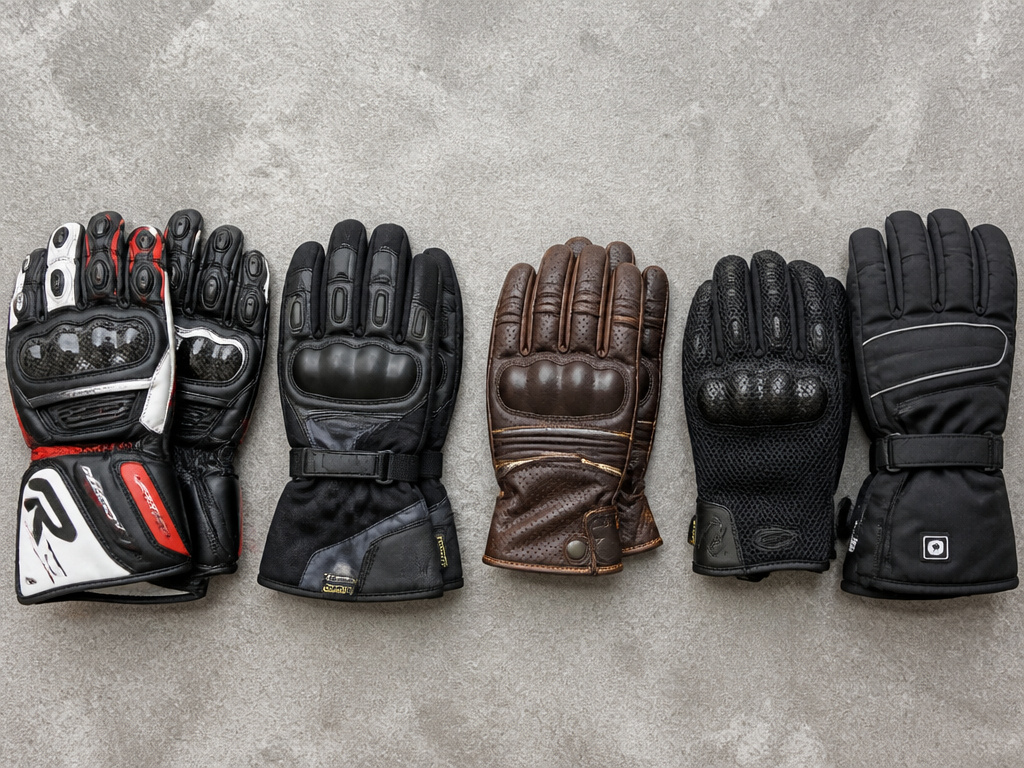
The standards define the how, but your riding defines the what when you compare the types of motorcycle gloves. You match the glove’s certified purpose to your primary riding environment. The categories below aren’t just marketing, they signal which standard the glove likely follows.
Sport and Track Gloves
These are your pure on-road, high-performance gloves. They prioritize pre-curved finger designs, maximum tactile feel for levers, and extensive armor (knuckle, palm, pinky sliders). They are almost exclusively Level 1 or Level 2 under EN 13594:2015. The cuff is usually a long gauntlet to tuck into a jacket sleeve and prevent intrusion. Ventilation is critical. For aggressive street or track riding, you must use a dedicated pair of sport gloves.
Touring and Adventure Gloves
This category spans on-road and off-road. A pure touring glove for highway miles is an on-road glove, often with weatherproofing (Gore-Tex) and insulation. An adventure glove is built for mixed use; some may be full EN 13594 Level 1, while others might lean toward the off-road PASS standard. The key is the cuff: a long, adjustable gauntlet to seal out weather and dirt. For long-distance comfort, the gloves for touring focus on waterproofing and insulation, while the best adventure gloves prioritize durability and ventilation for variable conditions.
Cruiser and Short-Cuff Gloves
Often focused on style, these gloves must still meet the on-road standard if sold as protective equipment. They typically have a shorter cuff for a casual look. The safety challenge here is the wrist closure, it must be exceptionally secure to compensate for the shorter length. A good cruiser glove will still have a robust strap and decent palm protection.
Seasonal Gloves: Summer vs. Winter
This is about materials and construction within the certified standard. A summer glove maximizes airflow with mesh panels but must still have abrasion-resistant leather or textile in the palm and knuckle zones. A winter glove adds insulation and a waterproof membrane, which can add bulk. The key is that both types, if for on-road use, still need to meet EN 13594. You can’t sacrifice certified protection for ventilation or warmth. The differences between summer and winter gloves come down to material layering, not safety level.
Materials, Construction, and Safety Features
The standards set the floor, but materials and features build upward from there. This is where the classic leather vs textile gloves debate lives within the broader types of motorcycle gloves.
Leather, especially goatskin or cowhide, remains the gold standard for abrasion resistance. The KTM Tourrain WP Gloves use about 0.8mm thick goatskin leather specifically in the palm’s impact abrasion area. Leather molds to your hand over time but requires more care.
Textile gloves (using materials like Cordura) offer advantages in weight, ventilation, and often cost. Modern textiles can meet the same EN 13594 abrasion requirements as leather. They also dry faster and are easier to clean.
Most high-end gloves use a combination: leather in high-wear zones (palm, thumb, fingertips) and textile or mesh elsewhere for comfort and airflow. The stitching is as important as the material, seams must be strong and placed to avoid direct contact with the ground in a slide.
Beyond the shell, look for:
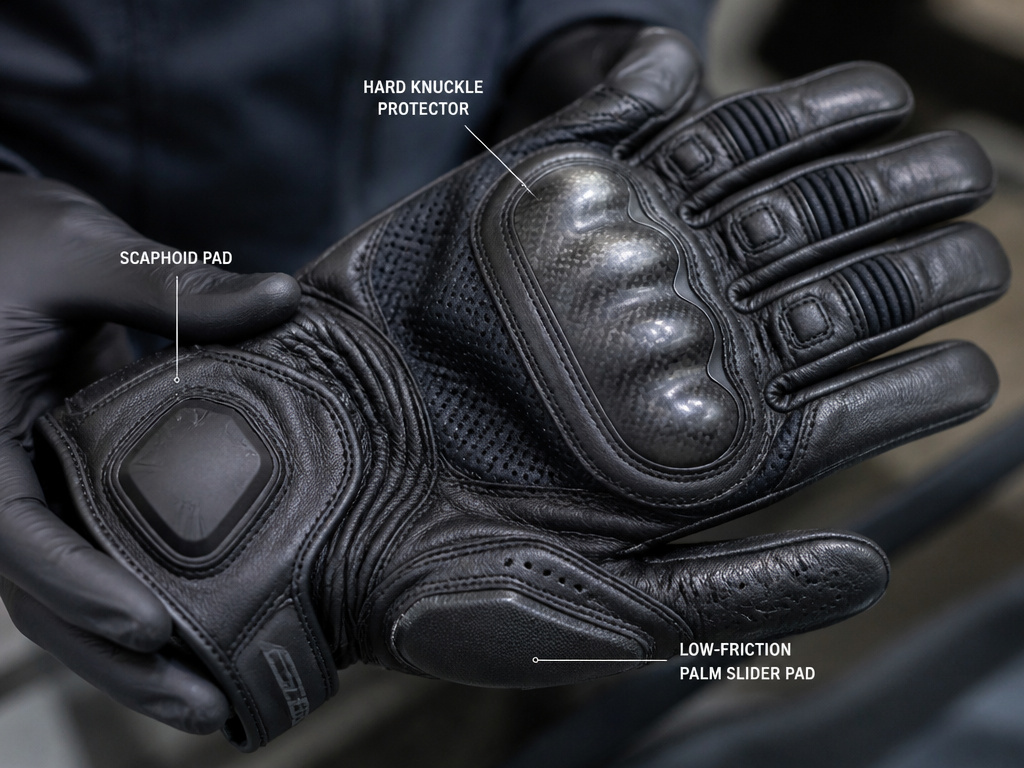
- Knuckle Protection (KP): Hard armor or dense foam certified to absorb impact.
- Palm Sliders: Low-friction pads designed to let your hand slide, not catch, on pavement. These are a key feature in the best protective gloves.
- Reinforced Scaphoid Protection: Extra padding or armor over the thumb-side wrist bone, a common impact point.
- Secure Wrist Closure: A strap that must, per standard, resist a 35 N pull. Velcro is common, but the quality of the hook-and-loop material varies wildly.
Sizing, Lifespan, and Storage: The Owner’s Manual Fine Print
You can buy the right type of glove and still fail at two critical points: fit and care.
How Sizing Actually Works
Forget your shirt size. Glove sizing under ISO 21420:2020 (the general requirements standard) is based on hand circumference and length. Brands like Richa and Leatt use tables from this standard. For example, a Leatt size Medium corresponds to a hand circumference of 19-21.5 cm. If your hand is 20 cm around, you’re a Medium. This is why you must try gloves on. A proper glove fit means no dead space at the fingertips, a snug but not tight palm, and full range of finger motion.
The 3-Year vs. 5-Year Lifespan Disagreement
Here’s a direct conflict from primary sources. Leatt’s manual recommends replacing protectors (including gloves) every 3 years under normal use. Richa’s certificates for its Mid-Season and Gladiator GTX gloves state a “peremption period” of 5 years after first use, assuming proper storage. Why the two-year gap? It reflects different manufacturer recommendations: Leatt recommends replacement every 3 years under normal use, while Richa sets a certified peremption period of 5 years after first use with proper storage. Inspect the seams, leather, and armor annually. If anything is frayed, stiff, or cracked, replace them early.
Storage: The One Mistake That Ruins Gloves
This is about preserving the impact absorption of the armor.
Common mistake: Storing gloves in an airtight plastic bag or box. Leatt’s manual explicitly warns against this: “Do not store them in airtight containers such as plastic boxes or bags.” It also says not to store them under heavy objects. Why? Moisture trapped inside can mildew and weaken stitching and leather. Compression flattens and permanently compromises the foam in knuckle and palm armor. That armor will look fine but won’t absorb energy correctly in a crash. Store them in a cool, dry, ventilated place. Hang them up.
Full Finger vs Half Finger Motorcycle Gloves
The fundamental construction choice is between full-finger and half-finger gloves. For on-road riding, the EN 13594:2015 standard is the relevant benchmark. It mandates that protective gloves must provide coverage extending at least 50 mm beyond the wrist joint. This inherently favors full-finger designs for complete protection. The standard also sets minimum requirements for tear strength and abrasion resistance for the materials used. Half-finger gloves, while offering more dexterity and ventilation, typically cannot meet these coverage requirements and are not certified for on-road protection under this standard. Your intended use dictates the choice.
Motorcycle Glove Features: Touchscreen, Wipers, and Heat
Modern gloves incorporate features for convenience and function. Touchscreen compatibility is a common addition, allowing you to operate devices without removing the glove. Some gloves include a visor wiper, usually a small patch on the index finger, to clear rain or debris. Heated gloves integrate wiring and elements to provide warmth in cold conditions. When considering these features, ensure they do not compromise the glove’s primary protective structure. Check that added seams or panels do not significantly reduce abrasion resistance, and for heated models, verify the wiring is well-integrated and does not create pressure points.
Frequently Asked Questions
What is the difference between CE Level 1 and Level 2 gloves?
Level 1 meets all minimum requirements of the EN 13594:2015 standard for on-road gloves. Level 2 offers increased protection, exceeding those minimums, but may come with trade-offs like added weight, stiffness, or reduced dexterity. For most riders, Level 1 provides an excellent balance of safety and comfort.
Can I use off-road gloves on the street?
You should not. Gloves like the Leatt Glove Moto 3.5 Lite are certified with a PASS level for “OFF-ROAD conditions only” and are marked as not intended for use on tarmac. Their protection is assessed for lower-speed, softer-surface impacts and does not equal the protection of an on-road Level 1 glove.
How should motorcycle gloves fit?
They should fit snugly with no extra material bunching in the palm or at the fingertips. Your fingers should reach the end of the finger compartments without being compressed. When you make a fist, the material should feel tight but not restrictive. A proper guide to motorcycle glove fit emphasizes trying them on while gripping a handlebar-like object.
What does “KP” mean on a glove certificate?
KP stands for “Knuckle Protection.” It is an additional property listed on a certificate (like for the Richa Mid-Season glove) indicating the glove includes certified protectors over the knuckles, beyond just achieving the base performance level.
How long do motorcycle gloves last?
Manufacturers disagree. Leatt recommends replacement every 3 years with normal use. Richa’s certificates state a 5-year “peremption period” (expiry) from first use with proper storage. Inspect your gloves annually for wear, stiffness, or seam damage, and let their condition, not just the calendar, guide your replacement.
Before You Go
The real “type” of glove is certified on-road or certified off-road. That certification, tied to a standard like EN 13594:2015 or the general ISO 21420:2020 standard, is the only objective proof it meets a tested safety floor.
So pick your riding environment first. Then find a glove certified for it. Check for the performance level (1, 2, or PASS) and key features like knuckle protection. Get the sizing right, snug, not loose. And remember that storage isn’t just closet organization; stuffing gloves in a plastic bag is a sure way to degrade the armor you paid for.
One last thing: the conflict between a 3-year and 5-year lifespan is real. When in doubt, trust the more conservative number, or simply inspect your gear. If the leather is cracked like an old saddle or the seams are pulling, it’s time. No standard can protect you from worn-out equipment.
