
Summer vs Winter Motorcycle Gloves: Which Should You Buy?
This post contains affiliate links. As an Amazon Associate, we earn from qualifying purchases.
Summer motorcycle gloves prioritize airflow and cooling with perforated leather and mesh panels, while winter gloves lock in warmth and block moisture with insulation, waterproof membranes, and windproof construction. The choice isn’t just about comfort, it’s about matching the glove’s design to the season’s specific physical demands on your hands.
That physical demand is the whole point. Your hands are the control interface, and they lose fine motor function fast, numb from cold, slick from sweat, or stiff from heat. A glove that mismatches the season doesn’t just feel bad; it fails at its job of keeping you in command of the bike. This is the core difference in summer vs winter motorcycle gloves.
What follows is a breakdown of the core differences in the summer vs winter motorcycle gloves question, the safety specs that matter in both seasons, and the real-world thresholds for when to switch. We’ll also cover the middle ground, gloves for those spring and fall days that don’t fit neatly into either box.
Key Takeaways
- Match the material to the mission. Summer gloves use perforated leather and mesh for maximum airflow; winter gloves rely on waterproof membranes and insulation (like Gore-Tex or Primaloft) to trap heat.
- Protection isn’t seasonal. Look for CE-rated armor at the knuckles and scaphoid (palm heel) in both types. The debate is over protector material, carbon vs. Thermoplastic, not its presence.
- A common guideline is to switch to winter gloves as temperatures drop, but the exact threshold depends on wind chill, riding duration, and personal circulation. The need to switch to winter gloves depends on wind chill, riding duration, and personal circulation.
- You cannot layer a summer glove into a winter one. Adding a liner inside a ventilated glove just blocks the vents and creates a damp, cold sandwich. Buy the right tool for the job.
- Fit decides everything. A winter glove must allow a lightweight liner if you run cold, and a summer glove must be snug without pinching to prevent bunching and blisters on long rides.
The Core Design Differences: A Side-by-Side Look
This isn’t about thickness. It’s about how the glove manages the environment outside and the heat your hand generates inside, which is the essence of the summer vs winter motorcycle gloves debate.
Summer gloves are heat exchangers. They’re built to dump warmth and moisture vapor as fast as possible. The Alpinestars SP-8 v3 uses Kangaroo leather palms, Clarino synthetic panels, and air mesh textile on the back. The Dainese 4 Stroke Evo adds perforated leather over the knuckles and fingers. The goal is constant airflow.
A true summer glove should feel like a slight breeze across your knuckles at anything above walking speed. If you don’t feel that, the ventilation isn’t working.
Winter gloves are sealed systems. Their job is to create a stable microclimate around your hand. The Rukka Virium Gore-Tex gloves use a Gore-Tex insert with Kangaroo leather in the palm. The Held Air’n’Dry has a removable inner glove with its own Air’n’Dry membrane. The REV’IT! Dominion H2O combines a Hydratex Pro membrane with Primaloft Gold 100g insulation. Any mesh or perforation would defeat the purpose.
| Design Focus | Summer Glove | Winter Glove |
|---|---|---|
| Primary Material | Perforated leather, mesh panels | Solid leather, often with waterproof laminate |
| Ventilation | Maximum (perforations, mesh, closable intakes) | Minimum (sealed to block wind) |
| Water Management | Dries quickly; rarely waterproof | Waterproof & breathable membrane (e.g., Gore-Tex) |
| Thermal Regulation | Cools via airflow | Insulates via synthetic fills (e.g., Primaloft) |
| Best For | Temperatures above 60°F (15°C) | Temperatures below 50°F (10°C) & wet conditions |
The ViaTerra touring tip from their video is blunt: keep two pairs. Their Kruger Summer Gloves use hybrid mesh and perforated leather, while the Tundra V3 uses a three-layer waterproof build with 3M Thinsulate. Trying to make one do the other’s job ends with cold, wet hands or sweaty, distracted ones.
Protection & Safety: The Non-Negotiable Layer
A glove’s first job is to stay on your hand and protect it during a slide or impact. That doesn’t change with the weather. Where summer and winter gloves differ is in how they execute that protection around their primary climate-control function.
Knuckle Protection: The Material Debate
This is where sources genuinely disagree. On one side, you have gloves like the Held Air Stream with its Titanium-carbon knuckle protector. Motorcycle.com argues that carbon fiber or titanium protectors (e.g., in Held gloves) offer superior impact dispersion and are a critical differentiator for sport riding, while WebBikeWorld contends that for most street incidents, well-designed thermoplastic protectors provide adequate protection at a lower weight and cost.
On the other side, gloves like the Rev’it! Jerez 3 or Alpinestars SP-8 v3 use thermoplastic rubber (TPR) or TPU protectors. WebBikeWorld contends that for most street incidents, well-designed thermoplastic protectors provide adequate protection at a lower weight and cost, while Motorcycle.com argues that carbon fiber or titanium protectors offer superior impact dispersion and are a critical differentiator for sport riding.
Where this goes sideways: Assuming a winter glove is automatically “safer” because it’s thicker. The insulation is behind the armor, not part of it. A bulky, poorly armored winter glove can be less protective than a slim, well-armored summer one.
Palm Sliders & Scaphoid Protection
This is another debated feature. SportRider Magazine calls palm sliders a vital safety feature to prevent wrist hyperextension, while a professional reviewer on RideApart argues that for non-aggressive street riding, their real-world benefit for casual riders is overstated compared to robust palm leather construction. Yet, some touring riders find they create a pressure point on long rides.
The scaphoid bone (palm heel) is a common fracture point in motorcycle falls. Look for specific protection here, like the SeeSoft Knox pad in the Jerez 3. This should be present in any glove you buy, regardless of season.
Cuff Design: Gauntlet vs. Short
This choice ties directly to the season’s threats. A long gauntlet, common on winter gloves, is critical for sealing over your jacket cuff to block wind and water from shooting up your sleeve. A professional touring rider review site argues a shorter, articulated cuff is preferable for easier tucking and less bulk, while a sport riding technique source states a long gauntlet is critical for winter riding to seal over the jacket cuff and prevent cold air/water intrusion.
For summer, a shorter cuff is standard for airflow, but it must have a secure wrist closure. A loose summer glove can roll or peel off in a slide. My stance is firm here: a secure wrist strap is underrated, and a short cuff is a compromise, not a default.
The Transition Zone: Gloves for Spring and Autumn
Temperatures between 50°F and 65°F (10°C and 18°C) are the no-man’s-land for gloves. A full winter glove overheats; a perforated summer glove chills. You have three strategies here, and your riding style picks the winner.
- The Lightweight Winter Glove: Some winter gloves are built for this range. Look for models with lighter insulation and a focus on windproofing. They block the chill without cooking you.
- The Summer Glove with a Liner: This is a tricky one. You can add a thin silk or technical fabric liner inside a summer glove. It works for short commutes in dry cold, but the liner inevitably compresses the glove’s ventilation channels. For a ride over an hour, moisture builds up against the liner and your hands get clammy.
- The Dedicated “3-Season” Glove: This is a specific category. These gloves often have removable liners or adjustable vents. The Held Air’n’Dry with its removable inner glove is a prime example. The outer shell blocks wind, and you add or subtract the insulating layer as needed. It’s the most versatile, and often most expensive, solution.
When to Switch: The Real-World Temperature Guide

Forums are full of riders asking, “How cold is too cold for my summer gloves?” The textbook answer is around 50°F (10°C). The real answer involves three more variables.
Wind Chill is the Multiplier. Wind chill significantly lowers the effective temperature on your exposed hands at highway speeds. Wind chill from sustained speed significantly lowers the effective temperature when choosing gloves.
Riding Duration. You can tough out 45°F (7°C) for a 20-minute commute in summer gloves. Your fingers will be cold, but they’ll recover. On a two-hour tour at the same temperature, the cold soaks in, fatigue sets in, and your reaction time drops. That’s dangerous.
Your Personal Circulation. Know your own hands. If you run cold, move to winter gloves at a higher ambient temperature. If you run hot, you might stretch summer gloves to lower temperatures with a liner. The switch point isn’t a single number; it’s the temperature at which you start thinking about your hands instead of the road.
I learned the hard way starting out. A one-hour morning ride in thin summer gloves when the temp was in the low 40s. My fingers were numb, white, and clumsy by the end. I could pull the clutch, but I couldn’t feel the friction point. That ride wasn’t just uncomfortable; it was a control deficit. Now I switch the moment I see my breath in the garage.
Care & Maintenance for Different Materials
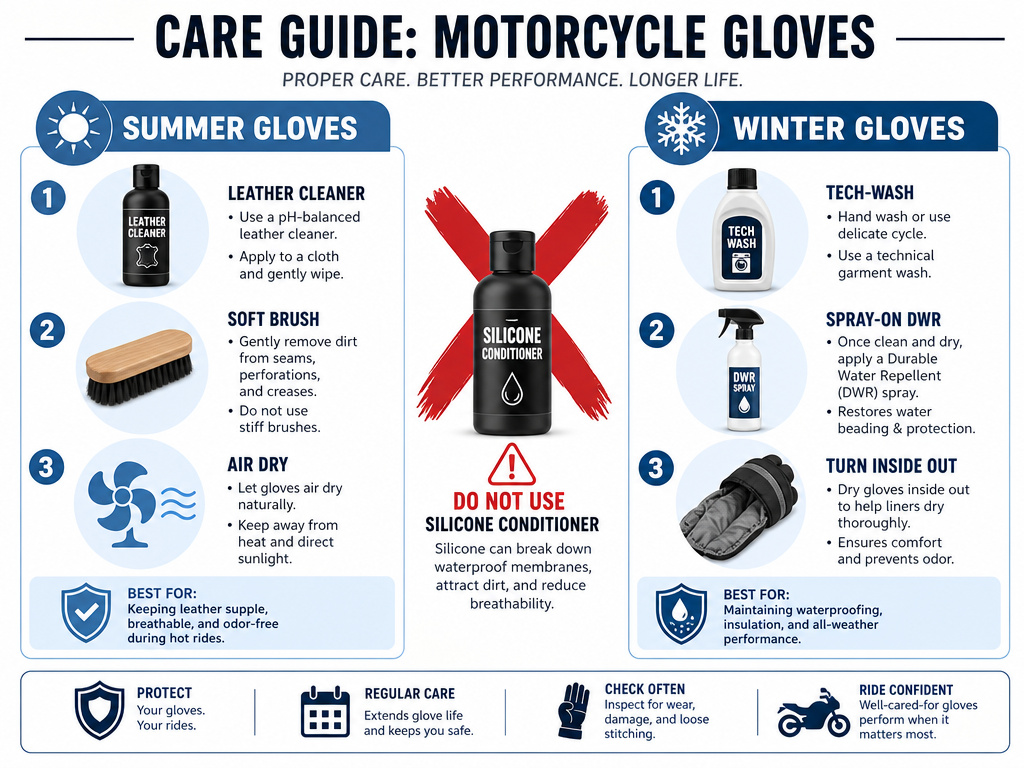
A perforated leather summer glove and a waterproof winter glove die different deaths. Caring for them correctly doubles their lifespan.
Summer Gloves (Perforated Leather & Mesh)
- Cleaning: Use a dedicated leather cleaner for the panels. For mesh, a soft brush and mild soap. Never soak them, water trapped in the perforations can stiffen the leather from the inside.
- Drying: Always air dry, away from direct heat. A heater or hair dryer will bake the leather, crack it, and destroy the moisture-wicking treatments.
- Storage: Keep them in a cool, dry place. Stuffing them in a tight ball degrades the pre-curved finger shape.
Winter Gloves (Waterproof Membranes & Insulation)
- Cleaning: Follow the manufacturer’s instructions for membrane care. Usually, this means a gentle wash with a tech-wash detergent (like Nikwax) that doesn’t clog the membrane’s pores. Never use traditional detergents or softeners.
- Drying: Air dry is best. If you must use low heat, turn the gloves inside out to protect the membrane. The insulation lofts back up as it dries.
- Re-proofing: Over time, the durable water repellent (DWR) on the outer shell wears off. You’ll notice water soaking in instead of beading up. Use a spray-on DWR treatment to restore it.
Common mistake: Using silicone-based leather conditioners on technical gloves. It can degrade the bonding agents holding armor pockets or membrane layers in place. Use products made for performance motorcycle gear.
Heated Gear: The Winter Game-Changer
When passive insulation hits its limit, you add heat. This is where the heated grips vs gloves debate lives. Heated grips warm your palms. Heated gloves, like the Gerbing Vanguard Heated Glove with its integrated 7.4-volt battery, warm your entire hand, including the fingertips, which get coldest first.
| Solution | How It Works | Best Use Case |
|---|---|---|
| Heated Grips | Warmth conducted through the grip into your palm. | Commuting, shorter rides in consistently cold dry weather. |
| Heated Gloves | Heating elements throughout the glove, often battery-powered. | Long-distance touring, extreme cold (below freezing), wet conditions. |
| Heated Liners | Thin liner with elements, worn inside a shell glove. | Versatile; lets you use your favorite winter glove shell. |
The REV’IT! Dominion H2O includes a T.E.S (Thermo Electric System) connection point, showing how integrated heated gear has become. For most riders, heated grips are the simpler, more reliable first purchase. But for true winter touring, a quality heated glove is a revelation.
How much do summer and winter gloves cost
You can expect to pay more for a dedicated winter glove than for a summer equivalent. Summer gloves focus on protection and ventilation, often using materials like perforated leather and mesh. Winter gloves incorporate all that plus specialized, costly components. These include waterproof and breathable membranes like Gore-Tex, advanced synthetic insulation such as Primaloft, and sometimes integrated heating systems. The added technology and layering required to combat cold, wind, and rain directly increase the manufacturing cost. For the same level of brand and protection features, a winter glove will typically command a higher price point.
Heated gloves or insulated gloves for winter
Riders often debate whether to use heavily insulated gloves or to opt for electrically heated ones. Insulated gloves, like those using Primaloft or similar materials, work by trapping body heat. Their effectiveness depends on the insulation weight and a seal at the cuff. Heated gloves, which may have an integrated battery system, generate their own warmth. The key difference is active versus passive heat. Heated gear can provide consistent warmth in extreme cold where insulation alone might fail, but it adds complexity with batteries and wiring. Some waterproof winter gloves even include a connection point for heated gear, offering a hybrid solution.
Frequently Asked Questions
Can I use waterproof winter gloves in summer?
You can, but you shouldn’t. A waterproof membrane blocks moisture vapor from escaping. In summer, your hands sweat, that sweat has nowhere to go, and you end up with hot, wet, uncomfortable hands inside the glove. The glove’s insulation will also overheat you. It’s the wrong tool.
What are the best motorcycle gloves for hot weather riding?
Look for maximum airflow. The Alpinestars SP-8 v3 (Kangaroo palm, mesh back) and Held Air Stream (closable air intake, perforated Pittards leather) are top-tier examples. For a more budget-conscious option, the ViaTerra Kruger uses large mesh panels. Fit is everything, a loose glove won’t ventilate properly.
Are touchscreen fingertips worth it?
It’s a trade-off. The conductive patch on the index finger and thumb allows you to use a phone without removing the glove. However, that patch is often a less durable material and can reduce tactile feel on the brake and clutch levers. Don’t let it be the deciding feature.
How should motorcycle gloves fit?
Snug, but not tight. With your hand flat, you should be able to pinch a small amount of material at the tip of your middle finger. Make a fist, the knuckle protectors should stay centered over your joints, and the palm material shouldn’t bunch excessively. For winter gloves, try them on with your intended liner.
Can I wash my motorcycle gloves?
Yes, but carefully. Follow the manufacturer’s tag. Generally, use a gentle, technical sportswear detergent, hand wash in lukewarm water, and air dry away from direct heat. Never machine dry leather or gloves with waterproof membranes.
The Bottom Line
Don’t buy one glove for four seasons. Your hands are your primary control, and they need the right interface for the job. In cold conditions with wind or distance, you need a winter glove. In warm conditions, a ventilated summer glove is important for comfort and focus.
If you ride year-round, invest in two good pairs: a protective, airflow-focused summer glove like the Alpinestars SP-8 v3, and a sealed, insulated winter glove like the Rukka Virium Gore-Tex. The middle ground exists, look at 3-season options with removable liners, but trying to stretch a summer glove through a freezing ride is a mistake you feel in your fingertips and your reaction time.
Fit them right, care for the materials, and your gloves won’t just protect your hands. They’ll keep you connected to the ride.
