
How to Put on a One Piece Motorcycle Race Suit
This post contains affiliate links. As an Amazon Associate, we earn from qualifying purchases.
Putting on a one-piece motorcycle race suit requires matching three things: a specific sequence, the right base layers, and a fit checked in the riding position, not standing up. The official Aerostich method for how to put on a one piece motorcycle race suit is a right-leg-first process designed to prevent zipper damage and align the suit’s pre-curved panels with your body. Skipping the base layer isn’t just uncomfortable, it removes a thermal barrier that can mean the difference between a scuff and a friction burn in a slide.
Understanding that sequence exists because a suit’s zippers and seams are built to load in one direction under tension is key to the how to put on a one piece motorcycle race suit process. Force the wrong arm first and the main zipper won’t seat, or you’ll strain the shoulder stitching. It’s a physical alignment problem, not a superstition. The rest of this guide walks through that mechanical why, plus the model-specific rules for airbag suits, how to dress alone, and what you should never do with the pockets.
Key Takeaways
The Official Aerostich 6-Step Sequence
The Aerostich R-3 manual prescribes a dressing sequence starting with the right leg. This isn’t a suggestion, it’s the path of least resistance for the suit’s full-length zipper and tailored panels.
Step 1: Hold the suit with the lapels facing you and lower it slightly. Start with the suit hanging open. This gives you a clear entry for the first leg. Step 2: Insert your right leg. Slide your foot and leg fully into the right side of the suit. The key here is to get the foot past the ankle cuff without catching the zipper teeth. Step 3: Pull on the right arm. With your right leg in, thread your right arm through its sleeve. The suit will now be hanging from your right shoulder. Step 4: Pull on the left arm and bring the main zipper together. This is the counterintuitive move. Don’t try to zip yet. Get your left arm in, then use both hands to draw the two sides of the main chest zipper into alignment. Step 5: Grasp both zipper slides, engage them, and lower the bottom slide. The R-3 uses a two-slider main zipper. Engage the top and bottom sliders, then pull the bottom one down to close the suit from waist to neck. Forcing a single slider up from the bottom is how teeth get misaligned. Step 6: Close the right leg zipper and wrist zippers. Finalize the seal. The left leg zipper on these suits is often pre-closed.
Where this goes sideways: Trying to zip the main zipper from the bottom up with one hand. The two-slider design exists because the zipper tape is under tension when the suit is on; forcing it binds the teeth. You’ll feel a gritty resistance, then a pop if a tooth jumps the track. Realign from the top.
Why this order matters comes down to physics. The suit is cut with a forward hunch. Putting the right leg and arm in first rotates the entire garment on your body, letting the left side fall into place for a clean zipper meeting. Reverse it and the left side drags, pulling the zipper tape sideways.
| If You Skip This Step | The Likely Consequence | Timeline |
|---|---|---|
| Don’t use the two-slider zipper correctly | Zipper teeth jump track or tape separates | Over time |
| Force your left arm in first | Shoulder seam strains; suit twists on torso | Immediate |
| Skip the ‘lower slightly’ start | Ankle cuff catches, you hop on one foot | Every time |
Why Your Base Layer Isn’t Optional
You need a full-length base layer, long sleeves and pants, underneath. This isn’t about sweat management. It’s a mandated thermal barrier.
Wearing a long-sleeved shirt and pants under your Aerostich suit is recommended to provide a thermal barrier. The base layer is that buffer. For track suits, a compression undersuit adds a second job: it minimizes fabric bunching and keeps the suit’s CE armor from shifting during a crash. A loose cotton t-shirt will wrinkle under the suit, creating pressure points and letting the armor drift.
The right base layer also changes the dressing feel when executing the how to put on a one piece motorcycle race suit. A slick, moisture-wicking layer allows the suit’s interior to slide easily over your skin. Trying to put a tight leather suit on over dry skin is like pulling on a rubber glove without wetting your hand, you’ll wrestle with every inch.
Common mistake: Dressing in street clothes for a fitting. You must mimic your riding layers. A suit that fits perfectly over a t-shirt will be dangerously tight over a back protector and compression base layer. That error puts pressure on seams and can misplace armor.
How to Check Fit Before You Zip
Your suit must be judged in a riding crouch, not standing in front of a mirror. This is a point manufacturers like Dainese emphasize.
For the Aerostich R-3, the manual’s test is simple: you should be able to raise your arms to a 90º angle, parallel to the ground. If you can’t, the suit is too tight in the shoulders and will pull when you reach for the handlebars. For sportbike riders with low bars, Aerostich notes you may need a Long size in the Aerostich R-3, which adds about 2″ in torso length and 1.2″ in sleeve length over a Regular of the same chest measurement.
Leather race suits from Dainese and Alpinestars are pre-curved forward to match a tucked position. The fit should be snug, almost tight, when standing. Alpinestars specifies that leather will stretch 3-5% during break-in. That initial snugness ensures the armor stays put after the suit molds to you. If it’s comfortable standing, it’s too loose in the tuck.
Put the suit on, then get into a riding tuck. Can you touch your wrists together in front of you? Does the back hump (if present) sit flat, or does it pull the collar into your helmet? This is the only test that matters for proper suit fit.
What About Airbag and Leather Race Suits?
Airbag systems impose strict rules. The dressing sequence is the same, but the tolerance for error is zero.
Dainese states that an incorrectly sized D-AIR RACING 1 I.P.S. Suit (too large) can interfere with the rider’s helmet when triggered. The airbag requires a specific volume to inflate properly; extra space allows it to expand into your neck or chin. Always try these on with your helmet. The system is designed to remain inflated for about 5 seconds after being triggered.
For leather suits without airbags, the break-in period changes the dressing feel. A new suit will fight you. The stretch panels are stiff, the leather is rigid. After a few rides, it will mold to your shape and slide on easier. That 3-5% stretch during break-in is real. Don’t mistake initial tightness for a bad fit.
| Suit Type | Critical Dressing Difference | Consequence If Ignored |
|---|---|---|
| Integrated Airbag (e.g., Dainese D-AIR) | Must fit with zero extra space in torso/neck | Airbag interferes with helmet on inflation |
| Standard Leather (e.g., Alpinestars GP Tech) | Expect a stiff, resistant feel when new | Rider buys a size up, suit becomes loose after break-in |
| Textile One-Piece (e.g., Aerostich R-3) | Requires full base layer for thermal protection | Increased friction burn risk in a slide |
Dressing Alone vs. With Help (And How to Remove It)
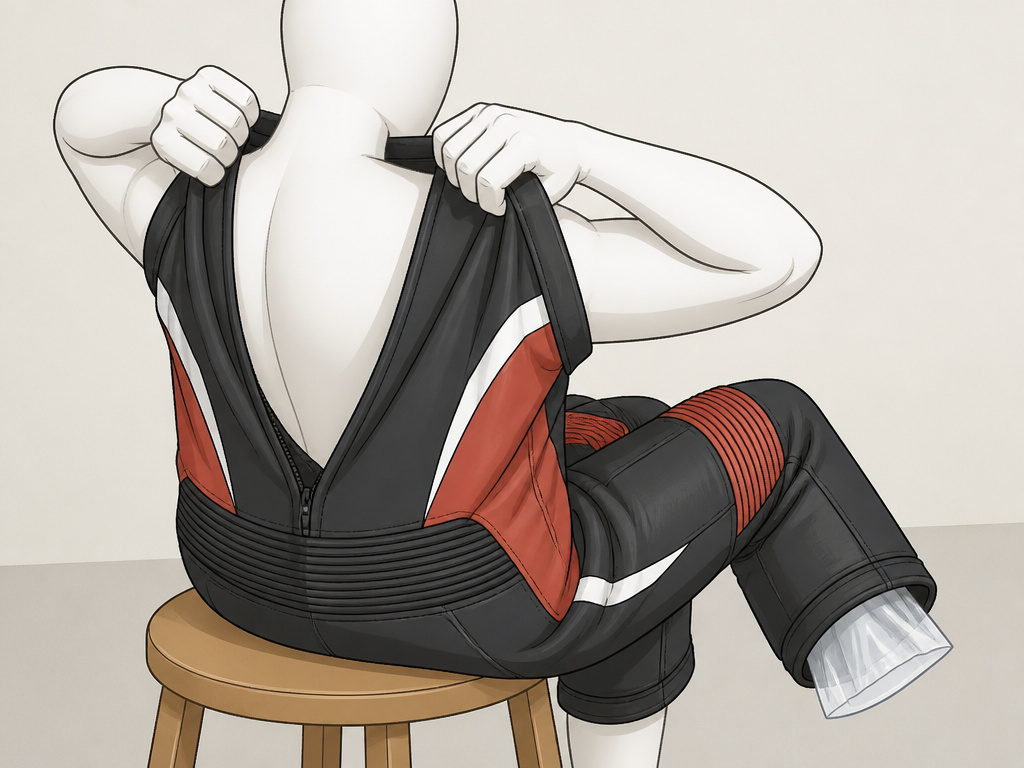
Most riders put the suit on alone. The trick is to use gravity and a seated start.
Sit on a stool or the edge of a chair. Drape the suit over your legs, then follow the Aerostich sequence from a seated position. This prevents the suit from sliding away and allows you to use your body weight to hold it in place. For leather suits, some riders use thin plastic bags over their socks to help feet slide through the tight ankle cuffs.
Removal is the reverse, but sweat complicates it. After a track day, the suit will cling. Unzip everything fully, then peel the suit off your shoulders first, like a wetsuit. Don’t try to yank it down from the waist, you’ll stretch the seams. Hang it immediately to dry; a balled-up, damp leather suit is a recipe for stiffness and mildew.
Easy to miss: The rear vent zippers on the Aerostich Classic Roadcrafter are difficult to operate when you are wearing the suit. Set your ventilation before you get dressed. Fumbling with them once you’re sealed in is a wasted effort.
What Not to Do: The Pocket and Zipper Rules
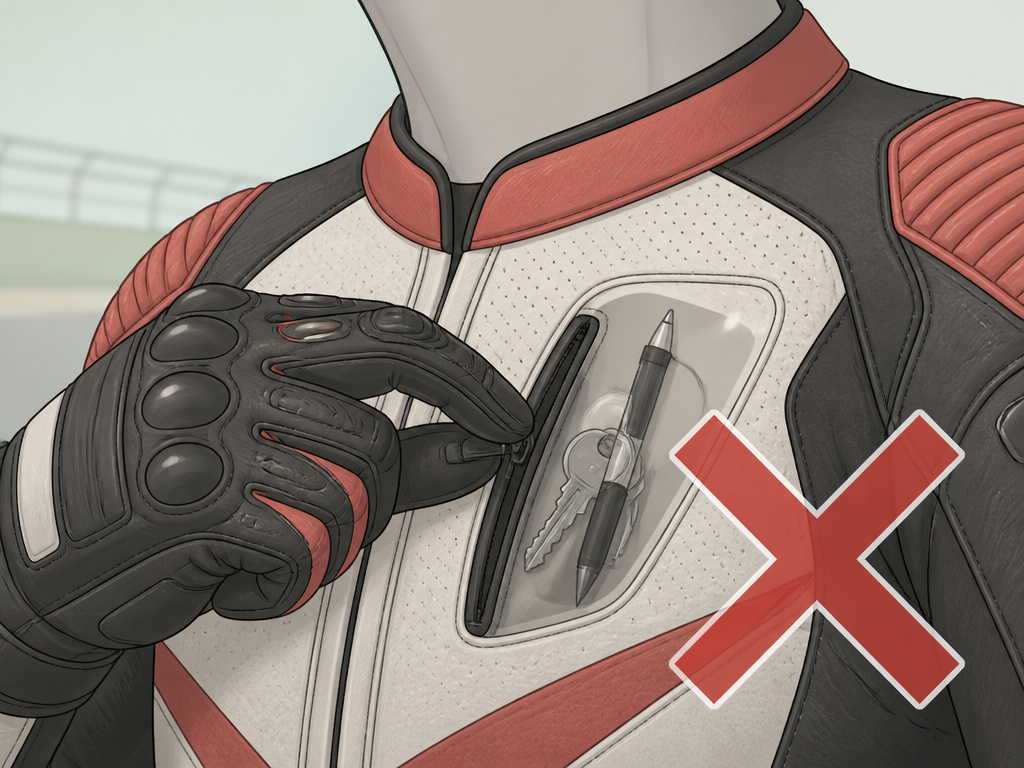
The pockets on a race suit are not for use in motion. This is a safety line, not a convenience tip.
Aerostich’s manual warns: do not carry hard or pointed objects in the pockets. In a crash, those items become secondary impactors. The pockets are designed as extra abrasion layers first, storage second. Also, do not use any of the pockets while the motorcycle is in motion. Reaching for a map or keys distracts you and can unbalance the bike.
For zipper care, never force a slider. If it catches, back it up and realign the teeth. On suits with hook & loop wrist and ankle tabs, set the adjustment once, then use the zippers for daily on/off. Constantly re-securing the hook & loop wears out the material.
Cleaning matters for longevity. When it’s time for cleaning a suit, follow the manufacturer’s wash instructions to the letter. Detergent residue stiffens leather and clogs textile pores.
How to Use Plastic Bags to Slide Feet Into a Race Suit
A common trick for getting into a tight-fitting leather race suit is to use plastic shopping bags or disposable shoe covers. This works because the slippery plastic reduces friction between your skin or base layer and the suit’s interior lining. To do it, simply place a bag over your foot and lower leg before inserting them into the suit leg. The material allows your foot to glide past snug ankle cuffs and calf sections with ease. Once your foot is in position, you can pull the bag out from the top of the bootie. This method helps preserve the suit’s interior and prevents you from straining against new, stiff leather during the break-in period.
Frequently Asked Questions
Do I put my boots on before or after the suit?
Put your boots on first. Some race suits, like the Dainese Laguna Seca 6, have a Boot-IN system that connects the suit calf to the boot. Trying to pull the suit over a boot is nearly impossible and stresses the ankle zipper. Connect the suit to the boot after you’re mostly dressed.
What is the hump on the back of the suit for?
The hump, or spoiler, is for aerodynamic stability at high speed on a track. It helps reduce wind lift on your back and helmet. For suits with integrated airbags, the hump may house system components. It is not a hydration pack holder.
Can I wear a backpack over a race suit?
You should not. A backpack straps will compress the suit’s armor, potentially moving it out of position, and will chafe the leather. If you need to carry items, use a tank bag or tail bag. The suit’s protection profile is designed to be unobstructed.
How tight should a new leather suit feel?
It should feel snug, with slight resistance when you move into a full tuck. You should be able to move, but not freely. Remember the 3-5% stretch rule. If you can’t get into a riding position at all, it’s too small. If there’s bunching in the knees or elbows when crouched, it’s too large.
What do you wear under a racing suit?
Full base layer designed for motorsports: long-sleeve top and pants made of moisture-wicking, slick material. Avoid cotton, which retains sweat and creates friction. Many riders use a dedicated undersuit that includes pockets for additional CE armor.
Before You Go
One rule most guides skip: if your suit is an integrated airbag model, its fit is not adjustable by break-in. The Dainese D-AIR RACING 1 I.P.S. Should be serviced once every 5 years. The airbag’s inflation geometry is fixed.
For non-airbag leather, the break-in is real. That initial fight getting dressed will ease after a few sessions. The stretch panel placement will soften where you bend.
Finally, always zip up. An open suit in a crash offers zero abrasion protection. It seems obvious, but you’d be surprised how many riders roll to the grid with their chest zipper only half-closed. Close it all. Your suit is a one-time-use shield, make that use count.
