
How to Reduce Motorcycle Helmet Wind Noise: Step-by-Step
This post contains affiliate links. As an Amazon Associate, we earn from qualifying purchases.
To reduce motorcycle helmet wind noise, you must seal leaks at the bottom of the helmet, ensure a perfect fit, and manage airflow from your bike. A University of Florida study recorded wind noise between 95dB and 105dB when traveling at 100 km per hour, that’s in the range of permanent hearing damage. The fixes aren’t complicated, but they require targeting the right leak points in the right order.
That noise level isn’t just annoying. It’s a documented health hazard with a simple mechanical cause: turbulent air finding a way inside your helmet. Understanding how to reduce motorcycle helmet wind noise is key. You can throw money at quieter helmets, but if the seal at your neck is broken or your bike’s windscreen is blasting your chin, you’ll still have a roar.
What follows is a mechanic’s approach. We’ll start with finding the leak, move to sealing it with the right gear, and finish with bike adjustments that most riders miss. By the end, you’ll know which fix to try first.
Key Takeaways
- Seal the bottom first. A loose neck seal is the single biggest source of wind roar; a $20 chin curtain or a scarf often cuts noise more than a $500 helmet upgrade.
- Fit is essential. Per Airoh’s manual, a helmet that’s even slightly too large creates noisy air vortices inside the shell, undermining any aerodynamic design.
- Sources disagree on earplugs: rider communities and gear sites recommend them as a ‘tried and tested method’ for protection, while University of Bath research warns that wind noise doesn’t necessarily block traffic sounds and cautions against in-ear devices for music.
- Your bike changes everything. Your helmet’s aeroacoustics “may vary according to the type of motorcycle, fairing design, seat position,” as Schuberth’s manual states. Adjust your windscreen before blaming the helmet.
- Test one change at a time. Put on a new seal, go for a short ride, and listen. Adding three fixes at once won’t tell you which one actually worked.
Find the Leak First
You wouldn’t fix a water leak without finding the drip. Don’t treat wind noise any differently. The goal is to identify where air is rushing in, because the fix changes with the location.
The main entry points are the bottom seal around your neck, the visor seal, and the ventilation ports. A leak at the bottom sounds like a constant, deep roar. A visor leak is often a high-pitched whistle. Vent noise is a localized hiss.
The One Tool You Already Own
Your hand is the best diagnostic tool you have. On a safe, straight stretch of road, slowly move your gloved hand around the base of your helmet, your visor, and the vents. When you feel a cold stream of air hitting your skin or your glove, you’ve found a leak. The noise will often change pitch or drop noticeably when you block that stream.
Common mistake: Adding a chin curtain without checking the visor first. If the whistle from a cracked visor is your main noise, sealing your neck does nothing but muffle a symptom.
Once you know the source, you can apply the right fix. Most of the time, it’s the bottom.
Seal the Bottom Gap
If your diagnostic run found a cold draft up your neck, this is your priority. The gap between the helmet’s neck roll and your jacket collar is a wind tunnel pointed at your ears.
A chin curtain or neck curtain is a padded skirt that attaches inside the helmet with Velcro. It extends down to rest on your collarbones. It doesn’t need to be fancy. The principle is simple: it breaks up the laminar airflow that gets sucked up into the helmet.
Schuberth knows this. Their C5 Carbon and E2 helmets include a removable additional wind deflector attached by Velcro inside the acoustic collar for exactly this purpose. Their manual bluntly states, “The fit of the bottom of the helmet is extremely important in ensuring that the helmet is as quiet as possible.”
| Bottom-Sealing Option | Best For | Noise Reduction | Trade-off |
|---|---|---|---|
| Integrated Chin Curtain (e.g., Shoei, Arai) | Riders who want a clean, OEM solution. | High. Seamless design. | Only works with specific helmet models. |
| Universal Neck Sock / Balaclava | Riders who switch helmets or need neck warmth. | Medium-High. Also reduces drafts. | Can be warm in summer; adds a layer. |
| Scarf or Bandana | A quick, cheap test or a temporary fix. | Low-Medium. Proves the concept. | Can come loose; not a permanent solution. |
For riders with a smaller neck, even a well-fitted helmet might leave a gap. Schuberth’s E2 manual has a direct tip for this: “If you have a smaller neck size, we recommend that you also wear a scarf.”
Get the Fit Absolutely Right
A helmet that shifts on your head at speed will roar. It’s that simple. Air gets inside and swirls around in the extra space. According to Airoh’s FAQ, “a helmet that is too large would leave room for annoying and noisy air vortices inside the helmet.”
The shop test is not the highway test. A helmet should feel snug, with firm, even pressure around your crown and gentle pressure on your cheeks. It should not rotate freely on your head when you grab the chin bar and try to twist it. If you can, you’re buying noise.
Where this goes sideways: Choosing a larger size for comfort. That “roomy” feel becomes a wind chamber at 70 mph. The noise fatigues you within an hour, and the helmet’s safety performance is compromised in a crash.
My own lesson was early and loud. I once picked a helmet a size too big because it felt comfortable standing in the shop. On the highway, it shifted and roared with every gust. I learned that a helmet should feel almost too snug at first, the cheek pads break in, the shell does not.
If you’re between sizes, follow Airoh’s advice: choose the smaller one. You can often swap out the cheek pads for a thinner set to fine-tune the fit without compromising the critical crown seal.
The Earplug Decision
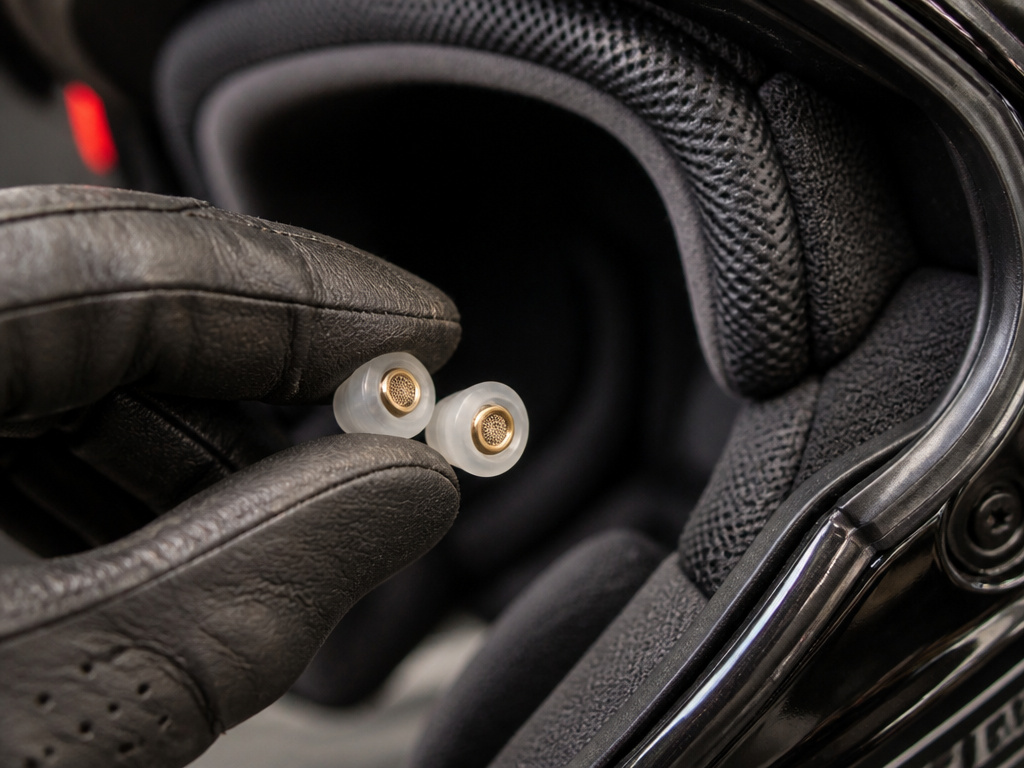
This is where sources disagree, and you need to understand why. The University of Bath research found that wind noise doesn’t necessarily block traffic sounds and can even make your hearing more acute at certain frequencies. They warn against using in-ear devices for music because the volume needed to overcome wind noise is damaging.
Meanwhile, rider communities and gear sites recommend earplugs as a “tried and tested method.” Who’s right? Both, from different angles.
The Bath research is about awareness, your brain can still pick out important sounds through the wind roar. But it doesn’t contradict the physics of sound pressure level. Wind noise at 100+ dB damages the tiny hairs in your inner ear, full stop. Hearing loss is cumulative and permanent.
| Earplug Type | Noise Reduction Rating (NRR) | Best For | Awareness Trade-off |
|---|---|---|---|
| Disposable Foam | High (29-33 NRR) | Maximum protection for long highway rides. | Muffles all frequencies; can over-isolate. |
| Filtered Musician’s Plugs | Medium (15-22 NRR) | Everyday street riding. | Attenuates damaging highs while preserving speech/traffic mids. |
| Custom Molded | High & Consistent | Riders who spend all day in the saddle. | Best overall balance of protection and clarity; significant investment. |
The practical take: Use earplugs for hearing protection, not to make the world silent. Filtered plugs are the sweet spot for most riders. They cut the damaging high-frequency screech while letting you hear your engine, horns, and sirens.
Adjust Your Bike, Not Just Your Helmet
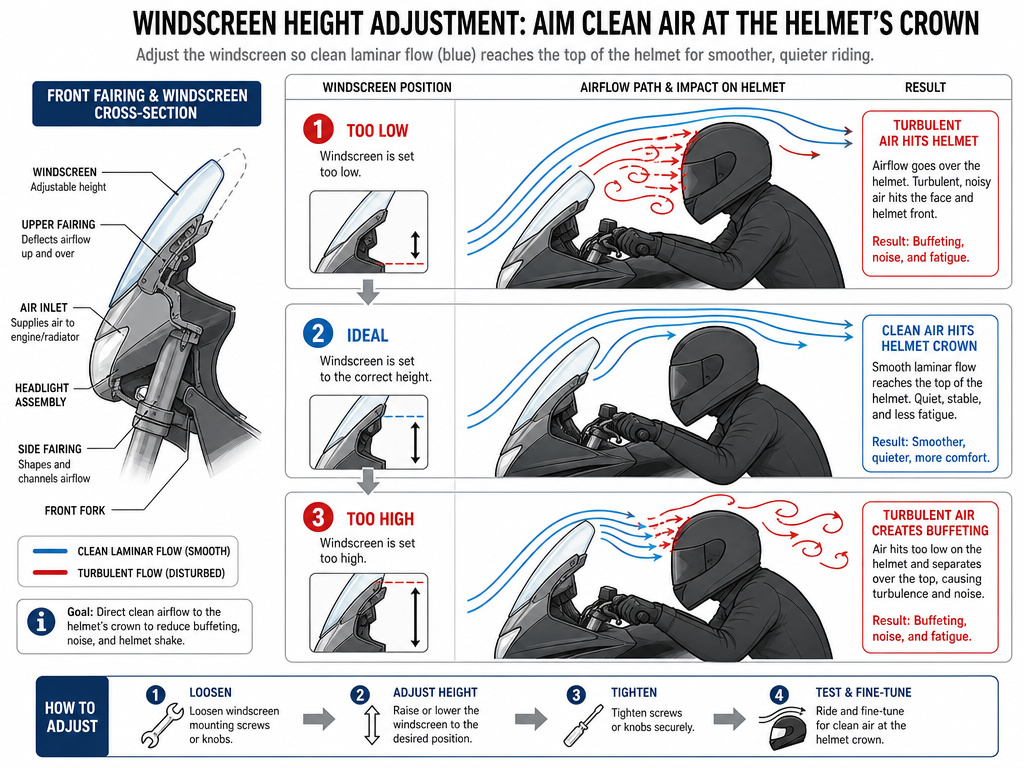
Your helmet doesn’t ride in a vacuum. It rides in the turbulent air coming off your bike’s windscreen and fairing. Ignoring this is like soundproofing a room but leaving the window open.
Schuberth’s manuals are explicit about this: “With faired motorcycles, strong currents occur at the edges of the wind shadow. These may significantly reduce the aeroacoustic performance of the helmet.” Their recommendation? “The motorcycle fairing should be adjusted so that the turbulence created does not reach the bottom surface of the helmet.”
For most riders, this means adjusting the windscreen height. The goal is to have the clean, laminar airflow hit the top of your helmet, not your chin or neck. A windscreen that’s too low blasts your helmet’s bottom edge. One that’s too high can create buffeting and low-pressure turbulence behind it.
Easy to miss: Tucking in slightly. On a naked bike, even a small change in posture, dropping your head an inch or bringing your elbows in, can dramatically change how clean air flows over the helmet. It’s a free fix.
If you’re getting loud buffeting, the problem might be helmet lift. An aerodynamic helmet should feel planted. If it feels like it’s trying to leave your head at speed, that’s unstable airflow creating noise and a safety distraction.
When to Upgrade the Helmet Itself
After you’ve sealed the bottom, confirmed the fit, and dialed in your bike, you might still have a noisy helmet. Some are just louder than others. This is when an upgrade focused on aeroacoustics makes sense.
Brands like Schuberth and Shoei design in wind tunnels. The Schuberth C5 Carbon, for example, is engineered for “outstanding aeroacoustics”.
But even a top-tier helmet has a caveat. Schuberth notes, “Aeroacoustic values may vary according to the type of motorcycle, fairing design, seat position and physical size of the rider.” A helmet that’s silent on a touring bike might howl on a sportbike with a different rider posture.
The rule here is to test, if possible. Or, research specific models known for quietness on bikes similar to yours. Don’t assume a premium price tag guarantees silence if the shape is wrong for your bike and your body.
Health risks of wind noise (hearing damage, tinnitus)
Research indicates that wind noise in a motorcycle helmet can have a long-term negative effect on your hearing. One study found noise levels can reach between 95dB and 105dB when traveling at 100 km per hour. While this noise does not necessarily limit your ability to hear traffic sounds and may even make your hearing more acute at certain frequencies, the sustained exposure is the primary concern for potential hearing damage. This makes the question of how to reduce motorcycle helmet wind noise a key part of protecting your long-term hearing health on every ride.
Blocking or modifying helmet vents
Ventilation ports are a common source of a localized hissing noise. To address this, you can close the air intakes when possible, as this can have benefits for reducing noise. Some helmets include additional wind deflectors attached inside the acoustic collar specifically for this purpose. The goal is to manage airflow without completely sacrificing ventilation. Remember, when you compare a how to reduce motorcycle helmet wind noise strategy, the fit of the bottom of the helmet is also extremely important for overall quietness, so ensure the bottom of the helmet fits properly before focusing solely on the vents.
Considering bike type and aerodynamics (e.g., naked bikes)
The type of motorcycle and its fairing design greatly influence helmet noise. Aeroacoustic performance can vary significantly based on your bike. With faired motorcycles, strong air currents occur at the edges of the wind shadow, which may reduce a helmet’s quietness. For these bikes, adjusting the fairing so the turbulence does not reach the bottom of the helmet can help. On naked bikes without wind protection, you are more exposed to direct airflow, making a helmet with good aerodynamic properties and a tight bottom seal even more critical for managing noise.
Frequently Asked Questions
Do helmet wind deflectors really work?
Yes, when they address a specific leak. The built-in wind deflectors in helmets like the Schuberth C5 Carbon are designed to stop air from flowing up into the helmet from the neck area. Their effectiveness depends entirely on whether that’s your primary noise source. If your leak is at the visor, a neck deflector won’t help.
Is it safe to wear earplugs while riding?
Yes, when you use proper hearing protection earplugs. The goal is to reduce damaging decibel levels, not eliminate sound. Filtered musician’s earplugs are ideal because they attenuate harmful high-frequency noise (like wind roar) while preserving mid-range frequencies needed to hear traffic, your engine, and sirens. Never use noise-canceling earbuds meant for music.
Can a new windscreen reduce helmet noise?
Absolutely. A poorly designed or adjusted windscreen is a major source of turbulent air that hits your helmet. Adjusting the height or angle, or switching to a windscreen designed to direct airflow over your head, can reduce noise more than any helmet accessory. It changes the environment your helmet operates in.
Why is my new, expensive helmet so noisy?
Three likely reasons: poor fit (the most common), a mismatch between the helmet’s aerodynamics and your bike/rider posture, or unsealed gaps (like a missing chin curtain). An expensive helmet isn’t magically quiet; its advanced aeroacoustics only work in concert with a proper fit and a compatible riding setup.
How do I know if my helmet is too big?
Perform the twist test. With the helmet on and strapped, grab the chin bar and try to rotate the helmet left and right on your head. If it moves easily, it’s too big. Your skin and scalp should move with the helmet. Also, listen for wind noise at low speeds; excessive noise often points to a poor seal from an oversized shell.
Before You Go
Chasing a perfectly silent ride is a fool’s errand. But cutting the roar down to a manageable hum is absolutely within reach, and it starts with the simplest, cheapest fixes.
Forget the helmet upgrade for a minute. Go buy a basic chin curtain or use a scarf on your next ride. If that cuts the noise noticeably, you’ve just solved the biggest part of your problem for under twenty bucks. Then, get a pair of filtered earplugs. Those two steps alone will protect your hearing and reduce fatigue on any helmet you own.
If you’ve done both and still have an issue, then look at your bike’s windscreen and your riding posture. Finally, if the noise is still unbearable, you can justify the search for a genuinely quiet helmet, and you’ll know exactly how to set it up for silence.
