
Are Timberland Boots Good for Motorcycle Riding?
This post contains affiliate links. As an Amazon Associate, we earn from qualifying purchases.
Timberland boots are good for motorcycle riding only as a stopgap. Crash data from the de Rome et al. 2011 study linked non-motorcycle boots to a relative risk of 0.46 against shoes or joggers. But a Timberland carries no EN 13634 motorcycle rating and has exposed laces. For street commuting they beat sneakers; for real protection, buy certified riding boots.
That 0.46 compares boots with shoes. It tells you a Timberland beats your runners, and it says nothing about how it stacks up against a real riding boot. Victoria’s road-safety insurer measured that second gap in the are timberland boots good for motorcycle riding debate, and the Timberland lands in the middle.
What follows: what four studies actually measured, where the Premium 6-Inch falls short, the steel-toe myth, how to set Timberlands up if you ride in them anyway, and a five-minute test for any boot you’re eyeing.
Key Takeaways
- Victoria’s TAC found riders in shoes had nearly double the open-wound rate of riders in boots: 47% against 25%.
- The Premium 6-Inch has a steel shank and a lug sole, but Timberland’s listing makes no motorcycle claim at all.
- Steel toes didn’t cut toes off in drop tests. Nobody has published crash data on them in motorcycle falls.
- Lace to the top and tuck every lace loop before you ride.
- Past slow town riding, the answer is an EN 13634-labelled riding boot.
What Does the Crash Data Say About Ordinary Boots?
The de Rome crash study gave us the clearest answer I’ve found. Researchers matched crash injuries to what the riders wore.
In de Rome et al. (2011), non-motorcycle boots were linked to lower injury risk than shoes or joggers. The relative risk was 0.46 (95% CI 0.28-0.75). Garments with fitted body armor cut foot and ankle injury risk (RR 0.54).
A relative risk of 0.46 means the boot wearers had a bit under half the injury risk of riders in shoes. The range runs from 0.28 to 0.75. That’s wide, so the exact number is uncertain.
I trust the direction more than the exact number.
The ANU motorcycle protective clothing research also found riders were less likely to land in hospital when they crashed in motorcycle gloves, pants or jackets. The authors didn’t recommend making gear mandatory. They suggested considering incentives instead.
Where the Studies Agree
The Transport Accident Commission motorcycle boot findings come from 763 Victorian riders injured in on-road crashes between 2010 and 2014. Lower-limb injury hit 47% of riders in riding boots, 55% in other boots and 63% in shoes.
TAC’s Samantha Cockfield put the design case plainly: “Motorcycle boots are specifically designed to stay on during a crash and provide protection from impacts and abrasion.” TAC also ranks ankle-covering work boots above everyday shoes and below protective boots. That’s exactly where a Timberland sits.
Where They Split
The motorcycle type and protective clothing study ran for a year in an Istanbul-area emergency department, starting in June 2012. It didn’t count ordinary boots as protective gear at all. Only motorcycle-specific shoes, helmets, jackets, pants and gloves made the list. Its jackets and gloves cut soft-tissue injuries but didn’t stop fractures.
The lab work cuts against ordinary boots too. The ISBS study on boots and ankle inversion put 15 adults through a simulated motorcycle-drop task in athletic shoes, work boots and motorcycle boots. Inversion is the sole tipping inward so the ankle rolls over its outer edge.
Motorcycle boots cut peak ankle inversion by 3.6 degrees against both other options. Work boots didn’t earn that result. The riding boots also raised the force pushing back up the leg on landing by 0.21 bodyweights, so stiffness has a cost.
| Source | What it compared | What it says about ordinary boots |
|---|---|---|
| de Rome et al. 2011 (212 riders) | Boots vs shoes or joggers | Non-motorcycle boots: RR 0.46 vs shoes |
| TAC Victoria (763 riders) | Riding boots, other boots, shoes | 55% leg injury vs 47% and 63% |
| ISBS 2019 (15 adults) | Athletic shoes, work boots, riding boots | Only riding boots cut ankle roll |
| Istanbul ED study | Motorcycle gear vs none | Ordinary boots not counted as protective |
So which study do you believe? Two of them back ordinary boots as a real step up from shoes. Two say only purpose-built footwear counts. None of them tested a Timberland by name, and that’s the hole in every forum argument about this.
Put together, the motorcycle boots versus regular boots gap looks like this. Ordinary boots beat shoes clearly. Riding boots beat ordinary boots too.
The Premium 6-Inch Spec Sheet: What Helps and What’s Missing
Timberland’s Premium 6-Inch Waterproof Boot, style TB0A2P6WEN1, is the Timberland most riders mean. Its spec list reads like a boot built for wet sidewalks.
The listing covers a seam-sealed waterproof leather upper, 400 grams of PrimaLoft insulation, a padded leather collar and a leather lining. Underfoot you get a steel shank for arch support, a rubber lug outsole and a removable anti-fatigue footbed. The TPR welt is a thermoplastic rubber strip where upper meets sole.
Nowhere on that page does Timberland mention motorcycles.
Weight is the one spec the sources argue about. Timberland lists a men’s size 9 at 2.10 lbs (951.41 g). A rider who reviewed his pair after a year of riding put them at about 1 lb 14 oz, without giving a size. Either way, they feel heavy on the pegs.
Leather thickness gets all the forum attention. I look at the joints first. A boot’s seams work like dovetails on a drawer: the oak face looks great, but the joint decides whether it holds under load.
Even purpose-built gear fails. In the de Rome crash study, 25.7% of motorcycle gloves, 29.7% of jackets and 28.1% of pants failed from material damage. Those were tested riding garments. The Timberland’s stitching has never faced a crash test, so its failure rate is a blank.
| Feature | Timberland Premium 6-Inch | EN 13634 riding boot | Sneaker |
|---|---|---|---|
| Motorcycle crash testing | None claimed | Rated at one of two levels | None (Air Jordan has no CE rating) |
| Crush resistance | Untested; shank is for arch support | Rated as transverse rigidity | Untested |
| Ankle coverage | 6-inch collar, no armor | Ankle or shin height, marked 1 or 2 | Low-cut |
| Stays on in a crash | Only as well as you lace it | Designed to stay on, per TAC | Laces only |
Premium 6-Inch vs the Cheaper Timberlands
The one-year reviewer was blunt about this. That’s one owner’s view, not a test.
Still, if you’re riding in a Timberland, I’d pick the Premium 6-Inch with its full leather collar over any low-cut hiking style. TAC’s own ranking rewards boots that cover the ankle. A low hiker gives that up.
Timberland PRO Safety-Toe Boots
Timberland PRO is the work line. Safety-toe work boots are tested to ASTM F2413, the US workplace footwear standard. It tests a toe cap against falling loads on a job site. It says nothing about a motorcycle crash.
Purpose-built leather riding boots get judged against a crash standard instead. That’s the trade you’re making when you pick a work boot for the bike.
What Happens to a Steel Toe in a Crash?
The toe-amputation story is a myth, and a TV show proved it. MythBusters ran heavy-weight drop tests and found no toe-cutting curl in the steel cap.
Workplace data backs that up. A Massachusetts General cadaver study dropped 150 pounds from 3 feet onto five pairs each of safety-toe and regular footwear. Feet in regular boots averaged 8.2 fractures. Feet in safety shoes averaged 3.2, a 67% drop in severity.
Toe caps aren’t all tested the same way, either. Canada’s CSA Z195 tests a Grade 1 toe at 125 joules of impact energy. ASTM tests at 75 ft-lbf, about 101.7 joules. Both are job-site numbers.
I’ll be straight with you. I can’t find one study that puts a safety toe through a real motorcycle crash. Anyone telling you exactly what a steel cap does in a highway slide is guessing, me included.
The problem I’d actually worry about is bulk. A safety cap makes the toe box taller, and nobody I can cite has measured how much that costs you at the lever.
I’d take a safety toe over a soft toe for the moment the bike tips onto your foot in a parking lot. I won’t call it motorcycle protection, though. It’s never been crash-tested on a bike, and I’m not going to pretend otherwise.
For what it’s worth, the Premium 6-Inch doesn’t have a steel toe. The listing names only a steel shank, and the one-year owner confirmed it.
The Half-Size Mistake That Wrecks Your Shifting
For years I bought boots a half size up, because that’s what every shop told me. On my narrow feet, the heel lifted every time I hooked the shifter. You feel it as a small slide at the back of the boot, then a lazy, mushy gear change (yes, I learned this one the hard way).
Now I tell narrow-footed riders to buy their true size and fix comfort with the right socks.
Timberlands make that problem worse. The thick lug sole and roomy toe box already put distance between your foot and the lever. Add a loose heel and you’re shifting through a gap.
Fit beats price tag.
The one-year owner said it took a few months to get the feel for the shifter and the kickstand. He kept hitting the lever slightly off and just missing. After that, he said, the boots fit his pegs perfectly.
He also liked two things I’d call real advantages. The heel added about an extra inch of reach at red lights, which matters if you have short legs. And he said the soles planted well when he stopped.
Easy to miss: A loose heel feels fine walking around the shop. It shows up on the bike, where the extra slop turns every upshift into a guess.
If your bike has a heel-toe shifter, use the heel pad for upshifts. Your toe leather will thank you. Does your heel lift when you stand on the pegs and rock your foot? Fix that before you worry about anything else on this list.
Laces, Leather and Rain: Setting Up Timberlands for the Bike

Three things need sorting before a Timberland goes near a footpeg: the laces, the toe leather, and how far you trust the waterproofing.
Before you start: Loose laces near the shift lever or footpeg are the first hazard; forum riders worry a snagged lace twists the ankle in a fall, so double-knot and tuck every loop. A half-laced collar leaves the ankle free to roll, so lace to the top hook every ride. Mud packed into the lugs slides on a wet peg; scrape the soles before you swing a leg over.
- Lace to the top hook every time. The one-year owner only laced fully for expressway rides and tied them halfway for commutes. I wouldn’t copy that. A half-laced collar gives your ankle room to roll in exactly the crash you didn’t plan.
- Double-knot, then tuck. Skip it and a loop ends up flapping beside the lever.
- Zip-tie the lace ends at the top for long rides. The same owner did this on the expressway. It stops the knot working loose at speed.
- Check the left toe weekly.
Rain is where the Timberland earns its keep. The seam-sealed construction did its job for the one-year owner, who said his feet stayed dry in ordinary rain. He was careful to add that it wasn’t a typhoon.
That 400 grams of PrimaLoft is insulation, so expect warm feet in summer traffic. I’ll be honest about my limits here: I don’t do much sub-freezing riding, so I can’t tell you how it holds up on a winter highway. For hours of steady rain at speed, waterproof riding boots keep you dry and carry the crash protection the Timberland lacks.
How Do You Judge Any Non-Motorcycle Boot in Five Minutes?
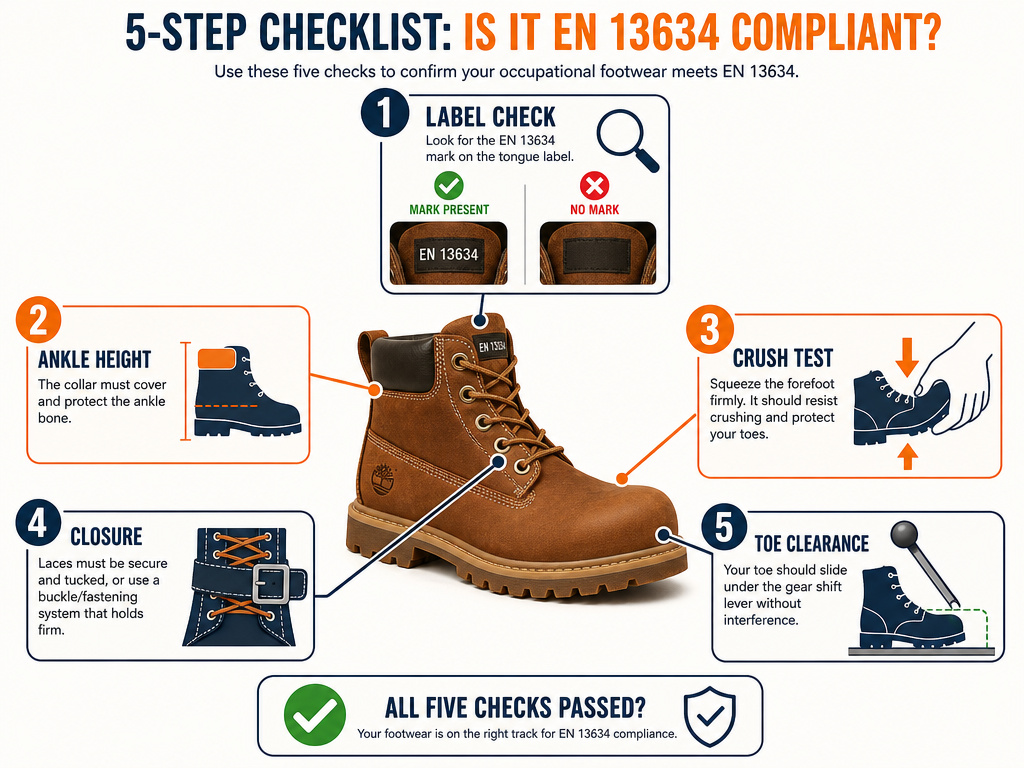
Got work boots or hikers in the closet and want to know if they’ll do? Run these checks in this order. The first one settles most cases on its own.
- Read the label first. Look on the tongue or inside the collar for EN 13634. No mark, no tested protection level.
- Ankle height. The collar should cover the ankle bone.
- Squeeze the forefoot. Press the boot across its widest point. If the sides fold flat in your hand, it has little crush resistance, the property EN 13634 rates as transverse rigidity.
- Closure. Laces you can fully tuck are acceptable. Buckles or a zip with no loose loops are better, because there’s nothing left to snag.
- Toe box. Slide it under your shift lever with the bike on its stand.
I’d love to give you a leather-thickness number for casual boots. There’s no published threshold I can point you to, so I won’t invent one.
Reading an EN 13634 Label
EN 13634:2017 is the current European standard for protective footwear for motorcycle riders. It’s the third revision since the standard started in 2002. The year on the label is the standard’s revision year, not the year the boot was made.
According to BSI, the standard covers on-road and off-road riding. Its properties come in two performance levels, matched to the type of riding and the nature of the crash. Ankle and shin coverage are optional, but the boot can’t seriously hurt your ability to work the foot controls.
The height digit tells you coverage: “1” means ankle height and “2” means a tall boot covering the shin. Some makers leave it off. Transverse rigidity is the boot’s resistance to being crushed, say when the bike drops onto your foot.
No EN 13634 mark means no tested protection level. Good leather and a high collar don’t change that.
Are Timberland Boots Good for Motorcycle Riding on a Short Commute?
For slow town riding, with the laces sorted, they’ll do. The one-year owner chose them so he could ride to work and wear them out at night. He called them “good enough” for the street and said plainly that they aren’t riding boots.
The Horizons Unlimited forum splits on this. Some touring riders accept hiking boots as a fair trade for comfort and one-pair travel. Others say they know riders with permanent limps or lower-leg damage from riding in normal boots, hiking boots or shoes.
I’m with the second group once speed goes up.
Timberland vs a casual riding boot: the Timberland wins only if you’ll wear it all day off the bike and ride a few slow miles. The casual riding boot wins everywhere else. Plenty of casual motorcycle boots pass for street footwear, so you keep the look and add a crash rating, once you’ve confirmed the label.
Cost isn’t the excuse it looks like. A Premium 6-Inch is a premium-priced boot. If you’re buying one only to ride, put that money toward the entry end of certified riding boots, last season’s clearance, or a lightly used pair.
If you want the Timberland’s height, short riding boots give you ankle coverage built for the bike. I’m less keen on riding shoes for anything past a cafe run. Calling a sneaker-cut shoe a highway boot does riders no favors.
Riders on Horizons Unlimited named a few boots worth a look if you want versatility:
- Sidi-made Combat boots from Aerostich, which another rider picked for travel and found decent for walking around town.
- Daytona Roadstar GTX. GoreTex-lined. Its owner reported dry feet through four days of heavy rain in France, plus two river crossings.
If you want one answer, buy a casual riding boot with EN 13634 on the tongue. Check the label on the pair in front of you.
Skip this if: you ride sport bikes on mountain roads, go off-road, or spend real time on the highway. The one-year Timberland owner draws that same line, and Horizons riders send off-roaders straight to MX boots.
Past that line, the best motorcycle boots for your type of riding are the only honest answer.
Frequently Asked Questions
Can I wear Timberlands as motorcycle boots?
For short, slow street rides, yes, as a stopgap. Crash data shows ordinary boots beat shoes, with a relative risk of 0.46 in the de Rome study. They still carry no EN 13634 rating, so their protection in a crash is untested.
What kind of boots are best for riding a motorcycle?
Boots certified to EN 13634:2017, at the performance level and height that match how you ride. TAC Victoria recommends motorcycle-specific footwear because it’s designed to stay on in a crash and resist impact and abrasion.
What not to wear on a motorcycle?
Shoes, runners, sandals and thongs. In TAC’s survey, 47% of riders in that kind of footwear got open-wound injuries, against 25% of riders in boots. Loose laces near the shifter are a second thing to avoid.
Do Timberlands protect your ankles on a motorcycle?
The 6-inch collar covers the ankle, but there’s no ankle armor. In the ISBS lab test, only motorcycle boots reduced ankle roll; work boots didn’t match them. Lacing to the top hook is the most you can do with a Timberland.
Are steel toe boots safe for motorcycle riding?
The amputation fear is a myth: MythBusters found no toe-cutting curl in drop tests. No published study covers safety toes in motorcycle crashes, though. The bigger day-to-day issue is a bulky toe box under the shift lever.
The Bottom Line
My trigger is simple: the day the bike goes onto a highway or a twisty back road, the Timberlands stay home. The crash data that flatters ordinary boots compares them with shoes. It never compares them with a certified riding boot at speed.
Do one thing this week. Pull the tongue on whatever you ride in and look for EN 13634. If it isn’t there, you’re riding on untested protection, and now you know it.
I’ll concede one point to the touring crowd. If you’ll only own one pair and you ride slow, a laced-up Premium 6-Inch beats the sneakers you’d otherwise wear. That’s a real gain, and the de Rome numbers support it.
So, are Timberland boots good for motorcycle riding? Buy them for short, slow town commutes where you’ll wear them all day off the bike. Skip them for highway, sport, mountain or off-road riding, and buy a certified riding boot instead.
