
What Is a Quickshifter on a Motorcycle?
This post contains affiliate links. As an Amazon Associate, we earn from qualifying purchases.
A motorcycle quickshifter is an electronic device that allows clutchless gear changes by momentarily cutting engine ignition and/or fuel when the rider moves the shift lever. This reduces load on the transmission, enabling a shift typically in under 50 milliseconds. It’s a performance and convenience feature found on many modern sport, touring, and adventure bikes.
That speed is the whole point. It’s not about eliminating the clutch lever; you still need that for starts and stops. It’s about removing the mechanical delay and rider fumble from the shift sequence when you’re accelerating hard or need to keep both hands firmly on the bars. This is what is a quickshifter on a motorcycle.
What follows is a breakdown of the sensor that makes it possible, the two main types you’ll encounter, and the very real trade-offs between convenience and mechanical sympathy, answering the what is a quickshifter on a motorcycle query in detail. By the end, you’ll know whether your bike can have one, how to use it without grinding gears, and which popular models come with them from the factory.
Key Takeaways
- A quickshifter works by using a sensor on the shift linkage to cue the engine computer to cut ignition/fuel for a few milliseconds, unloading the transmission for a clean shift.
- The term “quickshifter” is ambiguous, many are upshift-only (mono-directional), while advanced bi-directional systems also handle downshifts by auto-bliping the throttle.
- Proper installation is rarely plug-and-play; systems like the Kawasaki KQS or Honda accessory require dealer activation with proprietary tools to enable the function in the bike’s ECU.
- Using a quickshifter is less damaging to the transmission than sloppy clutchless shifting without one, as the microcontroller precisely controls the load reduction and reinstatement.
- Operation thresholds vary: Honda states its system only functions when engine speed is more than 1,500 rpm on upshifting, while Kawasaki markets its KQS as engineered for lower engine speeds.
How Does a Motorcycle Quickshifter Work? (Mechanism)
The process is a high-speed electronic handshake. When you pre-load the shift lever and then apply firm upward pressure, a sensor, usually a strain gauge or hall-effect type, in the shift linkage detects the force. This sensor sends a signal to the motorcycle’s Engine Control Module (ECM).
A motorcycle quickshifter places a sensor in the shift linkage. When the rider engages the foot shift control the sensor cues the ECM, and fuel and/or ignition are cut within milliseconds. This unloads the transmission, permitting a rapid shift without using the clutch or rolling off the throttle.
That’s the Harley-Davidson explanation. The exact method varies by manufacturer: Harley-Davidson states ‘fuel and/or ignition are cut’, KTM says its system ‘cuts the ignition instantaneously’, and Wikipedia notes the control module generally intervenes on the ‘ignition and/or fuel supply’. The goal is identical: to momentarily eliminate engine torque fighting the gears, letting the dog rings slip into place. The cut lasts just long enough for the gear to engage, often cited as “less than 50 milliseconds”, before power smoothly returns.
The rider’s job is simple: maintain steady throttle. Chopping the throttle while the system is active can cause a jerky, incomplete shift. The foot movement should be a firm, decisive push, not a tentative jab. Hesitation can confuse the sensor.
This electronic intervention is why using a quickshifter is less damaging to the transmission than clutchless gear shifting without one. A rider trying to force a clutchless shift by brute lever pressure is slamming un-synchronized dog rings together under load. The microcontroller does it with timed precision.
Upshift-Only vs. Bi-Directional Quickshifters
Not all quickshifters are created equal. This is the single biggest point of confusion. The bare term “quickshifter” alone is ambiguous.
A standard, or mono-directional, quickshifter only works on upshifts (e.g., 2nd to 3rd gear). It handles the cut for you. For downshifts, you’re back to using the clutch or attempting a manual rev-match.
A bi-directional quickshifter works on both upshifts and downshifts. On the downshift, the system doesn’t just cut power; it must briefly increase it to “blip” the throttle, matching engine speed to the lower gear’s wheel speed. This requires more sophisticated electronics and, critically, a drive-by-wire throttle (also called ride-by-wire) so the ECU can command the throttle bodies directly.
| Type | Works On | Throttle Requirement | Example Models |
|---|---|---|---|
| Mono-Directional | Upshifts only | Any (carbureted or fuel-injected) | Kawasaki Ninja ZX-10R (2016), many aftermarket kits |
| Bi-Directional | Upshifts & Downshifts | Drive-by-wire throttle required | BMW S1000RR, Suzuki GSX-R1000/R, Aprilia RSV4, KTM Duke 390 |
The Harley-Davidson article notes this technological split: older carbureted bikes can usually only use an upshift-only system that interrupts ignition. Newer bikes with drive-by-wire can enable the downshift blip. If you’re shopping for an aftermarket unit or wondering what your bike has, this is the first question to answer.
What Are the Real Benefits?
The advantages extend beyond just feeling like a MotoGP rider, which is often the first answer to what is a quickshifter on a motorcycle.
Faster, More Consistent Shifts: The system is objectively faster than even a skilled rider using the clutch. That 50-millisecond shift time keeps drive uninterrupted, which can shave tenths off lap times on track. On the street, it means smoother, surging-free acceleration when you’re pushing hard.
Convenience and Reduced Fatigue: It simplifies the shift action, especially in situations where operating the clutch is cumbersome. Adventure riders standing on the pegs off-road love them. So do tourers covering long miles. Your left hand stays on the bar, and you avoid the clutch-hand pump that can set in during aggressive canyon runs.
Improved Control: With both hands firmly on the grips, you have better steering input and brake modulation available. This is a genuine safety benefit in high-performance riding or emergency maneuvers where a split-second of instability from a clumsy shift could matter.
Potential for Less Wear: When used correctly, a quickshifter provides a perfectly timed load reduction. A bad clutchless shift by a rider is a crapshoot for gearbox longevity. The system is consistent.
What Are the Disadvantages?
It’s not all seamless upshifts and happy revs. There are tangible trade-offs.
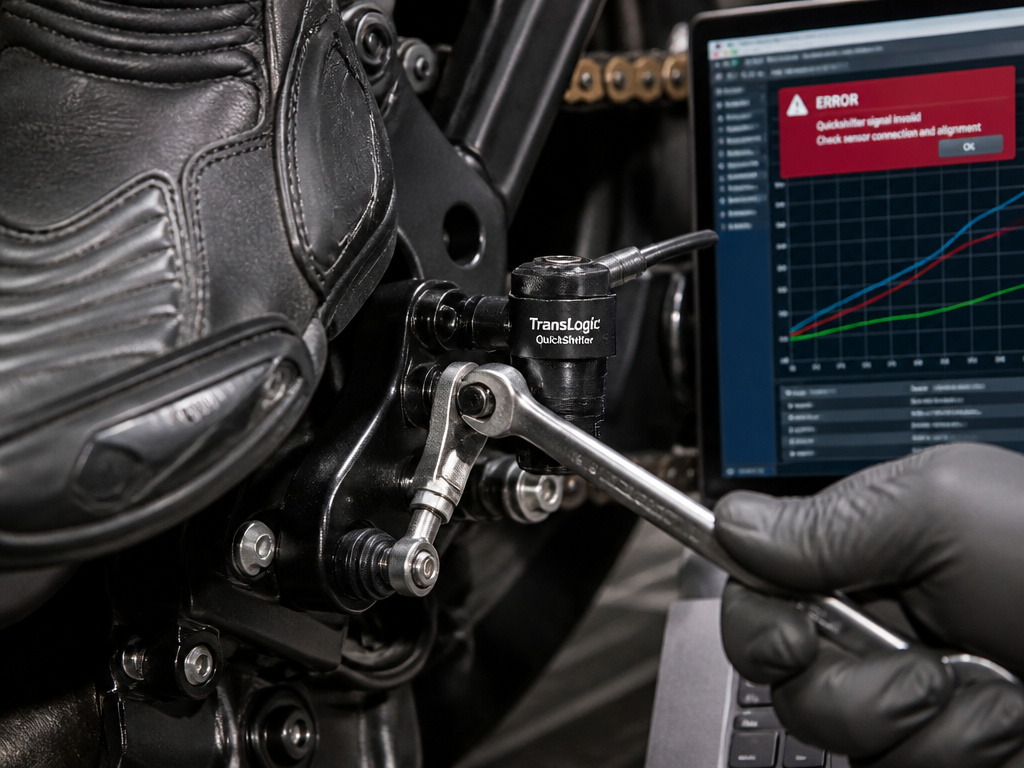
Cost and Complexity: Factory options are a significant upcharge. Aftermarket kits, like the popular units from brands like Translogic or HealTech, start at a few hundred dollars for hardware, not including installation and tuning. That tuning is critical, a poorly calibrated cut can be harsh or ineffective.
Where this goes sideways: Installing an aftermarket quickshifter without matching the shift rod’s “push” or “pull” design. The Harley-Davidson source explicitly warns that units must be matched to your transmission’s shift control rod direction. Get it wrong, and it won’t function.
Harshness at Low RPM or Incorrect Use: Many systems have a lower RPM limit for operation. The Honda CBR1000RR accessory quickshifter, for instance, only functions when engine speed is more than 1,500 rpm on upshifts. Try to use it below that, and nothing happens, or worse, you get a crunchy shift. Even within the operational range, a lazy foot movement, too slow or too soft, can result in a clunky, jarring shift that feels worse than doing it yourself.
It’s Not an Automatic: New riders sometimes confuse it with an auto-shifter or a full automatic transmission. You still move the lever. You still need the clutch for stopping and starting from a standstill. It’s an aid, not a replacement for learning proper shifting technique.
Can Mask Bad Habits: Relying on it exclusively means you might never learn the delicate art of rev matching on downshifts. If you ride a bike without one, or if the system fails, you’re back to square one. The fundamental skill matters.
Can You Add a Quickshifter to Any Motorcycle?
Technically, yes. Practically, it’s a spectrum of difficulty and expense that hinges on your bike’s age and electronics.
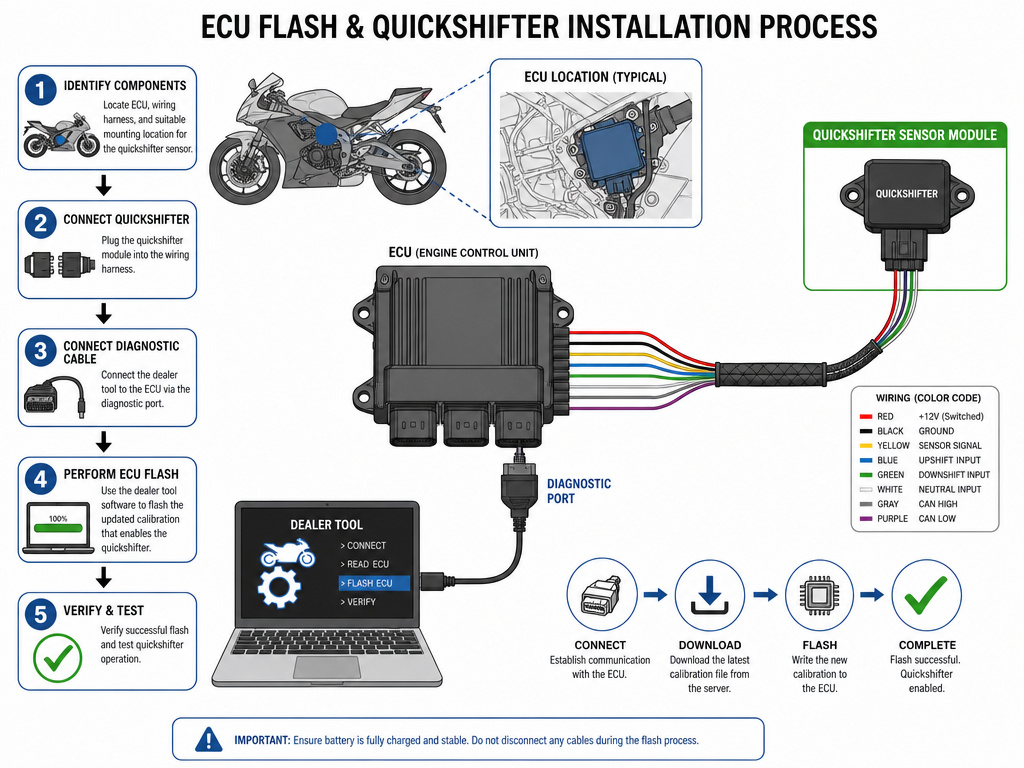
Modern Fuel-Injected Bikes (2010s+): This is the sweet spot. You’ll find bolt-on aftermarket kits with sensors that tap into your bike’s wiring harness. The major hurdle is often software. Systems like the Kawasaki Quick Shifter (KQS) for the Z900 or the Honda accessory (part number 08U70-MKF-D40) aren’t plug-and-play. The Kawasaki spec states it “requires dealer support with KVCI tool to enable Quick Shifter in bike ECU.” The Honda manual calls for an “ECU initialization procedure using a dealer SCS short connector.” You’re paying for the part and dealer labor to flash the bike’s computer.
Older Carbureted Motorcycles: It’s possible but limited. As the sources note, these bikes can usually only accommodate an upshift-only system that interrupts the ignition coil. It’s more of a crude, stand-alone module than an integrated performance feature. The results are often less refined.
Factory vs. Aftermarket: If your bike offers it as a factory accessory (like the Harley-Davidson Screamin’ Eagle® Quickshifter for the Pan America 1250), that is almost always the better, more integrated path. It’s designed for your specific ECU and likely includes the required flash from the dealer. Aftermarket is for when the factory doesn’t offer one, or you want a different brand’s characteristics.
How to Use a Quickshifter Properly (Without Breaking Anything)
Using one feels counterintuitive at first. You’re taught for years to coordinate clutch and throttle. Now you’re told to ignore both.
- Pre-load the lever. Apply light upward pressure to the shift lever with your toe before you intend to shift. This takes up any slack and ensures the sensor sees the movement instantly.
- Maintain steady throttle. This is the most critical step. Do not roll off. The system needs a consistent load signal to calculate the cut. Chopping the throttle mid-shift is a guaranteed route to a jarring experience.
- Apply firm, decisive pressure. Don’t stab at it. A smooth, solid push through the lever’s travel tells the sensor this is an intentional shift, not a boot brushing the lever.
- Listen and feel. A proper quickshifter shift is accompanied by a momentary, almost imperceptible drop in exhaust note (the cut) and a soft snick from the gearbox. A bad shift is a loud CLUNK and a jolt through the drivetrain. If you hear the latter, you’re either below the system’s RPM threshold or your technique is off.
- For downshifts (if bi-directional), be ready for the blip. The throttle will automatically open slightly as you press down on the lever. Don’t fight it. Let the system do its thing.
Common mistake: Trying to use the quickshifter while also manually blipping the throttle for a downshift. You’ll confuse the ECU and likely get a violent, mismatched shift. Let one system, the electronic one or your own wrist, handle the rev-matching, not both.
If you’re new to it, practice in a lower-risk environment. If you’re new to it, practice in a lower-risk environment.
Does a Quickshifter Wear Out the Transmission Faster?
The data says no, when implemented correctly. In fact, the consensus from engineering sources is that using a quickshifter is less damaging to the transmission than clutchless gear shifting without one.
The reason is control. When you force a clutchless shift, you’re relying on muscle memory and luck to time the momentary roll-off of throttle perfectly. Get it slightly wrong, and the gear dogs are grinding under load. A quickshifter’s microcontroller cuts and reinstates power with millisecond precision, every single time. It’s repeatable in a way human reactions are not.
That said, “less damaging” is not the same as “zero impact.” Any shift without disengaging the clutch puts more stress on the gearbox components than a perfectly executed clutch-assisted shift. Any shift without disengaging the clutch puts more stress on the gearbox components than a perfectly executed clutch-assisted shift.
The more practical concern is rider error. Stamping on the lever with hydraulic pressure, or using the system at very low RPM where it’s not designed to function, will accelerate wear. The quickshifter is a tool, not an invincibility shield for your gearbox.
Checking If Your Bike Has One & Brand-Specific Notes
Wondering if your ride is equipped? Look for these signs.
Physical: Check for a small, inline sensor on the shift linkage rod, usually near the shift lever. It’ll have wires coming out of it. Some bikes, like many KTMs, have it tucked under the engine cover.
Digital: Scroll through your bike’s digital dash menu. Look for settings like “Quick Shifter,” “Q/S,” or “Shift Assist.” If you can enable or disable it there, you have one.
Model Knowledge: Many modern performance bikes have them as standard or a very common option. Examples from sources include the BMW S1000RR, Suzuki GSX-R1000/R, Aprilia RSV4, and KTM Duke 390.
The Dealer Question: For accessory units, the process is revealing. If you’re told you need to buy the part and pay for a separate “ECU enablement” or “software activation,” you’re dealing with a system that requires dealer tools. Factor that into your cost. This is a key differentiator from simpler aftermarket units that may work with a plug-in module.
Brands implement them differently. The KTM Quickshifter+ uses a second sensor to detect actual gear engagement before reapplying power, aiming for smoother engagement. Kawasaki markets its KQS for the Z900 as engineered for lower engine speeds, directly contrasting with Honda’s 1,500 RPM floor. These aren’t marketing fluff points, they dictate how and where you can use the system effectively.
Frequently Asked Questions
How much does a quick shifter cost for a motorcycle?
Factory-installed options are a significant upcharge. Aftermarket kits also carry a cost, not including professional installation and tuning.
Can you downshift with a quickshifter?
Only if it’s a bi-directional quickshifter. These systems automatically blip the throttle on downshifts. Many standard quickshifters are upshift-only (mono-directional). Check your bike’s specifications or menu settings to see which type you have.
How do I know if my bike has a quick shifter?
First, check your owner’s manual or build sheet. Physically, check for a small sensor with wires on the gearshift linkage. Digitally, scroll through your instrument cluster’s menu for a “Quickshifter” or “Shift Assist” on/off setting. If you can enable or disable it electronically, it’s installed.
What is the disadvantage of a quickshifter?
The main disadvantages are cost, potential for harsh shifts if used incorrectly or at low RPM, and the dependency on complex electronics that can fail. It can also foster rider dependency, letting fundamental skills like clutch control and rev-matching deteriorate.
Is a quickshifter bad for your motorcycle?
When designed for the bike and used correctly, a quickshifter is not bad for your motorcycle. Engineering sources indicate it’s less stressful on the transmission than imperfect clutchless shifting performed by a rider. However, abusive use (e.g., excessive force, operation outside its RPM range) can cause damage.
Before You Go
The real value of a quickshifter isn’t in pretending you’re on a factory race bike. It’s in the genuine situations it simplifies: keeping momentum over rough ground off-road, managing a tight line while braking and downshifting for a corner, or just reducing left-hand fatigue on a long motorway blast. It’s a rider aid, like traction control or riding modes, that augments skill rather than replaces it.
If your bike has one, take the time to learn its personality, find its lowest smooth operating RPM, practice the firm foot pressure, and trust the throttle hold. If you’re adding one, budget for the dealer flash if needed, and match the unit to your bike’s shift rod direction and electronics. And if you’re riding an older machine without one, don’t sweat it. Mastering the perfect clutchless upshift and the heel-and-toe downshift is a satisfying skill in its own right, and it’ll make you a smoother, faster rider on any bike, with or without electronic help.
For those looking to push their bike to the limit, understanding this tool is part of preparing for a track day where every millisecond counts. For everyone else, it’s just a clever bit of engineering that makes a spirited ride a little easier on you and your machine.
