
Dual Sport vs Adventure Motorcycle: Which Should You Buy?
This post contains affiliate links. As an Amazon Associate, we earn from qualifying purchases.
In the dual sport vs adventure motorcycle debate, a dual sport is a lightweight, single-cylinder bike optimized for off-road agility, while an adventure motorcycle is a heavier, multi-cylinder machine built for long-distance, mixed-surface travel. The average dual sport weighs around 300 pounds, and the typical adventure bike weighs 500 pounds, that 200-pound gap changes everything about how and where you ride.
That weight difference is the single most important number. It dictates what kind of trails you can tackle, how far you can ride comfortably on pavement, and how much luggage you can carry. The categories in the dual sport vs adventure motorcycle debate are marketing terms, but the scale doesn’t lie.
What follows is a breakdown of the seven specs that actually matter: weight, suspension, engine type, ergonomics, luggage capacity, and price. By the end, you’ll know which bike fits your garage, your skill level, and your actual weekend plans.
Key Takeaways
- The 200-pound weight gap is the defining difference. It makes a dual sport nimble on trails and an adventure bike stable on highways.
- Choose a single-cylinder dual sport (250cc–690cc) to learn off-road skills or connect local trails. Choose a twin-cylinder adventure bike for multi-day trips mixing interstate and dirt roads.
- Stock fuel capacity on a dual sport averages 2–3.8 gallons. Adventure bikes like the BMW R 1300 GS carry 5.0 gallons, doubling your range between gas stops.
- Adventure bike subframes are built for hard luggage. Strapping heavy gear to a dual sport’s lighter frame risks damage on rough roads.
- If you are new to riding off pavement, start with a dual sport. The low weight and forgiving power make mistakes less costly and skills easier to build.
Weight & Physical Size: The 200-Pound Gap
Look at a Honda CRF300L next to a BMW R 1300 GS. One looks like a dirt bike with lights; the other looks like a small car with handlebars. This isn’t about styling. Bulk translates directly to weight, and weight decides where the bike can go.
The numbers from manufacturers are clear. The average dual sport motorcycle weighs around 300 pounds. Sources disagree on a weight threshold: Wikipedia cites a common industry threshold of under 400 lbs, while GearJunkie reports an average around 300 pounds. On the other side, Sources report different figures: GearJunkie states the average adventure motorcycle weighs 500 pounds, while specific models like the BMW R 1300 GS (523 lbs) and KTM 1390 Adventure (507 lbs) are heavier. The BMW R 1300 GS has a curb weight of 523 lbs. The KTM 1390 Adventure comes in at 507 lbs.
The most conspicuous difference is the size or bulk. Compared to a DS, an ADV motorcycle is massive. The windscreen and fairing partly encompass the chassis and engine, magnifying the height and girth.
That 200-pound gap is a canyon. On a loose gravel road, a 300-pound bike flicks and corrects with your knees. A 500-pound bike demands committed input and fights you when it starts to slide. In deep sand or mud, that difference is the line between riding through and digging out.
Where this goes sideways: Choosing a bike based on seat height alone. A tall adventure bike might feel fine in a showroom, but its weight becomes a real problem on a off-camber trail or when you need to paddle through a rut. The physical size also affects garage space and transport, loading a 500-pound bike into a pickup is a different job than loading a 300-pound one.
Engine & Transmission: Singles vs. Twins
Pop the hood. A dual sport almost always has a single-cylinder engine. Displacement typically ranges from 250cc to 690cc. These are often liquid-cooled, fuel-injected four-strokes, though classics like the Honda XR650L keep it simple with air-cooling. An adventure motorcycle runs a twin-cylinder engine, like the BMW’s boxer or the KTM’s V-twin, with displacements from 800cc to over 1300cc.
The cylinder count isn’t about prestige. It’s about power delivery and highway stamina. A big single makes its power down low, perfect for chugging up a rocky climb. A twin makes its power up high, designed to spin at 70 mph for hours without vibration numbing your hands.
| Engine Characteristic | Dual Sport (Single-Cylinder) | Adventure Bike (Twin-Cylinder) |
|---|---|---|
| Power Delivery | Low-end torque for technical trails | Broad, smooth power for high-speed cruising |
| Highway Comfort | Tiring above 60 mph; high vibration | Stable and relaxed at 80+ mph |
| Typical Maintenance | Simpler; often chain final drive | More complex; may include shaft drive |
| Sound & Feel | Thumpy, mechanical pulse | Smooth, turbine-like whirr |
The transmissions differ too. Dual-sport motorcycles employ a wide-ratio gearbox with a lower first and second gear for crawling over obstacles. This is a huge advantage on a steep, rocky climb where control is everything. An adventure bike’s gearbox is spaced for pavement, so first gear might feel tall when you’re picking through a rocky section.
Suspension & Wheels: Travel and Diameter
Suspension travel is the distance your wheel can move up and down. More travel absorbs bigger hits. Dual sports, born from dirt bikes, have ample suspension travel. Adventure bikes have less, but it’s still substantial. The BMW R 1300 GS has 7.5 inches up front and 7.9 in the rear. The KTM 1390 Adventure offers 8.7 inches at both ends.
The wheel diameter debate is a perfect example of where sources disagree. Some, like ADV Pulse, argue a 21-inch front wheel is critical for serious off-road work, handling rocks and ruts better. Others, like Motorcycle.com, contend that for most adventure riding, mostly pavement and graded dirt, a 19-inch front wheel offers better road manners with minimal penalty.
Most dual sports use a 21-inch front wheel. That larger front wheel rolls over obstacles more easily, but it makes the steering feel slower on a twisty road.
Common mistake: Assuming more suspension travel always equals better off-road performance. Softer, longer travel needs careful setup for your weight and luggage. An overloaded adventure bike will still bottom out on a trail, no matter its travel spec.
Ergonomics & Comfort: The 50-Mile Test
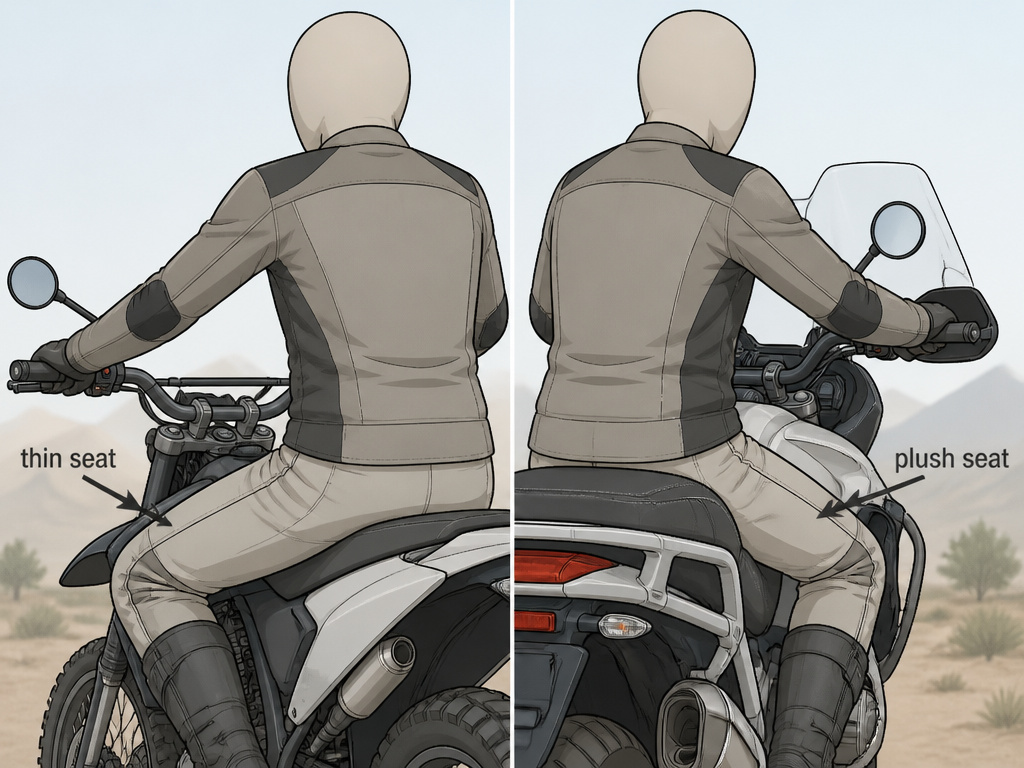
Sit on a dual sport. The seat is thin, almost like a bicycle seat. The handlebars are wide and flat. The pegs are directly under you. This is the “attack position,” meant for standing up on the trails. It’s great for an hour. It’s brutal for three.
Now sit on an adventure bike. The seat is wide and plush. The bars are pulled back toward you. Windshield and fairings deflect air and weather. The pegs are slightly forward. This is a cockpit designed for all-day mileage.
The difference shows up at the 50-mile mark on pavement. On a dual sport, you’ll be shifting your weight, feeling the buzz in your hands, and wishing for a windshield. On an adventure bike, you’ll be settled in, barely noticing the miles. For two-up riding or long-distance touring, the comfort advantages of adventure motorcycles are not optional, they’re the whole point.
The part nobody mentions: That plush adventure bike seat is often much taller. If you’re under 5’8″, flat-footing a fully loaded BMW GS at a stoplight can be a challenge. A dual sport, while less comfortable, is almost always easier to reach the ground on.
Luggage & Fuel Range: Travel-Ready vs. Travel-Lite
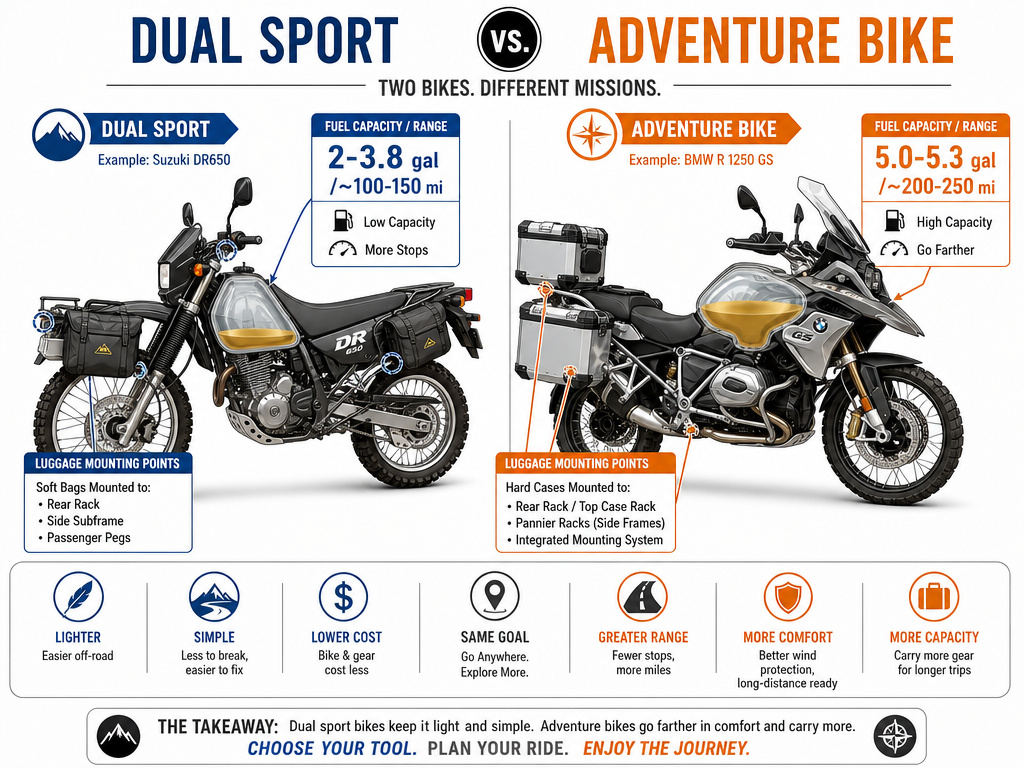
Adventure motorcycles are built to carry gear. Their subframes are designed to support hard panniers and top boxes loaded with camping equipment. A dual sport’s subframe is lighter, often designed just to hold the seat and maybe a small rack. Strapping heavy, rigid luggage to it can stress welds on rough roads.
Fuel capacity is a major divider. Stock fuel tanks for the 250/300cc dual-sport class average 2 to 3.8 gallons. The Suzuki DR650S has a 3.4-gallon stock gas tank. That gives you a limited range before you’re looking for a gas station. Now look at the adventure bikes: the BMW R 1300 GS holds 5.0 gallons, and the KTM 1390 Adventure holds 5.3 gallons. That’s a significantly longer range, which changes how you plan a trip through remote areas.
| Travel Consideration | Dual Sport | Adventure Bike |
|---|---|---|
| Luggage Capacity | Light, soft luggage only; hard cases risk frame damage | Integrated racks for hard panniers and top boxes |
| Fuel Range | ~100-150 miles | ~200-250 miles |
| Wind Protection | Minimal or none | Large windshield and fairings standard |
| Two-Up Viability | Poor; small seat, limited power | Good; designed for passenger and gear |
This is where the line in the dual sport vs adventure motorcycle distinction literally gets blurred. When dual-sports are fitted for long-distance travel with accessories like oversized gas tanks and luggage, they are often referred to as “adventure bikes.” But adding a 5-gallon tank and panniers to a 300-pound bike changes its handling completely. It’s a modification, not a factory design.
Cost & Skill Progression: Start Small, Ride More
The numbers from the source are clear. The 2023 Honda XR150L has an MSRP of less than $3,000. The 2023 Kawasaki KLR650 is $6,899. The 2023 Suzuki DR650 is $6,999. Now look at the adventure side: a 2023 BMW R 1250 GS Adventure will set you back more than $25,000. The Ducati Multistrada Pikes Peak has an MSRP of $28,995.
The price gap isn’t just about purchase price. Insurance, maintenance, and especially repairs are cheaper on simpler, lighter dual sports. Dropping a $7,000 KLR in a dirt parking lot costs you a turn signal. Dropping a $28,000 Multistrada costs you a carbon fiber side panel and a mirror assembly.
This is why the skill progression path matters. If you’re new to riding off pavement, start with a dual sport. The low weight and forgiving power make mistakes less costly, both for your wallet and your body. You’ll learn clutch control, balance, and reading terrain on a bike that won’t punish every small error.
I tested this the hard way. My first “adventure” bike was too much bike. I spent more time managing its weight on simple trails than actually riding. Switching to a lighter dual sport rebuilt my confidence and skills in one season.
After a year or two of weekend trail riding, you’ll know if you need more bike. If your trips are getting longer and involve more highway, then you’re ready to step up to a middleweight adventure motorcycle. You’ll appreciate the comfort and power because you’ve earned it.
Which Motorcycle Should You Buy?
Answer these three questions. They cut through the marketing.
- What is the longest stretch of highway you’ll ride regularly? If the answer involves significant highway distances, lean toward an adventure bike. For mostly local or trail-connecting rides, a dual sport is viable.
- Will you ride technical, single-track trails? If yes, a dual sport is the only correct answer. An adventure bike is too wide and heavy.
- Are you carrying a passenger or a week’s worth of gear? If yes, you need the luggage capacity and power of an adventure bike.
If you answered “adventure bike” to two or more, your path is clear. Look at the middleweight segment (700-900cc) for the best balance. If you answered “dual sport” to two or more, start shopping. A used 250-400cc bike is the smartest first move.
For the vast majority of new riders dreaming of dirt, the underrated choice is a dual sport. It’s the tool that makes learning less intimidating. For the rider who already tours on pavement and wants to add forest roads to the route, an adventure bike is the logical upgrade. It’s not about which bike is better. It’s about which bike is better for you next season.
How Did Dual-Sport and Adventure Motorcycles Evolve?
The split between dual-sport and adventure bikes grew from the machines riders were using. Early dual-sports were essentially street-legal dirt bikes, built light and simple to handle both trails and pavement. The category solidified around a weight threshold, with bikes generally staying under a certain limit to remain capable off-road. As riders wanted to cover vast distances on mixed terrain, manufacturers began building heavier, more powerful machines with larger fuel tanks and increased comfort for long hauls. This created the modern adventure category, defined by its greater mass and touring-focused features, while dual-sports kept their focus on lightweight, off-road agility.
Frequently Asked Questions
Can you ride a dual sport on the highway?
You can, but you won’t want to for long. The lack of wind protection, the high vibration from the single-cylinder engine, and the light weight make it tiring and unstable above 60 mph. A dual sport is meant to connect trails, not eat interstate miles.
What are the disadvantages of owning an adventure bike?
The main disadvantages are weight, cost, and complexity. Their 500+ pound weight makes them intimidating and difficult to handle on serious off-road terrain. Purchase prices and repair costs are high. The advanced electronics and multiple cylinders mean more potential failure points, as seen in recalls like the NHTSA Recall 24V-102 for certain KTM models for fuel line chafing.
Can you turn a dual sport into an adventure bike?
You can modify a dual sport for longer trips by adding a larger fuel tank, soft luggage, and a more comfortable seat. This creates an “adventure-lite” bike. However, you cannot change its fundamental DNA: the lightweight frame not designed for heavy loads, the buzzy single-cylinder engine, and the lack of wind protection. It’s a compromise.
Is a dual sport or adventure bike better for a beginner?
Dual sport is almost always the better beginner bike, especially if the rider has any interest in off-road riding. The light weight, lower power, and lower cost make it a forgiving platform to learn on. The upright riding position also provides great visibility. Adventure bikes are simply too much bike for a true beginner to handle safely, particularly off pavement.
What are the best tires for each type?
Tire choice underscores the different purposes. Dedicated tires for dual sport motorcycles prioritize off-road traction with aggressive knobs. Tires for adventure motorcycles are hybrids, designed with tire ratios like 50/50 or 70/30 on/off-road splits to handle highway speed while still offering some dirt capability.
Before You Go
One rule cuts through the noise: rent before you commit. Find a rental outfit that offers a dual sport like a Honda CRF300L and an adventure bike like a Yamaha Ténéré 700. Ride each for a day on your typical roads. Your body and your gut will tell you more than any spec sheet.
For your first bike off pavement, buy the lightest, cheapest, running dual sport you can find. Ride it for a year. Drop it. Scratch it. Learn what you actually need. Then, if your ambitions outgrow the bike, sell it for what you paid and move up. That path costs you nothing but time and teaches you everything.
