
Touring Motorcycle Pros and Cons: Is It Worth It?
This post contains affiliate links. As an Amazon Associate, we earn from qualifying purchases.
Touring motorcycles offer unmatched long-distance comfort and storage but demand a significant budget and physical strength to manage. The trade-off centers on their weight, an 845-lb Honda Gold Wing Tour delivers a plush ride and 61 liters of storage but feels like moving a small couch at low speeds or in a parking lot. For riders who prioritize multi-day highway travel over urban agility, the pros outweigh the cons.
The 845-lb curb weight isn’t just a spec sheet number. It’s the force you feel when you try to back the bike up a slight incline in a gravel driveway. That mass is the source of both the sublime highway stability and the most common rider frustration, a perfect illustration of the core touring motorcycle pros and cons.
What follows breaks down the touring motorcycle pros and cons with manufacturer specs, real recall data, and the maintenance realities most overviews skip. This article details the comfort you buy, the weight you manage, the true cost of ownership, and who should, and shouldn’t, consider a full-dress tourer.
Key Takeaways
- An 845-lb motorcycle like the Honda Gold Wing Tour is stable at 80 mph but a genuine handful under 5 mph, especially for riders under 5’8″.
- Total cost of ownership is significantly higher than the base MSRP when you factor in insurance, tires, and scheduled dealer service.
- Factory integrated storage (like the Gold Wing’s 61-liter trunk) is a pro, but adding electrical accessories or towing is a con, the 2016 manual explicitly warns against exceeding the electrical system or pulling a trailer.
- Low-speed wobble complaints on some models led to an official NHTSA service bulletin warning against adjusting steering head bearings “by feel,” a common but incorrect fix that can hurt stability.
- For most new touring riders, a used standard or naked bike in the 400-700cc range is a smarter first move than a $30,000, 845-lb flagship.
The 845-Lb Reality: Weight vs. Comfort
Its 66.9-inch wheelbase, 30.5-degree rake, and 4.3-inch trail are geometry choices that trade quickness for unshakable straight-line composure.
A touring motorcycle’s weight is its primary engineering constraint. The mass dampens road vibrations and crosswinds at highway speeds, creating the signature “flying couch” sensation. This stability comes from a long wheelbase and relaxed steering geometry, which directly opposes low-speed agility.
That weight delivers a sensory experience smaller bikes can’t match. At speed, the bike settles into a glide. You hear the wind, not the chassis. The seat, often chair-wide, supports thighs and lower back for hours. The fairing and electric windscreen manage airflow so you aren’t fighting a constant 70-mph blast.
But you trade for that in parking lots, driveways, and tight U-turns. The bike doesn’t tip; it commits. Correcting a lean requires a firm shove from your whole body, not just a shifted hip. If your footing slips on gravel or a slick gas station spill, the descent is slow, inevitable, and expensive. The sound is a deep, metallic crunch followed by a very quiet sigh.
For shorter riders, this is the deal-breaker. If you can’t flat-foot the bike with both feet, you’re managing 845 lbs on the balls of your feet. That’s a recipe for a dropped motorcycle in a seemingly benign situation, like stopping on a road crown.
| Weight-Driven Factor | Pro (Highway) | Con (Low Speed / Parking) |
|---|---|---|
| Stability | Unaffected by crosswinds, semi-truck bow waves. | Feels reluctant to turn, requires deliberate counter-steering input. |
| Ride Quality | Mass dampens bumps; suspension is tuned for loaded, two-up travel. | Suspension can feel overly soft if riding solo, leading to wallow. |
| Control | Cruise control, standard on modern tourers, eliminates throttle hand fatigue. | Physical effort to maneuver at walking speed can lead to rider fatigue before the ride starts. |
When you compare a touring motorcycle pros and cons, the pros win if your riding is 90% highway. The cons win if your riding includes daily urban commuting, errands, or navigating mountainous switchbacks.
Storage: Built-In vs. Added-On
Integrated luggage is a premier touring motorcycle benefit. The Honda Gold Wing Tour’s 61-liter travel trunk and saddlebags are waterproof, lockable, and designed as part of the chassis. You aren’t bolting on boxes that catch wind; the storage is aerodynamic.
This solves the “what to pack” dilemma for a weekend trip. A full-face helmet fits in the trunk. Saddlebags take changes of clothes, tools, and a small laptop. This convenience is a major advantage; you just get on and go.
The con is dependency. That integrated system is proprietary. A repair or replacement is a dealer-part transaction, not a universal Givi case you can find used online. It also defines your storage limit. With a standard bike, you can add a larger top case or side racks. With a tourer, you’re largely stuck with what you have.
Where this goes sideways: Adding aftermarket electrical accessories like extra lights, heated gear controllers, or a tire inflator. The 2016 Honda Gold Wing owner’s manual warns that accessories “must not exceed the motorcycle’s electrical system capacity.” Overload the stator and you’re stranded with a dead battery, often far from help.
Pulling a trailer is another common ambition that becomes a con. The same Honda manual states the bike “was not designed for these attachments.” It’s not about power; it’s about frame stress, braking dynamics, and cooling that the factory never validated. You void warranties and assume unknown risks.
But for integrated, sleek storage that’s always there, the touring bike’s factory setup wins.
The Budget Beyond the Sticker
A touring motorcycle’s price tag is the first of many costs. The 2026 Honda Gold Wing Tour starts at $29,500 MSRP, though pricing can vary by model year. The DCT automatic adds $1,000; the airbag model jumps to $33,800. These are significant investments before tax, title, or destination charges.
Insurance costs reflect the bike’s value and repair complexity. A low-speed tip-over that scratches a fairing, mirror, and saddlebag can be a very expensive claim. Premiums are accordingly higher than for a standard motorcycle.
Tires are a recurring, notable expense. Touring tires are built for mileage and load, but a rear tire for a Gold Wing or Harley-Davidson Road Glide costs significantly more than a tire for a mid-size bike. You’ll go through two rears for every front.
Dealer maintenance is another layer. For some brands and in certain countries, warranty compliance is strict. The Harley-Davidson owner’s manual for some markets specifies that all regular maintenance must be performed by an authorized dealer for the limited warranty to remain in effect. This locks you into dealer labor rates for oil changes and inspections.
Planning a long trip? Your touring budget needs to account for these operational costs, not just gas and hotels. The bike that cossets you on the road also demands a larger wallet in the garage.
Reliability and the Dealer Dependency Loop
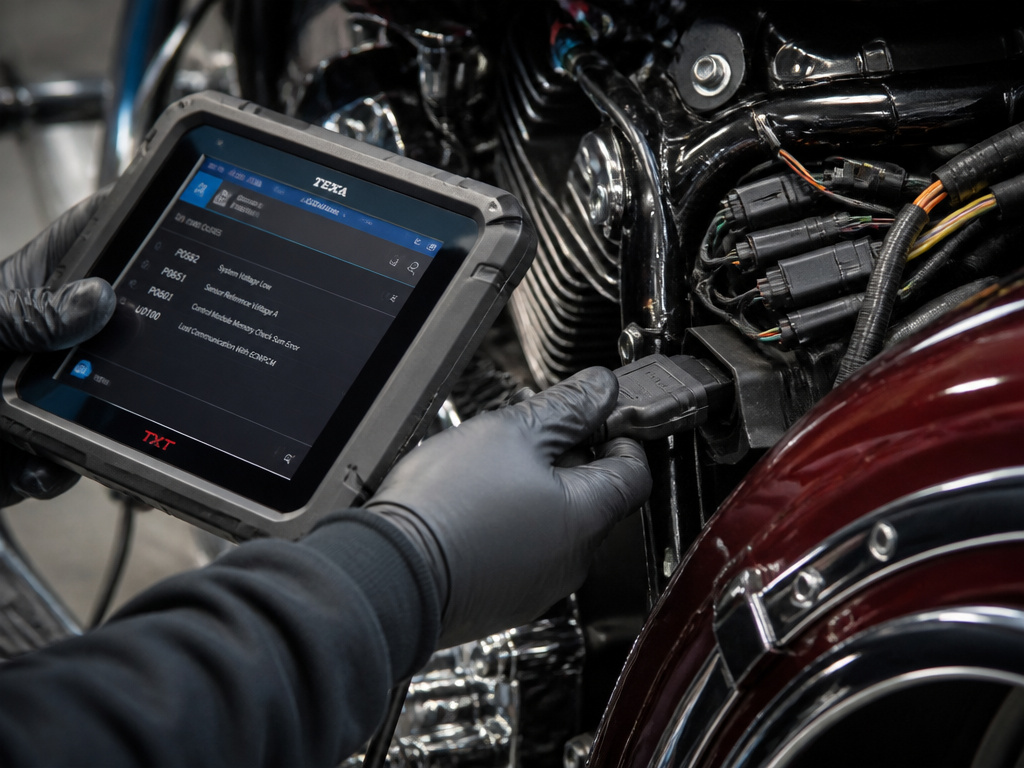
Touring motorcycles are complex machines. That complexity breeds both capability and specific failure points that aren’t common on simpler bikes.
Consider the September 2024 NHTSA recall (24V672) for certain 2024 Harley-Davidson Touring models (including FLHX, FLTRX, and their CVO variants). The recall states a regulator output wire may rub on the front corner of the crankcase, potentially shorting to ground. If this happens, the 60-amp main fuse may open, resulting in a loss of propulsion and all electrical power without warning. This isn’t a minor glitch; it’s a complete shutdown on the road.
Another documented issue involves steering head bearings on large touring frames. An official NHTSA technical service bulletin for Harley-Davidson Touring models notes that dealers were observed incorrectly adjusting bearings “by feel” to address “low speed wobble” complaints. The bulletin warns this improper adjustment can adversely affect stability. The correct procedure requires specific tools and torque sequences.
Common mistake: Assuming a new, expensive motorcycle is fault-free. Recalls and service bulletins target brand-new models. Your dealer relationship, and their willingness to perform warranty work correctly, becomes a critical part of ownership.
These examples highlight the con: troubleshooting often requires proprietary diagnostic tools and software. You can’t always fix it in a hotel parking lot with a basic toolkit. Your independence is traded for sophistication. This makes choosing a dealer with proprietary diagnostic tools as important as choosing the bike itself.
Who Actually Wins with a Touring Bike?
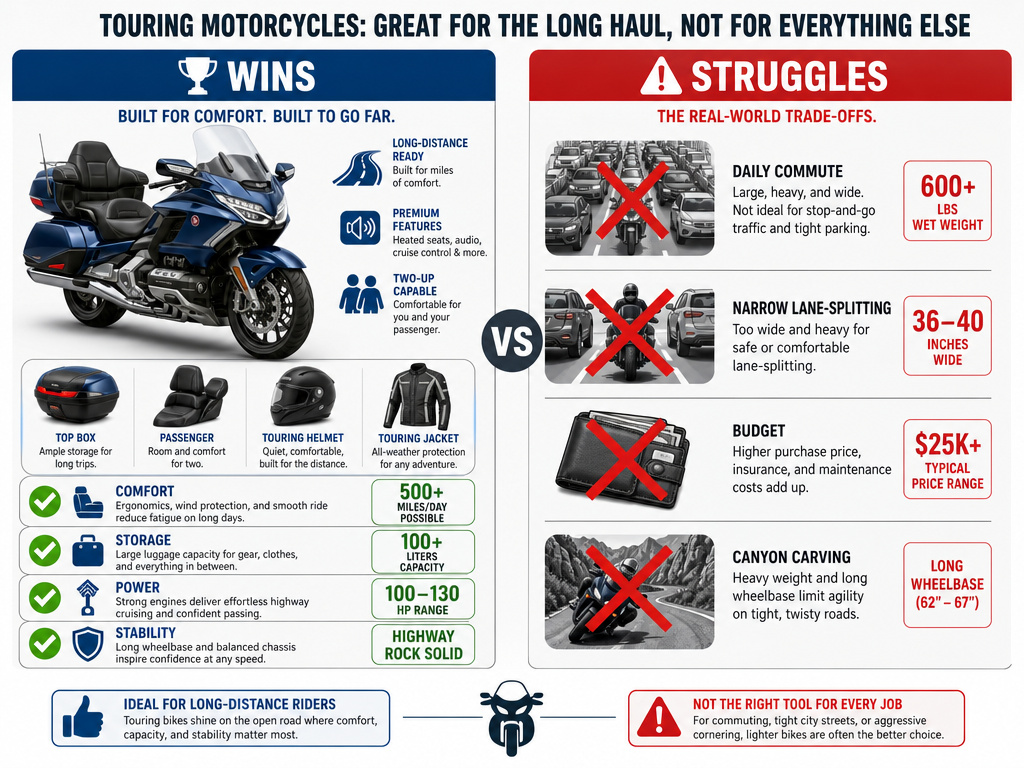
The perfect touring motorcycle owner has a specific profile. They take multiple long-distance trips (500+ miles) each year. They frequently ride with a passenger. They have a garage or dedicated parking space where the bike’s size isn’t a daily hassle. They have the physical strength and technique to manage the weight confidently.
For them, the pros are absolute. The comfort enables longer days in the saddle. The storage means traveling light isn’t a compromise. The power and stability make eating up interstate miles effortless. The best touring helmets and touring jackets complement the bike’s mission, creating a total system for distance.
For everyone else, the cons dominate. If you commute daily, lane-split (where legal), enjoy canyon carving, or have a modest budget, a touring bike is a burden. A sport-touring or standard motorcycle offers a much better balance.
This is why many experienced riders recommend starting with a different platform. A used standard bike helps you develop core skills without fighting mass. You can add a windscreen and soft luggage for weekend trips. When you’ve logged thousands of miles and find yourself craving more comfort and space, the upgrade to a true tourer makes sense. You’ll appreciate it more, and you’ll be a better rider for it.
Don’t overlook the middle ground. Sport touring motorcycles blend performance with comfort, and adventure motorcycles offer touring capability with more versatility. Both can be smarter first steps into distance riding.
Touring Motorcycle Fuel Efficiency
Fuel efficiency is often a weak point for touring motorcycles due to their substantial weight and large, wind-catching fairings. The physics are simple: moving a heavier object requires more energy. A motorcycle with a curb weight of 845 pounds, plus the weight of a rider, passenger, and gear, demands significant power just to accelerate and maintain highway speeds. This, combined with the aerodynamic drag of a full fairing and luggage, means the engine works harder than a lighter, naked bike. While fuel capacity is generous to extend range, the miles per gallon you achieve will be lower than smaller motorcycles, making fuel stops a more frequent and costly part of long-distance travel.
Frequently Asked Questions
Are touring bikes harder to ride?
They are harder to ride at very low speeds and when maneuvering manually. The weight is the challenge. At highway speeds, they are often easier and less fatiguing to ride than smaller bikes due to superior stability and wind protection. Mastering low-speed control techniques is essential.
Is 200 miles a long motorcycle ride?
On a touring motorcycle, 200 miles is a moderate morning ride. The riding position, wind protection, and seat design make covering distance easier. On a sportbike or minimal cruiser, 200 miles can be a long, tiring day. The bike type dramatically changes the definition of “long distance.”
What is the 12 second rule on a motorcycle?
It’s a following-distance guideline. You should stay at least 12 seconds behind the vehicle in front of you, giving you ample time to perceive a hazard and react. On a heavy touring bike, which requires more distance to stop smoothly, adhering to this rule is even more critical.
What is the 70/30 brake rule for motorcycles?
This is a principle for braking technique, suggesting that roughly 70% of your stopping power should come from the front brake and 30% from the rear. On a heavily loaded touring bike with a passenger and luggage, more weight is over the rear, so the rear brake can provide a slightly higher percentage of stopping force to maintain stability.
The Bottom Line
A touring motorcycle is a tool for a specific job. If your riding is dominated by long, straight highways and two-up travel, the comfort and convenience justify the cost, weight, and complexity. The pros are real and significant.
But if that’s not your primary use case, the cons will grate on you daily. The bike will feel heavy, expensive, and cumbersome. You’ll envy the simplicity of other riders.
Before you commit, be brutally honest about your actual riding habits. Rent one for a weekend trip. Practice low-speed maneuvers in a parking lot. Then decide. The open road deserves the right tool, but your garage shouldn’t hold a hostage.
