
Motorcycle Touring Packing List: What You Need to Bring
This post contains affiliate links. As an Amazon Associate, we earn from qualifying purchases.
A motorcycle touring packing list starts with your bike’s factory weight limits, not a generic checklist. The Harley-Davidson Backseat Roller Bag must not exceed 25 lb (11.4 kg) total weight when installed on a passenger pillion, the Tour-Pak Roller Bag must not exceed 30 lb (13.6 kg) under the same condition, and the luggage rack maxes at 10 lb (4.5 kg). A Ducati Multistrada V4 Pikes Peak (MY23) allows 66 lb (30 kg) total across its cases, but a Ducati Multistrada 1200 S Touring (MY14) has a different total and distribution. Exceed these, and handling degrades long before anything breaks.
Those numbers are the engineering ceiling printed in the service manual. Your job is to fit your life under that ceiling for the distance you plan to ride.
What follows is the method: core gear that meets the standards, a modular list that scales from a weekend to a month, and the packing logic that keeps the weight low and centered. The goal is a lighter bag and a more predictable bike.
Key Takeaways
- Check your motorcycle’s Gross Vehicle Weight Rating (GVWR) on the frame downtube before you pack a single sock. This is the legal and engineering maximum for bike, rider, passenger, and cargo.
- Riding gear is essential. A full-face ECE 22.06 helmet, a CE-rated armored jacket, gloves, boots, and pants are the baseline, not an upgrade.
- Build your tool and repair kit around your bike’s specific fasteners and tire type. A universal kit is often missing the one tool you need.
- Pack for the end of the ride, not the start. That means cold-weather layers even on a summer morning, and rain gear even under a clear sky.
- Limit your daily mileage. A successful tour is more about sustainable pacing than how much you can cram into a saddlebag.
The Core Riding Gear You Actually Need
Your gear is your primary safety system. A motorcycle touring packing list that treats it as an afterthought is a list that assumes nothing will go wrong.
Proper riding gear includes helmet, eye protection, gloves, boots, long sleeve jacket and long pants. Jacket, pants or riding suit must be made from leather or abrasion-resistant material and have high-visibility colours and inserts. Never wear loose clothing, items or accessories that may become tangled in motorcycle parts. — Ducati Owner’s Manual
That manual excerpt is a technical snippet, not marketing. “Abrasion-resistant material” means a textile like Cordura or aramid (Kevlar), certified to a standard like CE EN 17092. “High-visibility colours” are a measurable factor in being seen. Treat gear as equipment, not clothing.
Helmet: A full-face, dual-homologation model (ECE 22.06 and DOT, or FIM) is the touring default. A full-face helmet is part of the proper riding gear. I prefer a mid-priced, well-fitted ECE 22.06 helmet over a flagship model that doesn’t seal right. Fit first, features second.
Jacket & Pants: Look for CE Level 1 or 2 armor at the shoulders, elbows, and back (and hips and knees for pants). A touring-specific jacket should be made from abrasion-resistant material and have high-visibility colours and inserts, as recommended in motorcycle manuals. For hot climates, a mesh jacket with real armor is safer than a leather jacket left in the hotel room because it’s too hot.
Gloves: They must be full-finger and gauntlet style. The cuff should seal over or under your jacket sleeve. Gloves must be full-finger and made from leather or abrasion-resistant material.
Boots: They must cover your ankle. Short “urban” boots are a false economy. Riding boots or shoes must have non-slip soles and offer ankle protection.
This is the irreducible core. Everything else on the list is what you pack; this is what you wear.
The Modular Clothing Strategy: Weekend to Month-Long
Packing clothing is where weight and volume explode. The commodity advice is “pack light.” The useful advice is to build a modular, quick-dry wardrobe that scales logically.
The Base Layer (Every Trip):
- Socks (2-3 pairs): Merino wool or synthetic. Cotton retains moisture and leads to blisters.
- Underwear (2-3 pairs): Synthetic or merino. Quick-dry is the priority.
- Baselayer Top (1): A long-sleeve merino or synthetic shirt. It serves as sleepwear, an extra warm layer, or casual wear.
- Short-Sleeve Shirt (1): For off-bike wear.
- Pants (1 pair): Durable, quick-dry travel pants. They should be presentable enough for a casual dinner.
- Footwear (1 pair): Lightweight, packable shoes or sandals.
The Scaling Layers (Add based on duration and climate):
| Trip Duration | Added Clothing Items | Rationale & Packing Tip |
|---|---|---|
| Weekend (2-3 days) | Add one extra shirt. | You can re-wear your travel pants. Laundry isn’t needed. |
| Week (5-7 days) | Add a second pair of travel pants, 1-2 more shirts. | Enables a full outfit rotation. Plan to do laundry once. |
| Month+ | Core remains the same. | You do not pack 30 days of clothes. You pack a 5-7 day rotation and commit to doing laundry weekly. Add a sink stopper and a small bottle of concentrated soap. |
The Climate Adders (Never Optional Based on Forecast):
- Fleece or Mid-Layer: A packable grid-fleece or synthetic puffy jacket. It stuffs small and provides critical warmth when temperatures drop.
- Rain Gear: A two-piece waterproof and breathable suit. “Water-resistant” jackets wet through in an hour of interstate rain. Pack it at the top of your bag.
- Thermal Liner: If your jacket doesn’t have one, pack a separate lightweight insulated layer. I left mine at home once for a cool-weather day trip. The last hour was miserable.
The goal is to have every item serve at least two purposes. Those travel pants are for riding, hiking, and dining. That baselayer is for sleeping and cold rides. This multi-purpose philosophy is what makes a motorcycle touring packing list possible without a trailer.
Tools, Repair, and Safety Kit
This kit addresses the four most common roadside failures: a flat tire, a loose bolt, a dead battery, or a minor crash.
The Flat Tire Kit:
- Tire Plug Kit: A rope-type tire plug kit with plenty of plugs and cement.
- CO2 Inflator or Mini Pump: CO2 is faster, but a pump never runs out of cartridges.
- Tire Pressure Gauge: A small digital gauge.
- Tire Irons (if running tubeless tires on spoked wheels): Know your wheel type.
The Fastener & Electrical Kit:
- Multi-Tool or Small Wrench Set: Must fit your bike’s most common bolt sizes (often 8, 10, 12, 14mm).
- Hex/Allen Key Set: Folding set or bits.
- Zip Ties (Various Sizes): The heavyweight, UV-resistant kind.
- Electrical Tape & Wire: A small roll of each.
- Fuse Kit: With replacements for your bike’s specific amperages.
- Portable Jump Starter/Power Bank: A small lithium unit that can jump a dead battery and charge your phone.
The Safety & First-Aid Kit:
- Compact First-Aid Kit: Include trauma supplies like QuikClot gauze and a tourniquet. Take a stop-the-bleed course to know how to use them.
- Space Blanket: For shock or exposure.
- Headlamp: Hands-free light for nighttime repairs.
- Disposable Gloves: Nitrile gloves.
- Documentation: Copies of your license, registration, insurance, and emergency contact info in a waterproof bag.
A generic motorcycle toolkit is a start, but you must customize it. Open your kit and ask: “Does this actually fit the axle bolt on my bike?” If not, you’re carrying dead weight.
Electronics and Documentation
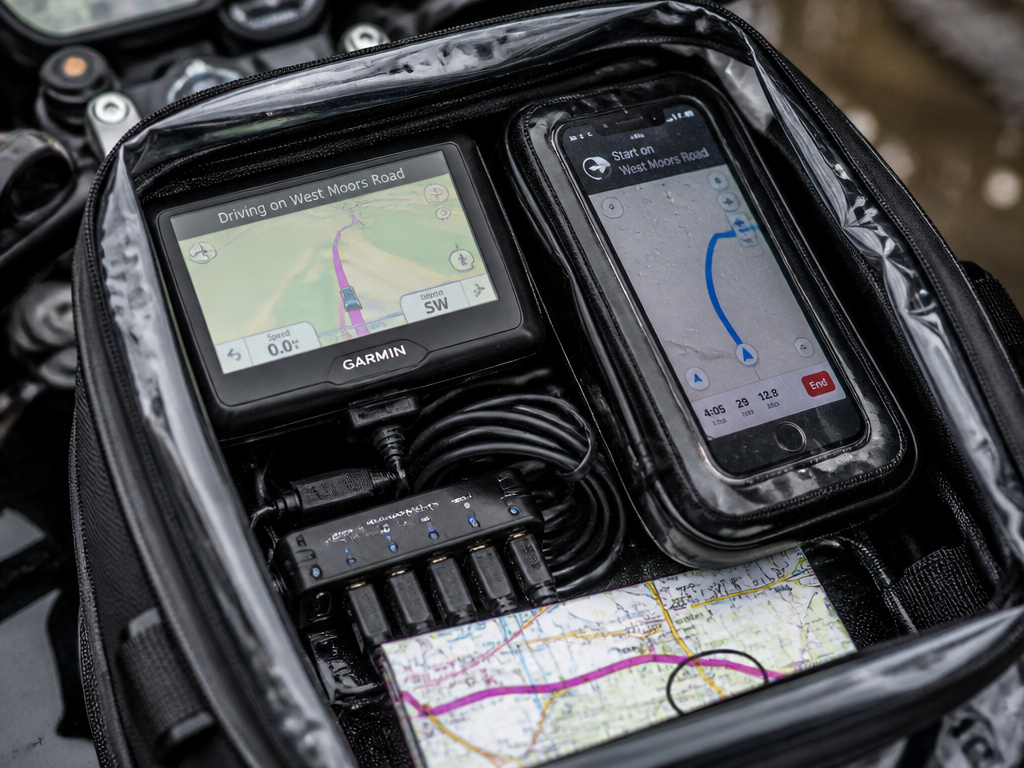
Electronics extend your capability and connect you. They also fail, drain batteries, and attract thieves. Pack them with redundancy.
Navigation & Communication:
- GPS Unit: A dedicated motorcycle GPS unit can be weatherproof and glove-friendly. Use it as your primary.
- Phone & Mount: Your phone is the backup. Use offline maps (Google Maps, Gaia GPS). A waterproof mount and a USB port are essential.
- Bluetooth Communicator: Useful for rider-passenger or group communication. For solo riders, it’s often an overrated source of wind noise and distraction.
- Earplugs: Required. High-fidelity plugs reduce fatigue and protect hearing.
Power & Storage:
- USB Power Hub: A multi-port hub that plugs into your bike’s accessory port.
- Cables: Charging cables for every device, plus a portable battery bank.
- Waterproof Storage: Small dry bags or zip-locks for your phone, wallet, and documents.
Paper Backups (The Underrated Lifesaver):
Print your route, key reservations, and emergency contacts. A simple paper map works when everything else is dead. This is the minimalist philosophy that actually matters.
When considering luggage options, ensure your electronics are in a waterproof compartment or dry bag. Water damage is a common, preventable end to a trip.
Personal Items, Hygiene, and Health
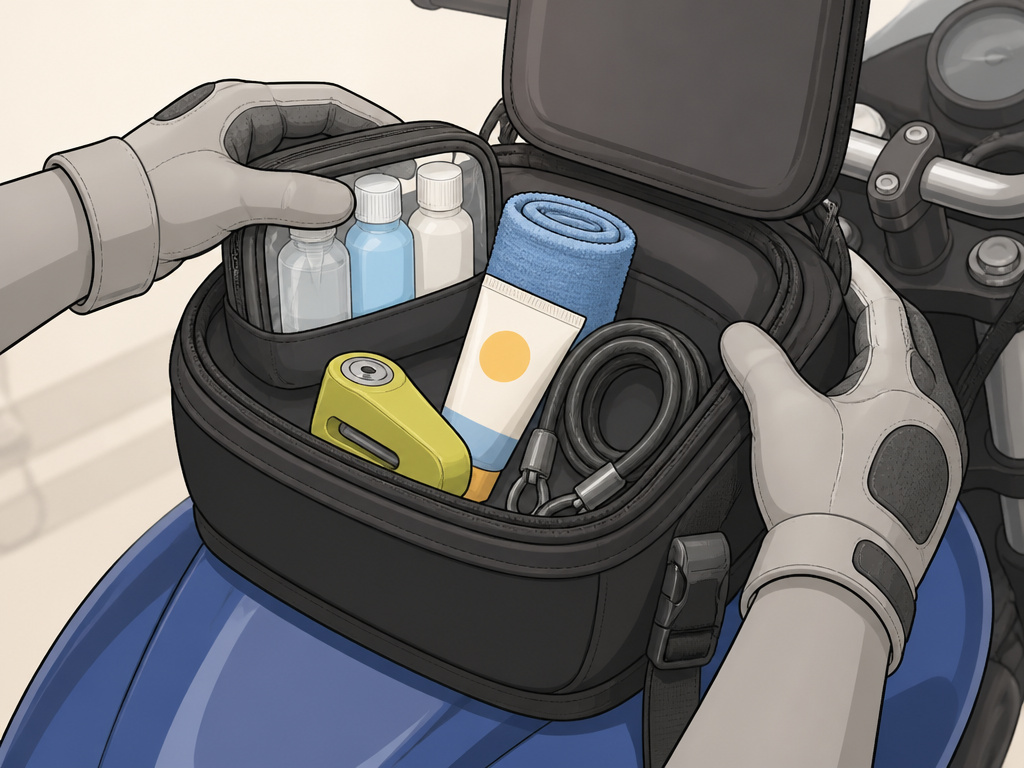
This category is deeply personal but follows the same weight rules. Travel-sized is your friend.
Hygiene Kit:
- Toiletry Bag: Use refillable silicone bottles for shampoo, soap, etc.
- Microfiber Towel: Quick-dry and compact.
- Sunscreen & Lip Balm: High SPF. Reapply often.
- Insect Repellent: The picaridin or DEET-based kind that actually works.
- Hand Sanitizer & Wet Wipes: For fuel stops and quick clean-ups.
- Medications: A full supply of any prescriptions, plus basics like ibuprofen, antihistamine, and anti-diarrheal.
Gender-Specific Considerations:
Beyond clothing sizes, think about accessibility. Some riding jackets and pants are easier to manage during bathroom breaks. Pack a Shewee or similar device if it increases comfort and convenience during long stretches in full gear. This is a practical gap most generic lists miss.
Security:
- Disc Lock with Alarm: A visible deterrent for quick stops.
- Covered Cable Lock: To secure helmets, jackets, or luggage to the bike.
- GPS Tracker: A hidden GPS tracker can help recover a stolen bike.
Your health on the road is paramount. Staying hydrated, protected from the sun, and clean prevents small issues from becoming trip-enders. Pack these items in an accessible outer pocket of your motorcycle packs.
Packing It All: Weight, Balance, and the 80 MPH Rule
This is where the factory limits meet your pile of gear. It’s a balance of physics and strategy.
Know Your Bike’s Hard Limits:
The numbers in the FACT SHEET are model-specific.
- Harley-Davidson Luggage Rack: Maximum luggage rack weight capacity is 10 lbs (4.5 Kg).
- Harley-Davidson Combined Load: Combined load of top rack and Tour-Pak must not exceed 25 lbs (11.3 Kg). This is a critical edge case. You cannot load the Tour-Pak to its max if you’re also using the rack.
- Ducati Multistrada V4 Pikes Peak: The maximum weight permitted for the side panniers, top case and the tank bag must never exceed 66 lb (30 kg), divided as follows 22 lb (10 kg) max. Per side pannier; 11 lb (5 kg) max. For the top case; 11 lb (5 kg) max. For the tank bag.
- Honda Gold Wing F6B: maximum cargo weight: = 51 lb (23 kg) includes following maximum compartment weights: each saddlebag = 20.0 lb (9.0 kg) fairing pocket = 4.5 lb (2.0 kg) shelter case = 6.6 lb (3.0 kg).
Where this goes sideways: Loading a top case or rack with a tall, soft duffel. The Harley-Davidson manual warns: “An item with a large surface area, such as a duffel bag, that is installed on the top rack can adversely affect vehicle handling.” It acts like a sail, catching crosswinds and making the bike feel vague at speed.
The Packing Order:
- Heavy, dense items low and centered: Tools, tire kit, chain lube. Place them in the bottom of saddlebags or panniers, close to the bike’s centerline.
- Medium weight forward: Clothing bags, hygiene kit. In saddlebags, keep weight toward the front.
- Light, bulky items on top: Sleeping bag, rain gear, extra layers.
- Frequently needed items last-in, first-out: Rain suit, snacks, water, sunscreen. In a tank bag or tail bag.
The Speed Limit You Didn’t Expect:
The Honda Gold Wing manual states a firm, sourced-number rule that applies to any loaded bike: “should ride at reduced speeds and never exceed 80 mph (130 km/h) when carrying cargo.”
This is about physics. A loaded bike has longer stopping distances, different suspension response, and altered aerodynamics. That 80 mph cap is a concrete reminder that touring is about the journey, not the top speed. Integrating this mindset with a solid trip planning process is what separates a stressful ride from a great one.
The Pre-Ride Integration: T-CLOCS and Your Packed Bike
Your packing is complete. Now, perform the T-CLOCS inspection with the bike fully loaded. This is the final gap most lists miss.
- T – Tires & Wheels: Check pressure cold, with the weight on them. Look for cuts or embedded debris. The loaded weight will change the contact patch.
- C – Controls: Verify levers, cables, and throttle move freely. Ensure no cargo straps are near the handlebars or footpegs.
- L – Lights & Electrics: Test all lights, signals, and brake lights. Check that luggage isn’t blocking any reflectors or lights (a specific Harley-Davidson warning).
- O – Oil & Fluids: Check levels. Look for new leaks that might have appeared.
- C – Chassis & Stand: Inspect the frame, suspension, and stands. With the bike upright, push down on the suspension. Does it feel drastically stiffer? That’s the weight.
- S – Sidestand & Final Drive: Ensure the sidestand is secure on a loaded bike (it will lean more). Check the chain or belt tension and final drive fluid.
This loaded inspection often reveals a pinched cable or a strap routing issue you’d miss with an empty bike. It’s the last step before you commit to the road.
Food and Water / Snacks
Treat food and water as cargo that must be secured and balanced within your motorcycle’s weight limits. Check your owner’s manual for specific compartment capacities, as these vary by model. For example, some motorcycles have strict individual limits for tank bags and top cases. Distribute weight evenly, placing heavier items low and centered. Use secure, non-shifting containers to avoid handling issues. Pack items that serve dual purposes, like energy bars for riding snacks and emergency meals. Always verify that your load does not obstruct lights or reflectors and recheck its security periodically during your trip.
Frequently Asked Questions
What is the most common packing mistake?
Overpacking clothing and underpacking tools. People pack for every hypothetical social occasion but forget the wrench that fits their axle. Be ruthless with clothes and thorough with repair items.
How do I pack for changing weather on a motorcycle tour?
You pack layers, not separate outfits. A moisture-wicking base layer, a insulating mid-layer (fleece/puffy), and a waterproof outer shell cover every condition from cold rain to hot sun. Never leave the rain gear behind because the forecast is clear.
Is a tank bag or tail bag better for touring?
Tank bag is superior for accessibility (maps, phone, snacks) and keeps weight low and centered. A tail bag can hold more but places weight further back, which can lighten the front end. For most tours, a magnetic or strap-mounted tank bag is the most useful single addition to your luggage types.
Should I pack camping gear for a motorcycle tour?
Only if you plan to camp. Quality motorcycle camping gear is compact, but a tent, sleeping bag, pad, and stove still consume 20-30 liters of space and 10-15 pounds of weight. For a hotel-based tour, that’s wasted capacity. Be honest about your itinerary.
How can I reduce the weight of my packing list?
Weigh every item category. You’ll often find your “light” clothing bag is 15 pounds and your tool kit is 5. Switch to lighter, quick-dry fabrics and scrutinize every tool. Do you need a full 3/8″ socket set, or will a multi-tool and two specific wrenches cover 95% of issues? The savings are in the details.
Before You Go
A perfect packing list is useless if your daily plan is unsustainable. The real secret isn’t what’s in your bags; it’s what’s in your schedule. Cap your days at a distance that leaves you energy to set up camp, find a meal, and actually see something besides the dashed line.
Test your full load on a local overnight trip. You’ll discover the jacket liner you should have brought, the tool you’re missing, and how the bike truly handles with the weight. That shakedown run is the final, most important item on any list.
Now check your tire pressure, look up your GVWR one more time, and go. The road is better than the planning.
