
Front vs Rear Brake on a Motorcycle: Which to Use When
This post contains affiliate links. As an Amazon Associate, we earn from qualifying purchases.
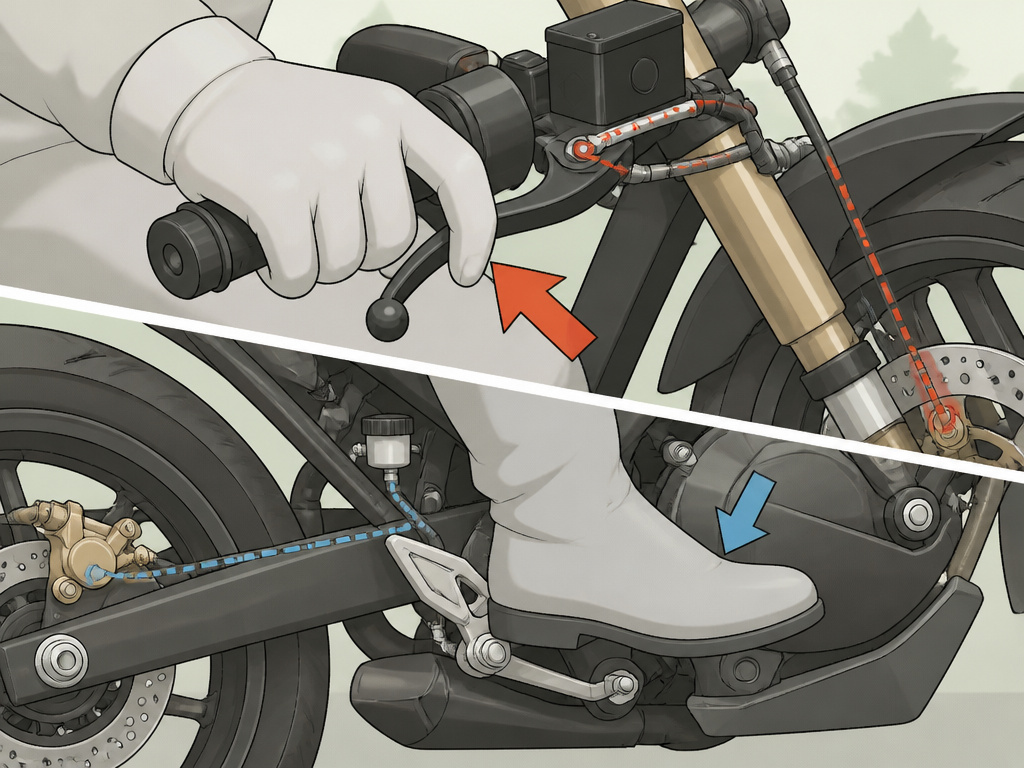
In the front vs rear brake choice on a motorcycle, the front brake provides 70% or more of the total stopping power in a straight line, while the rear brake is essential for low-speed stability and off-road control. For maximum stopping power, use both brakes together, applying the front brake progressively and the rear brake firmly but not to the point of lock-up.
The 70% figure from the California Motorcyclist Safety Program isn’t a suggestion, it’s physics. Weight shifts forward under deceleration, loading the front tire with more grip. That’s the mechanism that makes the front brake your primary tool for stopping. A key principle is the front vs rear brake on a motorcycle. The rear brake’s job is different: it manages that weight transfer, steers the back end in dirt, and keeps the bike upright when you’re barely moving.
What follows is a breakdown of when each brake works, the drills that build the muscle memory, and the manufacturer recalls that prove where these systems actually fail. By the end, you’ll know exactly which lever to pull in rain, on gravel, or when a car pulls out.
Key Takeaways
- The front brake alone provides 70% or more of total stopping power due to weight transfer, a fact quantified by the California Motorcyclist Safety Program.
- Use the rear brake dominantly for low-speed control and off-road riding, where it slides the tire and modulates traction, per BMW’s Offroad Skills academy.
- In an emergency without ABS, techniques vary: the UK’s Motorcycle Roadcraft manual prioritizes front-brake use even if the rear locks, while the Motorcycle Safety Foundation teaches using both brakes fully without locking either wheel.
The 70/30 Rule and Why It’s a Physics Problem
The front vs rear brake on a motorcycle provides up to 70% or more of a motorcycle’s stopping power. That number comes straight from the California Motorcyclist Safety Program handbook. It’s not a marketing claim. It’s the predictable outcome of weight transfer.
When you brake, the bike’s mass wants to keep moving forward. This force presses the front tire into the pavement, increasing its traction. The rear tire, meanwhile, gets lighter. That’s why you can’t just stomp on the rear brake and expect to stop quickly when you compare a front vs rear brake on a motorcycle, there’s not enough weight on it to generate strong grip.
A motorcycle’s maximum deceleration is achieved using both brakes, with the rear providing a stabilizing contribution and additional stopping force, according to the University of Michigan Transportation Research Institute’s foundational Hurt Report. The front does the heavy lifting; the rear keeps the chassis settled.
This dynamic explains component sizing. Look at a 2023 Honda CBR600RR: dual 310mm front discs with four-piston calipers, versus a single 220mm disc at the rear on a CRF300L. The engineering matches the job. The SAE J1082 standard defines how these systems are tested, but the performance split is baked into the design.
Common mistake: Avoiding the front brake at low speeds for fear of tipping over. This teaches bad muscle memory. The front brake works at all speeds; you just need to apply it smoothly.
When the Rear Brake Is Actually in Charge
Forget the highway. At very low speeds, the rear brake is your primary tool for control. The California Motorcyclist Safety Program curriculum teaches its use for low-speed maneuvering and control because it stabilizes the bike. It prevents the front end from diving and the bars from twitching.
Off-road, the rule flips entirely. The BMW Motorrad Offroad Skills academy teaches dominant rear brake use for sliding the rear wheel to initiate turns, controlling descents on hills, and modulating traction on loose surfaces. On dirt, locking the rear brake is often the goal. Locking the front is a guaranteed crash.
This is also where owners of big touring bikes get frustrated. Manufacturers like Honda and Harley-Davidson design linked braking systems where the rear pedal activates some front brake. Forums are full of experienced riders who hate this, arguing it ruins their ability to independently modulate the rear for slow-speed control, especially with a passenger. They want a discrete system.
Emergency Braking: The One Drill That Saves Rides
The theory is simple: both brakes, progressive squeeze. The reality under panic is different. Your wrist position matters. MCrider notes it directly affects stopping distance. If your wrist is cocked down, you can’t pull the lever quickly or smoothly.
Here is a structured, repeatable drill. Find an empty lot.
- Mark a start line and a braking point. Ride at a steady 25 mph.
- At the braking point, simultaneously squeeze the front lever and press the rear pedal. Focus on a progressive front squeeze, not a grab. The goal is to stop as short as possible without locking a wheel or triggering ABS.
- As you come to a near-stop, ease off the front brake and finish the stop with the rear. MCrider advocates this, and it works. It keeps the bike balanced and upright.
- Repeat. Then gradually increase your practice speed. Your brain needs to learn this sequence under stress.
The MSF teaches using both brakes fully without locking either wheel. The UK’s Motorcycle Roadcraft police manual adds a crucial nuance: in a true emergency, a locked rear wheel (which can often be managed) is preferable to under-using the front brake. That’s the priority.
| Situation | Front Brake Use | Rear Brake Use | Why It Works |
|---|---|---|---|
| Straight-line emergency stop | Progressive, firm squeeze to the point of ABS or near-lock | Firm, steady pressure | Maximizes weight transfer and uses all available traction |
| Stopping in a curve (street) | Very light, trailing pressure only if trained | Avoid | Reduces risk of overloading front tire and losing grip |
| Slow-speed U-turn | Light, with clutch friction zone | Primary speed modulator | Prevents front-end dive, maintains stability |
| Gravel or loose surface | Very gentle, avoid sudden application | Primary, can be used to slide rear | Prevents front wheel wash-out, allows controlled skid |
| Steep downhill descent | Light, to control speed | Primary, to hold bike back | Prevents front tire from overloading and losing traction |
Where the Experts Disagree (And Why It Matters)
You won’t find a universal rulebook. Accredited schools teach different techniques for the same problem.
The difference is philosophy: one prioritizes safety through simplification, the other performance through skill.
Try both in a lot. The right answer is the one that gives you consistent, confident control.
If your bike has one, know that your rear pedal might be activating a front caliper.
The Gripes and the Recalls: What Actually Breaks
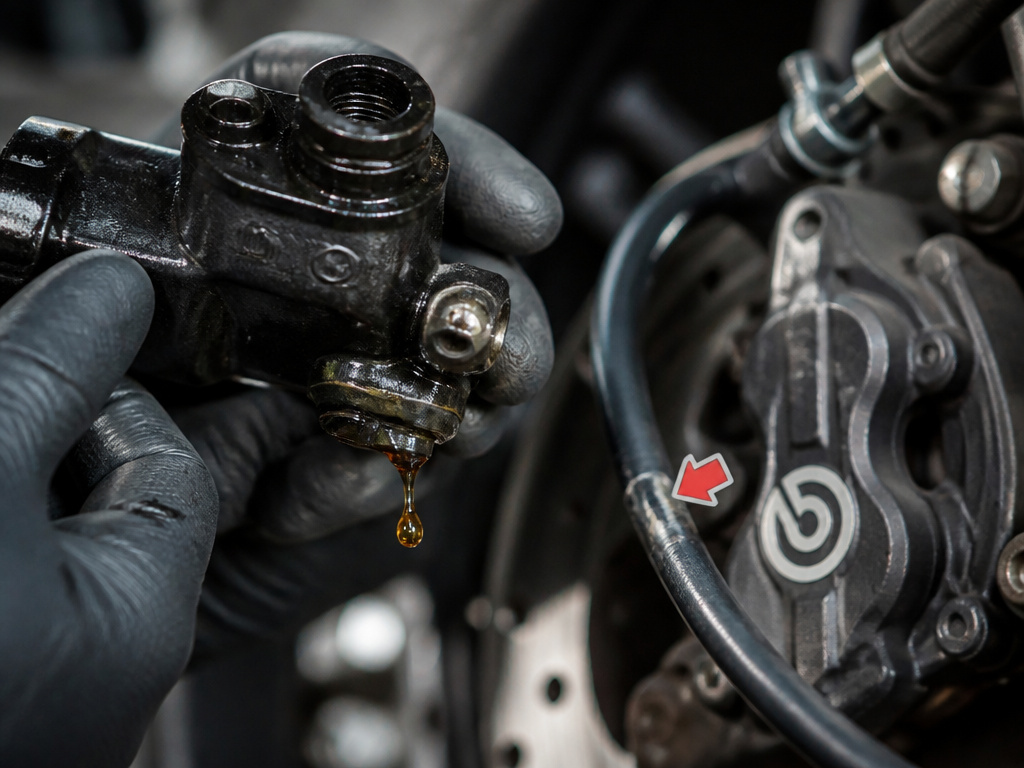
Theories are clean. Real-world failures are messy. The National Highway Traffic Safety Administration’s recall database shows where components fail.
Kawasaki recalled 2023 Ninja ZX-6Rs for a faulty front brake master cylinder seal that could leak fluid. Harley-Davidson recalled 2022-2023 models for a misrouted front brake line that could rub on the tire. At the rear, BMW recalled R 1250 RTs for a brake hose that could chafe on the shock absorber, and KTM recalled bikes for a mispositioned reservoir hose clamp.
These aren’t abstract warnings. A leaking master cylinder leads to a spongy lever and faded power. A fraying line leads to sudden, total failure. The recalls tell you what to listen and feel for: a soft lever, fluid on the garage floor, a chirping sound from the front wheel.
Where this goes sideways: Ignoring a spongy brake lever because the bike still stops. Air in the line or a slow leak from a failing seal reduces power and consistency. You might not notice until you need every percent of that 70% front-brake power.
Setting Up Your Controls for Success
You can’t brake well if the controls fight you. The rear brake pedal is the most common culprit. If you have to lift your heel off the peg to press it, you’re sacrificing stability and fine control.
Adjust it so the pedal sits just below the plane of your foot when it’s flat on the peg. You should be able to roll your ankle down to apply pressure without your foot shifting. This adjustment is detailed in your bike’s owner’s manual.
For the front, lever position is everything. Adjust the lever so your wrist is in a neutral, straight line with your forearm when you’re in your normal riding position. A cocked wrist fatigues you and slows your reaction.
How to avoid locking your front or rear wheel
Techniques vary: the MSF teaches stopping just short of locking either wheel, while the UK’s Motorcycle Roadcraft manual notes a locked rear wheel can be managed and prioritizes front-brake use. If the rear locks, keep the bike upright and hold the front brake; releasing the rear brake abruptly can cause a high-side. If the front locks, immediately release the lever to regain steering, then reapply smoothly. Practice in a safe area to learn the feel of your brakes’ limits. Your wrist position on the bar directly affects your control during a quick stop.
How cruiser and sportbike designs change brake use
The basic principle stays the same: the front brake provides most of the stopping power. But your bike’s geometry changes the feel. A sportbike’s aggressive stance puts more weight on the front, making that brake even more potent and responsive. A cruiser’s longer wheelbase and different weight distribution can make the rear brake feel more substantial for low-speed control and stability. Off-road, the rear brake becomes the dominant tool for sliding the rear wheel to turn and for controlling descents. Regardless of type, use both brakes for maximum deceleration, with the rear adding a stabilizing force.
What anti-lock brakes (ABS) actually do for you
ABS prevents wheel lockup during hard braking, especially on slippery surfaces. It’s a safety net that allows you to apply strong brake pressure without the high risk of a front-wheel lock and crash. On touring bikes with linked systems, applying the rear brake can also activate the front, which some experienced riders feel reduces their independent control for low-speed maneuvers. ABS is a powerful aid, but understanding its character on your specific bike is key.
Frequently Asked Questions
Is it better to use front or back brakes on a motorcycle?
For stopping in the shortest distance, use both. The front brake provides most of the power (70%+), but the rear brake adds crucial stability and extra stopping force. They are designed to work together.
Should I use front brake or rear brake on my motorcycle at low speeds?
At very low speeds (under 10 mph), such as in a parking lot or making a U-turn, the rear brake is your primary tool for speed control. It prevents the front end from diving and keeps the bike stable. Some advanced riders use light front brake with the clutch, but the rear is the default for good reason.
What is the 70/30 brake rule for motorcycles?
The “70/30 rule” refers to the approximate split of stopping power between the front (70%) and rear (30%) brakes during hard deceleration on dry pavement. It’s a guideline from rider training programs like the CMSP that illustrates weight transfer, not a strict formula to follow for every application.
Do you use your front and back motorcycle brakes at the same time?
Yes, for normal and emergency stopping, you should apply both brakes simultaneously. The key is how: squeeze the front lever progressively and press the rear pedal firmly. This technique uses the full braking potential of the motorcycle.
Can I use the rear brake in a curve?
On the street, it’s generally advised to avoid braking in a curve, especially with the rear. Trail-braking (light front brake while leaned) is an advanced technique. In a true emergency mid-corner, experts are split. The safest street tactic is to try to straighten the bike upright as much as possible before braking hard.
The Bottom Line
The front brake stops you. The rear brake controls you. Mastery isn’t about picking one; it’s about knowing which one is the lead actor in the scene you’re in.
If you take one action from this, make it the emergency braking drill. Do it until the simultaneous squeeze-and-press is automatic. That reflex is what stands between a close call and an insurance claim.
All the advanced debate about trail braking and linked systems is secondary. Get the fundamentals so deep that you don’t think about them. Your brakes are the most important safety feature on your bike, more than any helmet or jacket. Trust the physics, set up your controls, and practice the stop. Everything else is commentary.
