
Is It Legal to Wear Earbuds While Riding a Motorcycle?
This post contains affiliate links. As an Amazon Associate, we earn from qualifying purchases.
Whether it’s legal to wear earbuds while riding a motorcycle depends entirely on your state. About 30 US states have no specific law, but even there, you can still get a ticket for distracted driving. States like Florida ban all listening devices outright, while others like California only allow a single earbud. The safest, most universally legal option is to use hearing protection, not earbuds, or switch to a bone-conduction headset.
The confusion starts because the law often treats a noise-blocking earplug and a music-playing earbud differently, even though they look identical from the outside. A cop can’t see the difference, but the statute book cares. This isn’t just about a ticket. If you’re in a crash, using illegal earbuds can shift liability onto you, regardless of who ran the red light. A key question for many riders is: is it legal to wear earbuds while riding a motorcycle?
What follows is the breakdown no manual gives you: the actual state laws, the two states that directly disagree on earplugs, the insurance trap, and the gear that keeps you legal and actually protects your hearing.
Key Takeaways
- The law in about 30 states has no explicit rule against earbuds, but a distracted-driving citation is still possible.
- Florida and Rhode Island have the strictest laws, prohibiting nearly all listening devices with very narrow exceptions.
- Earplugs and earbuds are legally distinct; Washington explicitly allows in-ear hearing protection but bans in-ear speakers, while Florida’s ban could cover both.
- Using illegal earbuds can be used against you in an insurance claim or liability case, even if the crash wasn’t your fault.
- For universal compliance and real hearing safety, use high-fidelity earplugs or a bone-conduction headset.
The State-by-State Legal Patchwork (It’s a Mess)
There is no federal law. The National Highway Traffic Safety Administration (NHTSA) focuses on motor vehicles, leaving the rules to a patchwork of state vehicle codes. This creates three broad legal categories you need to know.
First, the silent majority. Analysis from Bike-size.com indicates about 30 US states have no statewide headphone rule for cyclists, so the is it legal to wear earbuds while riding a motorcycle answer there is not straightforward. This includes large states like Texas, Ohio, and Pennsylvania. In these states, wearing earbuds is not, by itself, a automatic traffic violation. That doesn’t make it safe, and it doesn’t make you immune to a ticket. An officer can still cite you under a general distracted or careless operation statute if they believe your ability to hear traffic was impaired.
Where this goes sideways: Assuming “no law” means “no risk.” In a no-rule state, a crash while wearing earbuds gives an insurance adjuster an easy argument for comparative negligence, potentially reducing your injury settlement.
Second, the “one ear only” states. This is a common rule. According to a Bike-size.com analysis, California, New York, Maryland, Virginia, Illinois, and Massachusetts all prohibit headphones or earplugs in both ears while operating a bicycle, which implicitly allows one-ear use. Florida’s law, by contrast, has a general prohibition with a specific exception for a one-ear cellular headset that allows surrounding sounds to be heard with the other ear. The law is structured as a prohibition on covering or inserting devices in both ears, which implicitly allows use in one ear. This is why you see riders with a single Apple AirPod.
Third, the prohibition states. Florida and Rhode Island are the strictest. Florida Statute § 316.304 states: “No person shall operate a vehicle while wearing a headset, headphone, or other listening device, other than a hearing aid.” The exceptions are narrow: hearing aids, a specific allowance for motorcycle helmet-installed systems, and for applicants taking a license examination.
| State Category | Key Rule | Example States | Practical Risk |
|---|---|---|---|
| No Explicit Law | No statute addresses headphones. | Texas, Pennsylvania, Ohio | Distracted driving ticket; liability shift in a crash. |
| “One Ear Only” | Devices prohibited in both ears. | California, New York, Virginia | Ticket for using two earbuds; one is technically legal. |
| Prohibited | All listening devices banned (exceptions apply). | Florida, Rhode Island | Ticket for any earbud use, even in one ear. |
Why the Law Exists: Hearing vs. Safety
Laws against earbuds aren’t about banning music. They’re a clumsy legislative attempt to preserve a rider’s situational awareness. Your ears are a critical safety sensor on a motorcycle. You hear the engine pitch of a car accelerating in your blind spot, the squeal of tires behind you, and the siren of an emergency vehicle long before you see it.
A peer-reviewed study in the Journal of Injury and Violence Research underscores this. A peer-reviewed study in the Journal of Injury and Violence Research found participants perceived the importance of hearing traffic sounds in all directions as high. A peer-reviewed study in the Journal of Injury and Violence Research notes that most motorcycle helmets impair the wearer’s ability to hear, creating a safety gap most riders don’t consider.
The Washington State Motorcycle Operator manual puts it plainly: “Long term exposure to wind and road noise can cause permanent hearing damage,” a key factor in the is it legal to wear earbuds while riding a motorcycle debate. Then it delivers the legal nuance most riders miss: “The use of in-ear hearing protection (ear plugs) is legal in Washington, but in-ear speakers (ear buds) are not.” This is the core conflict. The law is trying to separate the function: hearing protection versus audio entertainment. From the curb, an Alpine MotoSafe earplug and a generic earbud look identical.
Where the Laws Directly Conflict
This isn’t just a difference of opinion. Two state authorities directly disagree on a fundamental point, creating a legal trap for riders who travel.
Florida vs. Washington on Earplugs. Florida’s statute bans any “listening device” other than a hearing aid. It does not name an exception for non-electronic, noise-reducing earplugs. Washington’s manual explicitly states such earplugs are legal. So, a rider using certified hearing protection like Etymotic ETY-Plugs is explicitly legal in Washington, but could be argued to violate the letter of Florida’s law, which bans any ‘listening device’ other than a hearing aid with no explicit exception for non-electronic ear plugs. Enforcement may focus on visible wires or obvious distraction, but the legal texts are at odds.
The Helmet System Exception. This is where motorcycle law gets specific. Florida’s statute has a carve-out that many riders miss: “Any person operating a motorcycle who is using a headset that is installed in a helmet and worn so as to prevent the speakers from making direct contact with the user’s ears.” This is why systems from Cardo or Sena, with speakers that sit in the helmet liner near your ears, are legally distinct from earbuds that sit in your ear canal. This exception exists for a headset that is installed in a helmet and worn so as to prevent the speakers from making direct contact with the user’s ears.
Common mistake: Using the helmet-system exception to justify standard earbuds. The law specifies the speakers cannot make “direct contact” with the ears. An earbud, by design, makes direct contact. This distinction mattered in the 1981 Pennsylvania case Commonwealth v. Patchett, where a rider’s helmet-installed headphones led to a upheld conviction.
The Insurance and Liability Trap You Never Hear About
A ticket might cost you $150. The real financial risk is in a crash, even one where you’re not at fault.
If you are involved in an accident while violating a state vehicle law—like wearing illegal earbuds in Florida—that violation can be used to establish negligence. The other driver’s insurance company will argue your impaired hearing contributed to the crash. This is the doctrine of “comparative” or “contributory” negligence. In many states, if you are found partially at fault, your total damage recovery can be reduced by that percentage. In a severe injury case, that 20% could represent tens of thousands of dollars.
Furthermore, your own insurance policy has a “duty to cooperate” clause. Knowingly breaking the law could be construed as violating that duty, giving them grounds to deny or limit your coverage. It’s a argument you don’t want to have from a hospital bed.
Legal Alternatives That Actually Work
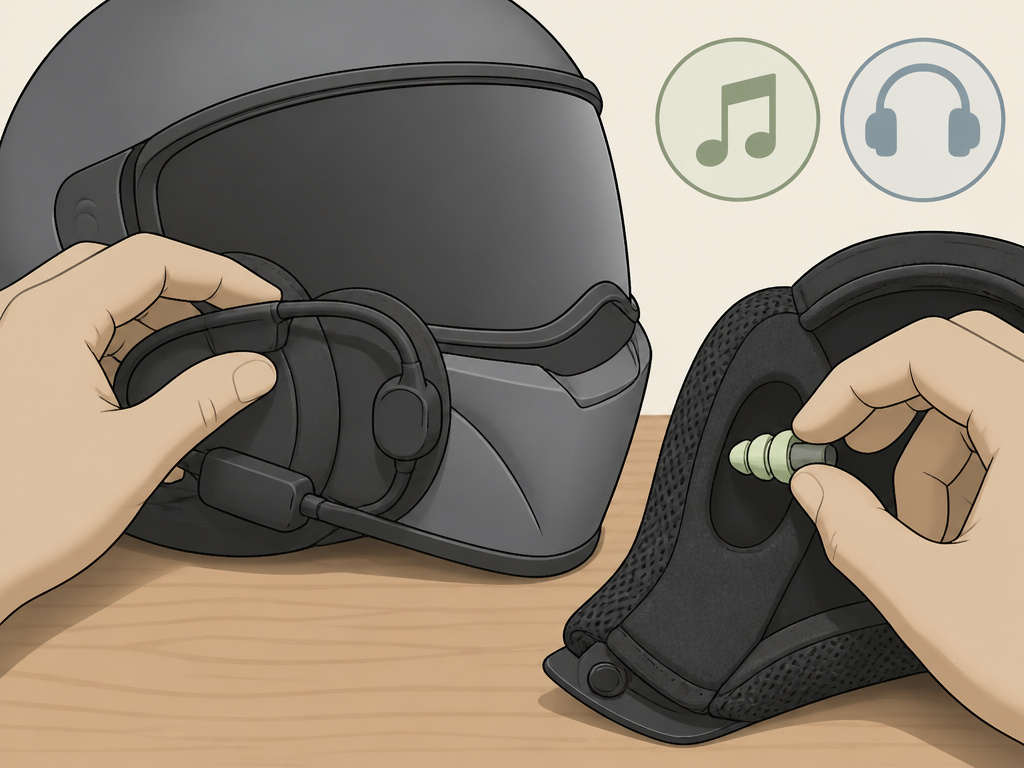
Your goal is to protect your hearing and stay legal. Luckily, you have better options than standard earbuds.
- High-Fidelity Earplugs. This is the simplest swap. Products like the Alpine MotoSafe or Etymotic ETY-Plugs are designed as hearing protection. They attenuate harmful wind and engine noise while allowing speech and traffic sounds to pass through. They have no electronics, so they fall under “hearing protection” in states like Washington. They are the single best thing you can do for your long-term hearing on a bike.
- Bone-Conduction Headsets. Devices from Shokz or others sit in front of your ears, resting on your cheekbones. They transmit sound through vibration, leaving your ear canals completely open. Because they do not “cover or in” the ear, they generally sit outside the definition of “headphone” in state laws. They are the most defensible legal choice for listening to music or navigation.
- Helmet Communication Systems. As noted, these are often explicitly legal under motorcycle exceptions. A helmet communication system with speakers installed in the helmet liner provides audio without ear insertion. The audio quality is decent, and they allow for rider communication, which can be a safety plus for group rides.
| Alternative | How It Works | Legal Standing | Best For |
|---|---|---|---|
| High-Fidelity Earplugs | Passive filters that reduce noise volume. | Treated as hearing protection, not a “listening device.” | Riders focused solely on hearing protection and legality. |
| Bone-Conduction Headset | Speakers vibrate cheekbones, bypassing eardrums. | Outside “in-ear” definitions; most universally legal audio option. | Riders who want music/navigation with full environmental awareness. |
| Helmet Comm System | Speakers mounted in helmet liner near ears. | Often covered by motorcycle-specific exceptions in state law. | Riders who want music, intercom, and phone capabilities. |
How to Make the Smart, Legal Choice
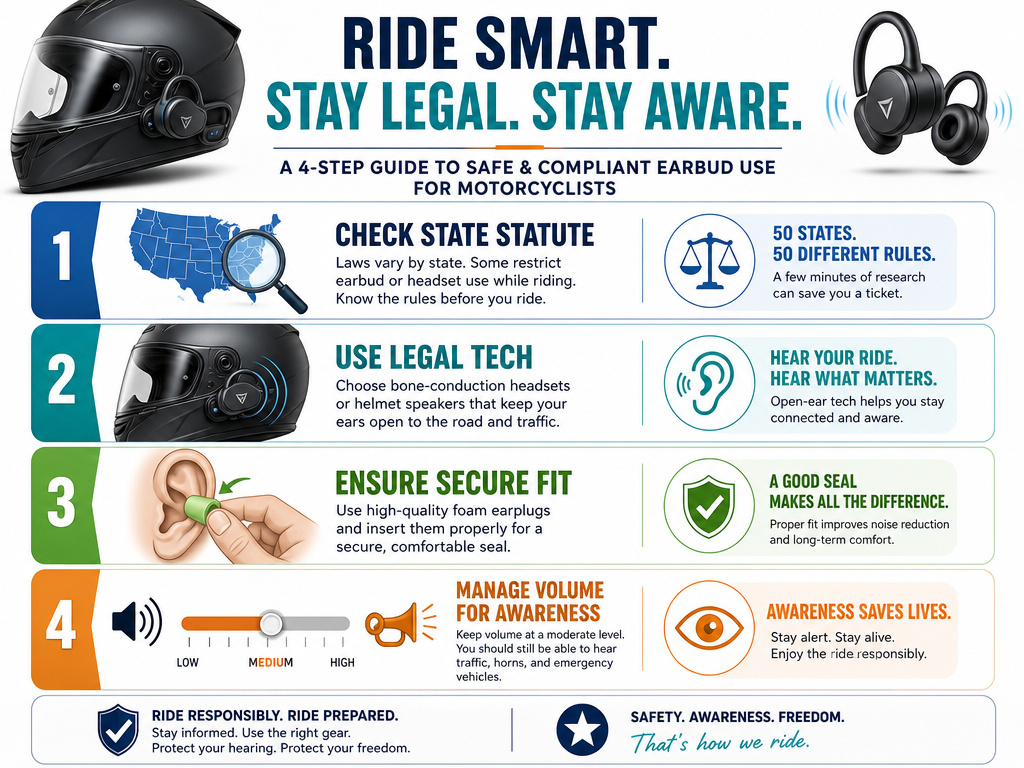
First, check your state’s actual statute. Don’t rely on forum posts from 2012. Look up “[Your State] vehicle code headphone” or consult your state’s motorcycle operator handbook. For example, the Washington State Motorcycle Operator Manual provides clear, official guidance.
If you ride in multiple states, plan for the strictest rule. Assume Florida’s prohibition applies. This makes bone-conduction headsets or simple earplugs your safest legal bet.
Fit is essential. An earplug or earbud that hurts or falls out is a distraction. For earplugs, learn to roll and insert them properly so they expand and seal. For a bone-conduction set, ensure the band doesn’t interfere with your helmet’s fit or retention system. A loose helmet is a far greater danger than any audio choice.
Volume matters more than the device. Even with legal, open-ear bone conduction, blasting music at max volume destroys your situational awareness. The Washington State Motorcycle Operator Manual states good protection “reduces the level of harmful noise, while still allowing you to hear important sounds such as horns and sirens.” Set your volume so you can still clearly hear your own engine and traffic around you. If you can’t hear the car changing lanes next to you, your volume is too high.
What experienced riders say about listening to music
Experienced riders often discuss the balance between legality, safety, and hearing protection. The consensus is to prioritize situational awareness. Many riders use legal helmet-installed speaker systems, as they sit outside the ear canal and allow ambient sound to mix with audio. Others use specialized hearing protection designed to reduce harmful wind noise while still letting important sounds like sirens pass through. Riders stress the need to check your specific state’s vehicle code, as laws vary widely. The key advice is to avoid anything that isolates you from your surroundings, as hearing traffic from all directions is critical for motorcycle safety.
Frequently Asked Questions
Can you ride a motorcycle with earbuds in?
You can, but it may be illegal depending on your state. In “one ear only” states like California, you can legally use one earbud. In prohibition states like Florida, you cannot use any earbud. Even in states with no law, it’s a safety risk that can affect liability in a crash.
Is it illegal to ride a motorcycle with AirPods in?
Yes, if it’s illegal to ride with earbuds in your state, then it’s illegal to ride with AirPods. The law doesn’t distinguish by brand. AirPods are considered a “listening device” or “earphone” under statutes like Florida Statute § 316.304.
What states ban headphones while riding a bike?
Florida and Rhode Island have the strictest bans, prohibiting nearly all headphones and earbuds. Many other states, including California and New York, ban them only if they are in or covering both ears. About 30 states have no specific ban.
What is the 12 second rule on a motorcycle?
The 12-second rule is a visual scanning technique, not an audio rule. It advises scanning the road ahead 12 seconds into your path to identify potential hazards early. It highlights why visual awareness is primary, but auditory cues remain critical for threats outside your immediate line of sight.
Before You Go
The law is a blunt instrument for a nuanced problem. It tries to legislate awareness but gets tangled on the difference between a protective earplug and an entertaining earbud. Your best path is to sidestep the legal grey area entirely.
Invest in a set of high-fidelity earplugs. They are unequivocally for hearing protection, they work in all 50 states, and they are the single most effective thing you can buy to prevent permanent, noise-induced hearing loss from wind roar. If you must have audio, get a bone-conduction headset. It keeps your ears open, satisfies the strictest state laws, and preserves the auditory cues that keep you safe.
Protect your hearing first. The music is optional. The ability to hear a siren or an engine in your blind spot is not.
