
How to Choose Motorcycle Riding Glasses: Step-by-Step
This post contains affiliate links. As an Amazon Associate, we earn from qualifying purchases.
To choose motorcycle riding glasses, match four specs: an impact rating (ANSI Z87.1+ or ASTM F2812), optical clarity (prism tolerance under 0.25Δ), a fit that seals under your helmet without pressure points, and a lens tint that matches your primary riding light conditions. Skipping any one compromises safety, vision, or comfort within the first hour.
That last spec—matching tint to light—is where most buying guides stop. They tell you “clear for night, dark for day.” The real decision is about the light you’re actually in 80% of the time, not the edge cases. A key part of how to choose motorcycle riding glasses is considering your typical conditions. A photochromic lens that never gets dark enough inside a tinted helmet visor is a waste. A dark smoke lens on a cloudy backroad forces you to lift your visor, which defeats the point.
What follows: a breakdown of the four essential specs, why the numbers in the standards actually matter, how to test fit with your helmet on, and where the “versatile” option usually fails in a how to choose motorcycle riding glasses guide.
Key Takeaways
- The ANSI Z87.1+ marking means the lens survived a 6.35mm steel ball at 91.4 m/s; basic impact (Z87) is for lower-speed hazards.
- Optical distortion is measured in prism diopters (Δ); ensure the tolerance is under 0.25Δ for goggles and under 0.50Δ for spectacles per the ANSI standard.
- Fit under your helmet is not optional; pressure on your temples can quickly lead to a headache.
- For day and night riding, a dedicated clear lens for low light and a separate tinted lens for sun beats a compromised “all-in-one” photochromic pair every time.
- Prescription riders need lenses over 2.0 mm thick to meet impact standards; clip-on shields or wearing street glasses underneath certified goggles is the compliant path.
The 4 Non-Negotiable Specs (Decoded)
Most advice lists features. Your eyes need specs—the kind with numbers and test results. A lens isn’t just “impact resistant.” It either stopped a defined projectile at a defined speed or it didn’t. The standards write that test down, which is central to how to choose motorcycle riding glasses.
ASTM F2812-12 and ANSI/ISEA Z87.1-2020 are the two key documents. ASTM F2812 covers eye protectors for off-road use by riders of motorcycles, mopeds, and snowmobiles and explicitly excludes helmet-mounted visors. ANSI Z87.1 is an occupational standard that defines impact levels, optical tolerances, and marking requirements for all protective eyewear.
The first thing your hand should do is flip the temple and check for the engraving. No marking, no trust. It’s that simple.
Impact Rating: Z87 vs. Z87+
The “+” matters. Here’s what the stamps mean, straight from the ANSI/ISEA Z87.1-2020 standard:
| Marking | Test Requirement | Best For |
|---|---|---|
| Z87 (Basic Impact) | Withstands a 6.35 mm steel ball at 45.7 m/s (150 ft/s) | Low-speed debris, general dust protection |
| Z87+ (High Impact) | Withstands a 6.35 mm steel ball at 91.4 m/s (300 ft/s) | Highway speeds, rock chips, high-energy impacts |
| ASTM F2812 | Covers impact/penetration for off-road motorsports; excludes prescription eyewear & helmet visors | Dirt biking, adventure riding, off-road use |
If you ride on the street at speed, Z87+ is the floor. A pebble at 70 mph has a lot more energy than one at 30 mph. The “basic” rating isn’t for that.
Optical Clarity: The Distortion You Can’t See (Until You Do)
This is the spec sheets’ secret. Lenses must meet refractive power and prism tolerance limits so they don’t strain your eyes. Per ANSI Z87.1, the tolerance for prismatic error—which causes double vision and headaches—is stricter for goggles than spectacles.
- Spectacles (Glasses): Prism tolerance <0.50 prism diopters (∆)
- Goggles: Prism tolerance <0.25 prism diopters (∆)
Goggles sit closer to your eyes, so any distortion is magnified. A cheap pair might pass impact but fail here. Your eyes will feel it before your brain names it, usually as fatigue on a long straightaway.
Coverage and Fit: The 40mm x 33mm Rule
The standard also dictates minimum coverage: each lens must protect an area at least 40 mm wide by 33 mm high in front of your pupil. This isn’t about style; it’s about making sure your peripheral vision is covered when you turn your head to check a blind spot.
- Wraparound designs naturally exceed this. Traditional “glasses” shapes might just meet it.
- Test it: Put the glasses on and look to the extreme left and right. If you see the frame edge in your central sightline, the coverage is too small.
Lens Material: Polycarbonate Is Default
This one’s short. All serious riding glasses use polycarbonate lenses. It’s light, inherently UV-blocking, and has the best impact resistance of any optical plastic. If the listing doesn’t say “polycarbonate,” assume it’s an inferior material like acrylic and move on.
Lens Tint and Coatings: Matching Light to Pavement
The common advice is “get a dark tint for day, a clear for night.” That’s true, but it’s incomplete. The real question is what color and density makes the road surface’s texture and hazards pop in your typical conditions.
The Tint Spectrum (And Where Each Works)
- Clear (≥85% Transmittance): Mandatory for night. The ANSI standard requires clear lenses to pass at least 85% of light. The European standard EN 1938:2010 sets a limit of ≥75% luminous transmittance for goggles intended for night driving, while the ANSI Z87.1 standard requires clear lenses to have ≥85% luminous transmittance. For street riding in the US, aim for the higher 85% clarity.
- Yellow/Amber: Best for low light, fog, or overcast days. They increase contrast by blocking blue light, making potholes and lane markings stand out against grey asphalt. They’re terrible for bright sun.
- Vermillion/Rose: A niche choice for off-road, enhancing contrast in dirt and vegetation.
- Dark Smoke/Grey: For bright, glaring sun. They cut overall light evenly without distorting color, which is crucial for reading traffic signals.
Where this goes sideways: Assuming photochromic (transition) lenses work inside a helmet. Most helmet visors have a UV-protective coating that blocks the UV light needed to activate the lens darkening. The lens might not reach its full dark state, leaving you squinting on a bright day. Test them under your closed visor before relying on them.
Coatings That Earn Their Keep
- Anti-Fog: A permanent, internal coating is key. The ANSI test requires treated lenses to remain fog-free for at least 8 seconds. Temporary sprays work until you wipe the lens, then you must reapply.
- Anti-Scratch: A hard coating on the outside. Polycarbonate scratches easily without it.
- Hydrophobic: Causes water to bead and roll off. Critical for riding in rain.
Polarized lenses are a divisive topic. They cut glare from wet roads and chrome, which is great. They can also make it harder to see the subtle matte finish of an oil slick or make LCD dash displays (on your bike or others) disappear. I lean against them for street riding for that reason.
Fit With Your Helmet (And Your Face)
This is the garage moment. You can’t judge fit from a product photo. The glasses must integrate with your helmet and your head, creating a seal without pressure.
The Helmet-On Test
- Don your helmet first, as you would to ride.
- Hold the glasses, and try to slide the temples between your helmet’s cheek pad and your head.
- Listen and feel. You should hear a soft shush of the temple sliding into place, not a scrape or a pop. The frame should rest on your face, not get pinned against your skull by the helmet liner.
- Check the nose bridge. Pressure points here cause numbness fast. The pads should distribute weight evenly.
- Look all around. Up at a traffic light, down at your gauges, left and right over your shoulders. The frame should not contact your brow or cheeks during these movements.
Face Shape Considerations (A General Guide)
- Round Face: Look for rectangular or shield-style frames to add definition.
- Square Face: Round or oval frames can soften strong jawlines.
- Narrow Face: Avoid overly wide frames that extend past your temple.
- Universal Truth: Adjustable nose pads and temple tips are worth every penny. They let you fine-tune the fit to stop slippage.
Common mistake: Choosing glasses that fit your bare face perfectly but fight your helmet. The helmet always wins, and you’ll either ride with the visor up (exposing your eyes) or in pain. The glasses are a subsystem of the helmet.
If you wear a full-face helmet, pay close attention to the process for wearing glasses under a helmet. Some helmets have designated channels in the foam for glasses temples.
Goggles vs. Glasses vs. Visors
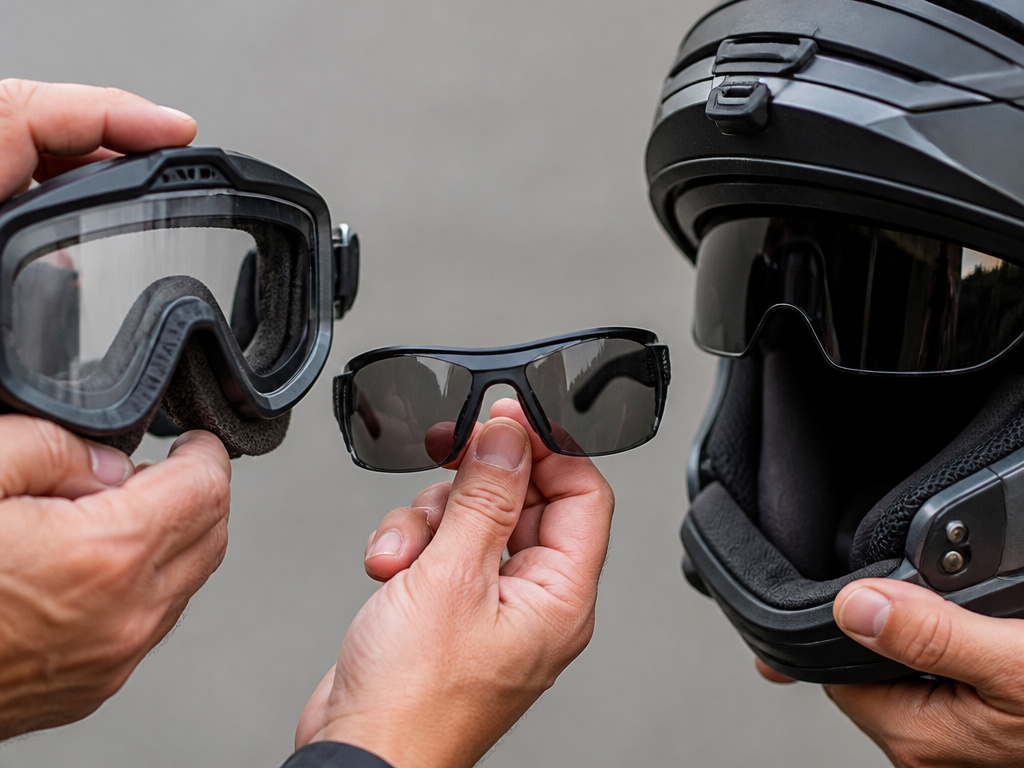
The choice here is about sealing and standard loopholes. Each has a specific job.
Goggles (EN 1938 / ASTM F2812)
Goggles provide a full seal, making them king for off-road, cold weather, or any situation with lots of particulate matter. The European standard, EN 1938:2010, explicitly covers them for both on-road and off-road use. Their foam seal blocks wind completely, which is why they’re warmer.
- Pros: Best seal, no wind drying your eyes, often fits over prescription riding glasses.
- Cons: Can fog more easily, warmer, bulkier to store.
Spectacles / Riding Glasses (ANSI Z87.1)
These are what most people think of. They’re lighter, less bulky, and often more stylish. Their protection relies on a close fit to the face. For a deep dive on specific models, our best motorcycle eyewear guide breaks down the top options.
- Pros: Ventilated (less fog), lightweight, easy to take on/off.
- Cons: Wind can sneak around the edges, drying your eyes on long rides.
Helmet-Mounted Visors (The Loophole)
Here’s the critical bit many miss. The ASTM F2812 standard states it “does not address shield-type eye protectors such as are connected to, integral to, and/or supported by protective helmets.” Your helmet’s built-in drop-down sun visor or a flip-up shield exists in a regulatory gray area. It’s tested as part of the helmet shell for penetration, but not necessarily to the same continuous coverage and impact standards as standalone eyewear. Relying solely on a tinted helmet visor without a primary clear shield is a risk.
For a detailed comparison of the form factors, see our guide comparing motorcycle goggles and sunglasses.
Prescription Solutions: The Thickness Rule
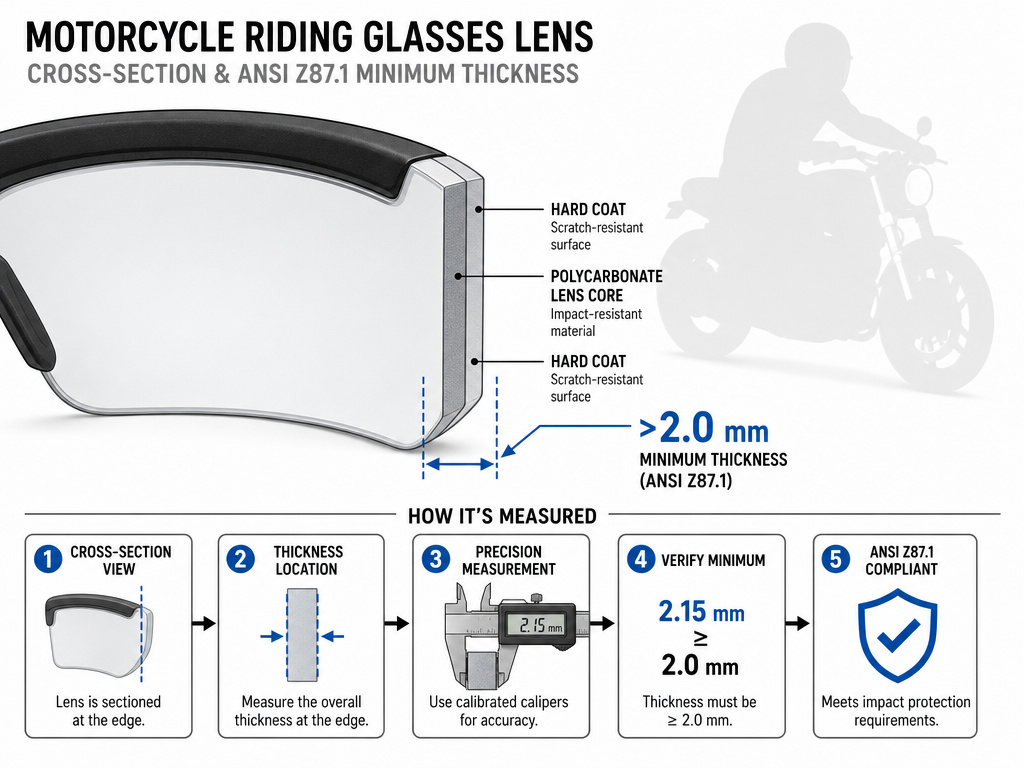
If you need vision correction, you have three paths, and only two are fully compliant with the safety standards.
1. Prescription Riding Glasses (Compliant)
These are custom-made with your prescription in a protective frame. The ANSI Z87.1 standard specifies that impact-rated prescription lenses must be thicker than 2.0 mm. Your optician must use a certified safety frame and grind the lenses to this thickness. This is the cleanest, most integrated solution. Our guide to prescription motorcycle glasses walks through the process.
2. Goggles Over Street Glasses (Compliant, per ASTM)
The ASTM F2812 standard says it doesn’t apply to prescription eyewear and suggests wearing impact-resistant spectacles (that meet ANSI Z87.1) under compliant goggles. This works if the goggles are large enough. It can feel bulky and may restrict peripheral vision.
3. Clip-On Shields (Risk of Non-Compliance)
ANSI Z87.1-2020 has a warning about aftermarket components. Section 5.6 states that aftermarket components or accessories must be tested assembled with the original device to show compliance. A clip-on tinted shield bought separately likely hasn’t been tested with your specific prescription base lens. The standard warns that “compliance cannot always be assured when components are replaced.” This path may void the certification.
Specific Brand and Model Recommendations
We do not recommend specific brands or models. Instead, verify the permanent markings that prove a product meets a defined safety standard. For goggles intended for on-road and off-road sport or leisure use, seek products marked as compliant with EN 1938:2010. For off-road use specifically, look for products stating conformity to ASTM F2812-12, but note this standard excludes helmet visors and prescription eyewear. For general impact protection, ANSI/ISEA Z87.1-2020 is a key benchmark, requiring clear markings for basic or high impact ratings. Always verify these markings on the product itself, as aftermarket components or accessories can compromise certified safety.
Polarized Lenses (Pros and Cons)
The fact sheet does not address polarized lenses. When considering them, weigh the practical benefits against potential drawbacks. The primary advantage is the reduction of glare from reflective surfaces like wet roads or car hoods, which can improve visual comfort and contrast. A significant downside is that polarized lenses can make it difficult to see certain digital displays, such as those on motorcycle instrument panels or some anti-lock braking system indicators, which may use polarized filters. They can also obscure patterns in ice or wet pavement. If you choose polarized lenses, ensure they still meet the required impact protection standards for your riding.
Frequently Asked Questions
What are the best glasses to wear while riding a motorcycle?
The best glasses are the ones that fit your helmet, carry a Z87+ or ASTM F2812 marking, have lenses with minimal optical distortion (prism tolerance <0.25∆ for goggles), and a tint suited to your primary riding light. There is no single “best” model for everyone. Start with the fit, then filter by safety rating.
What color lens is best for motorcycle riding?
It depends on the light. Clear (≥85% transmittance) is mandatory for night. Yellow/amber is best for overcast days and dawn/dusk to enhance contrast. Dark smoke/grey is for bright, sunny days. Avoid relying on photochromic lenses if you ride with a tinted helmet visor, as they may not darken sufficiently.
Can I just wear my regular sunglasses?
No. Regular sunglasses lack impact ratings, often have glass lenses that can shatter, and rarely provide sufficient coverage or wrap to block wind from the sides. They are a fashion item, not personal protective equipment. The ISO 12312-1 sunglasses standard for general use is not equivalent to occupational or motorsports impact standards.
How do I stop my riding glasses from fogging?
Start with glasses that have a permanent, internal anti-fog coating (ANSI tests for 8 seconds of fog-free performance). Ensure they have some ventilation, like top vents on goggles or a slight gap at the frame. For extreme cases, a dual-pane thermal lens (like in ski goggles) is the most effective but less common in motorcycle gear.
Do I need different glasses for day and night riding?
Yes. One lens cannot optimally serve both bright sun and darkness. The most practical setup is a frame (or goggle) with interchangeable lenses. Swap a dark smoke for a clear lens when the sun sets. Some of the most versatile systems are highlighted in our review of glasses for day and night.
Before You Go
The numbers cut through the marketing. Look for the Z87+ or ASTM F2812 engraving first—that’s your guarantee against a high-speed impact. Then, understand that optical quality (that prism tolerance under 0.25∆) is what separates gear that lets you see from gear that just protects your eyes while making you strain to see.
Fit is critical. A pressure point on your temple becomes a migraine. Test with your helmet on, every time.
Finally, match the lens to your mission. If you mostly ride in daylight, a dark, fixed tint and a cheap, separate clear pair for the odd night ride is smarter and safer than an expensive, compromised photochromic lens. Your eyes are the only camera you have for the road. The testing methods for sunglasses defined in standards like ISO 12311 are about durability, but your choice is about clarity, protection, and comfort. Don’t settle for two out of three.
