
Modular Motorcycle Helmet Pros and Cons: How to Choose
This post contains affiliate links. As an Amazon Associate, we earn from qualifying purchases.
A modular motorcycle helmet is a full-face helmet with a chin bar that flips up. The primary advantage is convenience for stops, communication, and wearing glasses, but it comes with a weight penalty, potential noise increase, and a mechanical hinge that is a documented failure point in specific models. For most riders who value maximum simplicity and safety, a traditional full-face helmet is the better choice, but it’s worth considering the modular motorcycle helmet pros and cons.
That hinge is the whole conversation when you compare a modular motorcycle helmet pros and cons. It’s not a minor feature, it’s a moving, load-bearing part of your helmet’s structure. When it works, it’s brilliant. When it doesn’t, the consequences are laid out in black and white by safety regulators. The rest of the trade-offs, the extra grams on your neck, the wind whistle, all follow from that one engineering decision to cut the shell in two.
What follows is a breakdown of the modular motorcycle helmet pros and cons, showing where that trade-off makes sense, where it absolutely doesn’t, and the specific maintenance steps that keep a flip-up helmet safe. We’ll walk through the certification labels that matter, the real-world failure modes pulled from recall documents, and a clear verdict on who should actually buy one.
Key Takeaways
- The hinge and latch are critical failure points; a 2025 NHTSA recall for the AGV Tourmodular cited a chin guard plate that “may, over time, break.”
- Modular helmets are heavier, which increases neck fatigue and inertial mass in a crash.
- Only helmets with dual P/J homologation are certified for riding with the chin bar open; a “P” only marking means it’s illegal and unsafe to ride flipped up.
- Convenience is the main pro, easy drinking, talking, and shade visor use at stops, but it directly trades off against structural simplicity.
- Maintenance is mandatory; lubricate the visor mechanism monthly and inspect the hinge for play or cracks, as per the AGV Tourmodular’s own manual.
The Safety Equation: Hinges vs. A Solid Shell
The core question concerns what happens to that hinge in a 70-millisecond impact. A full-face helmet is a single, continuous shell. A modular helmet is that shell, cut in half, and reconnected with a mechanical latch.
Modern certifications have tightened the rules. The current ECE 22.06 standard requires modular helmets to be impact-tested specifically at the chin-bar region in the closed position. It also tests the locking mechanism to ensure it stays engaged. This is a real improvement. A helmet like the AGV Tourmodular that passes ECE 22.06 has proven its chin bar can withstand a direct hit.
But a certification test is a controlled lab event. Real-world wear is different. The NHTSA recall report for AGV helmet from April 2025 is instructive. It states the chin guard plate “may, over time, break.” Dainese’s review of global data identified approximately 13 helmets with cracked plates. The cause was traced to a supplier’s quality controls. This is a documented failure mode for a specific component in a specific, high-end model.
The latch mechanism itself is another vector. A separate recall for the same AGV Tourmodular in Canada warned that the micrometric buckle might not auto-engage. The interim fix? You must manually close the red lever latch before every ride. That’s a daily, hands-on check a full-face helmet owner never thinks about.
A modular helmet certified to ECE 22.06 has closed the safety gap with full-face models, but the hinge and latch remain complex, wear-prone components that require your active inspection. A full-face helmet has neither.
The Weight and Noise Penalty
You feel the difference before you even start the bike. Pick up a modular helmet, then pick up a full-face in the same size and price range. The modular is noticeably heavier in your hands.
The numbers from independent testing bear this out. Data from The Lid Test registry shows modular helmets clustering between 1,700 grams and 1,814 grams. Full-face helmets in the same registry run from about 1,255 g to 1,651 g. That’s a penalty of roughly 50 to 550 grams, the weight of a small smartphone, strapped to your head.
| Helmet Type | Typical Weight Range | What It Means |
|---|---|---|
| Full-Face | 1,255 g – 1,651 g | Lighter, less neck fatigue, lower inertial mass. |
| Modular | 1,700 g – 1,814 g | Heavier, more tiring on long rides, higher mass in an impact. |
That extra mass does three things. First, it tires your neck muscles on a long touring day. Second, in a crash, more mass means more force trying to whip your head around, a secondary safety concern. Third, the weight often comes from the reinforced frame around the hinge cut-out, which can affect the helmet’s center of gravity.
Noise is the other half of the penalty. The flip-up junction is a natural wind leak. Even with excellent seals, most modular helmets are measurably louder than their full-face counterparts at highway speeds. That constant roar isn’t just annoying; it contributes to hearing fatigue. If you want a quiet ride, the comparison with full face helmets is stark, the one-piece shell almost always wins.
Convenience: The Flip-Up’s Real Advantage
This is why people buy them. The convenience is undeniable and genuinely improves the experience of touring or commuting.
- Stops are easier. Need a drink of water, a quick snack, or to ask for directions? Flip the chin bar up. No need to remove the helmet, fumble with gloves, or reset your comms microphone.
- Eyewear friendly. Putting on or taking off prescription glasses or sunglasses with a full-face helmet is a contortionist act. With a modular, flip up, handle your glasses, flip down.
- Communication simplified. Talking to a passenger, a gas station attendant, or a border agent is as easy as flipping the front up. It also makes initial setup and adjustment of a Bluetooth modular helmets system much simpler.
- Integrated sun visors. While not exclusive to modulars, the flip-up design pairs perfectly with a drop-down internal sun visor. You can deploy it with the chin bar up or down, giving you incredible light management on the fly.
The key is to confine this convenience to times when you’re stopped or moving at walking pace. Which brings us to a critical, and often misunderstood, rule.
Common mistake: Riding with the chin bar open on a helmet not certified for it. A modular marked only “P” is certified solely for riding in the closed position. Riding open is illegal and removes facial protection.
The P/J Rule and Riding Open
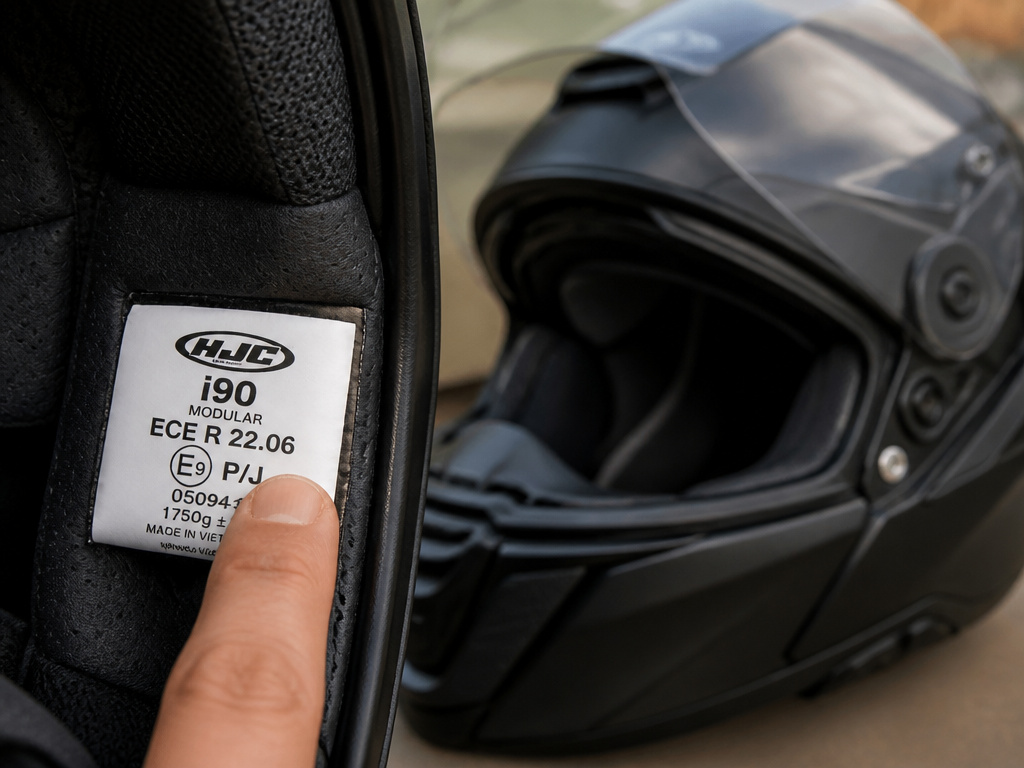
Look at the label inside your modular helmet. Near the ECE certification circle, you’ll see either a “P” or a “P/J” marking.
- P only: The helmet is certified as a “Protective lower face cover.” It passed impact tests with the chin bar closed. It is not legal or safe to ride with the chin bar flipped up. The open position is for stops only.
- P/J: The helmet is certified as both “Protective” (closed) and “Jet” (open). It was tested and approved in both configurations. You may legally ride with it open.
Most serious touring-focused modulars, like the AGV Tourmodular or Shoei Neotec II, are P/J homologated. But even if your helmet has the J approval, riding open at speed is a poor idea. The raised chin bar acts like a sail, creating lift and buffeting. The noise is unbearable, and your face is completely exposed to bugs, rocks, and the pavement.
The rule is simple: Use the flip feature for convenience when stopped. For moving, keep it locked down. Treating a modular like an open face helmet defeats its entire safety premise.
Maintenance Is Non-Negotiable
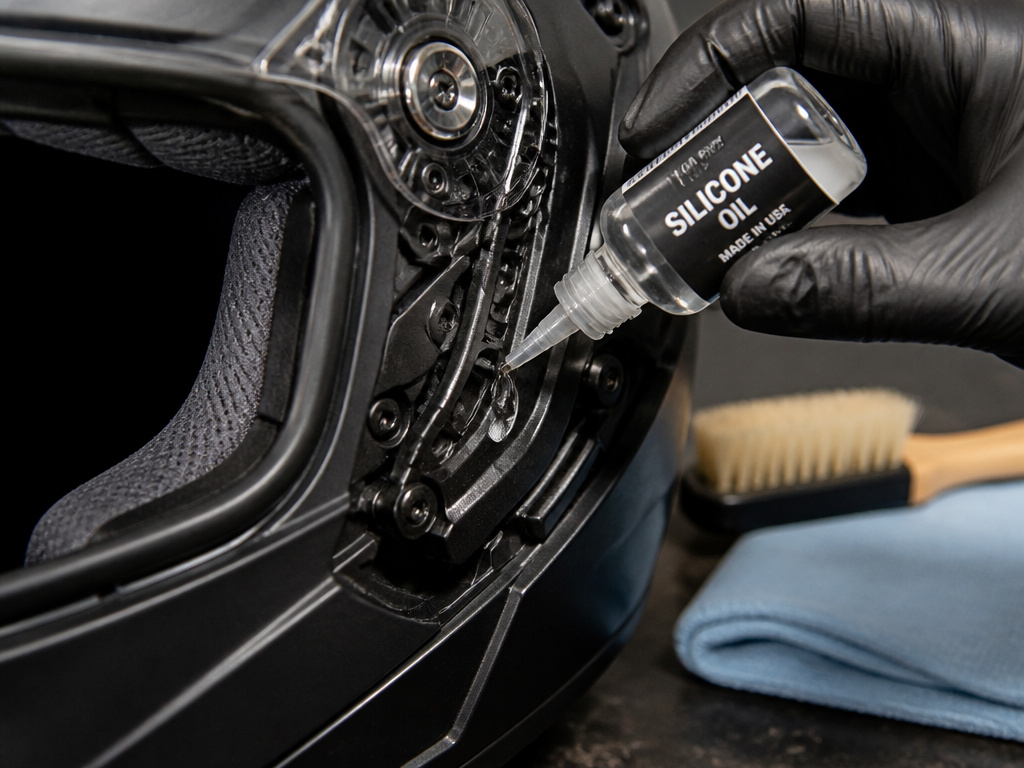
A full-face helmet needs its visor cleaned and its liner washed. A modular helmet needs that plus a mechanical service schedule. Ignoring it isn’t an option.
The user manual for the AGV Tourmodular is explicit. You must lubricate the visor mechanism monthly with silicone oil to prevent binding and wear. Vent openings should be brushed weekly to prevent clogging. The removable liner needs a wash every 30-40 hours of use to prevent sweat from degrading the comfort pads and hygiene.
The hinge and latch demand a visual and tactile inspection every few rides. Look for any hairline cracks in the plastic or metal around the pivot points. Feel for new, gritty resistance or looseness when operating the mechanism. The Dainese helmet manufacturer recall notice for the 2018 AGV Carbon Modular cited a chemical reaction from glue that could deteriorate the polycarbonate chin base. A separate consumer report on January 6, 2018, noted squeaking noises from a deteriorated chin base. Any new sound is a red flag.
Your maintenance checklist:
- Weekly: Brush out vent and exhaust ports.
- Monthly: Lubricate visor mechanism rails and pivots; clean interior mesh filters.
- Every 30-40 riding hours: Machine-wash the interior liner (cold, gentle cycle, air dry).
- Seasonally/Before long trips: Perform a detailed hinge and latch inspection. Check for cracks, play, or smooth operation.
This work is the price of admission for owning a machine with moving parts. A neglectful owner turns a premium helmet into a liability.
Who Should (and Shouldn’t) Buy a Modular Helmet
This isn’t a one-size-fits-all answer. Your riding style decides.
Buy a modular helmet if:
- You are a touring rider who makes frequent stops and values the convenience for hydration, communication, and glasses.
- You commute in urban environments with lots of stoplights and need to talk or drink without removing your helmet.
- You have verified the fit is perfect. A modular’s more complex shell can fit differently than a full-face; pressure points from the hinge area are common.
- You are disciplined about maintenance and willing to perform the monthly checks.
Stick with a full-face helmet if:
- Safety simplicity is your top priority. You prefer the proven, no-moving-parts integrity of a one-piece shell.
- You ride in cold or very wet climates where potential wind leaks at the chin bar seal are a major comfort issue.
- You are noise-sensitive and want the quietest possible environment.
- You want to keep initial cost and long-term maintenance to a minimum.
For the vast majority of sport, street, and even aggressive canyon riders, the advantages of full face helmets in weight, aerodynamics, and confidence outweigh the modular’s convenience. It’s the default, conservative choice. The modular is a specialized tool for a specific job, often best suited for the dedicated tourer looking at helmets for touring.
Built-in sun visor feature
A built-in sun visor adds major convenience, letting you adapt to changing light without stopping. The mechanism, however, is another moving part in an already complex helmet. While not directly addressed in the recall data, any internal component adds potential for failure or compromise. It’s a practical feature for touring, but it doesn’t replace the structural integrity of the primary chin bar and visor seal, which are the critical elements for safety. Keep the mechanism clean and operate it smoothly to prevent wear.
Cost/price factors
You pay more for the engineering that makes a modular helmet safe. The complex hinge mechanism, multiple shell sizes, and specialized testing all add cost. Recalls highlight that this complexity can introduce failure points, like a chin guard plate that may break over time. You are also often locked into the manufacturer’s ecosystem; one model states it can only be fitted with its own specific intercommunication system and original accessories. This limits aftermarket options and can lead to higher long-term costs.
Track day suitability (usually not allowed)
Modular helmets are generally not allowed on track days. The reason is in the certification. While a helmet marked P/J is approved for riding in both open and closed positions, the highest racing certifications are not available for modular designs. Track organizations require helmets certified to stricter standards that simply don’t exist for flip-up models. The moving chin bar represents a potential point of failure under extreme, repeated stress, which is the exact scenario track riding creates. For the street, it’s a trade-off; for the track, it’s a rule.
Frequently Asked Questions
Are modular helmets as safe as full-face helmets?
Modern, ECE 22.06-certified modular helmet is close, but a full-face remains the structurally simpler and more conservative choice. The hinge and latch are additional failure points that don’t exist on a full-face. The safety gap has narrowed significantly with newer standards, but it has not closed.
What does P/J mean on a helmet label?
The “P/J” marking on an ECE-certified modular helmet means it was tested and approved in both the closed (Protective) and open (Jet) configurations. A helmet marked only “P” is certified for riding only in the closed position. Riding with it open is not legal and is unsafe.
Can you wear a modular helmet with the chin bar up while riding?
You may only do this if your helmet has the dual P/J approval marking. Even then, it’s intended for low-speed scenarios. At highway speeds, the raised chin bar creates significant wind lift and buffeting, noise is extreme, and your face is unprotected. It is not recommended.
Why are modular helmets heavier?
The hinge mechanism, latch assembly, reinforcement around the shell cut-out, and additional sealing materials all add mass. Published weight data consistently shows modulars are 50–550 grams heavier than comparable full-face helmets.
How long does a modular helmet last?
Follow the manufacturer’s replacement guidelines, typically 5-7 years from the production date due to EPS liner degradation. However, the mechanical parts may wear out sooner with heavy use. Inspect the hinge and latch annually for play, cracks, or corrosion. Any compromise in the mechanism means the helmet must be replaced immediately, regardless of age.
The Bottom Line
A modular helmet is a tool for a specific job: making frequent stops easier on long tours or dense commutes. Its convenience is real, but it’s purchased with added weight, noise, and a mandatory maintenance ritual for its mechanical parts.
The hinge is the helmet’s most critical potential failure point, as real-world recall data proves. Your decision comes down to a simple trade: Are the daily conveniences worth accepting that mechanical complexity and the vigilance it requires? For most riders covering regular miles, the answer is no, the traditional full-face helmet is the safer, simpler, and quieter bet. For the disciplined tourer who stops often, the modular’s benefits can justify its compromises. Fit first, features second. And with a modular, the first feature you check is the latch.
