
Motocross Neck Brace Pros and Cons: Is It Worth It?
This post contains affiliate links. As an Amazon Associate, we earn from qualifying purchases.
Motocross neck brace pros and cons hinge on two conflicting sources: a ten-year, 8,529-case field study showing an 89% lower risk of critical cervical spine injury with a brace, and a biomechanical lab study finding a standard brace offered “negligible” risk reduction due to a ~50mm gap between the brace and helmet at the moment of impact. The real-world data is compelling, but the lab work exposes a critical flaw in how some braces might fit. For most aggressive trail and enduro riders, a properly fitted brace that achieves helmet contact is a worthwhile layer of protection, but it’s not a magic shield.
The field numbers are too large to ignore, yet the lab finding explains why some riders walk away convinced a brace did nothing. This isn’t about choosing a side; it’s about understanding why both can be true and what that means for your fitment. A brace that doesn’t touch your helmet when you look over your shoulder is operating in that ~50mm failure zone the lab identified.
What follows: the specific stats from the ambulance crews, the exact fit rules manufacturers print but riders ignore, the crash scenarios where the physics makes sense, and the one measurement that decides if your brace is jewelry or gear.
Key Takeaways
- Field data from Action Sports EMS shows not wearing a neck brace makes a critical cervical spine injury 89% more likely and death from such an injury 69%+ more likely.
- Lab research from Ohio State University found a ~50mm standoff distance between a standard brace and helmet can lead to “negligible” interaction and “insignificant” risk reduction in simulated impacts.
- Mandatory helmet contact is the manufacturer’s firm rule (Leatt manuals state the brace and helmet “must come into contact” at full head movement); if yours doesn’t touch, it’s not fitted correctly.
- Expect a 2-3 year replacement cycle; Leatt recommends discarding frequently worn braces every two years, and Atlas Brace limits its warranty to three years.
- A neck brace does not eliminate risk and may increase forces elsewhere; both OEM manuals warn against taking greater risks because you feel safer.
The Core Argument: 89% vs. Negligible Interaction
You can’t talk about neck braces without the 89% number. Action Sports EMS, an ambulance service covering amateur motocross in five states, collected data on 8,529 patients over nearly ten years. Their finding is stark: a critical cervical spine injury is 89% more likely without a neck brace. For non-critical injuries (like stingers), the risk was 75% higher without a brace. Death from a cervical spine injury was 69%+ more likely without a brace (4 cases vs. 1 with, though the one fatality with a brace involved a rider with a prior full spinal fusion).
A Critical Cervical Spine injury is 89% more likely without a neck brace. Over the course of the 10 year study, there were 239 recorded cases of Critical Cervical Spine injuries without a neck brace, and 26 with a neck brace. – Action Sports EMS (Great Lakes EMS Inc.) 10-Year Study
Then there’s the lab. Researchers at the Ohio State University Injury Biomechanics Research Center used finite element modeling to simulate crashes. Their 2016 abstract concluded that introducing a standard brace showed “negligible brace-to-helmet interaction prior to onset of the predicted neck injury, and resulted in an insignificant reduction in injury risk.” The reason? A “standoff distance between the brace and the helmet (~50mm)” that was greater than the neck compression at the time of injury. In short, the helmet hit the ground and started injuring the neck before the brace ever entered the picture.
| Data Source | Claim on Efficacy | Key Limitation / Note |
|---|---|---|
| Action Sports EMS (Field) | 89% lower risk of critical cervical spine injury with a brace. | Observational study; can show association, not prove the brace alone caused the reduction. |
| Ohio State IBRC (Lab) | “Negligible” interaction, “insignificant” risk reduction with a standard brace. | Modeling based on specific impact scenarios; a “modified” brace with reduced standoff showed moderate benefit. |
Key field data from Action Sports EMS shows a critical cervical spine injury is 89% more likely without a neck brace, while lab research from Ohio State University found a standard brace offered ‘negligible’ interaction and ‘insignificant’ risk reduction in simulated impacts due to a ~50mm standoff distance, illustrating the core of the motocross neck brace pros and cons debate. The practical bridge between them is fitment: if your brace has that ~50mm standoff, you’re in the lab’s failure scenario. If it’s fitted to make contact, you’re closer to the field’s success story.
How a Neck Brace Is Supposed to Work (And Where the Theory Falters)
The design principle is load transfer. In a crash, particularly an over-the-bars scenario where you pitch forward, your helmeted head can snap into hyperflexion or hyperextension. The brace is meant to act as a physical stop. The theory is that the helmet rim contacts the brace, and the force that would have bent your neck beyond its limits is instead transferred down through the brace’s wings to your shoulders, chest, and back, which is central to weighing the motocross neck brace pros and cons.
This is where certifications like the EU’s EN 1621-2 standard come in. The Leatt 4.5 neck brace was tested with a 50J “Kerbstone” impact, and it passed by transmitting a force of ≤ 18 kN. That’s the lab proof it can absorb and redirect a hit.
But the Ohio State study introduced two major caveats. First, the ~50mm standoff distance. If the brace doesn’t contact the helmet early in the impact sequence, this whole transfer mechanism never engages. Second, shoulder compliance. The study noted that “reduced shoulder compliance reduces any benefit of a fully engaged neck brace.” If your shoulders are tense or braced at impact, they don’t absorb and dissipate the transferred force as well, potentially reducing the benefit. The research admits the biomechanics of the shoulder in this specific loading are still unknown.
Where this goes sideways: Assuming any neck brace will work. The Ohio State lab model suggests a brace that doesn’t contact your helmet is just a plastic ring you’re wearing. The manufacturer’s fit rule exists for a mechanical reason.
The Non-Negotiable Pros: What the Data Says You Gain
The pros aren’t vague promises; they’re specific percentages from a massive dataset. If you trust real-world outcomes over lab models, this is the case for wearing one.
- Dramatically Lower Risk of Severe Neck Injury: The 89% figure for critical cervical injury is the headline. For non-critical injuries, the risk is 75% higher without a brace. This is the core protective claim.
- Reduced Mortality Risk: The same study found death from a cervical spine injury was 69%+ more likely without a brace. While the numbers are small (4 vs. 1), the trend reinforces the severity reduction.
- Possible Reduction in Clavicle Fractures: Contrary to the old “it’ll break your collarbone” myth, the Action Sports EMS data found a clavicle fracture was 45% more likely without a neck brace.
- A Defined Safety Ritual: Adding a brace completes the full-body protective gear mindset, alongside your essential motocross equipment. It’s one more layer between you and the terrain, alongside other torso protection like chest protectors and back protectors.
These benefits are based on real-world injury data collected across various motocross crash scenarios.
The Practical Cons and Physical Trade-Offs
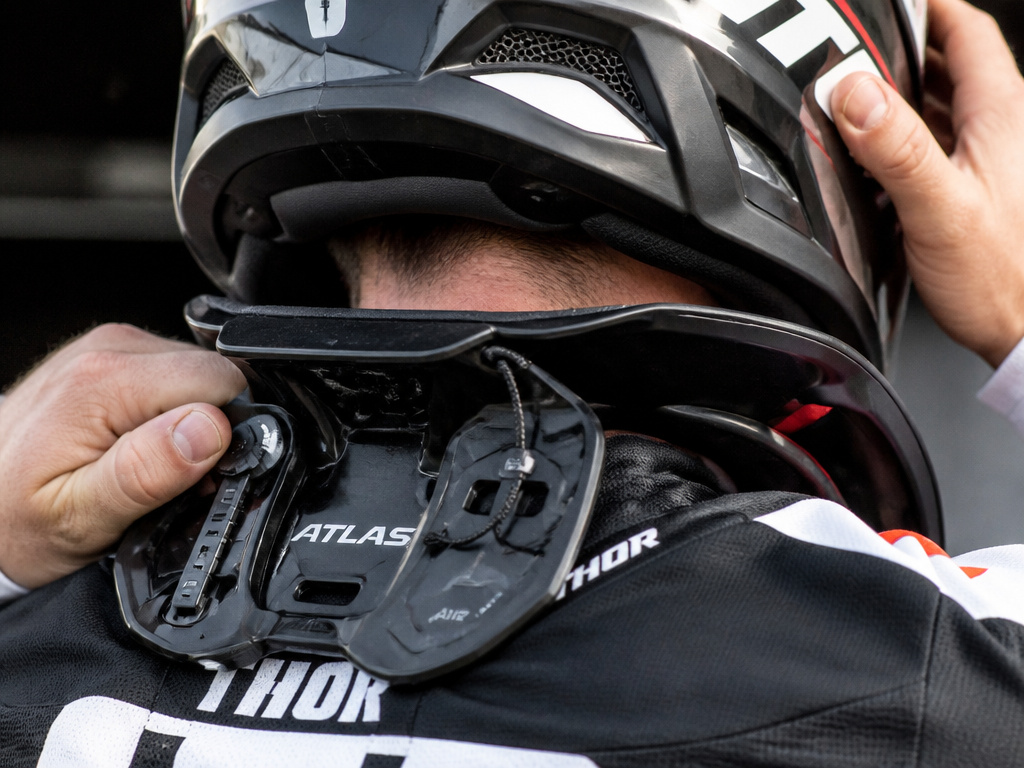
The cons aren’t deal-breakers for everyone, but they’re real physical and financial costs you pay for that potential protection.
- Fitment is Everything (And It’s Hard): This is the biggest con. Per Leatt’s manual, for a brace to work as designed, “the neck brace and the helmet must come into contact with each other as the full safe range of normal riding head movement is reached.” Achieving this often requires careful sizing, adjusting strut lengths, and sometimes buying a different helmet. A phenomenological rider experience study cited riders who quit using braces because “It prevented my full range of motion which impeded my vision.” The very contact required for safety is what many riders find intolerable.
- Cost and Replacement Schedule: A Leatt or Atlas brace is a significant investment. It is also a consumable item. Leatt explicitly says to “discard and replace frequently worn braces every two years.” Atlas Brace recommends replacement no later than every three years and offers a three-year limited warranty. This is a recurring cost.
- Potential for New Injury Vectors: While the data refutes the collarbone myth overall, the theory of load transfer means energy is going somewhere—into your shoulders and torso. If you have existing shoulder or upper back issues, that’s a consideration. It also changes how you think about integrating it with your other torso protection options, such as a chest protector or pressure suit.
- Comfort and Heat: It’s another layer trapping heat around your neck. On a hot day, that’s noticeable. It can also create pressure points, especially during long periods standing on the pegs.
- False Sense of Security: Every OEM manual includes a stark warning. Leatt’s: “Do not attempt potentially hazardous maneuvers… That you would not attempt without a brace.” Atlas Brace’s: “Do not take greater risks while wearing this product because you feel safer.” A brace is a mitigator, not an invincibility shield.
The Step-by-Step Fitment Checklist Most Riders Skip
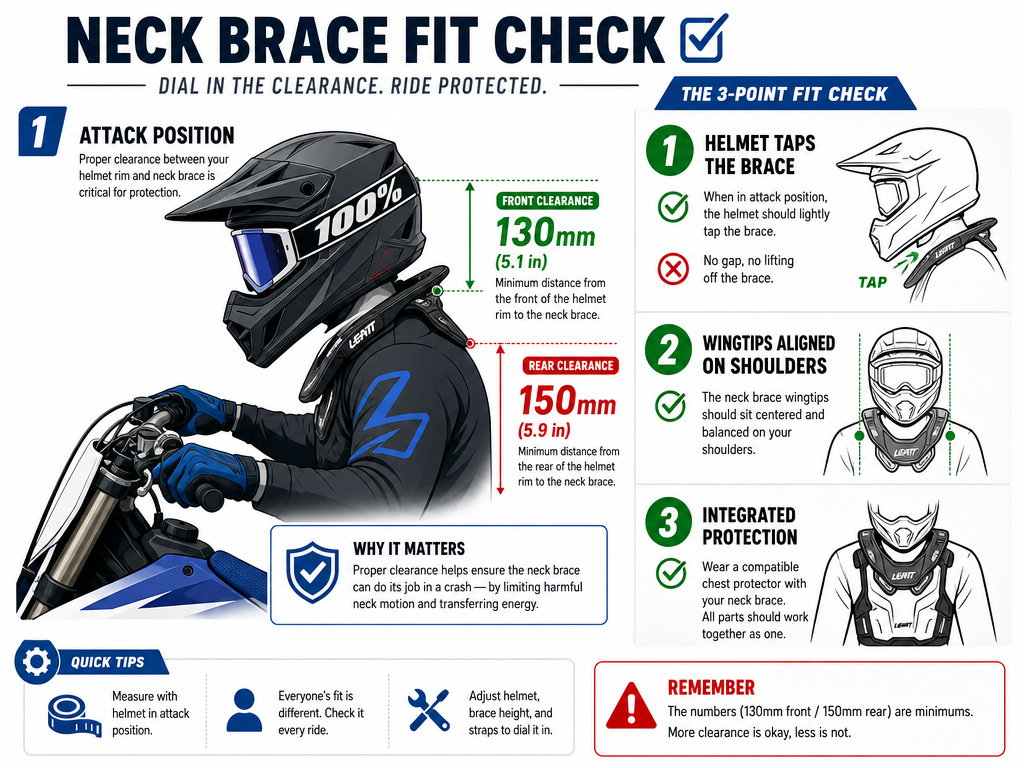
If you buy a brace, this is the process. Skipping it means you might as well not wear one.
- Size for Contact, Not Comfort: Try on the brace with your helmet. Look up as if spotting a landing, look down at your fender, look over each shoulder. You should feel the helmet rim tap the brace at the extreme of each motion. No contact? The size or adjustment is wrong.
- Measure the Rim Clearance: With help, place a ruler vertically against the front of the brace. Your helmet rim should sit within a 130mm zone, with at least 50mm of clearance between the rim and the brace’s lower edge. Repeat at the back (150mm zone). This ensures the helmet can contact the brace’s upper rim, not its lower structure.
- Align the Wings: The brace’s wingtips must sit flat on top of your shoulders, not dig into your trapezius muscles or float above them. This is critical for load transfer.
- Integrate with Other Gear: Put on your chest protector or jersey. Does the brace still fit and allow contact? Does it interfere with your knee braces vs guards? Gear is a system.
- Ride With It Before Racing: Do a full moto with it. The discomfort of a new brace often fades after an hour as you adapt. Persistent pinching or restricted vision means you need to re-adjust or try a different model.
Common mistake: Setting the brace height for maximum comfort on the stand. The only correct height is the one that guarantees helmet contact when you’re in the attack position, head up. Comfort is a secondary goal.
Who Should (And Shouldn’t) Wear One
This isn’t a one-size-fits-all answer. Your riding style and risk profile decide.
Prioritize a brace if you:
- Ride motocross tracks aggressively, especially if you’re clearing big jumps where over-the-bars crashes are possible.
- Ride hard enduro or technical terrain where sudden, high-energy tip-overs are common.
- Are a newer rider still building bike control and crash more frequently.
- Have a history of neck stiffness or minor strains and want to add a preventative layer.
- Already invest in full protective gear and view the brace as the final component.
You can likely skip a brace if you:
- Primarily trail ride at a casual pace on non-technical terrain.
- Find that even after proper fitting, it severely restricts the head movement you need to navigate safely.
- Have a pre-existing cervical spine condition or injury—consult your physician, as a brace could alter loading in an unexpected way.
- Are deciding between a brace and other more critical gear; always buy a helmet, boots, and knee protection first.
For youth riders, consult the manufacturer’s sizing guidelines and a physician to assess suitability. However, the habit of wearing full protection is invaluable. Many parents choose braces for kids as part of instilling a complete safety mindset from the start.
Maintenance, Lifespan, and When to Retire It
A neck brace is not a buy-it-for-life item. Its materials degrade, and its structure can be compromised invisibly.
- Inspect After Every Crash: Leatt’s manual is absolute: “A cracked, bent, or deformed Leatt Neck Brace, or any Leatt Neck Brace worn by a user during an injury-producing accident or fall, should not be used again by anyone.” Leatt’s manual states a cracked, bent, or deformed neck brace, or any brace worn during an injury-producing accident, should not be used again, as damage may not be visible.
- Clean Gently: Use only mild soap and water. Solvents can degrade plastics and foams. Atlas Brace specifically warns its device is not fire retardant and will melt if exposed to extreme heat.
- Adhere to the Calendar: Plan on a 2-3 year lifespan with regular use. Manufacturers recommend replacement after a set period: Leatt advises every two years for frequently worn braces, and Atlas Brace recommends no later than every three years. Even if it looks fine, replace it per the manufacturer’s schedule—Leatt says two years, Atlas says three.
- Store It Properly: Don’t leave it in a hot car or direct sunlight. Store it in its bag or a cool, dry place to slow material degradation.
Which neck brace brand is the best?
Manufacturers provide different guidance on their products, but direct comparisons are scarce. One key difference is the recommended replacement interval. One major brand states you should discard and replace frequently worn braces every two years. Another brand recommends replacement no later than every three years. Both brands emphasize that their brace is not a substitute for skill and that you should not take greater risks because you feel safer. The critical point is that a brace must be correctly fitted to the wearer’s body. Failure to achieve a correct fit will reduce its effectiveness and may create unexpected risks. The best brace is one that fits you properly, works with your helmet, and you will wear consistently.
What’s the difference between a neck brace and a neck collar?
The terms are often used interchangeably by riders, but they refer to the same category of protective gear designed for motocross. The core function is to help reduce certain cervical vertebra injuries when combined with a certified full-face helmet. The key operational principle from one manufacturer is that the device and the helmet must come into contact with each other as the full safe range of normal riding head movement is reached. This contact is mandatory for the system to work as designed. If there’s too much space, or ‘standoff,’ research suggests the benefit can be negligible. In extreme cases, you may need a different helmet model to achieve the required compatibility and safety.
When was the motocross neck brace invented?
The fact sheet does not contain specific information on the history or invention of the neck brace. For practical guidance, the modern development of neck braces for motocross was driven by a need to address a specific injury pattern. Studies indicate neck and upper spine fractures account for approximately 10% of all injuries to motocross riders in a crash. Early designs aimed to prevent excessive movement, but research into their biomechanical effectiveness highlighted the importance of the standoff distance between the brace and the helmet. This led to design refinements to ensure the brace engages with the helmet before substantial neck loading occurs, which is a key principle in current fitting instructions.
Frequently Asked Questions
Are neck braces worth it in motocross?
For most riders on motocross tracks or aggressive trails, yes—the field data showing an 89% reduction in critical neck injury risk is too significant to dismiss. However, “worth it” depends entirely on achieving the correct, helmet-contacting fit. A poorly fitted brace likely offers little to no benefit.
What are the risks of using a neck brace?
The primary risks are those of improper use: a false sense of security leading to riskier riding, and potential discomfort or restricted vision if fitted incorrectly. The old theory that braces cause collarbone breaks is contradicted by the latest field data, which found fractures were 45% more likely without a brace.
Do any pro motocross riders wear neck braces?
Usage among top pros is mixed. Some, like Eli Tomac, have worn them at points in their careers, while others do not. Pro choice is influenced by sponsor agreements, personal comfort, and the specific demands of Supercross vs. Outdoor motocross. Don’t use pro adoption as your sole guide.
Can a neck brace prevent all neck injuries?
No. Every manufacturer’s manual states this clearly. Braces are designed to help reduce the incidence or severity of certain cervical spine injuries by limiting extreme motion and distributing force. They cannot protect against all impact vectors, rotational forces, or injuries to the spinal cord itself.
How do I stop my neck brace from hurting?
Pain usually signals a fit issue. Ensure the wingtips are flat on your shoulders, not digging in. Adjust the front and rear strut heights evenly. The padding should not pinch your neck. If pain persists after adjustment, the brace size or model may be wrong for your anatomy. Trying a different brand is often the solution.
What is the best neck protection for motocross?
The “best” is the model that fits your body and helmet perfectly, ensuring contact at full head movement. Leading brands like Leatt, Atlas Brace, and Alpinestars have different designs—some are more rigid, others flex more. You must try them on with your gear. Our neck brace reviews detail the differences.
Before You Go
The numbers from the field are compelling, but they describe a population wearing braces that presumably fit. The lab study tells you what happens if yours doesn’t. That gap—between the statistic and the ~50mm standoff—is where your diligence lives.
Your single most important task is not buying the most expensive brace; it’s spending an hour in your garage verifying the fit rule. Put on your helmet, get in your riding stance, and look over your shoulder. If you don’t feel that tap of plastic on plastic, nothing else matters. The brace is just a placeholder for the protection you think you have.
And if you get that fit right, understand what you’re buying: a device that may dramatically reduce the worst-case outcome on a bad day, not a license to ride over your head. It’s part of the system, like learning how to reduce neck strain from your helmet, that helps you focus on the ride itself.
