
What Is EN 17092 Motorcycle Clothing Standard?
This post contains affiliate links. As an Amazon Associate, we earn from qualifying purchases.
EN 17092 is the mandatory European standard for motorcycle protective clothing, defining six performance classes (AAA, AA, A, B, C) based on abrasion resistance, impact protection, and fit. It replaced the older EN 13595 series for professional riders and is the benchmark all CE-marked motorcycle jackets, pants, and suits sold in the EU must meet. For classes AAA, AA, and A, a higher class letter indicates greater abrasion resistance, with AAA offering the highest level of protection. Class B offers abrasion resistance equivalent to Class A, and Class C offers impact protection only.
That 5mm hole limit is the physical line between a garment that might hold and one that failed. The standard simulates a 75kg rider sliding on concrete, and if the inner layer tears a hole 5mm or larger, it doesn’t pass. This isn’t academic. It’s the difference between road rash and skin graft.
What follows is a breakdown of the five classes, the specific tests they survive, and how to match the rating on the tag to the riding you actually do, which is the core of the what is EN 17092 motorcycle clothing standard question. We’ll also cover what the standard doesn’t guarantee and how to layer classes B and C for a custom setup.
Key Takeaways
- The EN 17092 class (AAA, AA, A, B, or C) is printed on a garment’s CE label and tells you its certified abrasion resistance level, with AAA being the highest.
- Class C garments are designed to be combined with other classes; a C-rated armored vest worn under a B-rated abrasion-resistant hoodie is a legitimate, certified system.
- The standard’s impact abrasion test simulates a 75kg rider sliding on concrete; to pass, the material cannot develop a hole ≥5mm on the layer closest to the skin.
- No garment guarantees full protection; the 2011 GEAR study found high failure rates in real crashes, meaning certification is a baseline, not a finish line.
- Always verify that removable armor is EN 1621 certified and correctly positioned; using a garment without its protectors voids its safety rating.
What Is the EN 17092 Standard?
EN 17092 is a series of six European standards that form the technical backbone for certifying motorcycle protective clothing as Category II Personal Protective Equipment (PPE) under Regulation (EU) 2016/425. If a jacket or pair of riding pants has a CE mark, it was tested against one part of this series. The standard had to be implemented across Europe by September 2020, and it fully replaced the older EN 13595 standards for professional riders by March 2023.
The whole point of the what is EN 17092 motorcycle clothing standard is to give you a measurable, comparable level of protection based on how you ride. The standard itself states the “degree of risk is closely linked to the type of motorcycle riding and the nature of the accident.” In other words, a track day suit and a summer mesh jacket face different hazards. EN 17092 tries to categorize those hazards into clear performance tiers.
EN 17092-1:2020 describes the test methods, while parts 2 through 6 detail the requirements for five distinct protection classes: AAA, AA, A, B, and C. This structure allows manufacturers to design and certify garments for specific risk levels, from heavy-duty racing to lightweight urban commuting.
The 5 Protection Classes: From AAA to C
This is the core of the standard. You’ll see the class printed right on the garment’s label inside a small pictogram. It’s not a suggestion—it’s the verified performance tier the garment achieved in lab testing. Higher letters mean greater abrasion resistance.
| Class | Standard Part | Protection Type | Impact Protectors | Best For |
|---|---|---|---|---|
| AAA | EN 17092-2:2020 | Highest abrasion & impact | Mandatory (Elbow, Shoulder, Knee, Hip) | Track days, high-performance riding |
| AA | EN 17092-3:2020 | High abrasion & impact | Mandatory (Elbow, Shoulder, Knee, Hip) | Sport touring, aggressive street riding |
| A | EN 17092-4:2020 | Good abrasion & impact | Mandatory (Elbow, Shoulder, Knee); Hip optional | General street riding, commuting |
| B | EN 17092-5:2020 | Abrasion only (equivalent to Class A) | None included | To be worn over separate Class C armor |
| C | EN 17092-6:2020 | Impact only (holds armor) | None (but designed to hold certified protectors) | To be worn under a Class A, AA, AAA, or B garment |
Class AAA is the heavyweight. Think leather one-piece or two-piece suits. The standard warns these garments “are likely to have drawbacks such as extra weight, ergonomic restrictions, or increased thermal/heat stress.” You trade mobility and comfort for the highest tested abrasion resistance.
Class AA and A are the workhorses for road riders. Both require mandatory impact protectors at major joints. The key difference is that Class AA meets higher requirements than Class A.
Class B and C change the game. Class B provides abrasion resistance equivalent to Class A but without impact protectors. Class C provides impact protection for covered areas only and does not offer minimum abrasion protection. Class C is intended to be worn with and supplement the protection offered by Class AAA, AA, A, or B garments. Understanding this combo is key to using the standard correctly, much like knowing how different test methods, such as abrasion test methods, compare.
How EN 17092 is Tested: The 75kg Slide
The numbers behind the letters matter. The tests are brutal, repeatable simulations. The most famous is the impact abrasion test, which defines the abrasion resistance levels for classes AAA through A.
The impact abrasion test simulates a 75kg, 1.75m rider sliding on concrete. Material samples are mounted in three different orientations (warp, weft, and 45 degrees) for testing against an abrasive surface. To pass, no hole 5mm or larger can form on the layer closest to the body. That 5mm limit is absolute. A hole 5mm or larger is a fail.
Other tests are just as specific:
- Dimensional Change: After cleaning per EN 13688, the garment cannot shrink or stretch more than ±5%.
- Seam Strength: All critical seams are tested to ensure they don’t burst open under stress, using methods from the related EN 13594 glove standard.
- Two-Piece Suit Connection: For jackets and pants meant to zip together, a force of 100N is applied for 60 seconds. No gapping or failure is allowed.
- Sleeve Restraint: A 50N force is applied for 30 seconds to try and pull a cone out of a sleeve or leg. The garment must keep the cone securely inside.
Where this goes sideways: Assuming all “CE certified” gear is tested the same. A Class A garment passes a less severe abrasion test than a Class AA garment. The label tells you which test it passed.
EN 17092 vs. CE Marking and Other Standards
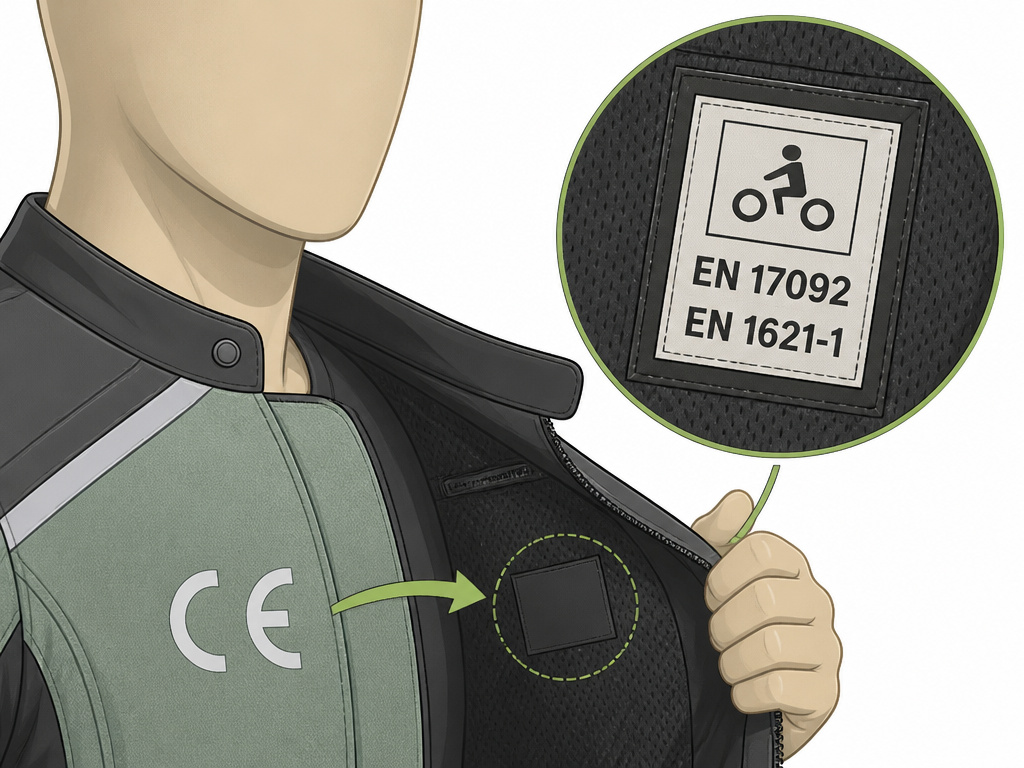
It’s easy to get the terms tangled. Here is the hierarchy:
- Regulation (EU) 2016/425: This is the law. It says motorcycle clothing is “Category II” PPE and must be independently certified before being sold.
- CE Marking: This is the symbol that shows a product complies with the law (the PPE Regulation). It’s the manufacturer’s claim of conformity.
- EN 17092: This is the specific technical standard that defines how to test motorcycle garments to prove they are safe enough to earn the CE mark. It’s the recipe for the certification cake.
Other key standards work alongside EN 17092 to form a full protective ensemble:
- EN 1621: This is the standard for the impact protectors (armor) themselves. A garment’s EN 17092 rating assumes it contains EN 1621-certified armor in the required zones. The armor is tested separately for shock absorption.
- EN 13594: The standard for motorcycle gloves.
- EN 13634: The standard for motorcycle boots.
Think of it this way: EN 17092 certifies the garment shell. EN 1621 certifies the armor inside it. You need both for complete protection. This is why checking the CE certification labels is an essential step.
What EN 17092 Doesn’t Tell You (The Limitations)
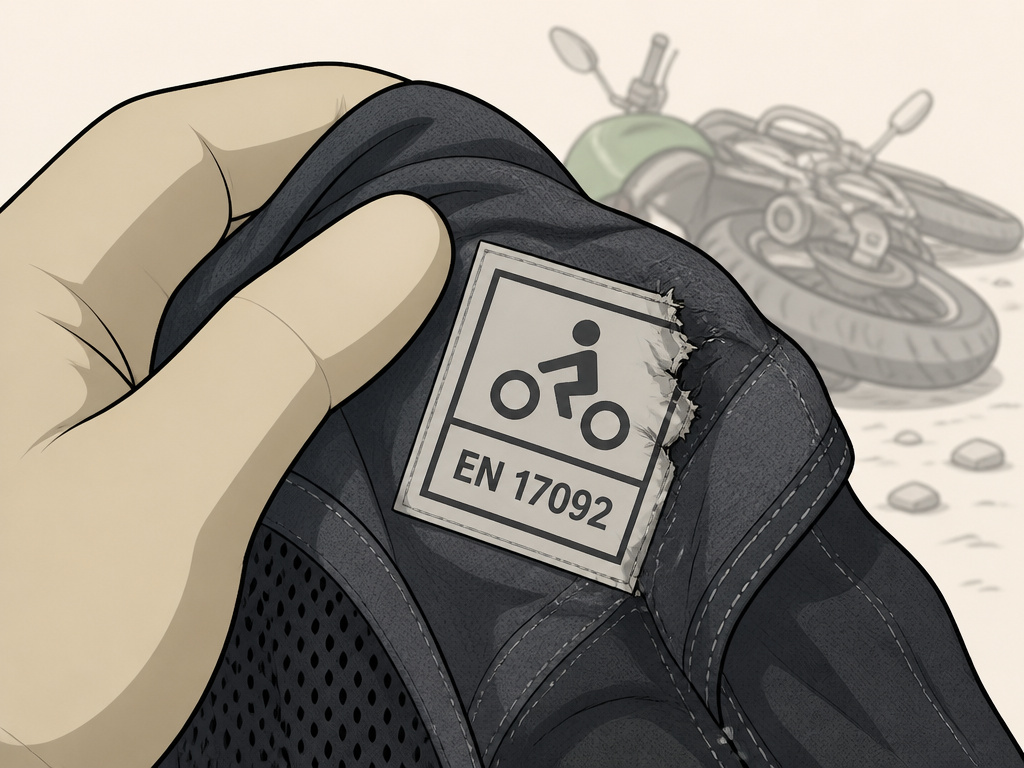
The certification, which answers the what is EN 17092 motorcycle clothing standard, is a vital baseline, but it is not a force field. Riders should understand its boundaries.
First, Second, fit is everything. The standard requires that “the assessor must be able to carry out all essential movements” and that the garment fits per the manufacturer’s size chart.
Most importantly, lab tests aren’t street crashes. The 2011 Australian GEAR study by researcher Liz de Rome analyzed real-world crashes and found “high clothing failure rates.” Some expensive, “safe” clothing performed poorly. The study concluded that improved quality control was needed. But as the manufacturer Alpinestars explicitly states in its documentation: “No garment or combination of garments can offer full protection against injury.”
The standard also can’t account for every riding scenario. This is where you move from trusting the label to understanding your own needs.
How to Use EN 17092 When Buying Gear
Don’t just look for a CE mark; read the class. Read the class.
- Match the Class to Your Riding:
- Verify the Armor: The garment’s label lists its class. The armor inside should have its own label stating compliance with the EN 1621 series for impact protectors. Removable protectors must be re-inserted every time; using the garment without them is, as the standard warns, “at your own risk and peril.”
- Check the Fit in a Riding Position: The EN 17092-3:2020 standard for Class AA gear explicitly recommends you “try garments in a riding position as well as when standing.” Separated jackets and trousers should sufficiently overlap when the rider is in the riding position. It is also recommended that there is at least 5cm overlap between the end of the sleeves/legs and the top of the gloves/boots.
- Consider the B+C System: This is a legitimate, certified combination that allows you to adapt to weather and style.
Ultimately, the standard is a tool for comparison. It can’t tell you which jacket is most comfortable for your body shape on a long ride. But it can definitively tell you that one jacket has survived a more severe slide test than another. That’s a fact worth shopping with.
What are the risk zones (Zone 1, 2, 3) in EN 17092 testing?
The EN 17092 standard does not use a specific ‘Zone 1, 2, 3’ classification for risk areas on a garment. Instead, the degree of risk is closely linked to the type of motorcycle riding and the nature of an accident. The standard provides different classes of garments, from AAA to C, each designed for different levels of protection. These classes reflect the expected risk, with higher classes like AAA intended for heavy-duty use and offering the best protection. Riders are cautioned to carefully choose protective garments that match their riding activity and the associated risks. The fit and coverage of the garment are also critical, as separated jackets and trousers must sufficiently overlap when the rider is in the riding position.
Frequently Asked Questions
Is Cordura or Kevlar better than an EN 17092 rating?
No. Cordura and Kevlar are brand names for specific high-strength fibers. An EN 17092 rating is a performance certification for a finished garment. A jacket can be made from Cordura and still fail EN 17092 if its seams, construction, or fit are subpar. The rating certifies the final product, not just the marketing material on the tag.
What is the difference between CE Level 1 and Level 2 armor?
CE Level 1 and Level 2 refer to the impact protectors certified under EN 1621, not the garment’s EN 17092 class. Level 2 armor absorbs more impact energy (transfers less force to your body) than Level 1 armor. A single garment, like a Class AA jacket, can contain a mix of Level 1 and Level 2 protectors in different zones. You must check the armor’s own label to see its level.
Can I wear a Class B jacket by itself?
You can, but you shouldn’t for protection. Class B is designed to provide abrasion resistance only. It has no impact protection. The standard intends for it to be worn with a separate Class C armor layer. Wearing it alone leaves you vulnerable to broken bones from impacts, even if your skin is protected from road rash.
How do I know if an EN 17092 label is genuine?
Look for the four-digit Notified Body identification number next to the CE mark. This number should be publicly traceable to a legitimate testing lab like SATRA. Be wary of gear sold online with blurry or generic CE labels that lack a class designation (AAA, AA, A, B, C) or a Notified Body number—these are often fakes.
Does EN 17092 replace the need for other gear like gloves and boots?
Absolutely not. EN 17092 covers jackets, trousers, and suits only. You still need EN 13594-certified gloves and EN 13634-certified boots to protect your extremities. Riding is a full-system activity; one certified piece doesn’t cover the gaps in another.
The Bottom Line
EN 17092 took the guesswork out of motorcycle gear. It replaced vague claims of “tough” or “protective” with a graduated scale of verified performance. Your first move when evaluating any jacket or pants should be to find that label and note the class.
Trust the scale, but remember its limits. A Class AAA suit is overkill for a coffee run and miserably hot. A sleek Class A mesh jacket might be perfect for city commuting but too light for a high-speed highway slide. The standard tells you the what; you have to supply the when and where.
Finally, the certification is a starting point, not an endpoint. The gear must fit you, not just the mannequin in the test lab. It must be worn correctly, with all armor secured and all closures fastened. Because the standard, for all its rigorous testing, still can’t account for the one variable it’s designed to protect: you, on your bike, on the road.
