
Motorcycle Neck Gaiter vs Balaclava: Which Should You Buy?
This post contains affiliate links. As an Amazon Associate, we earn from qualifying purchases.
A motorcycle neck gaiter is a fabric tube, typically 19 to 21 inches long, that covers the neck and lower face. A motorcycle balaclava is a fitted hood that covers the entire head, neck, and face, designed specifically as a helmet liner. For most riders, the choice isn’t about warmth alone, it’s about matching the covering to your riding style: a gaiter for stop-and-go versatility, a balaclava for sustained highway cold.
That distinction changes everything about fit, fogging, and wind sealing. A gaiter’s simplicity is also its weakness at speed, while a balaclava’s commitment can turn a comfortable helmet into a vise if you pick the wrong thickness. The debate of motorcycle neck gaiter vs balaclava often centers on these trade-offs.
What follows is a breakdown of the specs that matter, the fit warnings most riders learn the hard way, and a direct comparison of when each piece of gear actually earns its keep.
Key Takeaways
- Match the covering to your ride type. A neck gaiter is superior for city commuting with frequent stops, while a balaclava is built for sustained highway miles in the cold.
- Thickness directly impacts helmet fit. A thin Lycra balaclava adds 1–2 mm; a fleece version adds about 4 mm. On a snug helmet, that extra 2 mm is the difference between comfort and a headache by mile 30.
- Wind sealing is the gaiter’s weak point. Without a nose bridge or strap, a standard gaiter slides down at highway speed. The fix is to tuck the top edge under your sunglasses or goggles.
- For temperatures above 0°C (32°F), Motorcycle Gear Canada states a balaclava is often overkill, while American Legend Rider recommends a breathable lycra balaclava as the default for three-season riding, and Dainese markets a balaclava for year-round use. A lightweight merino wool or synthetic gaiter usually provides enough coverage, reserving the full balaclava for sub-zero or high-wind-chill conditions.
- Motorcycle News states balaclavas are usually a ‘one size fits most’ tailored for a medium head and might not fit well for size S or L helmets, while some brands like FXR Racing offer specific sizes (S, L, XL).
The Core Difference: Anatomy and Purpose
A neck gaiter is just a tube. It’s a stretchy loop of fabric, usually 19 to 21 inches long, with no seams and no hardware. You can pull it up over your nose, push it down as a collar, or twist it into a headband. Its whole design is about quick adaptation.
A balaclava is a helmet liner first. It’s a pre-shaped hood that covers your skull, ears, neck, and face, with a single opening for your eyes. It’s not meant to be versatile; it’s meant to be a dedicated, wind-blocking base layer that lives under your lid.
A motorcycle neck gaiter is a seamless fabric tube offering multi-position versatility for neck and face coverage. A motorcycle balaclava is a fitted, full-head hood designed as a dedicated thermal and windproof layer under a helmet. The fundamental trade-off is between the gaiter’s on/off convenience and the balaclava’s sealed protection.
This isn’t a small distinction in the motorcycle neck gaiter vs balaclava comparison. It dictates everything from how you put it on at a gas station to how it handles a 75 mph crosswind. The gaiter is about managing moderate conditions with maximum flexibility. The balaclava is about committing to full protection when conditions are punishing.
The Helmet-Fit Math: Why Thickness Is a Deal-Breaker
The number one mistake is buying for warmth without checking the helmet fit. The thickness of the material isn’t a minor detail, it’s the whole equation.
According to gear tests, a thin Lycra balaclava adds roughly 1 to 2 mm of material around your head. A fleece winter balaclava adds closer to 4 mm. On a helmet that already fits snugly, that extra 2 mm of material can make the helmet uncomfortably tight.
The “one size fits most” label common on balaclavas is tailored for a size M head. If your helmet is a true size S or L, that generic fit often fails. It’s either baggy and shifts, or it’s tight and bunches. Some brands, like FXR Racing with its Boost Anti-Fog Balaclava, offer three specific sizes (S, L, XL) for this exact reason.
Common mistake: Choosing a balaclava based on temperature rating alone. A thick fleece balaclava rated for -20°C is useless if it makes your helmet so tight you have to stop riding after an hour.
This is where the gaiter has a clear advantage in the motorcycle neck gaiter vs balaclava choice for riders with tight-fitting gear. You can wear a thin base layer and add the gaiter for neck warmth without adding critical millimeters around your skull. It’s a modular system that allows you to adjust the warmth without ruining the helmet’s safety fit.
Performance Face-Off: Wind, Fog, and Highway Speed
On paper, both items block wind. On the road, their performance diverges sharply once you pass 50 mph.
A standard neck gaiter has no nose bridge or strap. At highway speed, the wind gets underneath the top edge and pushes it down your face. Riders solve this by tucking the top of the gaiter under the bottom frame of their sunglasses or goggles, creating a mechanical seal. A snug fit under your jacket collar is also critical.
Technical gaiters like the Dainese CILINDRO WS Neck Warmer try to solve this with a Windstopper® membrane, claiming total windproof protection. The membrane helps, but the fundamental tube-without-anchor design still fights the wind.
Balaclavas are built for this. Models like the Spidi H2OUT® Balaclava feature integrated waterproof and windproof membranes and are marketed as ideal for long-distance highway riding. They seal around your entire head, with elastic hems that tuck under your collar and sometimes silicone grip strips to hold them in place. The wind has nowhere to get a grip.
Fogging is the other battle. A balaclava with a nose cover, like the FXR Boost with its contoured neoprene mask, actively diverts breath downward to prevent visor fog. A simple gaiter pulled over your nose does little to direct airflow, often channeling it straight up into your visor.
| Scenario | Neck Gaiter Performance | Balaclava Performance |
|---|---|---|
| Highway Speed (65+ mph) | Poor to Fair (slides without anchor) | Excellent (full head seal) |
| Stop-and-Go City Riding | Excellent (easy on/off) | Poor (full removal required) |
| Fog Risk | Medium-High (unmanaged breath) | Low-High (depends on design) |
| Wind Chill Below -10°C | Fair (good for neck only) | Excellent (full head coverage) |
Material Matters: From Summer Silk to Winter Membranes
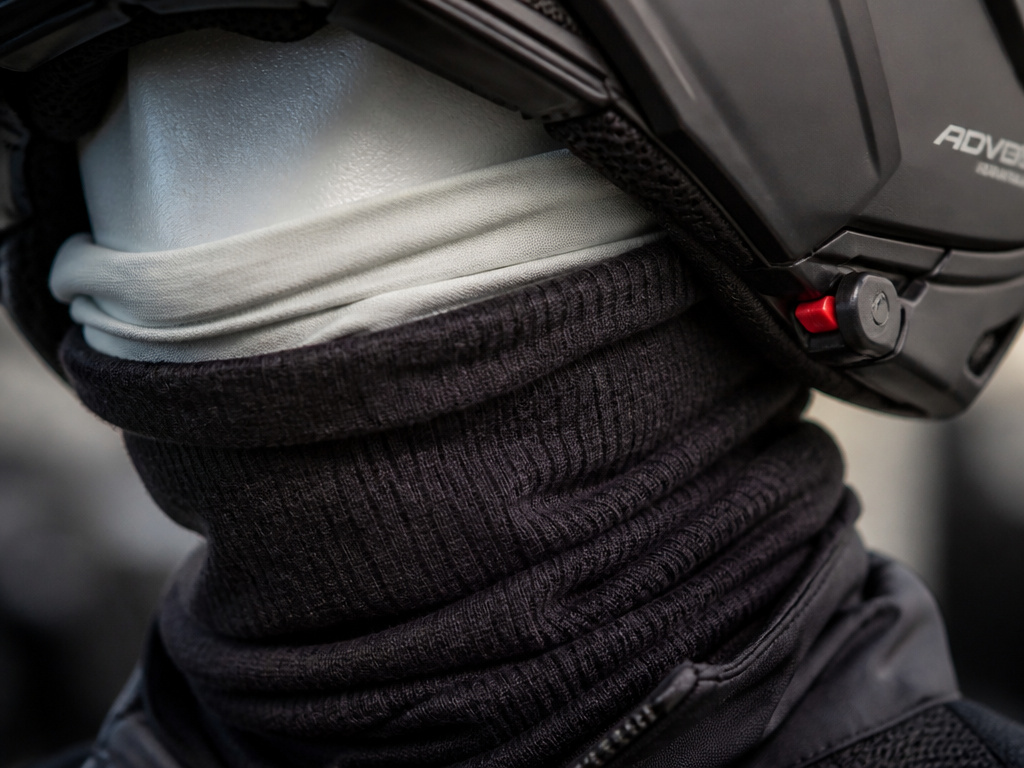
The fabric decides what season the gear belongs to. You wouldn’t wear a winter jacket in July, and the same logic applies here.
For hot weather and sun protection, an ice silk or cooling polyester gaiter works by evaporation. A UPF 50+ rated gaiter blocks about 98% of UV rays, making it a smart choice for long, sunny highway days. This is a summer-only piece.
For three-season versatility, a breathable Lycra balaclava is the default. It wicks moisture, dries fast, and fits easily under a full-face helmet. The Dainese Dry Balaclava, made of Dryarn® fabric, is marketed for year-round sweat management.
True winter gear demands specialized materials. The Dainese Thermo Balaclava uses Dryarn® and is rated for -20°C to 10°C. For the harshest wet-cold, the Spidi H2OUT® Balaclava uses a waterproof/windproof membrane. For natural performance, merino wool offers the best natural warmth-to-breathability ratio for a motorcycle balaclava in winter.
Dainese markets its Dry Balaclava as perfect for use all year round, while other sources categorize specific balaclava types for specific seasons. Brands categorize their gear into seasons for a reason.
When to Choose a Gaiter, When to Commit to a Balaclava
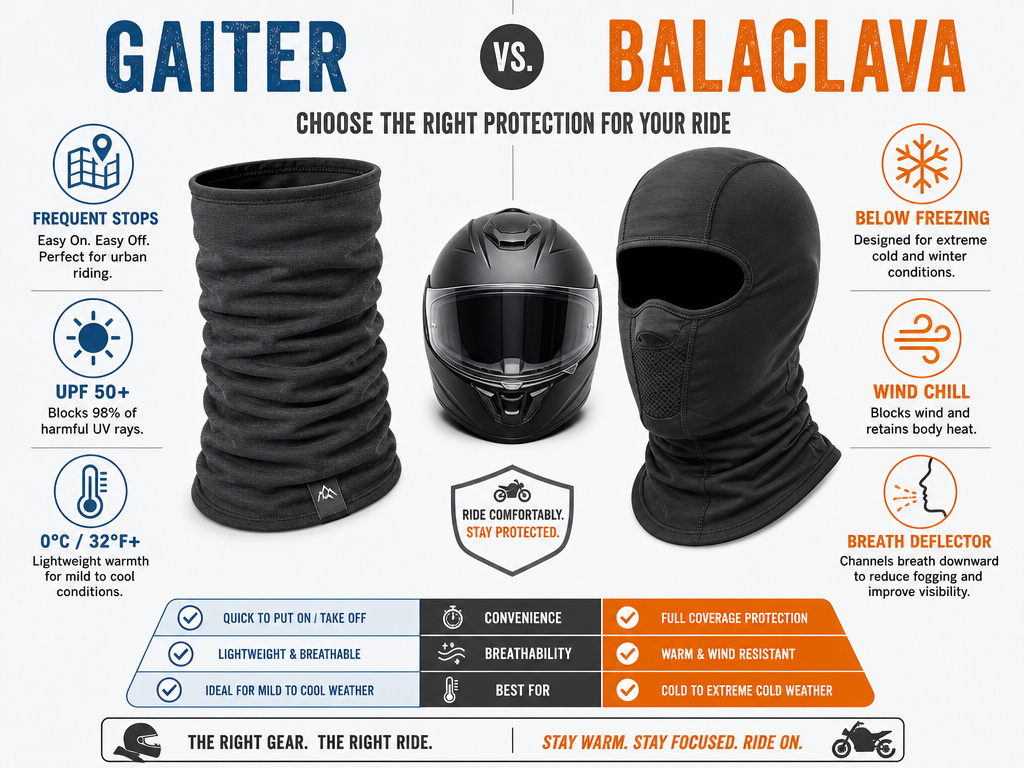
This is the decision tree. Your riding style gives you the answer.
Choose a Neck Gaiter If:
- You make frequent stops (deliveries, errands, city commuting).
- Motorcycle Gear Canada suggests a neck gaiter is superior for mild-to-moderate cold, generally above 0°C / 32°F, while other sources recommend balaclavas for broader temperature ranges.
- You have a tight-fitting helmet and can’t afford extra bulk.
- You need sun protection (prioritize a UPF 50+ rated model).
- You value a single piece that can also be a headband or hat.
Choose a Balaclava If:
- You ride long highway stretches in sustained cold (especially below freezing).
- Wind chill is your primary enemy (look for Windstopper, Gore-Tex Infinium, or H2OUT membranes).
- You need to manage long hair under your helmet.
- You want to reduce visor fogging with a dedicated breath deflector.
- You’re layering for extreme cold and need a dedicated, sealed base layer.
For the dusty backroads or dual-sport riding, the combination of a simple gaiter plus goggles is a classic solution, the tube seals neatly against the goggle frame better than a strapped mask can.
Sizing and Fit: Navigating the “One Size” Trap
Fit is everything, and the industry standard is unhelpfully vague. We will cut through the hype.
Most balaclavas are sold as one size fits most (OSFM). As noted by Motorcycle News testers put at least 1000 miles on gear before reviewing. Separately, they note that the common ‘one size fits most’ balaclava is tailored for the most common head size, a medium. If your helmet is a true small or large, this generic size will likely disappoint. It’ll likely fit poorly, being either too loose and shift, or too tight.
The solution is to seek out brands that offer specific sizes. It’s less common, but it exists. Don’t assume a stretchy fabric will compensate for a poor size match.
For gaiters, the primary fit issue is neck circumference and length. A gaiter that’s too loose will billow and slip; one that’s too short won’t tuck securely under your collar or pull up over your nose. Look for a gaiter that is roughly 19 to 21 inches long. A standard motorcycle neck gaiter is roughly 19 to 21 inches long on most brands.
The Bottom Line
Fit first, features second. Before you consider temperature ratings or fancy membranes, you must know how the piece fits under your specific helmet. A 4 mm thick fleece balaclava is a winter fortress, but only if your helmet can accommodate it.
A thin Lycra balaclava or a merino wool gaiter handles spring through fall. A dedicated windproof balaclava stands guard for winter highway slogs. The gaiter remains the king of convenience for mixed city riding.
The gear that keeps working is the gear that fits your ride, not just your head. Trust the ride, not the label.
What to look for in a tactical or hiking neck gaiter
When shopping for a gaiter, you’ll see a range of materials and features. A standard motorcycle neck gaiter is typically 19 to 21 inches long. Some technical gaiters, like the Dainese CILINDRO WS Neck Warmer, use fabrics like polyester and polyamide with a Windstopper® membrane. A UPF 50+ rated gaiter blocks about 98% of UV rays. Ice silk and cooling polyester gaiters work by evaporation. Some gaiters, like the Harley-Davidson Evo Thunder Neck Gaiter, feature moisture-wicking and antimicrobial properties.
The military history of the neck gaiter
The neck gaiter’s simple, tubular design has roots in practical field use. While our fact sheet focuses on modern motorcycle gear, the design principle is timeless. A tube of fabric is a versatile piece of kit for protecting the neck and face from sun, wind, and dust in harsh environments. This utility made it a natural fit for tactical and outdoor applications long before it was adopted by riders. Its ease of use and ability to be quickly adapted for different levels of coverage align with the needs of field operations where gear must be simple, durable, and multifunctional.
Comparing gaiter materials and features
Different gaiters serve distinct purposes based on their construction. A standard polyester gaiter offers basic wind and sun protection. For serious wind blocking, a model with a Windstopper membrane is key. In hot weather, an ice silk or cooling polyester gaiter uses evaporation to keep you cool and often carries a UPF 50+ rating for sun protection. For cold, a fleece or neoprene version provides warmth but adds bulk. The core trade-off is between the gaiter’s universal, quick-on convenience and its inherent limitation in wind sealing at speed compared to a secured balaclava.
Frequently Asked Questions
What is the difference between a balaclava and a neck gaiter?
Balaclava is a fitted hood covering the entire head and neck, designed as a dedicated helmet liner. A neck gaiter is a tube of fabric worn around the neck that can be pulled up to cover the lower face. The balaclava offers superior wind sealing and warmth; the gaiter offers quick on/off versatility.
Why do bikers wear neck gaiters?
Riders wear neck gaiters for versatile protection. They block wind and sun from the neck, can be pulled up as a face covering in dust or light cold, and can be removed in seconds during frequent stops, something a full balaclava can’t do.
Can you wear a neck gaiter under a motorcycle helmet?
Yes, most neck gaiters are designed to fit under a helmet. Choose a low-profile, moisture-wicking style and ensure it doesn’t interfere with your helmet’s chin strap or the seal around your visor. Tucking it under your jacket collar helps prevent it from sliding down.
Is a balaclava warmer than a neck gaiter?
Generally, yes. A balaclava covers the entire head and neck, providing more complete insulation. However, a heavyweight merino wool gaiter can be warmer than a thin synthetic balaclava in moderate cold. For extreme cold, a windproof balaclava is unmatched.
How do I stop my neck gaiter from sliding down while riding?
The most effective trick is to tuck the top edge of the gaiter under the bottom frame of your sunglasses or goggles. Also, choose a snug-fitting gaiter and tuck it completely under your jacket collar before zipping up to anchor it in place.
