
Motorcycle Lift vs Jack for a Home Garage: How to Choose
This post contains affiliate links. As an Amazon Associate, we earn from qualifying purchases.
A motorcycle lift is a full-height, stable platform for complete service, while a motorcycle jack is a compact, portable tool for targeted under-bike work. For a home garage, a lift table is the right choice if you have the space and budget for full-bike access and standing-height comfort, but a jack is the practical pick for tight spaces, low-clearance bikes, or riders who only need to lift the bike for wheels and oil changes.
The difference is not just size. It is a trade-off between a tool that becomes a workbench and one that tucks under a bench. A lift gives you a standing workspace; a jack gives you a kneeling workspace. That single decision changes how you store, use, and maintain your bike. The choice between a motorcycle lift vs jack for a home garage is fundamental.
What follows is a breakdown of the three numbers that decide the motorcycle lift vs jack for a home garage question, the specific jobs each tool is built for, and the safety habits that keep a 500-pound machine from becoming a garage-floor paperweight. By the end, you will know which one fits your bike, your space, and the work you actually do.
Key Takeaways
- According to one source, the minimum height of the tool rules out more bikes than the weight capacity, while another source leads with capacity and maximum height as the key comparative specs. A bike on its side stand needs at least 3.5 inches of clearance underneath for most jacks.
- A full-size lift table is a general-purpose work platform, while a compact scissor jack is for targeted, under-bike maintenance like wheel and chain work.
- Always transfer the load to a mechanical lock before working. Hydraulic seals can weep, and a visible drop is a seal to inspect.
- For long wheelbase cruisers or baggers, check the deck length. A 48-inch deck may not fully support a bike with a 64-inch wheelbase.
- Combining a lift table with a floor jack solves the wheel-spin problem, letting you lift one end of the bike while it’s on the table for tire or brake service.
Lift vs Jack: The Core Difference
Look at the business end of each tool. A motorcycle lift table, like the Harbor Freight 1000 lb. Motorcycle Lift (Item 68892), has a deck measuring 86-1/2 inches long by 26-3/4 inches wide. It is a stable, waist-high platform. A motorcycle jack, like the Black Widow Hydraulic Motorcycle & ATV Jack (Model BW-0101), has a platform measuring 40 inches long by 16 inches wide. It is a low-profile, mobile cradle.
A professional review of the Titan 1500 lb lift table, a comparable product, categorizes full-size tables as “general-purpose powersports tables” for comprehensive service. The same source says compact jacks “lift the bike so the rider can do wheel, chain, brake and oil work at a comfortable height. It does not give the rider a bench to stand on or a deck…”
This is the spine of the motorcycle lift vs jack for a home garage choice. Do you need a mobile workbench, or a precise lifting point? Your answer depends on three concrete numbers.
The 3 Numbers That Frame Your Choice
Forget marketing claims about versatility. Your garage floor and your bike’s frame decide what fits. These are the specifications you must match, in this order.
- Minimum Height. This is the gatekeeper. If the tool cannot slide under your bike, its capacity is irrelevant. A bike on its side stand, an ATV with a low skid plate, or a cruiser with floorboards may have only 4 inches of clearance. The Atlas Blackjack is built for this, with a 3-1/2 inch minimum height. Some hydraulic jacks, like the Black Widow BW-0101, have a minimum height of 4.875 in. Measure your frame’s lowest point when the bike is upright on its stand. That number rules out more tools than any other.
- Platform Size (Width x Length). Width determines stability; length determines support. A 16-inch wide jack provides a specific lifting platform, and users should ensure it adequately supports their bike’s frame or components. A 24-inch wide table supports a cruiser’s full footprint. Length matters for wheelbase. A 48-inch table deck supports most bikes, but a long-wheelbase bagger may have its rear tire hanging off the back. Check your bike’s wheelbase against the deck length.
- Working Height Range. How high do you need to go? For oil changes and chain cleaning, a lift that raises the bike to a comfortable working height is needed. For full exhaust or shock removal, you need table height—30 inches or more. The VEVOR 1000 lb Hydraulic Motorcycle Lift (Model JL-M03108) offers an 8.6 to 31 in. Range, while the VEVOR 1100 lb Scissor Lift Jack (Model JL-M01101) lifts from 3.74 to 13.38 in.
| Specification | Motorcycle Lift (Table) | Motorcycle Jack |
|---|---|---|
| Primary Use | Full-bike service platform | Targeted under-bike lifting |
| Typical Min. Height | 7–9 inches (e.g., Harbor Freight 68892: 7-7/8 in.) | 3.5–5 inches (e.g., Atlas Blackjack: 3-1/2 in.) |
| Typical Platform Size | 48″ x 24″ to 86″ x 26″ | 40″ x 16″ to 44″ x 18″ |
| Max Working Height | 30–34 inches | 13–16 inches |
| Portability | Low (165–254 lbs, often no casters) | High (29–85 lbs, often has casters) |
| Ideal For | Comprehensive repairs, long jobs, ATVs | Wheel/brake/chain service, tight spaces |
The Work You Actually Do
Your maintenance habits are a better guide than any spec sheet. Are you doing a seasonal oil change, or a winter teardown? The tool that fits the job you do most often is the right tool.
When a Motorcycle Lift Table Is the Answer
A lift table is a general-purpose powersports table. It turns a bike into a standing-height workbench. This is the tool for jobs where you need to walk around the bike, lay out tools, and apply force.
- Exhaust System Replacement: Swinging a muffler into place is a two-handed job you do not want to do on your knees.
- Fork or Shock Service: Removing a front end or a rear shock requires clearance and stability you only get with the bike at waist level.
- Winter Overhauls or Cosmetic Work: For detailing, wiring, or multi-day projects, a stable platform you can lean on is everything.
- ATV or UTV Maintenance: The wide deck of a table like the Titan 1500 lb Motorcycle ATV Lift Table is built for the track width of a quad.
The trade-off is space and effort. A table like the VEVOR JL-M03108 weighs 254.4 lbs and needs a permanent home. Pumping a hydraulic foot pedal to lift a heavy bike requires physical effort.
Where this goes sideways: Assuming the hydraulic pump is the primary safety. The Harbor Freight manual for its 1000 lb lift states you must “pass the Locking Bar through the holes” after lifting and “gently press Release Pedal to lower the platform to rest the load on Locking Bar.” The load should never rest solely on the hydraulic cylinder.
When a Motorcycle Jack Is the Answer
A jack is for targeted, under-bike maintenance. It gets the bike off the ground just enough to pull a wheel, scrub a chain, or drain the oil pan. Its job is access, not a work surface.
- Wheel Removal for Tire Changes or Brake Service: This is the jack’s core function. Center it under the frame or swingarm and lift.
- Chain Cleaning, Adjustment, or Replacement: A lift that raises the bike to a comfortable kneeling or sitting height is useful for chain work.
- Quick Oil and Filter Changes: Slide it under, lift, drain, lower. The whole job stays low to the ground.
- Storage in Tight Garages: A jack like the 29.3 lb VEVOR scissor lift can go on a shelf. A 254 lb table cannot.
The limitation is just that—it is a lift, not a table. You cannot safely stand on it or spread a full gasket set across it. For a detailed look at different jack options, our guide to motorcycle jacks breaks down hydraulic, scissor, and pneumatic models.
Safety, Hydraulics, and the One Habit That Matters
All the capacity in the world does not matter if the bike falls. The safety system is not just the tool; it is your routine. Hydraulic failure is a documented, known mode.
The Harbor Freight garage jack manual lists specific failure modes to troubleshoot: “Jack will not lift load,” “Jack will lift, but not maintain pressure,” “Jack will not lower after unloading,” and “Poor lift performance” from low fluid or air in the system.
Treat any visible drop—even a slow sink over an hour—as a seal to inspect. Set the bike on a mechanical lock or a stand before you walk away, and never get under a load held only by hydraulic pressure.
Before you start: Your floor must be level concrete rated for the load. The Harbor Freight 1000 lb lift requires a support surface rated for at least 1350 lb. Use tie-down straps to secure the bike at the handlebars or frame to the lift’s anchor points before you pump. Your first action after lifting should be to engage the mechanical lock and release hydraulic pressure.
Capacity, Weight, and Real-World Limits
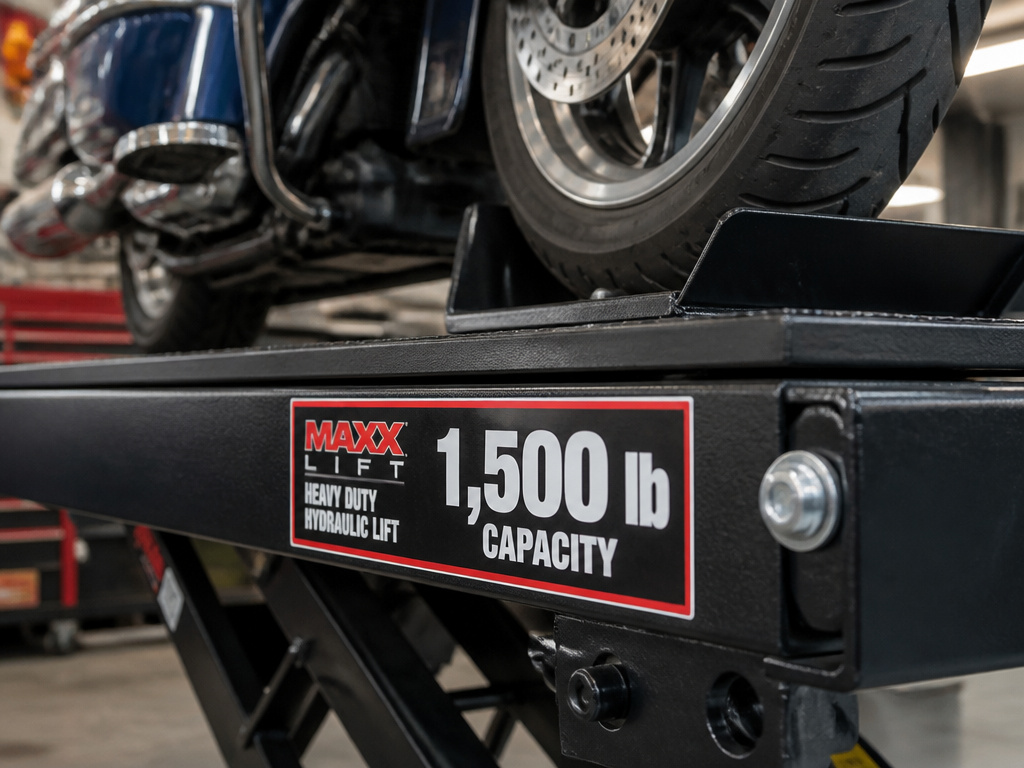
Manufacturer ratings are for a centered, static load. They are not an invitation to test physics.
- The 1,000 lb vs. 1,500 lb Debate: A 1,000 lb rating covers most production motorcycles. A heavy touring motorcycle can weigh around 900 lb. A 1,500 lb rating, like on the Black Widow BW-0101 or Garvee Hydraulic Jack, is for margin and for heavier ATVs. Do not confuse a Black Widow model. The hydraulic BW-0101 is rated for 1,500 lb, while a separate “Black Widow Steel Motorcycle Jack 1000 lbs” is rated for 1,000 lb.
- The Weight of the Tool Itself: A lightweight jack is portable but may use lighter-gauge steel. The VEVOR 1100 lb scissor jack weighs 29.3 lbs and uses a manual crank. The VEVOR 1000 lb hydraulic lift table weighs 254.4 lbs and is made from Q235B steel. The heavier build handles side loads and off-center weight better.
- Your Bike’s Wet Weight: Always use the curb weight (with fluids), not the dry weight. Add the weight of any luggage or accessories if they are on the bike when you lift it.
Power and Operation: Foot Pump vs. Hand Crank
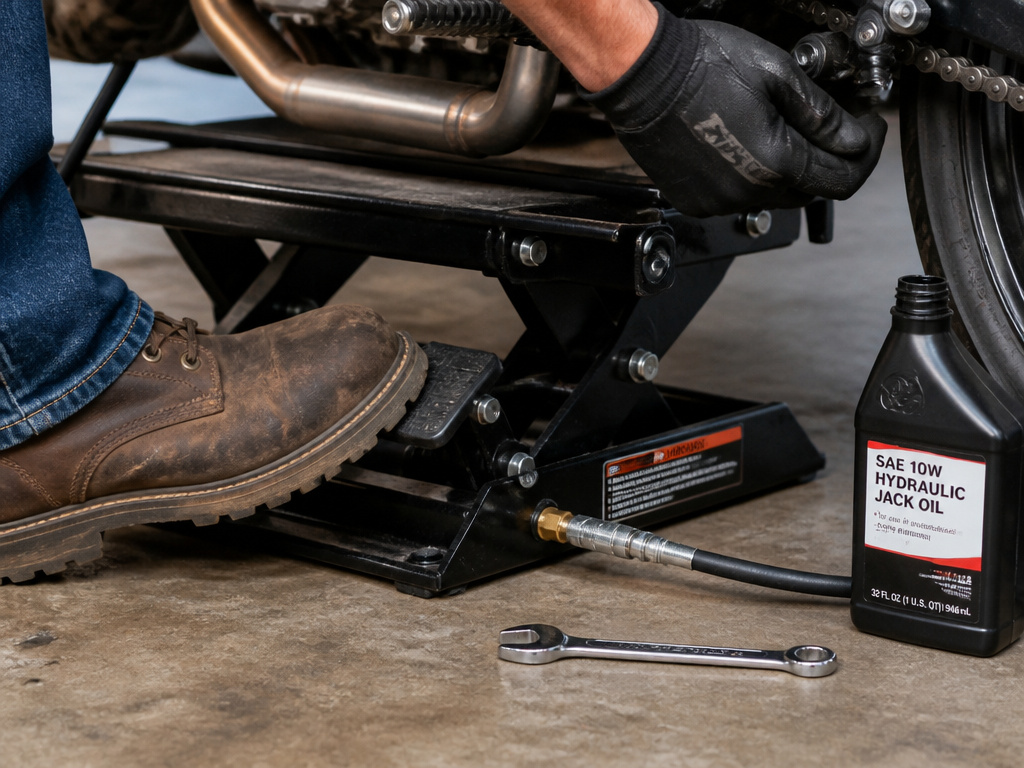
How you lift the weight is a matter of effort and trust.
- Hydraulic Foot Pump: Used on the Black Widow and Harbor Freight tables. A foot pedal allows you to keep two hands on the bike during the initial lift. It requires periodic maintenance with SAE Hydraulic Jack fluid and is subject to seal wear.
- Manual Crank: Used on the VEVOR 1100 lb scissor jack, operated with a 22mm hex socket wrench. It provides “positive mechanical safety” with no hydraulics to fail or leak. The trade-off is more turns of the wrench to reach full height.
- Air-Assisted: Some jacks, like the Black Widow, can be connected to an air compressor (90 psi minimum) to reduce pumping effort. This is a convenience, not a substitute for a mechanical lock.
Sources disagree on the best lift mechanism: one highlights that a hydraulic foot pedal allows you to keep two hands on the bike, while another states a manual crank offers positive mechanical safety and reliability. You can see the mechanism, and it will not slowly bleed down over a weekend project. For more detail on hydraulic floor jacks and their maintenance, we have a dedicated resource.
The Smart Combo: Using a Jack on a Lift
Here is a pro move most home garage articles miss: you do not have to choose just one. A lift table gives you full access, but the deck blocks the wheels from spinning freely. This is a problem for cleaning, balancing, or checking alignment.
The solution is to use a floor jack on the lift table. Once the bike is secured on the table at a comfortable height, use a low-profile floor jack under the front fork or rear swingarm to lift that wheel off the deck. Now the wheel spins, and you have a stable, standing-height work platform. This combination effectively gives you the benefits of a paddock stand and a full lift in one setup.
Long-Term Ownership: What Breaks First
A lift or jack is a long-term investment. Plan for maintenance and know the failure points.
- Hydraulic Systems: They require fluid checks. The Harbor Freight manual specifies adding SAE Hydraulic Jack fluid only and bleeding the system if the lift feels “spongy.” Common issues include weeping cylinder seals (causing overnight drift) and pumps that will not build pressure.
- Mechanical Parts: On scissor jacks, the screw and collar can loosen with use. Check pivot bolts annually. Casters can seize if not kept clean.
- Storage: For winter, lower the tool completely to relieve pressure on seals and cylinders. Store in a dry place.
These are not disposable tools. Buying a slightly heavier, better-built model often means fewer repairs over a decade of use. This philosophy extends to all your essential tools for home garage maintenance.
What are some specific motorcycle lift and jack models?
Common home garage options include full-size lift tables and compact scissor jacks. A full-size table, like the Harbor Freight 1000 lb. Motorcycle Lift, offers a large platform 86-1/2 inches long and 26-3/4 inches wide, lifting from 7-7/8 in. To over 30 inches high. It’s a general-purpose powersports table for complete service. In contrast, a compact scissor jack like the VEVOR 1100 lb model has a much smaller platform and lifts the bike just high enough for targeted under-bike maintenance like wheel or chain work. For bikes with very low ground clearance, a low-profile scissor jack that collapses to around 3-4 inches can fit underneath more easily.
Frequently Asked Questions
What is the best motorcycle lift for a home garage?
For most riders with a single bike and enough space, a mid-range lift table like the Titan 1500 lb Motorcycle ATV Lift Table offers a 48″ x 24″ deck, a 1,500 lb capacity, and a safety lock bar. If space is tight or you only work on sport bikes, a compact jack like the VEVOR 1100 lb Scissor Lift is a better fit.
Is the Harbor Freight motorcycle lift any good?
The Harbor Freight 1000 lb. Motorcycle Lift (Item 68892) is a capable, full-size table with solid specs: an 86.5″ x 26.75″ platform and a 30-1/8 in. Max height. It is good for the price if you follow the manual meticulously—especially the steps to bleed the hydraulic system and always use the locking bar.
Will a motorcycle jack lift a car?
No. A motorcycle jack is engineered for the specific weight distribution and frame contact points of a bike or ATV. Using it on a car is unsafe and will likely damage the jack and the vehicle’s undercarriage. Always use a jack rated for the vehicle’s weight.
What are the main differences between a lift and a jack?
Lift is a stable, stationary work platform you can stand at. A jack is a portable lifting tool you kneel beside. Lifts are for long, full-service jobs; jacks are for quick, targeted tasks like wheel removal. Lifts require more space and a higher budget.
Can I use a motorcycle jack on an ATV?
Yes, but you must check the jack’s platform size against the ATV’s frame or skid plate. A jack like the Black Widow BW-0101 is marketed for both motorcycles and ATVs, but a wide ATV may not be stable on a narrow jack platform. A lift table is generally safer for ATVs.
The Bottom Line
Your garage floor is the final judge. If you have a dedicated 4×8-foot spot on level concrete and work on your bike for more than an hour at a time, buy a lift table. The Titan 1500 or a comparable model is the default. If your bike lives in a crowded one-car garage, you rent, or you only pull wheels for tire changes, buy a jack. The VEVOR 1100 lb Scissor Lift or the Atlas Blackjack for low clearance are the practical picks.
One non-negotiable: whichever you buy, the first accessory is a set of heavy-duty tie-down straps. The second is the habit of locking the mechanical safety before your head goes under the frame. The tool is just the lift. The safety system is you.
