
Motorcycle GPS vs Phone Navigation: How to Choose
This post contains affiliate links. As an Amazon Associate, we earn from qualifying purchases.
Motorcycle GPS vs phone navigation comes down to a reliability-vs-convenience trade-off. A dedicated GPS, like a Garmin Zūmo XT, is built for the elements with an IPX7 waterproof rating, a glove-friendly screen, and full offline maps. Your phone wins on real-time traffic, a familiar interface, and zero upfront cost, but risks permanent camera damage from handlebar vibrations and can fail in rain or direct sun. For most riders doing serious miles, especially off-pavement, the GPS is the safer long-term buy.
That reliability difference concerns what happens when you’re two hours from the nearest town and your screen goes dark. The phone is a multi-tool; the GPS is a dedicated wrench. One is good at many things, the other is built for one job under punishing conditions.
What follows is a breakdown of where each option fails in the motorcycle gps vs phone navigation debate, the real cost of camera damage, and a straightforward checklist to match your riding style with the right tool. We’ll skip the marketing fluff and look at what you actually need.
Key Takeaways
- Mounting a phone directly risks a costly camera repair, both Apple and Google warn that high-amplitude vibrations from motorcycle engines can permanently damage optical image stabilization (OIS) systems. A quality vibration dampening mounts is mandatory, not optional.
- Dedicated GPS units guarantee offline operation, they come with continent-wide maps preloaded and weather-sealed hardware like the Garmin Zūmo XT’s IPX7 and MIL-STD-810 ratings for shock and vibration.
- Your decision hinges on three things: the remoteness of your routes, your tolerance for tech failure, and your bike’s vibration levels. A secure phone mounting solution works for the daily commute; a GPS is for the unknown.
The Core Trade-Off: Ruggedness vs. Convenience
The motorcycle GPS vs phone navigation comparison is about which one you can trust when everything gets wet, hot, and shaky. A phone is a consumer device that happens to navigate. A motorcycle GPS is a navigation device that happens to survive.
A dedicated GPS is engineered to a different standard. Take the Garmin Zūmo XT: its 5.5-inch display is rated for readability in direct sunlight, a feature phones chase with high-nit counts but often lose to thermal dimming. Its IPX7 rating signifies a high degree of waterproofing. Your phone might have a similar IP68 rating, but that’s for accidental drops, not a pressure-washing from road spray at 70 mph.
The Zūmo XT carries MIL-STD-810 certification for thermal, shock, and vibration resistance. This military standard is a benchmark for environmental toughness that no smartphone is designed to meet.
The convenience side is the phone’s domain. You already own it. Apps like Google Maps have superior real-time traffic, lane guidance, and points-of-interest data. For a quick jaunt on familiar roads, it’s obviously easier. But that ease has a physical cost the manufacturers are now shouting about.
The Direct Vibration Trade-Off
This is the single biggest practical concern that forums debate and OEM documents make terrifyingly clear. Your phone’s camera is not built for your handlebars.
Apple’s support document states it plainly: exposing your iPhone to high-amplitude vibrations from high-power motorcycle engines can degrade the camera’s optical image stabilization (OIS) and closed-loop autofocus (AF) systems. Google echoes this for Pixel phones, warning that such vibrations can cause permanent damage. Apple and Google warn this is a documented design limitation, though some motorcycle press and community sources argue the risk is manageable with a high-quality dampening mount.
The fix is isolation, not a better case. A mount with a vibration dampener is essential here. These use rubber or spring systems to absorb the high-frequency buzz that kills cameras. I’ve run phones for thousands of miles with a mount with a vibration dampener with no issues. Without one? That’s a gamble with a very expensive lens.
A dedicated GPS like the TomTom Rider 550 sidesteps this entirely. Its 13.5-ounce (383g) body and IP67-rated case are designed to be bolted directly to a motorcycle. The vibration concern is engineered out at the device level, not added on as an afterthought.
Sunlight, Gloves, and Battery: The Interface Battle
You ride with gloves. It rains. The sun glares. These are interface problems.
Sunlight Readability: Phone screens, even bright OLEDs, often rely on high brightness modes that drain battery and can trigger overheating. A GPS typically uses a transflective display that uses sunlight to enhance visibility, though some user forums argue the max brightness of modern phone OLED screens is sufficient for most conditions. The Garmin Zūmo 396’s 4.3-inch screen might seem low-res compared to a phone, but in a desert at high noon, you’ll see every pixel.
Glove Input: Capacitive touchscreens demand a conductive touch. Most riding gloves don’t provide that. You end up taking a glove off, using a stylus, or struggling with wet fingertips. Dedicated GPS units mix physical buttons with glove-friendly resistive touchscreens. I’ve punched the physical “back” button on a Garmin through thick winter gloves in a downpour. It worked. Every time.
Battery Life & Power: This is a logistics game. The TomTom Rider 550 has an internal battery, though its exact runtime can vary based on usage. A phone running navigation, screen at max brightness, with a Bluetooth headset connected, will have significantly reduced battery life compared to a dedicated GPS. This means managing a motorcycle charger. It’s another cable, another connection to fail. A GPS is typically hardwired to the bike’s battery, so it turns on and off with the ignition. It’s one less thing to charge, one less thing to forget.
Mapping and Connectivity: Offline vs. Real-Time
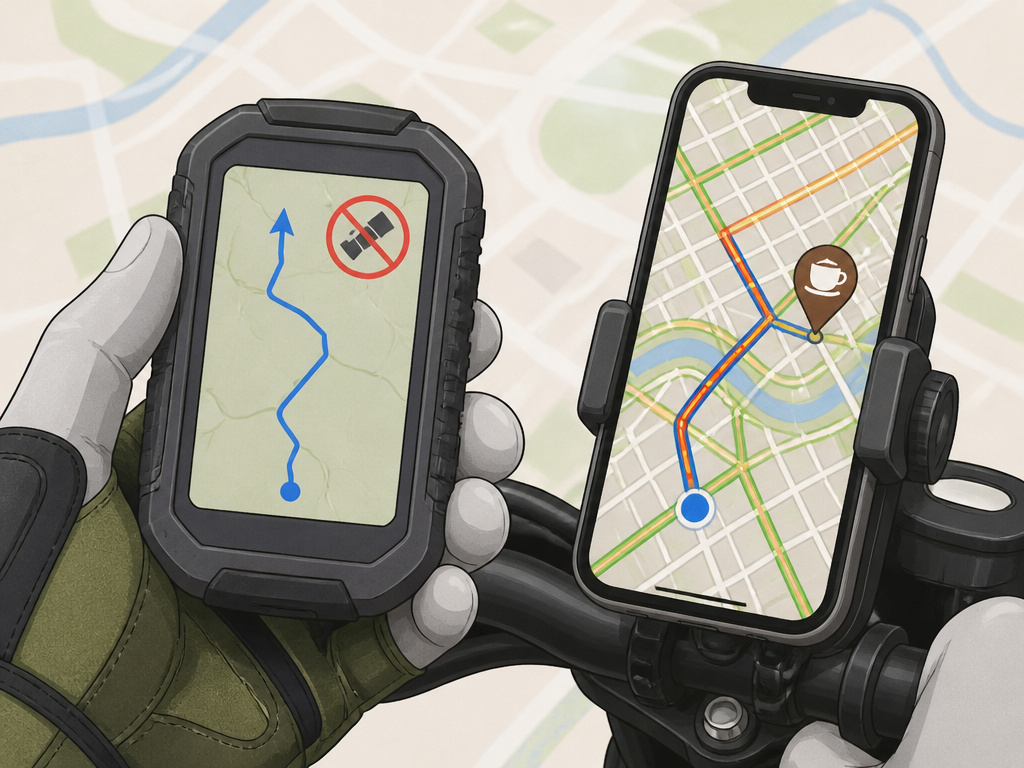
Your map is useless if you can’t see it. This is where the philosophies diverge completely.
| Capability | Dedicated Motorcycle GPS | Smartphone with Apps |
|---|---|---|
| Offline Maps | Preloaded for entire regions. No cell signal needed. | Must be manually downloaded for specific areas in advance. |
| Route Planning | Often clunky on-device. Best for simple A-to-B or imported GPX tracks. | Superior on a computer or large tablet screen. Easy to create and share complex routes. |
| Real-Time Data | Requires a tethered smartphone for traffic, weather, or updates. | Built-in. Live traffic, closures, and speed traps are automatic. |
| Adventure Routing | Functions like Garmin’s “Adventurous Routing” can find unpaved roads, but map data can be outdated. | Apps like Scenic or Kurviger are built specifically for curvy or scenic motorcycle routes. |
The GPS wins on set-and-forget reliability. You turn it on in Death Valley with zero bars and it works. The phone wins on intelligence and freshness. It knows the coffee shop that opened last week and that the bridge ahead is closed.
For touring, I plan routes on my phone or laptop, save them as GPX files, and load them onto the GPS. That gives me the best of both: intelligent planning and rugged, standalone execution.
How to Decide: The 3-Factor Checklist
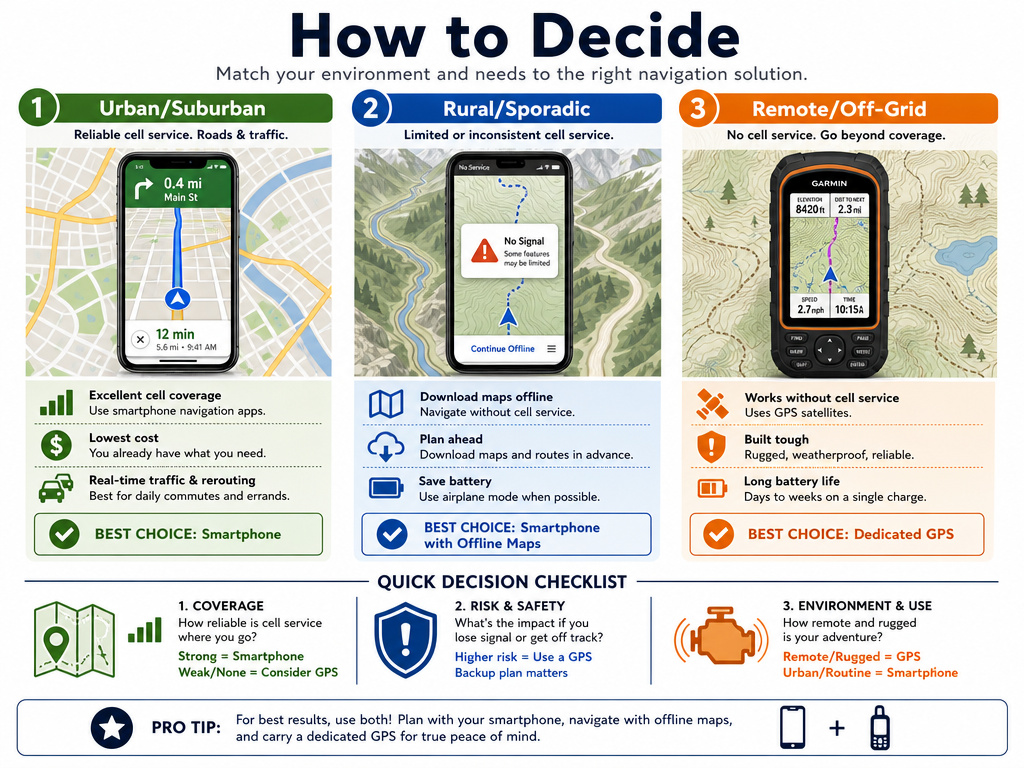
Don’t think about gadgets. Think about your last three rides. Then run them through this filter.
1. How remote are your typical routes?
- Mostly urban/suburban, cell service always present: Phone-friendly.
- Day trips through mountains or rural areas, sporadic service: Phone needs offline maps pre-downloaded.
- Multi-day touring, cross-country, or intentional off-grid travel: Dedicated GPS territory.
2. What’s your tolerance for failure?
- “If it dies, I’ll pull over and sort it.” Phone is acceptable with backup power.
- “Losing navigation would be stressful and potentially unsafe.” You need the reliability of a dedicated unit.
- “I rely on navigation for every turn; failure is not an option.” This is why GPS units exist.
3. What’s your bike’s vibration profile?
- Smooth inline-four, electric bike, or scooter: Lower risk, but a anti-vibration mounts is still wise.
- Large twin, adventure bike, or any high-displacement engine: High vibration risk. Consider a GPS or an extremely dampened phone mount.
Where this goes sideways: Assuming a phone in a waterproof case is “good enough” for a week-long trip through the Rockies. One dropped signal during a critical mountain pass turn can eat an hour as you backtrack.
For the vast majority of riders, the answer is a system that uses both. Your phone, kept safe in a pocket or tank bag, handles communication, music, and backup mapping. A dedicated GPS, mounted front and center, handles the primary navigation duty. This hybrid approach uses a wireless charger mounts to keep the phone topped up out of harm’s way.
Which is cheaper, a GPS unit or using my phone?
Your phone seems free because you already own it, but the real cost comes from accessories and risk. You’ll need a rugged, vibration-dampening mount and a weatherproof charging setup. The bigger expense is potential camera damage from motorcycle vibrations, a risk phone manufacturers explicitly warn against. A dedicated GPS is a single upfront purchase built for the job, with a mount designed to handle vibration. For occasional short trips, a phone might work. For regular riding, factor in the full cost of protecting a device that was never meant to be on your handlebars.
Frequently Asked Questions
Can I use my phone as a GPS on a motorcycle?
Yes, but you must mitigate two major risks: vibration damage to the camera and water exposure. This requires a high-quality secure phone mounting solution with a proven vibration dampener and a reliable waterproof case or bag. Always download offline maps for your route beforehand, as cell service is unreliable on many riding roads.
What is the best navigation system for motorcycles?
There is no single “best.” For adventure riders and long-distance tourists, the Garmin Zūmo XT is the benchmark due to its ruggedness, glove-friendly 5.5-inch screen, and preloaded TopoActive maps. For street riders who mostly commute or take day trips, a smartphone with a mount with a vibration dampener and apps like Google Maps or Calimoto is often sufficient and more cost-effective.
Is a GPS more accurate than a phone?
For positional accuracy, they are virtually identical, both relying on the same satellite GPS signals. The difference is in reliability and functionality. A GPS maintains accuracy without any cellular connection and is designed to maintain a lock while moving at high speeds through tree cover or canyons, where a phone might stutter.
Do I need a motorcycle-specific GPS, or can I use a car GPS?
Use a motorcycle-specific model. Car GPS units are not built for constant vibration, moisture, and temperature extremes. They lack glove-friendly interfaces, and their mounts will fail on a bike. Motorcycle GPS units like the Zūmo or Rider series have tougher build standards, like MIL-STD-810 or IPX7 ratings, and brighter, more visible screens.
The Bottom Line
Stop looking for a winner. Start building a system that doesn’t fail.
If you point your bike toward the horizon where cell towers don’t reach, buy a dedicated GPS. For most riders who do both, the hybrid setup is the smart play: a GPS for primary routing and a safeguarded phone for everything else.
Your navigation choice should be as deliberate as your helmet choice. It’s not about features; it’s about what works when the conditions turn against you.
