
Motorcycle Frame Types Explained
This post contains affiliate links. As an Amazon Associate, we earn from qualifying purchases.
Motorcycle frame types define how a bike handles, what it weighs, and where it will crack under stress. The five main designs are backbone, cradle (single and double), perimeter (twin spar), trellis, and monocoque. Your riding style, cruiser, sport, off-road, dictates which frame construction makes sense, but the choice always trades weight for stiffness, and cost for complexity.
That stiffness trade-off is a physics problem, not a marketing one. A frame’s only real job is to connect the steering head to the swingarm pivot without flexing under braking or cornering forces. How it does that, with fat aluminum beams, skinny steel tubes, or a hollow carbon box, changes everything you feel through the bars and seat. Understanding motorcycle frame types explained is key to appreciating these differences.
What follows is a breakdown of each frame type, the bikes that use them, and the engineering reasons they fail or succeed, which is the essence of any good motorcycle frame types explained guide. By the end, you’ll be able to walk up to any bike, spot its frame design, and know exactly what that means for a ride.
Key Takeaways
- Frame choice dictates handling feel more than horsepower; a stiff perimeter frame telegraphs every bump, while a flexible backbone frame absorbs them for a softer, slower ride.
- Steel cradle frames are cheap and heavy, perfect for low-power cruisers; aluminum perimeter frames are light and stiff, the default for modern sportbikes.
- The engine is a stressed member in backbone and diamond frames, meaning it carries structural load; remove it carelessly and the bike sags.
- Carbon fiber and hybrid frames (steel, aluminum, CFRP) exist in prototypes and race bikes, but mass production still relies on welded aluminum for its blend of stiffness, weight, and predictable recovery after welding.
- Visual identification is simple: identify a large main tube (backbone), a loop under the engine (cradle), a triangle lattice (trellis), or two beams boxing the engine (perimeter).
The Core Job of a Motorcycle Frame
A motorcycle frame isn’t a platform. It’s a bridge. Its entire reason for existing is to provide a torsionally rigid connection between the steering head at the front and the swinging-arm pivot at the rear. Everything else, holding the engine, mounting the seat, cradling the fuel tank, is secondary. If that bridge twists under load, the handling gets vague, unpredictable, and eventually dangerous.
Some bikes skip the single-frame idea entirely. They use the engine as a load-bearing stressed member, with a front and a rear subframe bolted directly to it. This is common on some adventure bikes and older classics. Most modern motorcycles, however, use a full frame that either cradles the engine or uses it as a stiffening element.
Where this goes sideways: A frame that’s too flexible lets the front and rear wheels move out of sync under hard braking or cornering. The rider feels a delayed, mushy response from the bars, and the bike loses the crisp, connected feel that allows precise control. In a true monocoque chassis, all forces travel through the outer shell, not through an internal skeleton.
The best way to understand this force path, after the motorcycle frame types explained, is to trace it with your hands. Start at the twist grip. Follow the throttle cable down to the throttle body, then to the crank, through the gearbox, down the chain, and finally to the rear tire’s contact patch. When you physically touch each component, the frame’s role as the rigid backbone that ties it all together clicks into place. I’ve done this walk-around with newer riders; after about 20 minutes, they stop calling the swingarm pivot “the back thing.”
Frame Types by the Numbers
You can group every production motorcycle frame into one of five main families. The differences come down to geometry, material, and how, or if, they encapsulate the engine.
| Frame Type | Classic Example | Best For | The Trade-Off |
|---|---|---|---|
| Backbone / Spine | Older Honda singles, many small scooters | Low-cost, low-power simplicity | Not very stiff; relies on the engine as a stressed member. |
| Single / Double Cradle | Classic British twins (Norton Featherbed), Harley-Davidson cruisers | Cruisers, retro bikes, entry-level models | Heavy for the stiffness provided; simple and cheap to manufacture. |
| Perimeter / Twin Spar | Modern Japanese sportbikes (CBR-RR, GSX-R) | Sport riding, track days, high-performance street | Can feel wide with inline-four engines; complex casting/welding. |
| Trellis | Ducati Streetfighter, older KTM Duke/Super Duke | Aggressive street riding, lightweight race applications | Labor-intensive welding; largely supplanted by perimeter designs. |
| Monocoque | Kawasaki ZX-12R (2000), some Ducati Panigale models | Maximum stiffness for racing; integrated aerodynamics | Very expensive to produce; makes engine access a chore. |
Backbone Frame: The Simple Tube
A backbone frame is about as simple as it gets. A single, large-diameter tube, usually steel, runs from the steering head, over the top of the engine, to the swingarm pivot and subframe mount. The engine bolts directly to this backbone and essentially hangs from it. These frames are not very stiff on their own, so the engine must be mounted rigidly and often acts as a stressed member to add overall chassis rigidity.
You’ll find backbone frames on small-displacement bikes, scooters, and some minimalist custom builds. Their simplicity means low cost and easy modification, but they’re unsuitable for high-horsepower applications where torsional flex would become a problem.
Cradle Frame: The Engine Loop
Cradle frames, true to their name, form a loop under the engine. A single cradle has one tube running beneath the motor, while a double cradle or duplex frame has two. The classic Norton Featherbed frame is the textbook example, though many so-called duplex frames actually use a single spine beneath the tank with additional cradling below.
These frames are fairly cheap and easy to make but quite heavy for their given stiffness. They were the standard for decades and are still common on cruisers and retro-style bikes where outright handling performance is secondary to style and cost.
Perimeter Frame: The Modern Standard
The perimeter frame, often called a twin spar or beam frame in common parlance, is the default for modern sportbikes. Note that some technical classifications use ‘perimeter frame’ as a broader category that includes designs like the delta-box. Two beams, usually fabricated from aluminum, curve around the perimeter of the engine, connecting the steering head to the swingarm pivot. Antonio Cobas is credited with pioneering the modern aluminum perimeter chassis in 1982. By the 1990s, all major Grand Prix racing teams used his design.
This setup provides excellent stiffness for precise handling and often uses the engine as a stressed member. The downside is width; wrapping beams around a wide inline-four engine can make the bike feel broad at the knees. The BMW HP4 Race even uses a carbon fiber version of this design.
The part nobody mentions: That famous perimeter stiffness comes from the material as much as the design. The switch from steel to aluminum tubing allowed beams to be larger and stiffer without a massive weight penalty. But welding aluminum changes its properties, and the frame must be heat-treated after to recover strength, a process Honda’s engineers documented takes a specific alloy (7003-T4 aluminum) about 12 days to complete after paint curing.
Trellis Frame: The Triangular Lattice
A trellis frame uses many small-diameter steel tubes welded together into a triangular lattice structure. The triangle is the strongest geometric shape in engineering, making these frames fairly light and dead strong. They offer fantastic feedback and were a hallmark of Ducati and KTM for years (KTM used one in MotoGP until relatively recently).
The catch is manufacturing complexity. Hand-welding a trellis is time-consuming and expensive, which is why most major manufacturers have moved to more automatable perimeter designs. Ducati’s shift away from the trellis on models like the modern Monster remains a sore point for purists.
Monocoque Frame: The Stressed Skin
In a true monocoque, the outer skin carries all the structural loads, like an airplane fuselage or a Formula 1 car. On motorcycles, this often manifests as a large, hollow box section that also houses the airbox, electronics, and sometimes even the fuel tank.
True monocoques are rare because they complicate everything, engine access, wiring, and manufacturing. Ducati’s Panigale “monocoque” is more accurately a highly integrated frame that uses the engine as a central, stressed element with massive cast alloy side plates.
Trellis vs. Perimeter: The High-Performance Split
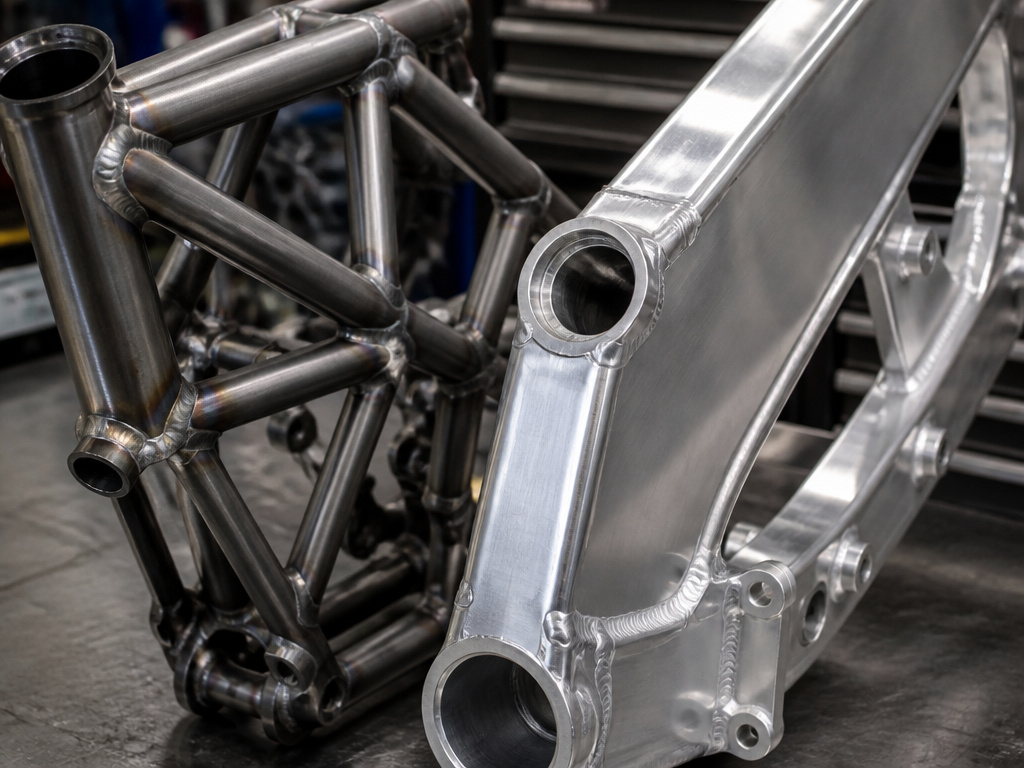
If you’re looking at a serious sportbike or naked bike, the choice often narrows to trellis or perimeter. It’s not just an aesthetic debate; the difference shows up in your hands.
A trellis frame (think Ducati Streetfighter, older KTM Super Duke) is a collection of short, straight steel tubes. The welds are everywhere, but the triangulation means stress is distributed across many small members. The result is a specific kind of feedback: very direct, slightly nervous, and incredibly informative. You feel the road texture more. The frame is also lighter at a given stiffness level, but only if welding costs are ignored.
A perimeter frame (think Yamaha YZF-R1, Honda CBR1000RR) uses two long, curved aluminum beams. The stiffness comes from the deep section of those beams, not from triangulation. The feel is different, slightly more damped, less busy, and incredibly stable at high speed. It’s the engineering choice when the priority is isolating the rider from minor vibrations to focus on pure stability.
So which wins?
- For track use and ultra-precise feedback, a well-made trellis is hard to beat. It’s the choice of many custom builders and race shops.
- For mass production, high-speed stability, and cost control, the perimeter frame is the clear choice. It’s why you see it on every Japanese superbike.
This is the core of motorcycle chassis engineering: translating a rider’s input into pure, unadulterated machine response. The frame is the translator.
What the Frame is Made Of: Steel, Aluminum, and Beyond
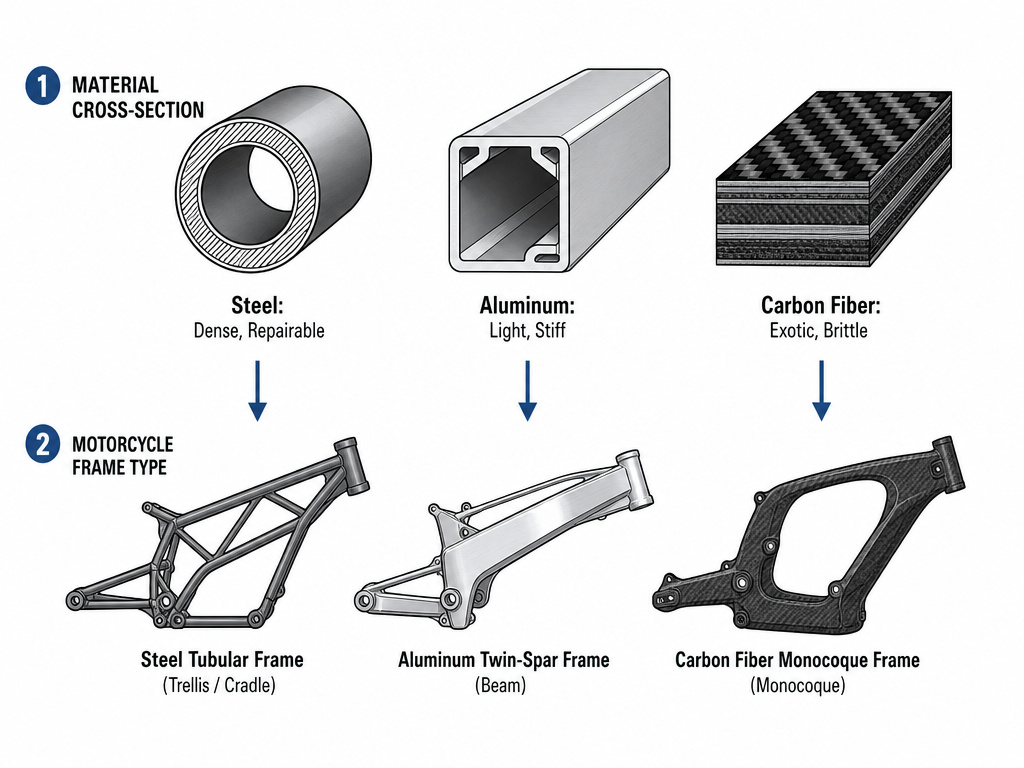
The frame’s shape decides its job. The material decides whether it can do that job without breaking or weighing a ton.
Steel is the old reliable. It’s relatively cheap, easy to weld and repair, and has a strong strength-to-weight ratio. Most cradle and trellis frames are steel. Its fatigue life is predictable, and it’s tolerant of less-than-perfect welding. The downside is density; to get the same stiffness as aluminum, you need more mass.
Aluminum is the modern standard. It’s about one-third the density of steel, so designers can use larger, stiffer beam sections without a weight penalty. Almost all perimeter frames are aluminum. The catch is fabrication. Welding aluminum weakens the heat-affected zone, so frames must be heat-treated afterward, the “reversion and recovery” process documented in Honda’s research. Their tests showed that under specific paint curing conditions, the 7003-T4 aluminum frame material required 12 days to recover to the target hardness, while the hardness of the welds returned to the as-welded condition within 14 days.
Carbon Fiber is the exotic outlier. It’s incredibly stiff and light, but it’s brittle in comparison to metals and fears point impacts. In 1983, Armstrong motorcycles produced a 250cc Grand Prix motorcycle using a revolutionary carbon fiber frame, and Ducati’s 2020 Panigale V4 Superleggera features a carbon frame, carbon wheels and swingarm. For now, it remains a cost-no-object material for limited-production hyperbikes.
Hybrids and Composites are the research frontier. Academic studies analyze frames mixing steel, aluminum alloy, and Carbon Fiber Reinforced Polymer (CFRP). The goal is to place the right material exactly where the load demands it. These aren’t common yet, but they point to where frame technology is headed once costs come down.
How to Spot Frame Damage (And Why It Matters)
A bent frame is a dead bike. It’s almost never cost-effective to repair, and a damaged frame will never handle correctly again. Here’s what to look for, whether you’re buying used or inspecting after a tip-over.
Visual checks come first. Look for:
- Cracks or wrinkles in the paint, especially around welds, steering head, and swingarm pivot points. Paint doesn’t crack by itself.
- Misalignment. Sight down the bike from the front. The front wheel, steering head, and rear wheel should be in a straight line. A visible dog-leg means trouble.
- Uneven gaps. Are the gaps between the fuel tank and frame equal on both sides? Do the body panels line up?
Functional tests come next. These are simple but revealing:
- Steering head bearing test: Lift the front end. Grab the fork legs and push/pull. Any clunk or notchiness means worn bearings and possible frame damage where the steering stem is pressed in.
- Swingarm pivot test: Lift the rear. Try to wiggle the swingarm side-to-side. Any play here is bad news; the pivot bearings or the frame’s mounting points are worn.
- Symmetry test: Measure the distance from the swingarm pivot to the axle on both sides. They should be identical.
Common mistake: Assuming a light drop only scratches the bar ends and levers. Even a stationary tip-over can tweak the frame if the bike lands hard on a protrusion like a footpeg or crash bar. The force travels straight into the mounting points.
A bent frame isn’t a cosmetic issue. It changes the rake and trail, the fundamental geometry that determines how a motorcycle steers and holds a line. That’s a problem no suspension tweak can fix.
Frequently Asked Questions
What are the different types of motorcycle frames?
The five primary types are backbone, cradle (single and double), perimeter (twin spar), trellis, and monocoque. Each uses a different structural approach, from a single large tube to a triangulated lattice, to connect the steering head to the swingarm pivot while supporting the engine.
Are 883 and 1200 Sportster frames the same?
While visually similar, the frames for Harley-Davidson Sportster 883 and 1200 models often have different engineering details to handle the increased power and torque of the larger engine. Mounting points and wall thicknesses may vary. They are not always directly interchangeable without modification.
What is the 12-second rule on a motorcycle?
This is a general guideline for new riders regarding following distance. It suggests you should be at least 12 seconds behind the vehicle in front, giving you far more time to react to hazards than the standard 2-second rule for cars. It’s about creating a safety buffer at motorcycle speeds.
Which motorcycle frame is best?
There’s no single “best” frame. The best frame for a cruiser is a heavy, simple steel cradle. The best frame for a track-day sportbike is a stiff aluminum perimeter. Your riding style chooses the frame: cruisers use cradle, sportbikes use perimeter, aggressive naked bikes often use trellis, and hyperbikes experiment with monocoque or carbon.
Before You Go
Forget memorizing specs. Walk into a garage or a dealership lot and practice spotting the frames. Identify the big tube over the engine (backbone), the loop underneath (cradle), the cage of small tubes (trellis), or the two beams boxing it in (perimeter). That skill tells you more about how a bike will ride than any brochure.
The frame is the one part of the motorcycle you can’t upgrade later. You pick it when you buy the bike. So match it to the job: a perimeter frame for canyon carving, a cradle for relaxed cruising, a trellis if you live for raw feedback. Everything else, the engine, the suspension, the brakes, builds on that foundation. Get the foundation wrong, and you’re fighting the bike every time you lean into a corner. Get it right, and the machine disappears beneath you.
