
Motorcycle Crash Detection Apps Explained: How to Choose
This post contains affiliate links. As an Amazon Associate, we earn from qualifying purchases.
Motorcycle crash detection systems use sensors, on your bike or in your phone, to recognize a sudden impact or fall. The best systems then send your GPS location and vehicle data to emergency services or contacts automatically. A phone app is the simplest and cheapest option, while built-in or aftermarket eCall modules follow stricter technical standards like DIN SPEC 70009-5.
If you miss the part about the 20- to 30-second delay, you are missing the whole point of the design. That window is the safety release valve that stops a false trigger from summoning paramedics because you dropped your bike in the driveway. Systems built to the DIN standard give you that chance to cancel. Many phone apps do not. This is a key point in motorcycle crash detection apps explained.
What follows is a walk around the three paths to crash detection: the phone in your pocket, the module wired into your bike, and the factory system you might already own. We will trace where the data flows, what a real standard requires, and why a certified eCall unit has a better chance of working when the road surface is the last thing you feel.
Key Takeaways
- Phone apps are affordable and simple, but they rely entirely on your smartphone’s sensors and signal, and most lack the 20- to 30-second cancellation window mandated by professional standards.
- A true motorcycle eCall system per DIN SPEC 70009-5 must transmit specific data fields, including impact direction and vehicle roll angle, not just a location.
- Aftermarket modules like the Wunderlich dguard® require a permanent, hardwired connection to the bike’s battery and ignition-switched power, creating two potential points of failure.
- Testing for motorcycles focuses on vibration, water, and voltage spikes, environments that would kill a consumer phone or a poorly built accessory.
- The best approach for most riders is a layered safety toolkit: a reliable phone app for daily use, plus understanding the limitations of any system that depends on a cell signal.
How Smartphone Apps Like REALRIDER and Detecht Work
You mount your phone, start the app, and ride. The process could not look simpler. Under the hood, the app is polling your phone’s inertial measurement unit, the same accelerometer and gyroscope that know when to flip your screen, hundreds of times a second.
The motorcycle eCall triggering algorithm needs to consider acceleration, angular velocity, vehicle tilt angle, and airbag deployment status.
That line from the DIN SPEC 70009-5 shows what a professional system evaluates. Your phone app is doing a version of the first three. It is watching for a sudden, multi-axis deceleration that does not look like hard braking. It is checking if the phone’s orientation has gone from upright to horizontal and stayed there. Some apps also listen for the distinctive, high-frequency vibrations of a crash or scrape through the phone’s microphone. When enough of these thresholds trip in a specific sequence, the app declares an accident.
The next steps depend on the app. Most will first try to get your attention with a loud, persistent alarm. You have a few seconds to tap a button to cancel. If you do not respond, maybe you cannot, the app moves to alert. It grabs your GPS coordinates, opens a data connection, and sends an SOS message with your location to your pre-set emergency contacts. Some premium services can route the alert directly to local emergency dispatchers, but that is rare.
What most people get wrong: Assuming the app works if the phone is in a pocket or tank bag. For impact detection, the phone needs to be firmly coupled to the bike’s frame, usually via a handlebar or stem mount. A phone bouncing in a jacket pocket will dampen the forces and likely miss the event. For the cancellation alarm to be heard, the phone’s speaker needs to be unobstructed and loud, often impossible over wind and engine noise with a full-face helmet.
| App Feature | How It Works | Risk If Skipped/Misunderstood |
|---|---|---|
| Sensor Access | Uses phone’s built-in IMU (accelerometer, gyroscope). | Phone in pocket or bag dampens crash impulses; event is missed. |
| Crash Validation | Algorithm checks for sustained unusual orientation after impact. | A simple drop or hard bump can trigger a false positive without this layer. |
| Alert Method | Sends GPS location via SMS/data to preset contacts. | Fails completely in areas with no cellular reception, giving a false sense of security. |
| Cancellation Window | Typically 5-15 seconds of audible alarm before sending. | Much shorter than the DIN standard’s 20-30 seconds; easy to miss if unconscious or distracted. |
I have watched riders download an app, set it up once, and then never think about it again. They trust the technology implicitly. The problem is that trust is placed in a consumer device operating in one of the harshest electronic environments we have: the vibration through a motorcycle’s handlebars is measured in G-forces, not megapixels. An app can only work if the phone’s sensors are still functional and calibrated after months of that abuse. Many are not.
The Core Components of a Crash Detection System
A purpose-built system is different. It is hardware you install, following a standard. The European DIN SPEC 70009-5 lays out exactly what a motorcycle eCall system must include. Think of it as a blueprint for what a phone app tries, but fails, to be.
The system starts with a map of mandatory parts. You need a main control unit, typically a small, sealed computer. You need a collision sensor, which is a specialized accelerometer designed to be installed near the vehicle’s center of gravity. You need a GNSS receiver for location, a mobile communication module with its own SIM card, a microphone for the eventual voice call, and a simple button or screen for you to interact with it.
Installing this is not plug-and-play. The Wunderlich dguard® manual is blunt about the wiring: the module must connect to the vehicle battery (“terminal 30”) and the switched positive pole of the circuit switched by the ignition (“terminal 15”). That means tapping into your bike’s electrical system. If you are unsure about finding the correct ignition-switched circuit, the manual tells you to ask a dealer. Many riders should.
Before you start: Working with a motorcycle’s electrical system carries risk of short circuits, battery drain, or damage to the ECU. If you connect the permanent power (“terminal 30”) but miss the ignition-switched signal (“terminal 15”), the module may stay on constantly and drain the battery flat within days. Always use a multimeter to verify the circuit is dead with the key off.
The components have specific jobs. The collision sensor feeds raw G-force data to the control unit. The control unit runs the triggering algorithm, checking acceleration, angular velocity, and tilt, to decide if this is a crash or just a pothole. If it decides it is a crash, it starts a timer. This is where the standard’s 20- to 30-second delay period kicks in. The system will typically activate a visual or audible alert on the bike itself, giving the conscious rider a chance to cancel. If the rider does not cancel, the system then activates.
What a Motorcycle eCall System Actually Sends
When a certified eCall system triggers and is not canceled, it does not just send a text saying “I crashed.” It transmits a structured Minimum Set of Data (MSD) directly to a public safety answering point. The DIN SPEC 70009-5, as motorcycle crash detection apps explained, specifies required data fields for transmission. Reading this list shows you what a phone app leaves out.
This tells rescuers if the bike is on its side and which way it was hit.
Compare that to a typical smartphone app alert. Your contact gets a Google Maps link and maybe a note: “Motorcycle crash detected.” They have no idea if you were t-boned at an intersection or slid out on a curve. They do not know if you are lying in a ditch or trapped under the bike. The data from a true eCall system gives professional responders a fighting chance to size up the scene before they even get in the ambulance.
Here is what actually held up. I have seen the inside of a system built to this spec. The circuit boards are potted in epoxy. The connectors are automotive-grade and sealed. The collision sensor installation is recommended to be multi-axis to detect impacts from any direction, not just forward deceleration. This is because a motorcycle crash is not like a car crash. You can be hit from the side, lowsided, or highsided. The sensor must see all of it.
The Sensor Fusion Challenge on Two Wheels
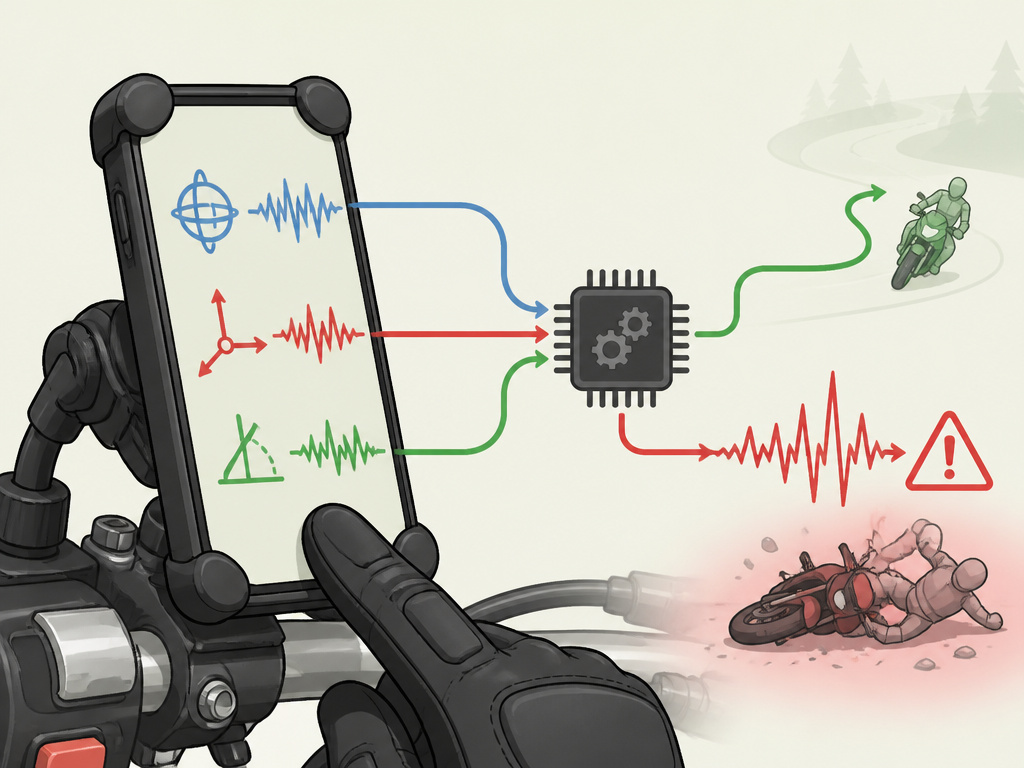
A car is a stable platform. A motorcycle is not. This difference is everything for a crash algorithm. The DIN standard knows this. It says the triggering algorithm must consider acceleration, angular velocity, and vehicle tilt angle. In practice, this means the system is constantly comparing data from the gyroscope (which measures rotation) with data from the accelerometer (which measures linear force).
The goal is to filter out normal motorcycle motions. Leaning hard into a corner produces high angular velocity and a sustained tilt angle. A hard stop produces high deceleration. The algorithm has to learn that these, together, are likely just riding. It is looking for the signature that says “this combination does not happen in normal control.” A sudden, massive deceleration plus an immediate and extreme change in tilt angle plus a violent rotational spike, that is the fingerprint of a crash.
Multi-axis sensor installation is recommended to ensure omnidirectional detection capability.
That recommendation from the standard is a direct response to the two-wheeler problem. Mount a single-axis sensor facing forward, and a side impact or a lowside might not register with enough force to trip the threshold. The system needs to feel the world in three dimensions.
This sensor fusion is also the weak spot of phone apps. Your phone’s IMU is good, but it is designed for a device sitting on a table or in a hand, not for something experiencing sustained, high-frequency vibration at 70 mph. Calibration drifts. Some phones even have software filters that smooth out sudden motions to improve camera stability, exactly the data a crash detection app needs. You cannot turn that filter off.
Phone App vs. Built-in eCall vs. Aftermarket Module
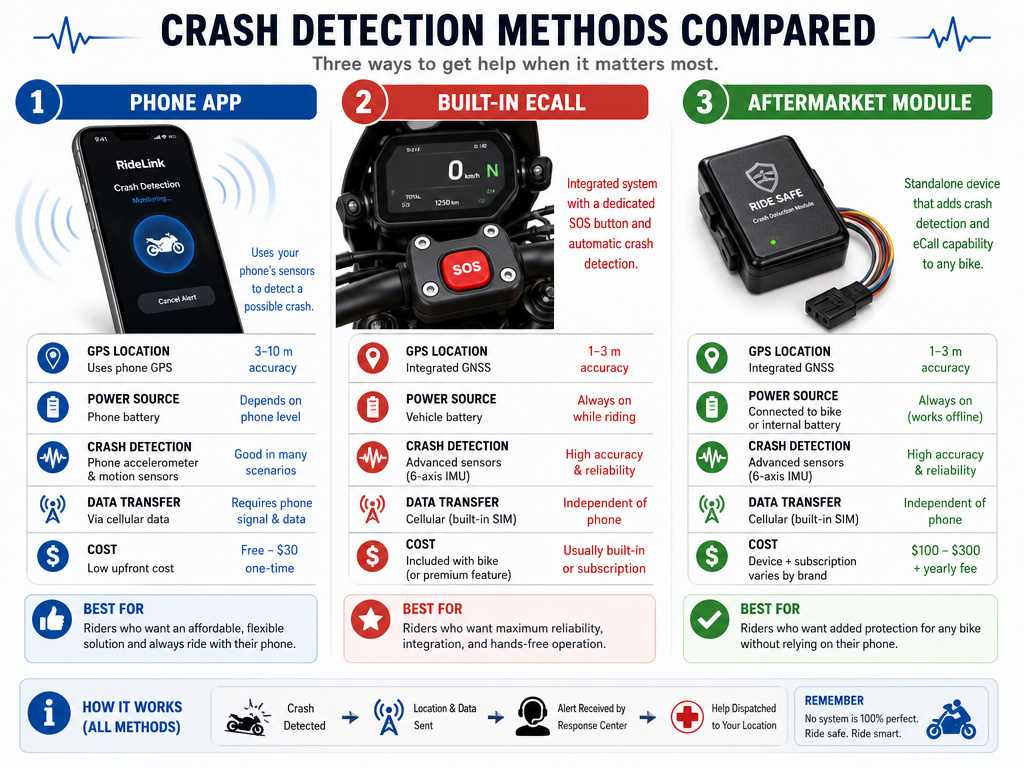
You have three roads. Your choice depends on how much you trust your phone, how much wiring you want to do, and what your bike already has.
Smartphone Apps (e.g., REALRIDER, Detecht)
- How it works: Software using phone’s sensors and GPS.
- Data Sent: Location, sometimes pre-set medical info, to personal contacts.
- Cancellation: A short alarm on the phone, much shorter than the DIN standard’s 20-30 second delay.
- Power: Phone battery.
Built-in eCall (e.g., BMW Motorrad Intelligent Emergency Call)
- How it works: Factory-installed hardware meeting DIN SPEC.
- Data Sent: Full MSD (VIN, impact direction, roll angle, etc.) to professional emergency center.
- Cancellation: For systems built to the DIN SPEC 70009-5 standard, a 20-30 second delay with on-bike alert is required.
- Power: Motorcycle battery.
- Best for: Owners of bikes where it is a factory-installed option, such as certain BMW Motorrad models.
Aftermarket Module (e.g., Wunderlich dguard®)
- How it works: Hardwired telematics unit with own SIM and GPS.
- Data Sent: Depends on the specific model and its capabilities.
- Cancellation: Depends on the specific model and its design.
- Power: Hardwired to motorcycle battery and ignition.
The BMW F 900 XR’s system shows what factory eCall can do. Its manual states it transmits “the direction of impact detected by the vehicle sensors” and “the phone number of the installed SIM card.” That is the DIN standard in action. It is reporting measured data.
An aftermarket module like the Wunderlich dguard® adds another layer. It is a telematics device first, a GPS tracker and anti-theft alarm. The crash detection is one feature. Its manual notes a key limitation: the web app for anti-theft warnings “can only use SMS notification, as push notifications are not available.” That is the kind of specific, slightly inconvenient detail you only get from reading the actual product manual. It also reminds you the module “requires mobile phone reception and thus should not be fitted directly under the metal parts of the motorbike.” Good luck getting that advice from an app store description.
Where This All Goes Sideways: False Alerts and Dead Zones
No system is perfect. The fear of a false positive, the system calling 911 because you dropped your bike in the garage, is real. The DIN standard’s 20- to 30-second delay is the primary defense against this. It is a long enough window for a conscious, embarrassed rider to scramble over and hit the cancel button.
Phone apps have a harder time here. Their cancellation windows are shorter, and their alarms are quieter. If your phone is in a bag or your helmet speakers are in, you might not hear it. I have seen forum reports of riders getting panicked calls from family after a minor off, all because they never heard the phone’s siren over the adrenaline and the bike’s own noises.
The other hard stop is signal. Every system that uses cellular networks, which is all of them, has a dead zone. The app cannot send the alert. The eCall module cannot connect. For true remote riding, you are on your own.
Then there is the bike itself. The DIN SPEC says testing must account for the motorcycle-specific environment: vibration and shock tolerance, waterproof/dustproof IP ratings, extreme temperatures, and power supply voltage fluctuations. A cheap aftermarket module might fail all four. The consequence is silence when you need noise.
How much do motorcycle crash detection apps cost?
What are real users saying about crash detection apps?
Systems that are hardwired into the bike’s electrical system must be installed correctly, with the collision sensor placed appropriately, to avoid false triggers or failures.
Frequently Asked Questions
How does my phone know it’s a motorcycle crash and not just a drop?
The app’s algorithm looks for a specific pattern. A simple drop usually involves a single sharp spike in acceleration followed by the phone lying still. It is the combination of these signals across multiple sensors that makes the guess educated.
What is the 20- to 30-second rule for motorcycles?
This is a requirement from the DIN SPEC 70009-5 eCall standard. After a potential crash is detected, the system must wait 20 to 30 seconds before placing the emergency call. This gives the rider time to cancel the call if it was a false alarm, like a tip-over in a parking lot. Most smartphone apps have a much shorter cancellation window, often 10 seconds or less.
Are crash detection apps a replacement for a proper eCall system?
No. They are a less reliable, consumer-grade alternative. Apps rely on your phone’s battery, your phone’s mounting, and your cellular signal. A proper eCall system is hardwired to the bike’s power, has its own dedicated cellular modem and SIM, uses specialized sensors, and follows the DIN SPEC 70009-5:2019 / CEN/TS 17249-5:2019 standard designed specifically for motorcycle dynamics and environments.
What happens if I crash in an area with no cell service?
The system cannot transmit its alert. This is the single biggest limitation of any cellular-based crash detection, whether it is a phone app or a built-in module. The detection might happen, but the SOS message will fail to send until the device moves back into coverage. Some satellite communicators have crash detection, but they are generally not marketed for motorcycles due to mounting and power challenges.
Do I need to do anything to maintain a crash detection system?
Yes. For phone apps, you need to ensure the app is updated, your phone’s location permissions are granted, and your emergency contacts are current. For wired systems, you should periodically check that the module has power (no blown fuses) and that the external GPS antenna has a clear view of the sky. The Wunderlich dguard® manual notes that when first switched on, “it may take up to 2 minutes until the LED goes out”, a baseline for a health check.
Before You Go
Your choice of technology matters less than knowing the difference between its promises and its real performance when a handlebar lifts. A phone app is better than nothing, but it is a consumer product operating in an industrial environment. A system built to a standard like DIN SPEC 70009-5 is the engineering answer to the same problem.
For most riders, the practical path is to run a phone app as a first layer. Mount the phone securely on the bars. Set the emergency contacts. But then, know its limits. That knowledge is your real second layer. If you ride often in remote areas or want a system that works when the phone is shattered, look at the wiring diagram for an aftermarket module or the spec sheet of your next bike. The goal is to stack the odds in your favor with the clearest view of where each link in that chain can break.
