
How to Stop Motorcycle Helmet Buffeting: The 3-Target Fix
This post contains affiliate links. As an Amazon Associate, we earn from qualifying purchases.
Sources disagree on the primary point of intervention: Schuberth advises adjusting the motorcycle fairing first, SWEGOTECH focuses on bike-specific aerodynamic accessories, and rider forums advocate for low-cost modifications to the windscreen’s angle or spacing. Buffeting is low-frequency shaking caused by turbulent air hitting your helmet, and the most common source is a poorly managed windscreen on a faired bike. According to Schuberth’s manual for the C3 Pro, strong eddy currents from a fairing can “significantly reduce” a helmet’s performance, so adjusting the fairing to keep turbulence off the helmet’s underside is the manufacturer’s stated first step.
That’s the direct answer, but which step you start with depends entirely on your bike. The debate isn’t academic. Helmet makers say fix the bike; aftermarket parts makers sell solutions for specific aerodynamic flaws; rider forums swear by five-degree shim jobs with duct tape. Your height, your helmet’s shape, and whether you ride an adventure bike with a peak change the equation. Understanding how to stop motorcycle helmet buffeting is therefore a highly individual process.
What follows is the diagnostic flow the top search results don’t give you when you compare a how to stop motorcycle helmet buffeting guide: how to tell if your problem is windscreen angle, a helmet seal gap, or the helmet itself. We’ll walk through the OEM data, the forum-proven hacks, and the one accessory that actually works for a named problem on the Honda Africa Twin.
Key Takeaways
- Buffeting is turbulence, not clean wind. It’s the shaking from choppy air hitting your helmet, distinct from constant wind noise.
- The first fix is always windscreen angle or height. A community fix for the Kawasaki Versys uses 1/4-inch thick shims to tilt the screen back roughly five degrees, which one rider reported made buffeting almost entirely gone after testing.
- Seal the helmet’s base. Schuberth’s manual states a “well sealed off” underside is critical for quietness; a slim neck may need a scarf. This is the second target.
- Helmet shape is the last variable. Flip-front modular helmets and helmets with peaks (common on ADV helmets) are more prone to catching updrafts, per SWEGOTECH’s testing for the Africa Twin.
- Test one change at a time. Alter your windscreen, ride. Then address the seal. Changing your helmet is the last resort, not the first.
How Does Buffeting Actually Work?
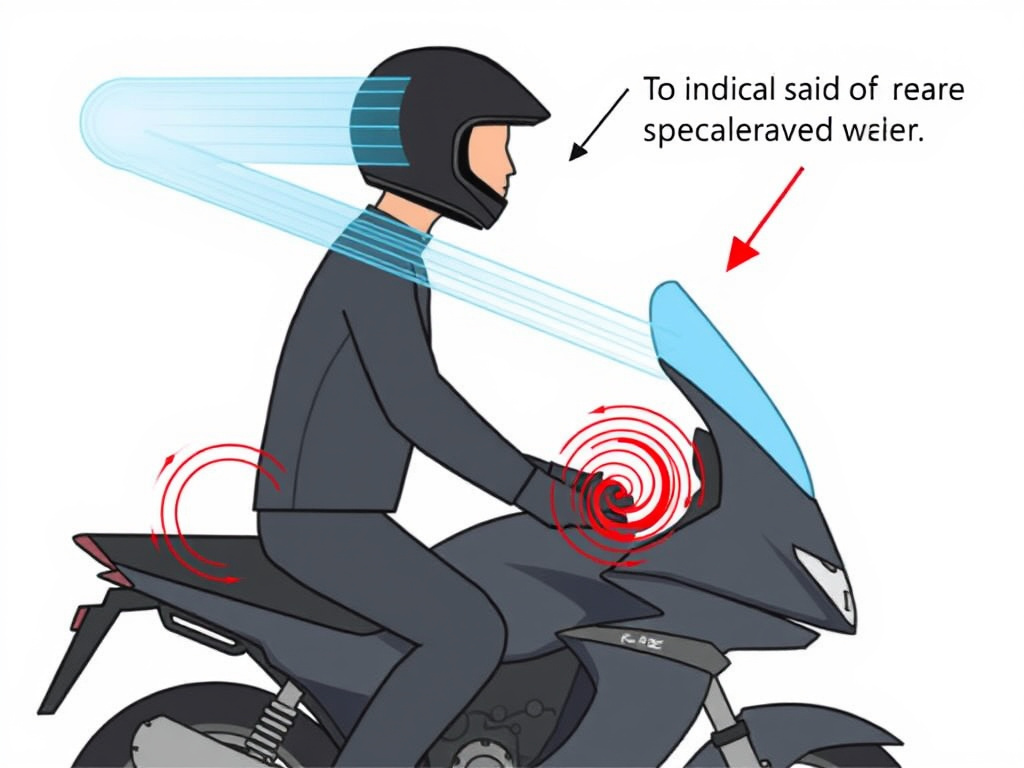
Buffeting isn’t just loud. It’s a physical shake. You feel it in your neck first, a low-frequency wobble that blurs your vision around the edges after a few minutes at speed. It’s the difference between standing in a steady breeze and standing behind a dumpster in a wind tunnel.
The mechanics are simple. Your motorcycle pushes air. On an unfaired bike, that air hits you and your helmet in a relatively clean, predictable stream. On a faired bike, the windscreen redirects that air up and over you. If the angle or height is wrong, the redirected air doesn’t flow smoothly. It tumbles, creating a zone of chaotic, swirling air right where your head sits.
The aerodynamic performance of a helmet can be significantly affected by strong eddy currents that occur at the edges of the wind shadow created by a motorcycle fairing. For a helmet to be as quiet as possible, the fit on the underside needs to be well sealed off. – Schuberth C3 Pro Manual
This OEM note pins the cause on the bike, not the helmet. The “wind shadow” is the pocket of calmer air behind the windscreen. The turbulence happens at its edges. If your head is in that turbulent edge, you get buffeting. If you can move your head fully into the calm pocket or fully out into the clean stream, the buffeting often stops.
That’s the theory. In practice, you’re dealing with your height, your riding posture, and a windscreen that probably only adjusts up and down, not in and out. This is why the community fix for bikes like the Kawasaki Versys isn’t about height. It’s about angle. Tilting the top of the screen back just a few degrees changes where that turbulent edge falls.
The 3-Target Fix: Bike, Seal, Helmet
Tackle buffeting in this order. Jumping straight to a new helmet is expensive and often doesn’t solve a problem that starts six feet in front of you.
Fix the Wind Source First
This is the most effective lever you have. The goal is to get your helmet either completely in the calm air behind the windscreen or completely out in the clean airflow ahead of it.
Adjust What You Have
Start with your stock, adjustable screen. The advice to set it at a “comfortable” height while parked is useless. You need to test at speed.
- Go low. Set the screen at its lowest setting. Go for a highway ride. Is the buffeting gone but replaced by chest-level wind blast? Note it.
- Go high. Set the screen at its highest. Same ride. Does the buffeting decrease but maybe your vision is now looking through a distorted plexiglass wall? Note it.
- Find the edge. One of these extremes usually works better than the middle. Your job is to find which one moves the turbulent zone away from your helmet.
The Angle Modification
If height adjustment alone doesn’t work, angle is the next variable. This is the quintessential rider hack.
On the Kawasaki Versys forum, a rider solved his buffeting by adding 1/4-inch thick spacers (made from Lexan wrapped in duct tape) at the bottom mounting points of his windscreen. This tilted the top of the screen back an estimated five degrees. The result after testing was that buffeting was “almost entirely gone.” The same principle appears on the F650 forum, where a user inserted 1.5mm and 2mm spacers between the windscreen and its mounting bracket.
Where this goes sideways: Adding a taller aftermarket windscreen without adjusting the angle. A taller screen can actually lift the turbulent edge higher, placing it directly on your helmet. The Kawasaki Versys thread notes one rider found buffeting increased as his aftermarket Givi screen went up.
Model-Specific Solutions
For some bikes, the issue is a known aerodynamic flaw. The SWEGOTECH Forkshield is a dedicated accessory for the Honda Africa Twin CRF1000L. It addresses “fork tunnel updraft” (wind coming up through the fork area that strikes the bottom of an adventure helmet’s peak, causing violent vibration).
SWEGOTECH claims riders feel the improvement strongest at speeds between 65mph to 90mph. It’s a specific fix for a specific problem on a specific bike. This highlights a key point: if you ride an adventure bike with a peaked helmet, your buffeting might be coming from below, not from the front.
| Your Bike Type | Primary Buffeting Source | First Fix to Try |
|---|---|---|
| Faired Sport/Touring | Turbulent edge of windscreen wind shadow | Adjust height to extremes; then try angle shims |
| Adventure (with peak) | Fork tunnel updraft hitting helmet peak | Consider a deflector like the SWEGOTECH Forkshield (if model-specific) |
| Naked/Unfaired | Clean airflow (less common) | Focus on helmet seal and aerodynamics; buffeting here is often minimal |
Seal the Gaps Around Your Neck
Once you’ve optimized the wind hitting you, seal the door. Turbulence is looking for a gap to exploit, and the biggest one is around the base of your helmet.
Schuberth’s manual is blunt: “To ensure the helmet is as quiet as possible, the fit on the underside of the helmet is important. This area needs to be well sealed off. If you have a slim neck, it is advisable to use a scarf additionally.”
This isn’t about warmth. A neck gaiter, balaclava, or even a bandana fills the cavity between your jacket collar and your helmet liner, smoothing the airflow. You can test this cheaply. Go for a ride with your current setup. Then, put on a dense neck gaiter and ride the same route. If the buffeting is reduced, you’ve found a major leak.
The Trade-Off: Sealing vs. Fogging
Sealing the base has a consequence Schuberth also warns about: “The improved sealing… Can lead to an increased concentration of moisture inside the helmet, and thus to misting of the face shield.” The solution they provide is practical: if you fog up, “open the visor so that there is a small gap through which the moisture can escape. Never ride with restricted vision.”
This is a direct, sourced cause-and-effect. A better seal can mean more fogging in stop-and-go traffic. It’s a manageable trade, but one you need to be aware of.
When the Helmet Is the Culprit
If you’ve tuned the windscreen and sealed the neck, and the helmet still shakes, the helmet’s design might be the issue. This is the last step, not the first.
Helmet Shapes That Catch Wind
- Peaks / Visors: Common on adventure helmets, these act like little sails catching updrafts or turbulent air. SWEGOTECH’s data specifically calls out helmets with peaks as “more prone” to vibrations from fork tunnel updrafts.
- Modular / Flip-Front: SWEGOTECH also notes that flip-front modular helmets are more prone because their peak is often mounted at only two points, allowing more flex and vibration.
- Poor Overall Aerodynamics: Some helmets, regardless of type, simply have shapes that generate lift or are unstable in crosswinds. This is less about price and more about design intent. A helmet designed for a tucked sportbike riding posture might be unstable in the upright posture of a touring rider.
The Aerodynamic Reality Check
The Schuberth C3 Pro is marketed as designed for a “touring or sport-touring riding posture”. This is what you’re looking for in a helmet’s spec sheet: mention of aerodynamic stability for your riding position, not just a list of vents.
Before you buy a new helmet to solve buffeting, try to test it. If that’s not possible, look for reviews that specifically mention “stable at highway speeds” or “good in crosswinds,” not just “quiet.”
Why Do Sources Disagree on the Solution?
Look at the advice from different corners of the riding world and you’ll see a clear split. It’s not that one is wrong; they’re solving for different primary causes.
| Source | Stated Root Cause | Primary Solution | Context |
|---|---|---|---|
| Helmet OEM (Schuberth) | Eddy currents from motorcycle fairing | Adjust motorcycle fairing/windscreen | Focus on ideal bike setup for their helmet’s performance. |
| Aftermarket Part Maker (SWEGOTECH) | Fork tunnel updraft on specific ADV bike | Install model-specific aerodynamic accessory (Forkshield) | Solving a documented, localized flaw on a popular model. |
| Rider Communities (Forums) | Windscreen angle/height mismatch | DIY spacers, shims, washers to change angle | Low-cost, reversible, empirical fixes tested on real bikes. |
The F650.com community FAQ summarizes the pragmatic rider view on another “solution” in the how to stop motorcycle helmet buffeting debate: adhesive Rumble-Strips stuck to the helmet. The consensus is they work “to a greater or lesser extent, but not so well as to eliminate buffeting altogether.”
That’s the theme. Most fixes help, but few are magic bullets. Your height matters. Your jacket matters. Even your mirrors matter. One F650 user reported that bending his mirrors down to a ninety-degree angle, slightly lower than the windshield, improved buffeting.
Your Diagnostic Roadmap
Don’t throw parts at the problem. Follow this sequence to isolate the cause.
- Baseline Ride: Pick a stretch of highway you know well. Ride it with your current setup. Note the exact speed where buffeting begins and its severity. Is it a constant shake or does it come in pulses?
- Test Windscreen Extremes: Perform the high/low height test. Does the buffeting change dramatically? If yes, your problem is primarily windscreen position.
- Test the Seal: Ride the same stretch with a snug neck gaiter. Is the buffeting reduced? If yes, you have a significant airflow leak at the helmet base.
- Check Localized Turbulence: On an adventure bike, try taping a small flap of plastic over the gap between the fork and headlight (temporarily, for testing). If buffeting decreases, you have a fork tunnel updraft issue.
- Helmet Variable: Only after steps 1-4, try a different helmet if possible. Borrow a friend’s. A rounder, smoother helmet might be the fix if the problem persists.
Common mistake: Changing your helmet first. It’s the most expensive variable and the one least likely to solve a problem created by your bike’s aerodynamics. Diagnose the bike and your setup first.
Buffeting creates a specific kind of noise: a deep, pounding roar mixed with a low-frequency vibration you feel in your bones. Earplugs are a direct countermeasure for the auditory component. They cut the sheer volume, reducing rider fatigue and protecting your hearing on long rides. However, earplugs do not address the physical shaking of your helmet or the aerodynamic turbulence causing the problem. They treat a symptom, not the source. The buffeting forces are still there, shaking your head and blurring vision. For a true fix, you must tackle the airflow hitting your helmet, whether by adjusting your windscreen, sealing gaps at the helmet’s neck, or modifying the bike’s aerodynamics.
Frequently Asked Questions
How do I stop my motorcycle helmet from steaming up when I seal the neck?
This comes directly from the Schuberth manual. The improved seal that reduces buffeting can trap moisture, leading to fogging at stops or behind a large fairing. Their instruction is clear: if you fog up, open the visor a small gap to let moisture escape. Never ride with obscured vision. Anti-fog treatments on the inside of your shield are a necessary partner to a well sealed off underside.
Which motorcycle helmet is best for reducing wind buffeting?
Look for helmets designed for your riding posture. The Schuberth C3 Pro is explicitly designed for a touring/sport-touring posture. In general, helmets with smooth, rounded shells and minimal protruding parts (like sun peaks) tend to be more aerodynamically stable. However, no helmet can fully compensate for severe turbulence created by the motorcycle itself. Fit and seal are as important as shell shape.
What is the 5 year rule for motorcycle helmets?
The 5-year rule is a common safety guideline suggesting you replace your helmet every five years from its production date, regardless of use. The rationale is the degradation of internal materials (EPS liner, adhesives) from exposure to sweat, UV light, and temperature cycles. It’s a conservative benchmark. Always replace your helmet immediately after any impact.
Earplugs help with noise, not buffeting. Buffeting is a physical shaking of the helmet and your head. While foam earplugs will make the experience subjectively quieter and less fatiguing by blocking the roar of the wind, they do nothing to stop the low-frequency vibration causing the blurry vision and neck strain. Treat them as a companion to a fix, not the fix itself.
Before You Go
Buffeting is a solvable physics problem, not a rite of passage. The process is always the same: control the wind coming off the bike, seal the helmet against what’s left, and only then judge the helmet itself.
The most persistent myth is that you need a bigger, more expensive windscreen. The Kawasaki Versys hack proves the opposite. Sometimes you need less screen, or at least a different angle, not more. Start with the free fixes: the height test, the neck gaiter test. They’ll tell you more than any product page.
If you take away one thing, let it be this: your helmet is the last variable in the chain. The Schuberth manual, the SWEGOTECH data sheet, and a hundred forum threads all point back to the motorcycle first. Fix the wind, then fit the helmet to it.
