
How to Remove Motorcycle Exhaust Bluing: Step-by-Step
This post contains affiliate links. As an Amazon Associate, we earn from qualifying purchases.
While enthusiast methods often use abrasives like metal polish or 0000 steel wool, manufacturers like Harley-Davidson present bluing as a normal condition and do not provide a specific removal procedure. The discoloration is heat oxidation in the metal itself. Harley-Davidson and Honda define bluing as a non-defect caused by tuning and heat, not a manufacturing flaw, so permanent removal often means replating, ceramic coating, or replacement.
That definition from the manufacturers changes the whole game. They’re not telling you how to scrub it off because, in their view, a blue pipe is a working pipe. The community’s polish-and-elbow-grease methods work to varying degrees, but they fight physics. A common search is for how to remove motorcycle exhaust bluing.
What follows: the cause, the safe step-by-step removal methods the manuals don’t give you when you compare a how to remove motorcycle exhaust bluing, the one tool to avoid on chrome, and the permanent solutions that actually work. By the end, you’ll know whether to polish, wrap, coat, or just ride.
Key Takeaways
- Bluing is baked-in oxidation, not surface dirt. Polishes like Blue-Job or Autosol can remove light discoloration, but deep purple stains are often permanent without aggressive refinishing.
- Manufacturers like Harley-Davidson and Honda define bluing as a non-defect caused by factors like heat and tuning, not a manufacturing flaw.
- Sources disagree on using 0000 steel wool on chrome: some warn it leaves iron particles that rust, while others recommend it as a proven approach for stainless steel. Use bronze wool or a non-scratch pad with polish instead.
- Clean and inspect cold pipes. Working on a hot exhaust can cause severe burns and makes chemicals evaporate before they work.
- For a lasting solution, consider ceramic coating or professional replating, as polishing is a recurring maintenance task, not a one-time fix.
What Causes Exhaust Bluing in the First Place?
You see a rainbow of blue, gold, and purple on your header pipes. It looks like a defect. Harley-Davidson’s service manual has a different take: “Blueing is caused by tuning characteristics, cam timing, over-heating, and so on. It is not caused by defective manufacturing.”
That’s the official line. The metal isn’t failing; it’s changing color under extreme heat. When your exhaust gases meet the metal at high temperatures, it causes a thin layer of oxidation. This isn’t rust. It’s the metal’s crystalline structure altering at a microscopic level, which refracts light differently. On chrome, it’s the steel underneath the plating that’s changing. On stainless or titanium, it’s the surface of the metal itself.
This heat oxidation is in the metal, not on it. That’s why you can polish off surface rust or road grime, but bluing often comes back or never fully disappears—you’re not removing a stain, you’re abrasively thinning the metal layer where the discoloration lives.
The hotter the pipe runs, the deeper and more colorful the bluing. A lean fuel mixture, advanced ignition timing, or just hard riding on a hot day pushes temperatures up. This is why the factory stance is one of acceptance. In their view, if your pipe is blue, your engine is just working hard.
The Essential Safety Prep: Work Smart on a Cold Pipe
This isn’t a cosmetic warning. A motorcycle exhaust can hold enough heat to cause a severe burn long after you shut the engine off. The number one rule is so simple it gets skipped: let the bike sit. Overnight is best. A few hours is the minimum.
Before you start: The pipe must be cool to the touch along its entire length. Heat also causes cleaning chemicals to flash off or become ineffective, and it can warp thin metals if you apply pressure.
Gather your tools away from the bike. You’ll need nitrile gloves, safety glasses, and a well-ventilated space—many polishes and compounds produce fine dust you don’t want to breathe. Lay down a microfiber cloth or towel on your workbench if you’re removing the pipe. Protect any nearby painted bodywork or plastics with masking tape and paper; splatter from polishes can stain.
This is also your inspection window. Run your fingers along the pipe (once it’s cold) and look for cracks at the welds, especially where the header meets the cylinder head. A deep clean is pointless if the pipe is damaged. This prep turns a cleaning job into a real maintenance check.
Method 1: Polish and Elbow Grease (The Community Standard)
This is the fix you find on every forum. It works, with caveats. The goal is to use a mild abrasive suspended in a paste to gently cut away the oxidized layer. For light blueing on stainless steel, it can look brand new. For deep purple on chrome, manage your expectations.
The products are specific. Blue-Job Chrome Polish is formulated for this exact job; it’s a powder you mix with water to form a paste. Autosol Metal Polish is a creamier, all-purpose metal polish that works well on stainless. These are the two named products the community reaches for repeatedly.
Here’s the step-by-step, adapted for safety and realism:
- Clean the pipe. Use a dedicated motorcycle degreaser or a cleaning agent like a liquid kitchen abrasive (as one Honda manual specifies) or a mild detergent (as another Honda manual specifies) for stainless steel. Dry it completely. Any grit left on the surface will turn your polish job into a scratching job.
- Apply the polish. Dampen a fresh, clean microfiber cloth, apply a dime-sized amount of polish, and work it into a small section (about 6 inches of pipe at a time). Use back-and-forth motions, following any grain in the metal.
- Buff and inspect. After a minute of firm rubbing, use a clean part of the cloth to buff the paste away to a haze, then a second dry cloth to a shine. Inspect under good light. The bluing will lighten with each pass.
- Repeat as needed. For stubborn areas, reapply polish. This is where the “elbow grease” comes in. A drill with a soft buffing wheel attachment can save your shoulders on long pipes, but keep the speed low and the pressure light to avoid burning the metal.
What happens if you skip a step? If you don’t fully degrease first, you’ll just grind street grit into the finish, leaving fine scratches that look worse than the bluing under certain light. If you use too much polish, it will dry into a chalky residue that’s a pain to remove.
Polishing a stainless header with a non-scratch paste can be a time-consuming process in the how to remove motorcycle exhaust bluing. The light blue tint vanished. The deep purple near the cylinder head? It faded but never fully left. Heat discoloration is in the metal, so set expectations accordingly.
Method 2: Abrasive Compounds and Pads (For Stubborn Stains)
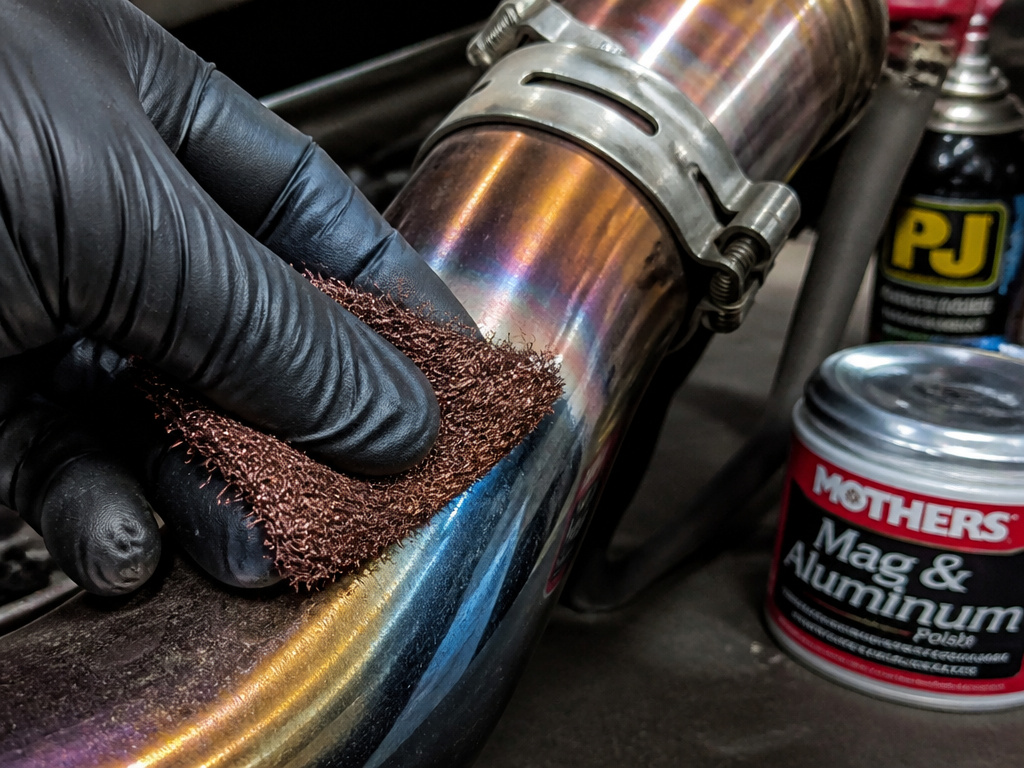
When polish alone isn’t cutting it, the next step is a more aggressive abrasive. This is where the factory manuals and enthusiast methods visibly diverge. Honda, for example, says for heat stains: “use a commercially available fine texture compound.”
The community translation for “fine texture compound” is often a rubbing compound designed for automotive paint, or a specific metal polishing compound like Simichrome. The key is “fine.” You are not sanding; you are polishing with a slightly more aggressive grit.
| Abrasive Option | Best For | Critical Warning |
|---|---|---|
| Fine Rubbing Compound | Moderate bluing on stainless steel or titanium. | Can remove clear coatings or thin plating if over-applied. |
| 0000 Steel Wool with WD-40 | Heavy oxidation on stainless steel only. | NEVER use on chrome. Iron particles embed and rust. |
| Bronze Wool with Polish | Heavy oxidation on chrome. Safer than steel. | More expensive than steel wool, but won’t cause rust. |
| Non-Scratch Scouring Pad | Light to moderate bluing on any material. | Less cutting power, but zero risk of embedded particles. |
Where this goes sideways: Using 0000 steel wool on a chrome pipe. It feels right—it’s super fine! But as BikeEXIF notes, it leaves microscopic iron in the pores of the chrome that will rust, making the problem worse in a few weeks. For chrome, the old-timers’ trick is aluminum foil and water, or the safer bet: bronze wool.
The process is the same as polishing, but wet. Spray a light lubricant like WD-40 on the pad or wool, add a dab of compound, and work in small, controlled circles. Rinse and check your progress often. You’re removing metal, so go slow. This is the point where many riders decide if the effort is worth it or if they should consider a permanent fix.
The Permanent Fix vs. Accepting Bluing

Polishing is maintenance. It will need to be redone, especially if your bike runs hot. The permanent solutions involve removing the pipe and either changing its surface or covering it up.
Ceramic Coating (Like Cerakote): This is a professional-grade ceramic-based finish sprayed on and baked. A good ceramic coating can withstand high temperatures and seals the metal from oxidation. It’s the most durable option, but it requires complete disassembly, professional application, and changes the look (usually to a matte, even color).
Professional Replating: For chrome pipes, this is the nuclear option. The old chrome is stripped, the base metal is repaired and polished, and new chrome is applied. It’s expensive and time-consuming, but it returns the pipe to a showroom finish.
Exhaust Wrap: This doesn’t remove bluing; it hides it. A fiberglass wrap insulates the pipe, which can slightly reduce under-engine heat. It has a specific aesthetic and is a one-day DIY job.
Then there’s the manufacturer-recommended option: acceptance. Harley-Davidson’s manual includes this blunt note: “There is no warranty on exhaust pipes and mufflers with regard to any discoloration.” They see it as a badge of use, not a flaw. For many riders, especially on dual-sport or classic bikes, a little bluing is character.
The choice often comes down to the bike’s role. A show bike gets coating or replating. A daily rider might get a polish every season. A dirt bike probably gets a rinse and a shrug.
Material-Specific Guide: Chrome vs. Stainless vs. Titanium
Not all pipes are created equal, and using the wrong method can do real damage. Your approach must match the material.
Chrome Exhaust Pipes
Chrome is a plating over steel. The bluing is in the steel underneath. Aggressive abrasives can cut through the thin chrome layer to the base metal, causing irreversible damage.
- Do: Use a chrome-specific polish (Blue-Job, Mothers Chrome Polish). For heavier stains, use bronze wool with polish. Harley-Davidson specifically recommends Boot Mark Remover gel for boot marks on chrome.
- Don’t: Use steel wool, Scotch-Brite pads, or liquid kitchen abrasives. Avoid acidic cleaners.
Stainless Steel Exhaust Pipes
Stainless is solid through and through. You can be more aggressive, but you can also scratch it.
- Do: Start with a liquid kitchen abrasive (per Honda manuals) for cleaning. Use metal polish (Autosol) or fine rubbing compound for stains. 0000 steel wool with lubricant is acceptable here.
- Don’t: Use a green Scotch-Brite pad—it’s too abrasive and will leave a permanent brushed finish.
- Why-layer: Stainless steel has a passive oxide layer that protects it from rust. Aggressive polishing can strip this layer, so it’s good practice to finally wipe the pipe with a clean, dry cloth.
Titanium Exhaust Pipes
Titanium blues and golds easily and is often left unfinished for that look. The colored layer is very thin.
- Do: Clean with a mild detergent and water. To reduce coloring, use a very fine metal polish by hand. The goal is often to even out the color, not remove it.
- Don’t: Use any abrasive pads or compounds unless you want to remove the color entirely and reveal the bare, silver metal underneath.
- Pro tip: The color is a thin oxide layer on the metal surface. Polishing it off changes the dimensions of the pipe negligibly, but over many years, you could theoretically thin it.
How to Prevent Future Bluing (The Tuning Fix)
If you absolutely hate bluing and want to minimize it, you have to address the cause: heat. This moves the job from the garage to the mechanic’s bay.
Running a slightly richer air-fuel mixture lowers combustion temperatures. Retarding the ignition timing a degree or two can also help. Both changes trade a bit of peak performance for cooler exhaust gases. It’s a valid tuning choice for a street bike, but it’s not something to do just for pipe color.
The most effective prevention is also the simplest: don’t let the bike idle excessively. Sitting still with no airflow turns the headers into furnaces. After a hard ride, take a few minutes of easy cruising to let airflow cool the pipes before you shut it off.
Clean pipes while cold and wipe off fingerprints before the first ride. Oils baked in by heat are what turn a nice pipe brown within one hot ride. It’s a small habit that makes the next clean-up far easier.
Frequently Asked Questions
What is the fastest way to remove bluing from a motorcycle exhaust?
The fastest effective way is to use a powered buffer with a soft wheel and a dedicated metal polish like Autosol. Hand-polishing with a product like Blue-Job is slower but gives you more control to avoid burning through thin chrome plating. There is no safe “instant” chemical wipe-on solution.
Does WD-40 clean exhaust bluing?
WD-40 is a lubricant and light rust penetrant, not a cleaner or polish. It will not remove bluing on its own. However, it is an excellent lubricant to use with 0000 steel wool on stainless steel to prevent scratching. It should be thoroughly washed off after use.
Can you permanently fix a blued exhaust?
Yes, but not by polishing. Permanent fixes are ceramic coating (like Cerakote), which seals the metal against heat oxidation, or professional replating for chrome pipes. Both are costly professional procedures that require removing the exhaust system.
Is exhaust bluing a sign of engine problems?
Not necessarily. As Harley-Davidson’s manual states, bluing is caused by normal heat and tuning. However, if one header pipe is significantly more discolored than the others, it could indicate a lean condition or cooling issue on that cylinder, warranting a carburetor or coolant system check.
Will exhaust wrap stop bluing?
Exhaust wrap will hide existing bluing and can help prevent it by insulating the pipe, keeping the metal surface temperature lower. However, wrap traps moisture against the pipe, which can accelerate corrosion on steel headers if not installed and maintained correctly.
The Bottom Line
Here’s the deal. You have two paths: fight the bluing every season with polish and pads, or make a permanent change. For most riders with stainless pipes, a twice-a-year polish with Autosol keeps it looking sharp. For chrome, the battle is harder, and bronze wool with Blue-Job is your safest weapon.
The manufacturer’s stance is the hidden truth in all this. When Harley-Davidson says there’s no warranty for discoloration, they’re telling you a blue pipe is a functioning pipe. Polishing is cosmetic maintenance, like waxing a tank.
If the color bothers you that much, save the elbow grease and invest in a ceramic coating. It’s the only method that actually changes the pipe’s relationship with heat. Otherwise, clean it, inspect it, and ride it. A little blue never slowed down a motorcycle.
