
How Many Miles Is Motorcycle Tires Good For?
This post contains affiliate links. As an Amazon Associate, we earn from qualifying purchases.
How many miles motorcycle tires are good for has no fixed answer, and Dunlop’s own warranty guarantees no specific mileage. Replace each tire when it wears to its treadwear indicators, which federal rules set at 1/32 inch for motorcycles. Michelin and Dunlop both add an age limit: 10 years from manufacture.
That missing mileage figure is the whole story, so the best real-world numbers come from owners, and they are the closest thing we have to an answer on how many miles is motorcycle tires good for. A Harley dealership channel found its stock Dunlop front more than half worn at a little over 11,000 miles, on a bike they admit is always loaded. A trike owner replaced stock tires at about 14,000. Both numbers mean something only once you know why those bikes ate rubber the way they did.
What follows: the depth rules (and where Michelin, the feds and the UK disagree), the age limits, a garage check you can do with a gauge and a flashlight, and three recalls that show a tire can fail for reasons the odometer never sees.
Key Takeaways
- Rear tires wear out first on most bikes, so Michelin says to replace each tire at its own limit while weighing the other tire’s age and condition.
- Plan the swap around 3/32 inch of tread, where one Harley dealership tells owners to start thinking about it. Don’t wait for the bars to sit flush.
- Both Michelin and Dunlop call for an annual pro inspection after 5 years and replacement at 10, even if the tread looks fine.
- Dunlop calls cold pressure checks the most important tire maintenance job, because low pressure brings irregular wear, heat and, eventually, carcass failure.
- A good-looking tire can still be under recall, so read the DOT code on both wheels.
Why Can’t Anyone Tell You How Many Miles Motorcycle Tires Are Good For?
Dunlop won’t put a figure on how many miles is motorcycle tires good for in writing. Its limited warranty states there is no warranty for any specific mileage achievement, and Michelin says a tire’s lifespan is hard to predict.
Motorcycle tire life is set by tread depth and age rather than mileage. FMVSS 119 requires at least three treadwear indicators on every motorcycle tire, showing wear to 0.8 mm (1/32 inch). Michelin and Dunlop both recommend annual professional inspection once a tire passes 5 years of use and replacement at 10 years, regardless of remaining tread.
Michelin’s reason is simple. Too many things chew on a tire at once, and it lists them:
- Weather.
- Storage and usage conditions, which covers the bike that sits all winter as much as the one ridden daily.
- Load. A passenger plus full hard bags is a different tire life than a solo rider.
- Speed and riding style. Two riders on the same bike and tire can get wildly different results.
- Tire pressure and maintenance, the two you control completely.
You’ll find tidy mileage ranges on plenty of sites. I couldn’t trace any of them to a manufacturer or a published test, so I’m not repeating them here.
Fair warning on where I’m coming from. My testing lives in helmets, jackets, gloves and boots. Tires I ride on, measure and replace like everyone else, so here I rely on the paperwork and on owners, not my own lab bench.
The part nobody mentions: Storage is on Michelin’s list. A tire parked in a garage keeps aging, so low miles on the odometer don’t buy it extra years.
11,000 and 14,000 Miles: What Two Owners Actually Got
A tech at a Harley dealership drops a depth gauge into the front of a stock-tired bike with a little over 11,000 miles on it. The front reads more than halfway gone. That’s from a dealership video, and the riders were upfront about why: they’re always loaded, they ride heavy, and they said mileage varies with riding style and tire pressure.
That honesty is the useful part. They said straight out that mileage swings with riding style and tire pressure, and that someone else might get a lot more from the same tire.
The second number comes from a TrikeTalk owner who replaced stock Harley tires at about 14,000 miles on a trike. He planned his next change on Dunlop American Elite rubber at about 15,000. Trikes load their tires differently than two-wheelers, so don’t map that straight onto a solo bike.
My take? If you ride a loaded bagger or a trike, those two reports are the closest thing to a real answer on how many miles is motorcycle tires good for that I found. If you ride a light bike solo, they tell you very little.
Rear Tires Go First, So Stop Buying in Pairs by Default
Michelin says rear tires wear faster than fronts. That’s why one mileage figure per bike is misleading. The rear puts the power down, so it wears on its own clock.
Michelin’s advice is to replace each tire when it reaches its wear limit, and to look at the other tire’s condition and age while you’re at it. If the remaining tire is close to its limit or has been in service for several years, Michelin says doing both gives you a known starting point.
One New Tire or Two?
Dunlop warns that a new rear fitted with a worn front, or the reverse, can cause instability. Michelin recommends against mixing brands or models front to rear, because a matched pair is engineered to work together.
Here’s where I land. One tire wins when the other is young with plenty of tread left. Both win when the other tire is several years old or close to its limit. Either way, buy the same model: if your front is a Dunlop American Elite, the new rear should be a Dunlop American Elite too. When you shop replacement tires, start with the model already on the other wheel.
The 1/32-Inch Line (and Why Michelin Says 2/32)
Federal rules let a motorcycle tire wear to 0.8 mm, or 1/32 inch, before its indicators show. The FMVSS 119 motorcycle tire requirements call for at least three indicators on every motorcycle tire. Most other tires under the same standard get indicators at 1.6 mm (1/16 inch), and at least six of them.
So the line on a bike tire sits at half the depth. The standard doesn’t explain why, and I won’t guess. The same motorcycle clause shows up in a 2018 NHTSA tire standard petition ruling, which quotes the same three-indicator, 0.8 mm requirement.
Now the messy part. Not every source agrees on where “worn out” begins:
| Source | Where It Draws the Line | What It Means |
|---|---|---|
| FMVSS 119 (US federal) | Indicators at 0.8 mm (1/32 in) | Minimum the tire must signal |
| Dunlop warranty | Last 1/32 in of tread | Tread life delivered, warranty ends |
| Michelin | 2/32 in, called the legal limit | Change before reaching it |
| UK MOT (over 50cc) | 1.0 mm band over 3/4 of tread | Fails inspection below it |
| Harley dealer (owner video) | About 3/32 in | Start planning the swap |
Michelin’s figure is double the federal motorcycle number. I can’t tell you why its page uses 2/32, and I’d rather say that than paper over it. What Michelin says next matters more: past its limit, there’s no guarantee of grip, especially on wet roads.
State rules add another layer. Pennsylvania’s code, for example, requires motorcycle tires built to new-tire standards, and the excerpt I read lists no numeric depth at all. Check your own state’s inspection rules.
Worn tread is a safety question, not only a legal one. A DOT study on tread wear effects looked at how worn tread relates to safety. It covered vehicles in general, not bikes specifically.
Sources disagree: a Harley dealership suggests starting to plan at 3/32, Michelin says to change before its 2/32 legal limit, and FMVSS 119 indicators show wear at 1/32.
Riding a tire down to its bars is like sanding a veneered panel until the glue line shows. There’s nothing left to save.
A Five-Step Garage Check for Depth, Date and Damage

Four things retire a tire: depth, age, damage and an odd wear shape. You can check all four with a tread depth gauge, a flashlight and the bike on a stand. If you’ve never used a gauge before, how to check tire tread depth walks through it with photos.
Before you start: Get the bike on a rear or center stand. The UK MOT manual advises against pulling a bike over on its side stand to lift a wheel, and a tipping bike pins ankles. Let the exhaust and brakes cool before you kneel beside the wheel. Check pressure cold, since a reading right after a ride sits higher than your cold spec.
- Find every wear indicator. On a Michelin, the Michelin Man symbol on the upper sidewall marks where they sit, and they look like small bumps at the bottom of the main grooves. Motorcycle tires carry at least three, so check them all. Skip one and you can miss a spot worn harder than the rest.
- Measure depth at the center and toward each edge. The center wears first on a commuter.
- Scan the full width. UK testers want a continuous 1.0 mm band across 3/4 of the tread, and that band doesn’t have to follow the center line. Check for a flat strip that has lost the round profile; it means the tire will fall into corners unevenly.
- Read the date code. The DOT tire identification number starts with “DOT”, and its last four digits give the week and year. A code ending in 1922 means week 19 of 2022. Skip this and you’re guessing at the 5- and 10-year marks.
- Hunt for damage.
A worn rear tells on itself under a shop light. The indicator bumps sit flush with the rubber around them, and the center goes flat and slightly glossy while the shoulders keep their curve and crisp groove edges.
Does Tire Pressure Really Change How Long Tires Last?
Yes, and I learned how fast pressure moves on my first track day. Street tires at street pressure went greasy fast. I dropped pressure from my road numbers cold, then checked them hot the moment I came off.
The readings had climbed more than I expected. Pressures rise a lot over a session, so you have to measure straight away, before the tires cool and hide it. While I’m on track days: skip tire warmers on your first one. Novice pace never needs them, and the money does more good spent on a coach.
The street job is simpler and duller. Dunlop calls checking pressure the most important tire maintenance you can do. It says to check cold pressure often, always before long trips, with a gauge that holds a reading. My motorcycle tire pressure guide covers where to find your numbers.
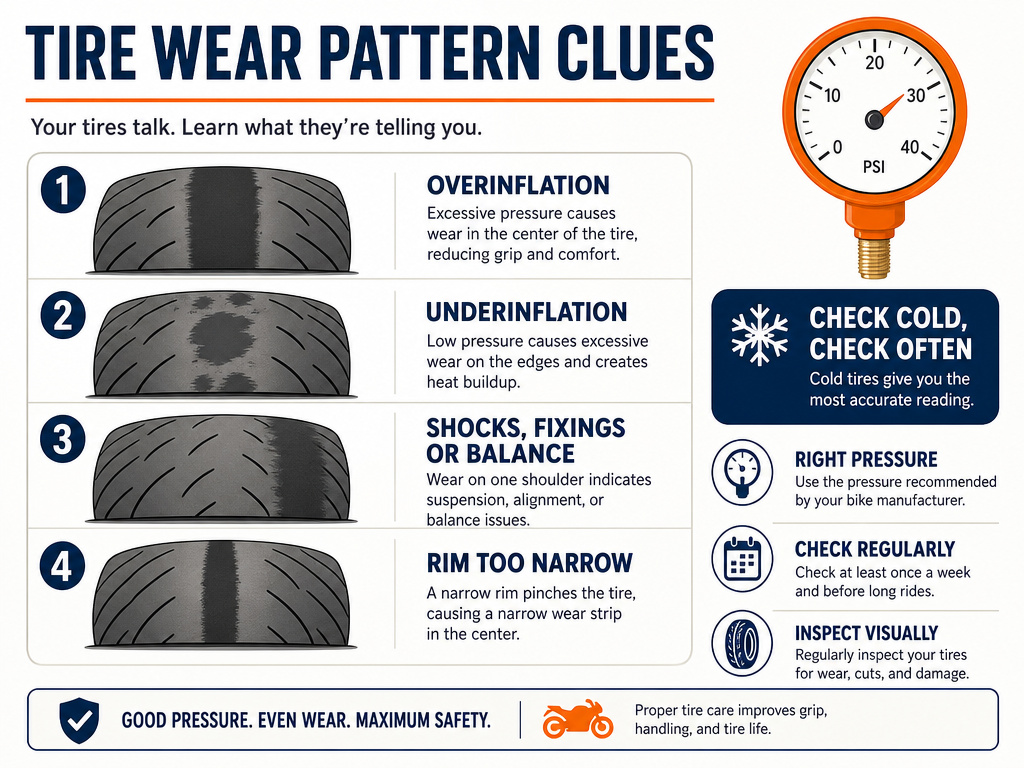
Low pressure is the expensive mistake. Dunlop links underinflation to irregular wear, higher running temperatures and eventual failure of the carcass (the tire’s inner body of cords). A soft tire flexes more every revolution, and that flexing turns into heat.
Overinflation fails differently. Dunlop says it won’t add load capacity, but it does give a harsh ride and speeds wear in the center of the contact patch.
Your wear pattern tells you which mistake you’re making:
| Wear You See | Likely Cause | Who Says So |
|---|---|---|
| Fast wear down the center | Overinflation | Dunlop |
| Irregular, patchy wear | Underinflation | Dunlop |
| Localized or shoulder wear | Worn shocks, fixings or balance | Michelin |
| Wear packed into a narrow strip | Rim narrower than recommended | Dunlop |
Michelin also says to check wheel balance every six months to head off unusual wear.
Easy to miss: Michelin says a tire that looks worn out for its mileage, compared with other bikes ridden the same way, points to a mechanical problem. See a specialist before you buy another tire, or the new one goes the same way.
The 10-Year Rule and the 5-Year Checkup
Age retires plenty of tires that never got near their wear bars. Michelin says tires that have never been used, or used rarely, can still show signs of aging. Low-mile weekend bikes are the classic case.
Michelin and Dunlop agree on the big two. After 5 years of use, have a professional inspect the tires every year. At 10 years, replace them as a precaution, even if they look fine and have tread left. Dunlop extends that to spares. For how this fits a normal replacement schedule, see how often to replace motorcycle tires.
Dunlop’s 6-year number gets misquoted. It’s a warranty window: a new Dunlop that becomes unserviceable within 72 months of manufacture, for a covered reason, gets replaced on the warranty’s terms. It doesn’t say the tire dies at 6.
| Interval | What to Do | Source |
|---|---|---|
| Weekly | Inspect condition, depth, damage | Michelin |
| Every 6 months | Check wheel balance | Michelin |
| Often, and before long trips | Check cold pressure | Dunlop |
| Within 6 years of manufacture | Warranty covers unserviceable tires | Dunlop |
| After 5 years of use | Annual pro or specialist inspection | Michelin, Dunlop |
| 10 years | Replace, even with tread left | Michelin, Dunlop |
Storage, Weather and Tire Shine
Michelin names weather and storage as aging factors. Dunlop’s warranty gets more specific: it excludes ozone cracking and weather checking on tires treated with dressings or incompatible cleaning agents, or submitted more than 48 months after manufacture.
Weather checking looks like fine, crazed cracks in the sidewall rubber, a bit like dried mud. Skip the tire-shine sprays on bike tires. They do nothing for grip, and Dunlop’s own paperwork treats them as a reason to deny a cracking claim.
What About 14- or 20-Year-Old Tires?
Neither Michelin nor Dunlop gives any tire a pass past 10 years. A 14-year-old tire is four years beyond both. A 20-year-old one is double the limit.
I couldn’t find a published test of decade-old motorcycle tires to put numbers on the risk. Both makers say replace, and that’s enough for me.
Trust the wear, not the label. When the label is a date code past 10 years, trust the date over the tread. A garage-kept classic with pretty rubber still needs new tires before it sees a highway.
Sport, Touring, Cruiser: Which Tire Type Lasts Longest?
The tire type matters, but the right hand on the throttle matters more. Michelin lists speed, load and riding style as life factors, and the dealership riders above blamed their loading before anything else.
I didn’t find a sourced mileage chart by tire category worth printing. Makers publish claims for specific models, not categories. So I won’t hand you a sport-versus-touring number I can’t back up.
What I can tell you is the trade you’re making. The sport vs sport touring tires choice comes down to grip against longevity. If you commute and do weekend trips, buy touring motorcycle tires or a sport-touring model. A pure sport tire on a daily commuter buys grip you rarely use and swaps you’ll pay for sooner.
Why Bike Tires Wear Faster Than Car Tires
A bike leans on a rounded tire, so the part touching the road is a small patch. That patch slides from the center toward the edge as you lean. Every bit of braking, acceleration and cornering force goes through it.
Rim width makes it worse when it’s wrong. Dunlop says a tire on a rim narrower than recommended concentrates wear in a very small area. Same tire, wrong rim, shorter life.
When a Tire Fails With Tread Left: 3 Recent Recalls
What does an odometer reading tell you if irregular wear can break a tire’s internal belt? Not much. Three recent recalls make the point:
- Pirelli recall 24T011000 (Oct 8, 2024): about 3,093 Pirelli Scorpion Trail II, Metzeler Tourance Next and Next II tires, including the Tourance Next 150/70R18 M/C 70V fitted as original equipment on certain Triumphs. Irregular wear can break the belt reinforcement (the cord layer under the tread), and pieces of tread can separate. Dealers replace them free; owner letters went out November 20, 2024, though RideApart had reported an expected November 6 date.
- Dunlop 25T002: tires built September to October 2024 can develop a bulge in the inner liner near the belt edge, which can lead to belt edge and tread separation. Only tires matching all four sidewall markings on the affected list count.
- Dunlop 25T015: 57 Dunlop TT93GP PRO MS 120/80-12 55J and TT93FGP PRO 100/90-12 49J tires. Sidewall compound may have contaminated the tread surface, cutting traction.
The Pirelli case matters most for this question. Those tires failed through wear, not because they hit some mileage or a birthday.
So check your sidewall markings against the recall lists, not just your depth gauge. If you run a Metzeler Tourance Next or a Pirelli Scorpion Trail II, look it up today.
Where this goes sideways: Assuming recalls only hit old or high-mile tires. The 25T002 Dunlops were built in late 2024 and recalled in 2025, so a nearly new tire can be the one on the list.
How many miles do motorcycle tires usually last?
The honest answer is a wide range, and the paperwork backs that up. Dunlop states there is no warranty for any specific mileage achievement, and Michelin says a tire’s lifespan is hard to predict. Owner reports are the best real-world signal I can offer. One trike owner on a forum swapped stock Dunlop American Elite tires at about 14,000 miles, with the next change planned near 15,000. A Harley dealership video showed a stock Dunlop front at a little over 11,000 miles with the front more than half worn, on a bike that was always loaded and ridden hard.
So treat the 11,000 to 14,000-mile owner reports as a rough frame, not a promise. Michelin lists weather, storage, load, speed, tire pressure, maintenance and riding style as the factors that move the number. Your tread, not the odometer, makes the call.
Do sport, sport-touring and cruiser tires wear at different rates?
I can’t give you a clean mileage number for each category, because none of the sources I rely on publish one. Dunlop offers no mileage guarantee for any tire, and Michelin says lifespan is hard to predict. What the sources do support is a practical pattern: how you use the bike matters more than the label on the sidewall.
Owner reports I found came from the cruiser and touring side. A trike owner got about 14,000 miles from Dunlop American Elite tires, and a loaded Harley front was more than half worn at about 11,000. The Harley shop pointed to load and riding style as the reasons, and the trike’s loading differs from a two-wheeler. Michelin also notes that rear tires usually wear faster than fronts, so expect to replace them at different points whatever type you run.
If you ride hard or carry a lot of weight, plan for earlier replacement. Check your own tires against the wear indicators instead of trusting a category average.
Frequently Asked Questions
Are 20-year-old motorcycle tires safe?
Not by any manufacturer guidance in this research. Michelin and Dunlop both say to replace tires at 10 years even if they look fine and have tread left. A 20-year-old tire is double that limit, so trailer the bike to the shop instead of riding it there.
Are 10-year-old motorcycle tires still good?
At 10 years, both Michelin and Dunlop say replace them as a precaution, and Dunlop includes spares. Even before that, tires past 5 years of use should get a professional inspection every year.
Should I replace both tires at the same time?
Not automatically. Michelin says rears wear faster, so each tire gets replaced at its own limit. If the other tire is near its limit or has been in service for several years, doing both gives you a matched, known starting point.
Does the Dunlop warranty cover tread life?
No mileage is guaranteed. The warranty covers new tires that become unserviceable within 6 years of manufacture for covered reasons, and it ends once the tire wears to the last 1/32 inch of tread.
Is 100,000 miles on a motorcycle a lot?
That’s a question about the bike, not its tires. A high-mile bike has gone through many sets, so ignore the odometer and check the date code and tread depth of whatever is mounted now.
Before You Go
Here’s the trigger I’d use. Depth guidance varies: a Harley dealership says to start thinking about replacement at 3/32 inch, Michelin says to change before its 2/32 inch limit, and FMVSS 119 wear bars show 1/32 inch. Separately, any date code past 10 years retires the tire, whatever the tread says.
Your first step this week: read the DOT codes on both wheels tonight. Write the week and year on a strip of tape on your garage wall, then check both tires against the recall lists.
If you came here asking how many miles motorcycle tires are good for, the honest answer is that nobody guarantees one, and my numbers come from paperwork and two owners rather than a lab. If your tires wear out faster than other bikes ridden the same way, take Michelin’s advice and see a specialist before buying another set.
Bottom line: buy new tires on depth and date, not on mileage. Only a loaded bagger or trike rider should treat the 11,000 to 14,000-mile owner reports as a rough benchmark.
