
Gauntlet vs Short Cuff Motorcycle Gloves: How to Choose
This post contains affiliate links. As an Amazon Associate, we earn from qualifying purchases.
Gauntlet vs short cuff motorcycle gloves: a gauntlet covers the forearm and wrist joint, sealing over your jacket sleeve for weather protection and retention, while a short cuff ends at the wrist for airflow and quick on/off. The palm, knuckle, and finger protection come from the glove’s construction, not its cuff length. For most riders, the practical answer is two pairs: a gauntlet for cold and wet, a short cuff for summer and short trips.
The gauntlet vs short cuff motorcycle gloves decision decides where your jacket meets your glove and how much of your wrist stays covered. That’s the whole trade-off. It’s not about which one is universally safer; it’s about matching the closure to the weather you ride in and the roads you ride on.
What follows: the specific protection each cuff offers (and what it doesn’t), the real-world hassle of putting them on, how to handle the jacket-sleeve debate, and the simplest two-glove rotation that covers a year of riding.
Key Takeaways
- The cuff decides wrist coverage and retention. The palm, knuckle, and finger protection come from the glove’s materials and armor, not the cuff length.
- A gauntlet is required for track days and is the better choice for cold, wet, or high-speed riding where sealing out weather matters.
- A short cuff is the standard hot-weather answer, it’s cooler, goes on in seconds, and is less bulky under a sleeve for around-town rides.
- Every serious glove needs a wrist strap cinched below the wrist bone. A loose strap is how a glove comes off in a slide, regardless of cuff length.
- Most experienced riders end up with both types: a gauntlet for one season, a short cuff for the other.
The Cuff Length Breakdown: Gauntlet vs Short
Look at your wrist. Now look at where your jacket sleeve ends. The gap between those two points is what the cuff debate is about. A gauntlet glove extends up the forearm to cover that gap. A short cuff glove stops at the wrist, leaving it open.
Gauntlet gloves are designed to be worn over the sleeve in almost every case. The gauntlet is shaped to flare over the jacket cuff so water and air run off the sleeve and past the glove.
This is the traditional rule. Brands like Dainese and Alpinestars design their sport gauntlets to fit over a racing suit or jacket sleeve. The seal keeps wind and rain from shooting up your arm. It also means the gauntlet needs to be wide enough to actually fit over your sleeve, a common gripe with some newer models.
The alternative is the REV’IT! System, where the glove is designed to tuck under a specially tailored jacket cuff for a clean look and to block water ingress. It’s a valid design, but it’s the exception. For 90% of gauntlets on the shelf, the intent is to go over the sleeve.
A short cuff, by definition, stops at the wrist. It’s designed to be worn under your jacket sleeve. This leaves your wrist open to airflow, which is why a vented short-cuff glove is the go-to for hot days.
What Does the Cuff Actually Protect?
This is the part people get backwards. In the gauntlet vs short cuff motorcycle gloves debate, remember the cuff does not protect your palm or your knuckles. Those are jobs for the leather, the sliders, and the hard armor on the back of the hand. The cuff has one job: coverage and retention.
The cuff decides retention and wrist coverage. Everything else is the rest of the glove.
Think about what happens in a slide. Your hand hits the pavement and friction pulls the glove toward your fingertips. If the wrist closure is loose or absent, the glove can roll right off. That’s the failure mode.
A gauntlet covers more surface area, the forearm and the wrist joint, and when sealed over a sleeve, it creates a longer, more secure tunnel that’s harder to pull off. A short cuff has a shorter closure, so the wrist strap becomes the single critical point holding the glove on your hand.
| Protection Element | Gauntlet Glove | Short Cuff Glove |
|---|---|---|
| Wrist & Forearm Coverage | Covers the wrist joint and several inches of forearm. | Ends at or just past the wrist bone. |
| Retention in a Slide | Longer cuff and over-sleeve seal resist roll-off. | Relies entirely on the wrist strap cinched below the wrist bone. |
| Weather/Debris Seal | Seals over sleeve to block wind, rain, and road debris. | Leaves a gap at the wrist; relies on jacket cuff fit. |
| Palm/Knuckle Protection | Determined by glove construction (leather, armor, sliders). | Determined by glove construction (leather, armor, sliders). |
That last row is the key. You can buy a flimsy gauntlet with poor palm leather or a fantastic short cuff with a carbon knuckle and a palm slider. The cuff length doesn’t dictate that quality. This is why simply asking “are gauntlets safer?” is the wrong question. You need to ask what’s protecting your palms and knuckles, and then look at the cuff.
The safety standard EN 13594:2015 defines performance for impact abrasion, cut resistance, and seam strength. It doesn’t mandate cuff length. A glove like the Dainese Carbon 4 Short is certified to this standard (CE EN 13594:2015 Standard Category II, Level 1) despite its short cuff, because its construction, with carbon knuckle protectors and a DCP system on the little finger, meets the test criteria.
The On/Off and Feel Test
Here’s where the choice gets personal. How much hassle are you willing to accept for the extra coverage?
A short-cuff glove goes on in a couple of seconds. You slide your hand in, pull the wrist strap tight, and you’re done. There’s no sleeve to manage. On a hot day when you’re making frequent stops, that speed matters. It’s the difference between wearing gloves and leaving them in your bag.
A gauntlet needs the sleeve managed, the flare pulled over, and usually two closures done up (a wrist strap and the gauntlet closure). It takes longer. If you’re just running to the store, that extra time can feel like a chore.
There’s a feel difference, too. A short cuff is less bulky at the wrist. You have more direct feel of the bar, and for some riders, that translates to better control feedback. A gauntlet can feel more substantial, even restrictive, until you get used to it. In cold weather, that substantial feel becomes an advantage, the seal keeps the draft off your skin.
Common mistake: Buying a glove that’s too big for a “comfortable” fit. The extra material bunches in your palm, making the throttle feel vague, and the wrist strap can’t cinch tight enough to hold during a slide.
Your glove should fit snugly with no dead space at the fingertips. The widest point across your palm below the knuckles (in inches) is your starting size. If you’re between sizes, size down, leather breaks in.
Weather, Riding Style, and the Two-Glove Wardrobe
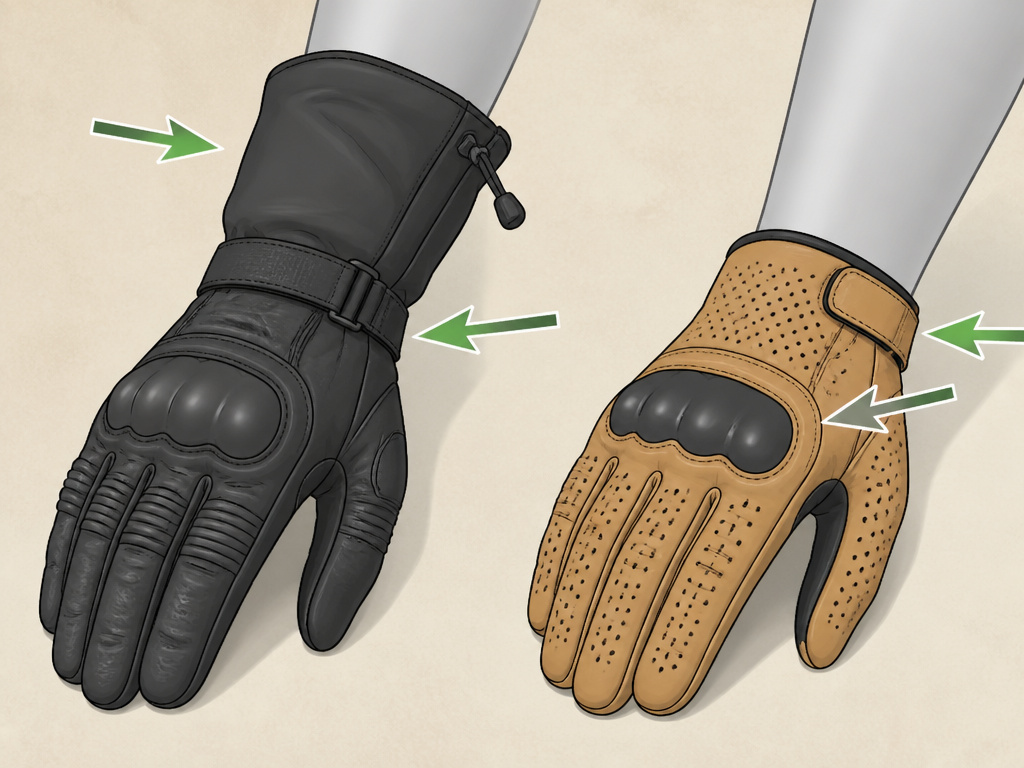
You don’t have to pick one glove for life. Most riders who cover real miles end up with a small rotation. The cuff length is the main variable in that rotation.
| Riding Scenario | Recommended Cuff | Why, and a Real Example |
|---|---|---|
| Track Days / Sport Riding | Gauntlet | Required by most organizations. Maximum wrist coverage and retention. |
| Cold / Wet / Touring | Gauntlet | Seals out weather. The Harley-Davidson Men’s Ratchett Gauntlet has an insulated back of hand and adjustable cuff for draft-blocking. |
| Hot Weather / Summer Commuting | Short Cuff | Ventilation and speed. The Klim Badlands Aero Pro Short glove uses premium goat leather with mapped big-bore perforations. |
| Adventure / Dirt Riding | Short Cuff | Better bar feel, less bulk, easier on/off. Often paired with a jacket that has a long, tight cuff. |
| Around Town / Short Errands | Short Cuff | The convenience factor wins. You’re more likely to wear them every time you swing a leg over. |
The “commuting” category is where sources disagree. One major article says short-cuffs are better for commuting. Another argues that gauntlets are a perfect option for commuters. Who’s right? Both are.
If your commute is in stop-and-go traffic in a hot climate, a short cuff makes sense. If your commute involves highway speeds in variable weather, a gauntlet’s seal and coverage are legitimate advantages. You have to look at your actual ride.
The Two-Glove Wardrobe
The simplest, most effective gear strategy is two pairs.
- A gauntlet for cold and wet. Look for a secure closure, a weather seal, and a CE rating like EN 13594:2015.
- A vented short cuff for summer. Look for perforated leather or mesh, a hard knuckle, and a solid wrist strap.
This covers the vast majority of riding conditions without overcomplicating your gear closet. A gauntlet and a short cuff will outlast several seasons of abuse if you buy right.
How Gloves and Jackets Actually Work Together

The interface is everything for weather protection. You have three main configurations:
- Gauntlet OVER Jacket Sleeve (Standard): The gauntlet flares over the cuff. This sheds water and wind. The jacket sleeve cannot ride up and expose your wrist. This is the setup for most touring and sport riding.
- Gauntlet UNDER Jacket Sleeve (REV’IT! System): The glove tucks under a specially designed jacket cuff. This gives a cleaner look and, according to the brand, prevents water from running down your arm into the glove. It works, but you lose the over-sleeve weather seal.
- Short Cuff UNDER Jacket Sleeve (Standard): The glove ends at your wrist, inside your jacket cuff. This relies on your jacket having a snug cuff to minimize gaps. It’s the standard for cruiser and summer riding.
Where this goes sideways: Mixing systems without checking fit. A gauntlet designed to go over a sleeve will fight you if you try to tuck it under a tight leather cuff. A short cuff under a loose jacket sleeve leaves a gap that catches wind on the highway.
Try the glove with your jacket before you commit. See how the sleeve sits when you’re in your riding position on the bike. That’s the only fit that matters.
How much do gauntlet and short cuff gloves cost?
For consistent riding across seasons, $100 to $135 is the realistic price point for quality American-made deerskin gloves. Price is not dictated by cuff length but by the glove’s construction, materials, and certification level. A vented short-cuff glove with a hard knuckle is the standard hot-weather answer, while gauntlet gloves often provide greater seasonality with more waterproof and thermal options, which can affect their value proposition. The key safety standard for professional motorcycle gloves is EN 13594:2015, which defines performance requirements, but this certification is not required in the US, so many gloves sold here have no rating at all.
Are there motorcycle gloves between a short cuff and a gauntlet?
Yes, middle-ground options exist. A classic cuff extends past the wrist to overlap a jacket sleeve and seal against wind, offering more coverage than a short cuff but less bulk than a full gauntlet. Some brands design gloves to be worn under specially designed jacket cuffs, which gives the jacket a cleaner look and prevents water from running down the arm into the glove. The cuff decides retention and wrist coverage, so these hybrid designs aim to balance the quicker on-and-off convenience of a short cuff with some of the weather sealing and overlap benefits of a longer cuff.
Frequently Asked Questions
Are gauntlet gloves safer than short-cuff gloves?
For the wrist and forearm, yes, a gauntlet covers more area and provides a longer, more secure retention system. However, the safety of the palm, knuckles, and fingers is determined by the glove’s construction (leather quality, armor, sliders), not its cuff length. A well-made short-cuff glove with a secure wrist strap is still highly protective.
Can a motorcycle glove come off in a crash?
Yes, if the wrist closure fails. When a hand slides on pavement, friction pulls the glove toward the fingertips. A loose or absent wrist strap allows the glove to roll off. This is why every serious glove has a wrist strap that must be cinched tight below the wrist bone, regardless of whether it’s a gauntlet or short cuff.
What is the best cuff length for summer riding?
Short cuff. It allows airflow at the wrist, doesn’t trap heat under a jacket sleeve, and is significantly quicker to put on and take off during frequent stops. A vented short-cuff glove with a hard knuckle protector is considered the standard hot-weather answer.
Do I need a CE-certified glove?
The European standard EN 13594:2015 defines rigorous tests for abrasion, impact, cut resistance, and seam strength. It is not required in the US, so many gloves sold here have no published rating. A CE certification (like Level 1 or 2) is a verified benchmark of protection. If you can find a certified glove that fits, it’s an indicator of baseline safety.
How should motorcycle gloves fit?
They should fit snugly, like a second skin, with no extra material bunching in the palm or fingers. Measure the widest part of your palm (below the knuckles) in inches. If you’re between sizes, size down, the leather will stretch and conform to your hand. A snug fit ensures control feel and that the wrist strap can function correctly.
Before You Go
The gauntlet vs short cuff decision isn’t a lifetime commitment. It’s a match-your-conditions choice. If you ride in cold, wet, or at high speeds often, a gauntlet’s extra coverage and seal are worth the minor hassle. If you ride in heat or just around town, a short cuff’s ventilation and convenience are the obvious win.
Most riders who log serious miles end up owning both. It’s not extravagant, it’s practical. Your hands are the most likely point of contact in a fall, and they’re your primary interface with the bike. Skimping here makes no sense.
Buy one good pair for your dominant season. Ride them. Then, when the weather flips or you find a gap in your protection, buy the other. That two-glove wardrobe will cover 95% of the riding you’ll ever do.
