
10 Best Motorcycle Tire Pressure Monitors in 2026
This post contains affiliate links. As an Amazon Associate, we earn from qualifying purchases.
Our best overall motorcycle tire pressure monitor is the FOBO Bike 2 Smart TPMS for its comprehensive, smartphone-integrated alerts that work even while parked. We also highlight the Sykik Rider SRTP300 for a simple standalone display and the XiangAi Bluetooth TPMS for detailed app-based analytics.
Knowing your tire pressure is critical for safety, handling, and tire life, but checking manually before every ride is a chore. This guide is based on in-depth research into specifications, expert insights, and owner feedback to help you choose the right system for your bike and riding style.
Top 10 Motorcycle Tire Pressure Monitors in the Market
Certain content that appears on this site comes from Amazon. This content is provided "as is" and is subject to change or removal at any time.
The Best Motorcycle Tire Pressure Monitors, Reviewed
FOBO Bike 2 Smart TPMS

What We Like
- Real-time monitoring while parked or riding
- Smart alerts for leaks and temperature changes
- Easy wireless setup with no separate receiver
- Cloud sync and multi-bike management
Trade-offs
- Requires a smartphone and internet for setup
- App-based system lacks a dedicated physical display
The FOBO Bike 2 provides real-time monitoring of tire pressure and temperature, sending alerts to your phone if a change occurs while riding or when parked. It uses a smartphone app as its display and syncs data to the cloud, offering a connected safety system. This setup is designed for riders who want to track their bike’s condition and share updates with others.
The trade-off is that you must rely entirely on your phone, which isn’t ideal for riders who prefer a dedicated, always-visible cockpit display like the Sykik Rider SRTP300 provides. However, for the rider invested in a modern, app-driven ecosystem, the FOBO Bike 2 delivers a level of integration and remote awareness that simpler systems can’t match. The ability to manage multiple bikes and receive instant leak notifications directly on your device makes it a standout for tech-savvy users.
Sykik Rider SRTP300 TPMS
What We Like
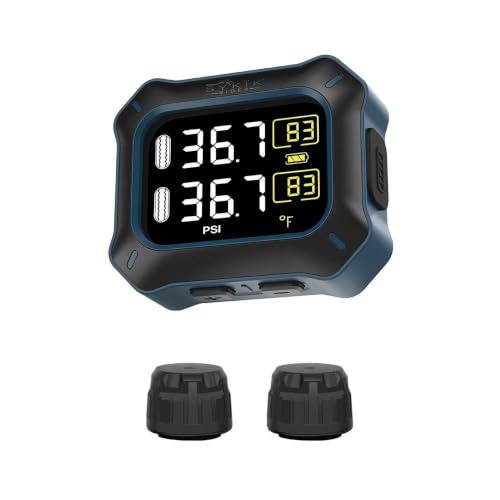
- Compact, water-resistant 1.5-inch monitor
- Long-life rechargeable batteries included
- Default PSI/Fahrenheit for immediate use
- U.S.-based customer service support
Trade-offs
- Owner reports sensors can read inaccurately by several PSI
- Monitor requires recharging every 9-12 months
The Sykik Rider SRTP300 offers a dedicated, compact 1.5-inch display that mounts cleanly on your bars, letting you check pressures without pulling out a phone. Its default settings mean you can install it and ride immediately, a straightforward choice for riders who prefer a simple, standalone gauge. The long sensor battery life and U.S. warranty add to its appeal for those wanting a set-and-forget hardware solution.
Owner reports indicate the Sykik Rider SRTP300 can show inconsistent pressure readings, with one user noting a front sensor reading 2-3 PSI low and a rear reading 3-4 PSI high. For riders who rely on precise tire pressure for handling or tire wear, this potential variance is a key factor to weigh. Those who prefer smartphone integration over a dedicated display could consider the FOBO Bike 2 Smart TPMS, which uses a Bluetooth connection for real-time monitoring.
XiangAi Bluetooth TPMS
What We Like
- Real-time monitoring via intuitive smartphone app
- Customizable high and low pressure alerts
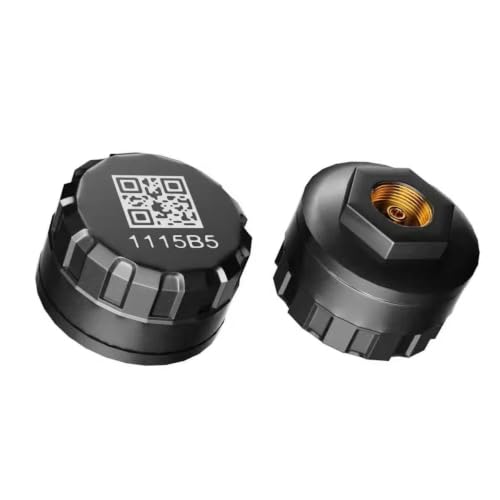
- Weatherproof, tool-free external sensor installation
- Historical data logging in companion app
Trade-offs
- Requires a smartphone for monitoring, no dedicated display
- App dependency means no data if phone battery dies
- Universal fit limited to American style valves only
Bluetooth connection to your smartphone puts a detailed tire data dashboard in your pocket. The XiangAi system delivers real-time PSI and temperature readings through an app, with the ability to set custom alerts for pressure drops or spikes. This design is perfect for riders who want the deepest possible insight into their tire health, prefer managing gear through their phone, and appreciate the clean handlebars that come without a mounted display. The historical data logging turns every ride into a source of actionable information for maintaining optimal tire pressure.
This system relies on your phone for all monitoring, which isn’t ideal if you prefer a dedicated, always-on display. However, for riders comfortable with app-based tech, the installation is genuinely simple. You just screw on the sensors, and the waterproof build means you can set it and forget it until your phone buzzes with an alert. It transforms your smartphone into a comprehensive tire management tool, giving you proactive warnings long before a slow leak becomes a roadside problem.
Product photos
Spedal iBar Bluetooth TPMS

What We Like
- Real-time PSI and temperature for both tires
- Customizable alert thresholds via the iBar app
- No separate display required, uses your phone
- Compact, weather-resistant sensor design
Trade-offs
- Requires phone app and Bluetooth for all data
- External sensors need valve stem clearance
- App must run in background for continuous alerts
The Spedal iBar’s core strength is its deep integration with a dedicated smartphone app, turning your phone into a comprehensive monitoring hub. This setup is perfect for riders who want detailed, customizable alerts for pressure and temperature without adding a permanent display to their handlebars. The system delivers live readings and can warn you about slow leaks or high temps, provided you keep the app running. It suits tech-savvy riders who always ride with their phone accessible and prefer a minimalist cockpit.
Monitoring relies entirely on your phone and its Bluetooth connection, so you cannot glance at a dedicated display if the phone is stowed away. The Spedal iBar’s sensors are compact and low-profile, but you must always confirm they have enough clearance from the fender or brake caliper before riding. This verification step is emphasized in the instructions to prevent contact damage.
Product photos
LNKERCO Solar TPMS
What We Like
- Solar panel eliminates frequent battery swaps
- Auto on/off and alarms require no display monitoring
- Factory-paired sensors install in seconds
- Magnetic charging avoids worn-out ports
Trade-offs
- Receiver is bulkier than some app-based monitors
- External sensors are more vulnerable to damage or theft
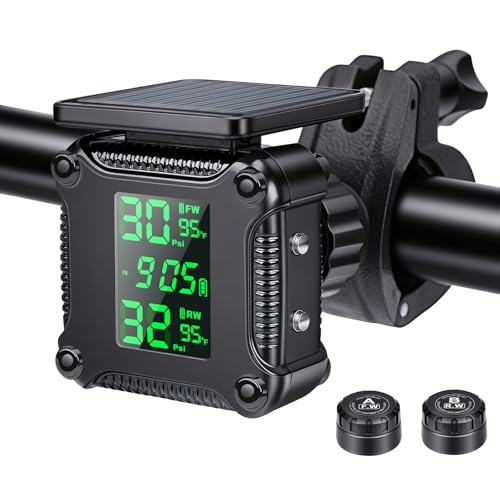
Solar charging on the receiver addresses a common TPMS hassle: keeping the display unit powered. It automatically turns on from vibration when riding and enters sleep mode ten minutes after stopping, requiring no switch operation. This design suits riders seeking a safety monitor that minimizes daily interaction, as the unit charges via sunlight or a magnetic cable instead of a regular plug.
The trade-off for this convenience is size. The 6.3-inch tall receiver is notably larger than many compact units, so mounting it cleanly on a minimalist cockpit requires some planning. It’s a system built for function over stealth, prioritizing clear readouts and self-sufficiency. If your priority is a permanent, zero-fuss monitor that you literally never have to think about charging, this design delivers exactly that.
Product photos
Liwogi TPMS System

What We Like
- Comprehensive seven-alert warning system for multiple fault conditions
- Magnetic charging eliminates port wear and provides stable connection
- Waterproof and dustproof design for all-weather riding
Trade-offs
- Maximum pressure limit of 6.6 bar excludes some high-pressure tire applications
- Monitor dimensions (6.3 x 5.2 inches) are larger than compact units like the Sykik SRTP300
A detailed seven-point alarm system monitors for leakage, low pressure, high pressure, high temperature, low sensor power, no signal, and low receiver power. This range of specific warnings helps riders identify the nature of a tire issue beyond a basic alert. Magnetic charging avoids wear on a physical port, and the waterproof and dustproof design is built to handle various weather conditions, which keeps the unit functional in rain or on dusty roads.
Its physical size is a consideration; the monitor is larger than some streamlined competitors, which matters on crowded handlebars. The 6.6 bar pressure ceiling also means it’s not suited for bikes requiring higher tire pressures. For riders who prioritize a compact display above extensive alert detail, a smaller monitor is an alternative. But if you want the most comprehensive set of audible and visual warnings from a rugged, self-contained unit, the Liwogi delivers that specific peace of mind.
Product photos
Hyphoon Spedal Link TPMS

What We Like
- Customizable alert thresholds for pressure and temperature
- Provides real-time pressure and temperature monitoring via app
- Alerts for fast leaks and abnormal conditions
- Simple wireless setup with no wiring required
Trade-offs
- Requires a smartphone app for all monitoring and alerts
- No dedicated physical display included in the system
The ability to set your own high and low limits for pressure and temperature alerts is the core of this system, letting you filter out normal fluctuations and focus on genuinely concerning changes. It’s built for the rider who wants to define their own safety parameters and prefers managing everything through a modern smartphone interface. The real-time data and fast leak warnings are delivered directly to your phone, making it a streamlined, app-centric monitoring solution.
Riders must use a smartphone to view tire data because the Hyphoon Spedal Link TPMS does not include a dedicated display. This app-only approach means you cannot check pressure or temperature without your phone, a limitation for those who prefer a physical readout or ride without their device accessible. The system differs from alternatives that include a separate handlebar monitor.
Product photos
Avutrel LCD Display TPMS

What We Like
- IP67 waterproof rating for all-weather riding
- Real-time alerts for pressure, leaks, and temperature
- Tool-free installation with anti-theft design
- Complete kit with magnetic charging
Trade-offs
- No solar charging like the LNKERCO TPMS
- Requires periodic USB charging
With IP67 waterproofing, this system handles wet weather and routine cleaning, a practical feature for year-round riders. Real-time alerts for abnormal pressure and overheating act as a continuous safety monitor during rides. Tool-free installation also means setup is straightforward, getting the system operational without delay.
You get ruggedness and a clear LCD screen, but the display unit is bulkier. At nearly seven inches long, it requires more real estate on your handlebars compared to more compact options. If you prioritize a massive, easy-to-read display and top-tier weatherproofing over a minimalist cockpit, the Avutrel delivers a practical, self-contained monitoring solution ideal for long-distance touring.
Product photos
EOHMAK LCD TPMS

What We Like
- Clear LCD display shows tire pressure and temperature.
- Audiovisual alarm for pressure or temperature abnormalities.
- Waterproof and dustproof display for all-weather use.
- Universal fit for two-wheeled motorcycles.
Trade-offs
- External sensors may be vulnerable to theft or damage.
- No Bluetooth connectivity for smartphone integration.
A waterproof and dustproof LCD display means you can read tire data in any climate, from sunny to harsh rainy or snowy days. This EOHMAK system provides real-time monitoring of pressure and temperature with audiovisual alarms for any abnormalities, which acts as a direct safety warning. Its oversized digital display clearly shows tire information and time, giving riders a dedicated gauge for their handlebars.
Unlike app-based systems such as the FOBO Bike 2, this TPMS does not offer Bluetooth connectivity for data logging or remote smartphone checks. It uses a standalone wireless display, so riders get their readings directly from the unit without involving a phone. The system is listed as universal for two-wheeled motorcycles and motor vehicles, positioning it as a straightforward hardware monitor.
Product photos
LEEPEE TPMS 5.0

What We Like
- Intelligent auto-sleep conserves sensor battery life
- Real-time monitoring and alerts via dedicated smartphone app
- Rugged, all-weather construction for diverse riding conditions
- Multiple specific alarm modes for comprehensive tire monitoring
Trade-offs
- Requires a smartphone for monitoring, no dedicated display
- Sensors enter sleep mode, requiring vibration to reactivate
Sensors conserve energy by entering sleep mode after 10 minutes of vehicle inactivity, a design that helps prolong battery life. They reawaken upon vibration and update data through the app, so pressure and temperature information is ready when you start riding. This intelligent operation provides app-based oversight for tire condition without requiring manual activation.
While the smart power saving is a benefit, there is no dedicated physical display, so it relies entirely on your smartphone. You can’t just glance at a handlebar-mounted screen; you need to open the app, which isn’t practical or safe to do while moving. For riders who prefer an always-on, glanceable readout, a system with a small monitor is a more straightforward choice. The LEEPEE excels for those who plan their ride checks before departure and value long-term convenience over at-a-glance data.
Product photos
How We Evaluated Motorcycle Tire Pressure Monitors
Our evaluation combined technical specifications, manufacturer documentation, insights from expert round-ups, and patterns in long-term owner feedback. We prioritized systems offering reliable, timely alerts and clear data presentation, whether on a dedicated screen or a smartphone app. While our research highlights the features and reported performance of popular TPMS systems, we note that installation nuances, precise sensor accuracy, and real-world battery life can vary between individual units and motorcycles.
What To Look For In Motorcycle Tire Pressure Monitors
The right TPMS provides peace of mind, but choosing between a dedicated handlebar display and a smartphone-based system depends on your habits. Knowing what features matter most ensures you get a system that works for you.
Look for a system with reliable, real-time alerts for low pressure, leaks, and temperature changes. Decide if you prefer a dedicated handlebar display for constant visibility or a smartphone app for detailed data and cloud features.
Display Type: Dedicated vs. Smartphone
Your choice here defines your interaction. A dedicated display, like the one on the Sykik Rider SRTP300, provides immediate, glanceable information without needing a phone. These are ideal for riders who want simplicity or frequently ride without a phone mount. In contrast, app-based systems like the FOBO Bike 2 use your smartphone as the display, offering detailed analytics, historical logs, and the ability to check pressures remotely, even when away from the bike.
Accuracy and Reliability
A monitor is only as good as its data. While most systems provide useful trend information, some owner reports, particularly for certain models, note discrepancies of several PSI from verified gauges. Consistency is key, a system that reliably alerts you to a 20% drop is more valuable than one with perfect accuracy that fails to transmit. Cross-referencing your readings with a tire pressure gauge occasionally can help you calibrate your expectations.
Power and Durability
Consider the long-term maintenance. Sensor batteries can last from several months to over a year, while display units may use rechargeable internal batteries, replaceable cells, or solar charging like the LNKERCO system. Look for weatherproof ratings (like IP67 on the Avutrel model) for all-weather reliability and secure, theft-resistant sensor mounting to protect your investment.
- Verify the sensor installation type, external screw-on caps are easiest but more exposed.
- Check the display’s mounting options and size to ensure it fits your handlebar space.
- Confirm the alert types: basic pressure warnings are common, but some add temperature and fast-leak alarms.
- Review the setup process: some systems require a smartphone for initial pairing only, while others rely on it continuously.
Choose a system whose power source and update method fit your maintenance tolerance and riding frequency.
Motorcycle Tire Pressure Monitors Compared
The following table lets you quickly compare the key features of all 10 picks at a glance.
| Product | Sensor Type | Display/Connection | Sensor Battery/Installation |
|---|---|---|---|
| FOBO Bike 2 Smart TPMS | N/A | Bluetooth to smartphone app | DIY, no tools required |
| Sykik Rider SRTP300 TPMS | N/A | 1.5 inches | Sensor battery life: 2 years |
| XiangAi Bluetooth TPMS | External caps | Bluetooth to smartphone app | External caps |
| Spedal iBar Bluetooth TPMS | 2 external sensors | Bluetooth to phone app | External sensors |
| LNKERCO Solar TPMS | External screw-on | Real-time PSI/Bar, °F/°C | External screw-on |
| Liwogi TPMS System | N/A | N/A | Magnetic suction |
| Hyphoon Spedal Link TPMS | 2 external valve sensors | Bluetooth app connection | Wireless, screw-on sensors |
| Avutrel LCD Display TPMS | IP67 external sensors | LCD | USB rechargeable |
| EOHMAK LCD TPMS | 2 external wireless sensors | LCD digital display | N/A |
| LEEPEE TPMS 5.0 | 2 external sensors | Smartphone app only | External sensors |
Frequently Asked Questions
What is the best tire pressure monitoring system for motorcycles?
The best system depends on your needs. For comprehensive, smartphone-integrated monitoring with remote alerts, the FOBO Bike 2 Smart TPMS is our top pick. Riders who prefer a simple, dedicated display without using a phone should consider the Sykik Rider SRTP300.
What is the most accurate tire pressure gauge for motorcycles?
The most accurate tools are dedicated, high-quality digital gauges designed for motorcycles, used on cold tires. While a TPMS provides convenient monitoring, periodically verifying pressures with a manual gauge is a good practice, as some monitoring systems can have slight calibration variances.
Which brand of TPMS sensor is considered the most reliable?
Reliability reports vary by model and user experience. Systems from FOBO and others recognized for durable construction and consistent alert delivery have received positive feedback. However, reliability also depends on correct installation, battery maintenance, and selecting a system that matches your specific valve type and motorcycle.
What is the best TPMS for a bike?
For motorcycles, look for systems specifically designed for two-wheeled vehicles with appropriate pressure ranges and sensor designs. Our best overall, the FOBO Bike 2, is an excellent choice for bikes. The key is selecting a system with a form factor and features suited to motorcycle riding, not a universal car system.
How does a tire pressure monitoring system work?
A basic TPMS involves sensors on the valve stems that measure pressure and temperature, then wirelessly transmit this data to a receiver. That receiver can be a dedicated display on your handlebars or a smartphone app, which then shows you real-time readings and triggers alerts if values fall outside your preset safe ranges.
The Bottom Line
For riders who want the most advanced features, including remote monitoring via smartphone and cloud-based alerts, the FOBO Bike 2 Smart TPMS is the best overall choice. If you prefer a self-contained system with a physical display, the Sykik Rider SRTP300 offers straightforward operation, while budget-conscious riders should examine the app-based value of the XiangAi Bluetooth TPMS. Ultimately, the best system is the one you’ll consistently use and trust, providing that crucial early warning for safer rides.
