
Adventure Motorcycle Jacket Features Explained
This post contains affiliate links. As an Amazon Associate, we earn from qualifying purchases.
An adventure motorcycle jacket is defined by modularity, its ability to adapt protection, waterproofing, and ventilation for long-distance travel across changing weather and terrain. The core features are a CE-certified outer shell (EN 17092 class AA or AAA), removable waterproof and thermal liners, extensive adjustable vents, and a fit that accommodates both a seated and standing riding posture while integrating with pants and other gear.
That definition separates a true adventure jacket from a touring or sport jacket. A touring jacket might excel on pavement in predictable weather. An adventure jacket must handle a downpour at 50 mph, a 90-degree desert crossing, and a rocky trail, all in the same trip, without forcing you to carry three separate garments. The key adventure motorcycle jacket features explained are its versatility and protective capabilities across extreme conditions.
What follows: the six essential features that make a jacket “adventure-rated,” the debate over waterproofing construction, the real-world integration with pants and airbags, and the one maintenance rule that keeps a $700 jacket from failing in year two, all part of the adventure motorcycle jacket features explained.
Key Takeaways
- Fit is everything, an adventure jacket must accommodate an upright, active riding posture and layering without letting armor shift away from your shoulders and elbows.
- Look for EN 17092 class AA or AAA, this European standard certifies the jacket’s abrasion and burst resistance, not just the armor inside it.
- Modular vs. Bonded waterproofing is debated, a removable, packable membrane (like the Dainese Absøluteshell™) lets you strip layers in heat and add them in cold, which sources like Mad or Nomad argue is more versatile for multi-climate travel. However, manufacturers like Dainese market bonded laminates (like the GORE-TEX® ePE in the SUPER EXPEDITION) as durable and suitable for all-season trips.
- Vent placement matters more than count, large chest panels and back extractors move air when you’re standing on the pegs; sleeve vents often get blocked by armor.
- Integration zippers are non-optional, a jacket-to-pants connection zipper stops cold air and rain from riding up your back, a common failure point on long, wet rides.
What Makes a Jacket an “Adventure” Jacket?
The label gets slapped on everything. A true adventure jacket answers one question central to the adventure motorcycle jacket features explained: can it change its job without you changing your gear?
I learned this the hard way on a long weekend ride that started in cool morning fog and ended in afternoon heat. My standard touring jacket had a fixed waterproof liner. I was either sealed in a sauna or getting damp. The jacket couldn’t adapt, so I spent miles uncomfortable and distracted. That’s the opposite of adventure riding.
The technical definition: An adventure motorcycle jacket is a protective garment certified to a recognized safety standard (e.g., EN 17092), featuring a modular construction with removable insulation and waterproof layers, extensive ventilation adjustable for flow while in a standing riding position, and integration points for pants, hydration systems, and optional torso protection.
The Dainese SUPER ADVENTURE ABSØLUTESHELL™ jacket shows how far modularity can go. Its separate Absøluteshell™ membrane can be worn over the jacket for rain or inside it for extra warmth and packs into a rear cargo pocket.
Other brands approach it differently. The Ducati Explorer jacket uses a detachable H2Out® membrane that can also be worn over or under the main jacket. The Alpinestars Ketchum GORE-TEX jacket uses a fixed GORE-TEX LTD liner, less modular, but simpler.
The debate isn’t about which is better. It’s about matching the system to your riding. Sources like Mad or Nomad argue that for touring across climates, modularity wins, while manufacturers like Dainese market bonded laminates as suitable for all-season trips.
Protection & Armor: The CE Label is the Floor, Not the Ceiling
A CE certification on the tag tells you the armor meets an impact standard. It doesn’t tell you if the armor will stay over your elbow when you need it.
The European standard for limb protectors is EN 1621-1. Look for Level 2, it’s a higher impact-absorption threshold than Level 1. The Dainese SUPER ADVENTURE ABSØLUTESHELL™ includes EN 1621-1 Level 2-certified composite shoulder and elbow protectors. That’s a good start, with its EN 1621-1 Level 2-certified composite shoulder and elbow protectors.
The real test happens in your driveway. Put the jacket on. Adopt your riding posture, sitting, then standing. Reach for the bars. Where are the elbow pads? They should cup your elbow’s point without gaping. The shoulder pads should sit on the bony protrusion of your shoulder, not slide down your arm.
Common mistake: Buying a jacket too large “for layers.” The armor floats. In a slide, that inch of gap means the pad hits your elbow late or misses it entirely. The shell abrades, the armor doesn’t engage, and the injury is worse.
A jacket’s main shell also has a certification: EN 17092. Classes are A (lightest), AA, and AAA (most protective, typically leather). Most serious adventure jackets are class AA. This means the entire garment, the Cordura®, Duratex™, or laminated fabric, has been tested for abrasion and seam burst strength, not just the panels with armor.
| Protection Element | What It Means | What to Check |
|---|---|---|
| Shell Certification (EN 17092) | Tests the jacket’s fabric for abrasion and tear resistance. | Look for class AA or AAA on the tag or spec sheet. |
| Armor Certification (EN 1621-1) | Tests the shock-absorbing foam in elbows/shoulders. | Level 2 is better than Level 1. Verify it’s not a generic “CE” sticker. |
| Armor Pockets | Hold the pads in place. | They should be closed-cell (foam won’t push through) and adjustable with hook-and-loop tabs. |
| Back Protector Pocket | Accommodates a separate spine protector. | Look for a “type G” or specific size mention (e.g., for a G1/G2 protector). |
The Dainese SUPER ADVENTURE ABSØLUTESHELL™ has pockets for a type G back protector and a Pro-Armor Chest 2 PCs chest protector. The Alpinestars Ketchum GORE-TEX is designed for their Nucleon Plasma inserts. If you want to upgrade protection, the pocket must fit the specific shape.
Waterproofing & Breathability: The Removable vs. Bonded War
This is where manufacturers and reviewers openly disagree. Your choice decides how hot you’ll get and how much luggage space you’ll need.
The Removable Layer Argument (Mad or Nomad)
The review site Mad or Nomad states: “Adventure jackets need to have removable layers… The alternative… Bonded jacket… Or… Pro laminate… Aren’t usually suitable for travel because they’re hotter, thicker and lack ventilation.” They note a strong preference for removable layers among travelers. The logic is simple: in heat, you remove the waterproof liner entirely. The jacket becomes a highly breathable shell. The liner packs small. You carry only what you need.
The Bonded Laminate Argument (Dainese)
Dainese markets its SUPER EXPEDITION jacket, which uses a “GORE-TEX® laminated fabric” (a bonded/pro construction), as “perfect for tackling medium. . . Trips in any season.” Their claim: the lamination is more durable, doesn’t shift, and dries faster because water can’t soak into a separate liner. It’s a simpler, one-layer system.
Who’s right? It depends on your climate itinerary.
- Choose a removable membrane (like the Dainese Absøluteshell™ or Ducati Explorer’s H2Out®) if: Your trip swings between desert heat and mountain rain. You need to strip down to mesh in the afternoon and add a layer at dusk. You have luggage space to pack the liner.
- Choose a bonded laminate (like the GORE-TEX® ePE in the Dainese SUPER EXPEDITION) if: You ride in consistently cool, damp climates (e.g., UK, Pacific Northwest). You want zero risk of misplacing the liner. You prioritize a slimmer, always-ready profile.
Where this goes sideways: Assuming a “waterproof” rating means forever. All membranes lose effectiveness as dirt and body oils clog the pores. A bonded jacket may last longer before needing a re-treatment, but when it fails, you can’t remove the layer, you’re wet. A removable liner can be replaced separately.
Breathability is measured in Moisture Vapor Transmission Rate (MVTR). Higher numbers are better. GORE-TEX® ePE and H2Out® both publish high MVTRs. But numbers don’t matter if the venting is poor. Which leads to the next feature.
Ventilation & Temperature Management: It’s About Airflow, Not Zipper Count
Five tiny zippered vents look good on a spec sheet. One large chest panel that moves a significant volume of air keeps you cool.
Adventure riding generates heat. You’re working the bike, standing, moving. Ventilation must work in that posture. Look at the Dainese SUPER EXPEDITION: it has “large ventilated panels on the chest” and “large vents on the sleeves and back.” The Alpinestars Ketchum GORE-TEX uses “direct ventilation ports” and “hidden ventilation ports.”
The chest panel is key. When you’re standing, air rams into that panel. It should channel through the jacket and out the back extractor. Sleeve vents are secondary, they often get blocked by elbow armor or your arms.
Here’s a simple test. With the jacket on, open the main chest vent. You should feel immediate airflow across your torso. If you don’t, the vent is decorative.
| Vent Type | Best Location | Why It Matters for Adventure |
|---|---|---|
| Chest Panel | Centered, high on the torso. | Catches maximum ram-air when standing. Cools the core. |
| Back Extractor | Lower back, often a large flap. | Creates a vacuum to pull hot air out. Works with chest vent. |
| Sleeve Vents | Forearm, above elbow armor. | Cools arms, but flow is often restricted by armor and riding position. |
| Underarm Vents | Along the side seam. | Useful when seated, but can let in rain if opened off-road. |
Some jackets use specific zipper designs for easy one-handed operation with gloves. That’s an adventure-specific detail.
Fit, Comfort & Adjustability: The Posture Decides the Pattern
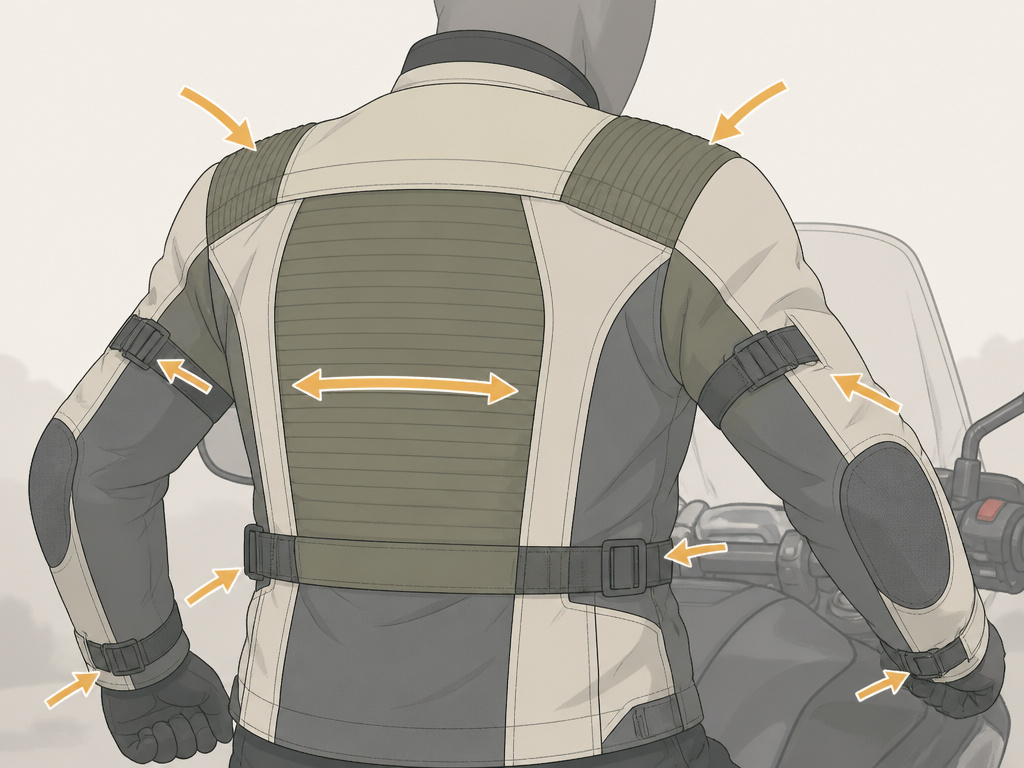
An adventure jacket isn’t just a touring jacket with more pockets. The cut is different because the riding position is different.
A touring rider is mostly seated, slightly leaned back. An adventure rider switches between seated and standing, with a more upright torso and arms forward. The jacket must allow that range without binding at the shoulders or riding up the back.
Look for these adjustments:
- Shoulder gussets: Extra fabric or stretch panels (like the S1 stretch fabric in the Dainese SUPER ADVENTURE) that expand when you reach for the bars.
- Bi-swing back: A pleated or elastic panel across the shoulders that expands as you lean forward.
- Adjustable waist and sleeves: Not just one strap. Multiple points to synch the jacket so it doesn’t billow at speed but doesn’t squeeze when you add a mid-layer.
- Collar design: A high, storm collar (like the “Storm Guard” on A high, storm collar seals out wind and rain without chafing your neck when you look over your shoulder.
The Aerostich Darien jacket is designed for comfort and mobility while riding. That’s the kind of feature you find by wearing the jacket in a riding stance, not on a hanger.
Easy to miss: The jacket-to-pants zipper. It’s not just for looks. A full-circle connection zipper stops cold air and road spray from riding up your back. It also keeps the jacket and pants aligned so armor stays in place. If a jacket lacks this, you’re buying a separate problem.
Pockets, Storage & Integration: More Than Just Places for Your Phone
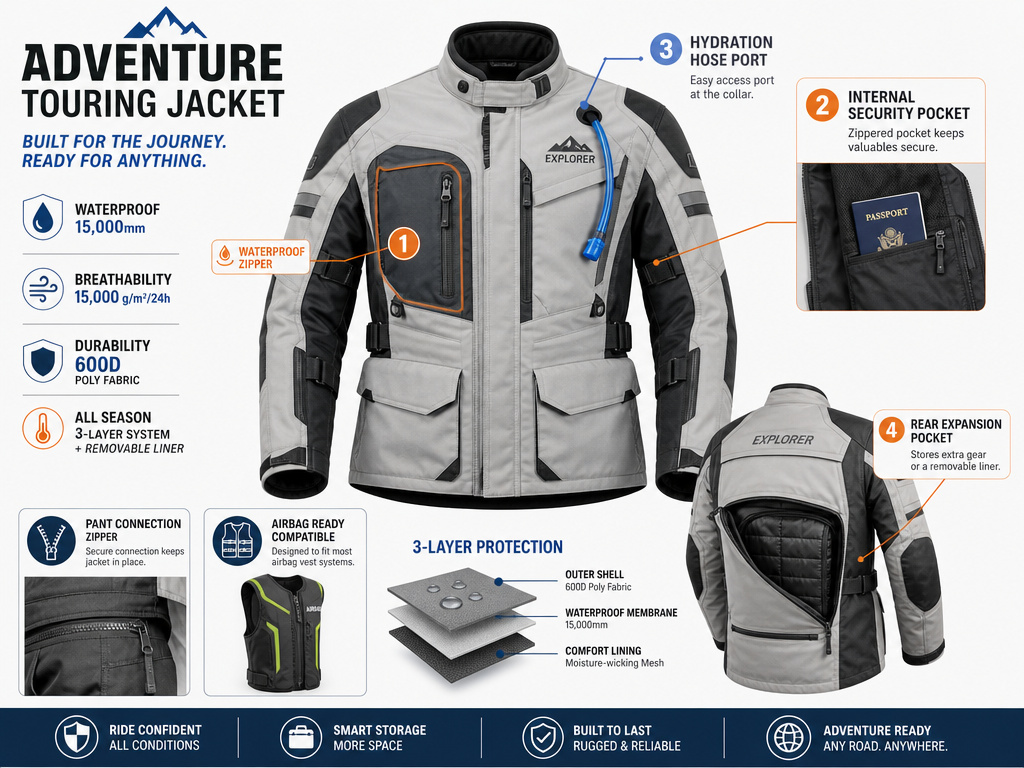
Pockets on an adventure jacket have specific jobs. The wrong layout costs you time and security.
- External Cargo Pockets: Large, bellows-style pockets on the thighs or chest. They should close with waterproof zippers or flaps. The Ducati Explorer has 7 outer pockets, 2 of them waterproof.
- Internal Secure Pockets: Zippered pockets inside the main shell, often on the chest or lower back, for passports, wallets, phones. They should be accessible with the jacket partially unzipped.
- Hydration Pack Pass-Through: A dedicated sleeve or port inside the jacket to route a hydration hose. The Dainese SUPER ADVENTURE ABSØLUTESHELL™ is compatible with packs up to 1.5L.
- Map/ Liner Storage Pocket: A large rear pocket, often with an expansion zipper, designed to store the removed waterproof or thermal liner. The Dainese jacket’s rear pocket holds both the torso cover and the Absøluteshell™ membrane.
The Aerostich Darien has an optional left sleeve window pocket (6” by 4”) for directions or a compass. That’s a traveler’s detail.
Integration extends beyond pockets. True adventure jackets are part of a system.
- Pants Connection: The zipper must be a standard length (usually 8-10 inches) to match major brand adventure pants.
- Airbag Compatibility: Jackets like the Dainese SUPER ADVENTURE and SUPER EXPEDITION are compatible with wearing over the Smart Air airbag device.
- Layering with Off-Road Armor: Some jackets allow for the removal of included protectors to accommodate other safety gear. This allows you to use a more protective external armor vest for extreme off-road sections.
Long-Term Ownership & Maintenance
A $700 jacket shouldn’t become a leaky shell in two seasons. The care instructions are as important as the features list.
The Aerostich Darien owner’s guide is brutally honest. It says: “Do not leave the inner jacket stuffed for more than a few days, or it will look wrinkly for a long time unless laundered.” It also guarantees the jacket against defects for two full years and expects it to last 5 to 10 years or 50,000 to 100,000 miles.
That’s a benchmark. Most textile jackets won’t hit that, but your maintenance decides how close they get.
Before you start: Never use standard detergents or fabric softeners on a waterproof membrane. They clog the pores. Use a technical cleaner like Nikwax Tech Wash. Re-proof with a DWR (Durable Water Repellent) spray every season or after three heavy washes.
Check the stitching at stress points, armpits, collar, pocket corners, once a season. If threads are fraying, get it repaired before the seam opens. A bonded laminate jacket is harder to repair than a shell with removable layers.
Zippers are the first point of failure. Lube them with a dry silicone spray (not WD-40) every few months to keep them smooth, especially the main and vent zippers.
How much should I spend on an adventure motorcycle jacket?
A higher price often buys long-term durability and integrated protection. Premium jackets may be constructed with laminated waterproof membranes and high-tenacity fabrics, designed for multi-season use over thousands of miles. They typically come with certified limb protectors and dedicated pockets for additional armor. The value lies in how these features work together for consistent performance. A budget jacket might save money upfront but could compromise on material quality or the integration of safety components, potentially needing replacement sooner.
Frequently Asked Questions
What is the best motorcycle jacket for adventure riding?
There is no single “best.” The right jacket matches your climate range and riding style. For extreme multi-climate travel, a modular jacket like the Dainese SUPER ADVENTURE ABSØLUTESHELL™ is top-tier. For mostly cool, wet pavement touring, a bonded laminate jacket like the Dainese SUPER EXPEDITION GORE-TEX® is simpler. Try before you buy, fit decides everything.
Is Cordura better than Kevlar?
For adventure riding, Cordura® is the default. It’s a high-tenacity nylon (like the 300 g/m2 fabric in the Ducati Explorer) that balances abrasion resistance, weight, and cost. Kevlar is stronger per weight but is often woven into panels (not the whole jacket), is heavier, and is more expensive. Cordura works for 95% of adventure riders; Kevlar is for those prioritizing maximum slide protection over ventilation and packability.
What is the hump on a motorcycle jacket for?
The “hump” or spoiler on the back of some sport and adventure jackets is an aerodynamic feature. At highway speeds, it smooths airflow over the rider’s helmet, reducing buffeting and neck strain. On an adventure jacket, it’s often less pronounced but still helps with stability in crosswinds. It’s not a storage pouch.
How should an adventure jacket fit?
Snug but not tight in a riding posture with a base layer on. The shoulder and elbow armor must stay in place when you move. There should be enough room in the torso to add a mid-layer (like a fleece) without the jacket becoming baggy. The waist should adjust to prevent billowing. The sleeves must be long enough to cover your wrists when your arms are extended to the handlebars.
Before You Go
Skip any jacket that doesn’t let you try it on in your riding stance. The best feature list is worthless if the armor floats or the shoulders bind.
For most riders doing mixed-distance travel, the modular system is the safer bet. You can adapt. A bonded laminate is a commitment to a specific climate.
One final check: look at the connection zipper. If it’s not a full-circle, standard-length design, you’re buying a jacket that fights your pants. That’s a design flaw, not a feature.
Your jacket is your primary shelter on the road. Choose the one that changes when the weather does.
