
Motorcycle Back Protector Pros and Cons: Is It Worth It?
This post contains affiliate links. As an Amazon Associate, we earn from qualifying purchases.
Motorcycle back protectors are CE-certified pads that reduce the force transmitted to your spine in an impact, but they cannot protect against bending, twisting, or crushing injuries. The EN 1621-2:2014 standard defines two protection levels: Level 2 (≤9 kN average force) offers higher protection but is thicker, while Level 1 (≤18 kN average) is lighter. A 2023 biomechanics study found their effectiveness drops to 0-3% for flat impacts, a critical detail most riders miss.
The standard’s force-transmission numbers are a lab result, not a real-world injury guarantee. They measure performance against a specific, repeatable impact, not the chaotic variables of a crash. This is the gap between certified safety and actual survival odds, a key consideration when weighing motorcycle back protector pros and cons.
What follows is a breakdown grounded in manufacturer manuals and recent peer-reviewed research of the motorcycle back protector pros and cons. This article explains the two certification levels, the real data on flat vs edge impacts, how they stack up against modern airbag vests, and the practical maintenance that keeps them working.
Key Takeaways
- The EN 1621-2:2014 Level 2 standard (≤9 kN average force) offers superior impact reduction but is heavier; Level 1 (≤18 kN) is the default for most gear.
- Against a flat impact surface, a back protector may reduce spinal compression by only 0-3%, per a 2023 IRCOBI study—its main benefit is against penetrative edges like curb stones.
- No back protector can prevent injuries from bending, twisting, or over-stretching; they are designed solely for blunt trauma and abrasion reduction.
- Manufacturers disagree on replacement: Leatt Corporation recommends 3 years, while Sport Conrad‘s safety sheet suggests up to 5 years, but both advise replacing it immediately after any significant impact.
- For comprehensive protection, consider pairing a protector with a modern motorcycle airbag vest, which the same study showed reduced compression by 63-79% in flat impacts.
What Does the EN 1621-2:2014 Standard Actually Measure?
You see the CE label and the EN 1621-2:2014 code on the tag. That’s the European technical standard every back protector sold in the EU must pass. It doesn’t mean “unbreakable spine.” It certifies that the pad reduces transmitted force below a specific threshold when hit in a very specific way, as defined by the standard.
The test defined in the EN 1621-2:2014 standard uses a striker dropped onto the protector; one manufacturer’s safety sheet notes its protector is tested at an impact energy of 50 J. Sensors measure how much force gets through to the other side. The standard then defines two protection levels based on those readings.
The EN 1621-2:2014 standard defines two back protector performance levels. Level 1 requires the average transmitted force from all test impacts to be ≤18 kilonewtons (kN), with no single strike exceeding 24 kN. Level 2 requires a more stringent ≤9 kN average, with no single strike over 12 kN. The standard also defines three protector shapes: Full Back (FB), Central Back (CB), and Lower Back (LB).
This is a pass/fail lab test. It doesn’t simulate a multi-impact crash, a twisting fall, or your body sliding over a guardrail. It tells you the pad meets a baseline for energy absorption under controlled conditions. Most jackets come with a Level 1 protector as the default insert. Upgrading to a standalone Level 2 protector is a common move for riders seeking the highest certified protection.
The shape designation matters more than people think. A Central Back (CB) protector, as defined by the standard and noted in the Sweet Protection manual, provides no scapula protection. A Lower Back (LB) protector provides no upper back protection. You’re buying coverage for a specific zone, not your entire back.
The Pros: What a Back Protector Actually Does Well
We can cut through the hype.
Reduces Force from Concentrated Impacts. This is its primary function. If you fall and your back hits a curb edge, a rock, or a protruding handlebar, the protector spreads that impact force over a larger area. The foam or composite material compresses to absorb energy, lowering the peak force that reaches your spine. This can mean the difference between a bruise and a vertebral fracture.
Prevents Abrasions and Lacerations. The outer shell, whether hard plastic or a tough textile covering, acts as a barrier between your skin and the pavement. This is a straightforward, undeniable benefit. In a slide, it can save you from a serious case of road rash on your back, which is notoriously difficult to treat.
Provides a Psychological Comfort. This isn’t nothing. Knowing you have an extra layer of protection can make you a more confident rider. Confidence reduces tension, which can improve reaction times. It’s not a safety feature you can measure in a lab, but it’s real for many riders.
Offers a Certified Baseline. The CE certification means the product has been verified by an independent body to meet a published safety standard. You’re not relying on marketing claims about “high-density foam.” You’re buying a product that passed a test whose parameters are published in documents like the BSI Standards Publication preview. This is why you should never use a vest where the comfort padding is listed as non-compliant, as some safety sheets warn.
| Pro | How It Works | Real-World Benefit |
|---|---|---|
| Impact Force Reduction | Absorbs and spreads energy from a blow. | Can lower risk of spinal fractures from curb stones or rocks. |
| Abrasion Resistance | Tough outer shell slides on pavement. | Prevents severe road rash on the back during a slide. |
| Certified Standard | Must pass independent EN 1621-2:2014 testing. | Provides a verifiable, minimum level of performance assurance. |
The Cons and Critical Limitations
The drawbacks aren’t just about comfort. They’re about fundamental gaps in what the technology can physically do.
Minimal Protection Against Flat Impacts. This is the most significant and least-discussed limitation. A 2023 study presented at the International Research Council publication (IRCOBI) used finite element modeling to test protectors. It found that for compression of the spine from a flat impact—like sliding back-first into a flat guardrail or a car door—the reduction was 0-3%. The protector’s effect was “almost nil,” as noted in the IRCOBI conference paper. Its benefit was much higher (5-9%) for a penetrative “kerb stone” impact. This matches a warning from Sport Conrad’s safety sheet that the protector offers protection mainly against edge impacts.
Zero Protection Against Bending or Twisting. Your spine is just as vulnerable to injury from hyperflexion, extension, or rotation as it is from a direct blow. The Sweet Protection manual states clearly: the protector “does not provide protection against injuries that are caused by over-stretching, bending or twisting.” A separate safety sheet echoes this, saying it cannot guarantee protection against traumas from bending, twisting, or crushing.
Bulk, Heat, and Fit Issues. A Level 2 protector is necessarily thicker and heavier than Level 1. This can make a jacket fit tighter, reduce airflow, and become uncomfortable on long, hot rides. An ill-fitting protector is worse than useless; if it shifts out of place in a crash, it’s not protecting anything. The manuals are explicit: a protector that is too big can interfere with your helmet’s movement.
This isn’t to say they don’t work; it says the real-world, crash-based data to prove they reduce serious spinal injuries is thin.
Where this goes sideways: Assuming a back protector makes you invulnerable to spinal injury. It is a single tool for a specific type of impact (concentrated, blunt trauma). Riders who understand its limits ride more cautiously than those who think they’re fully armored.
The 0-3% Reduction for Flat Impacts
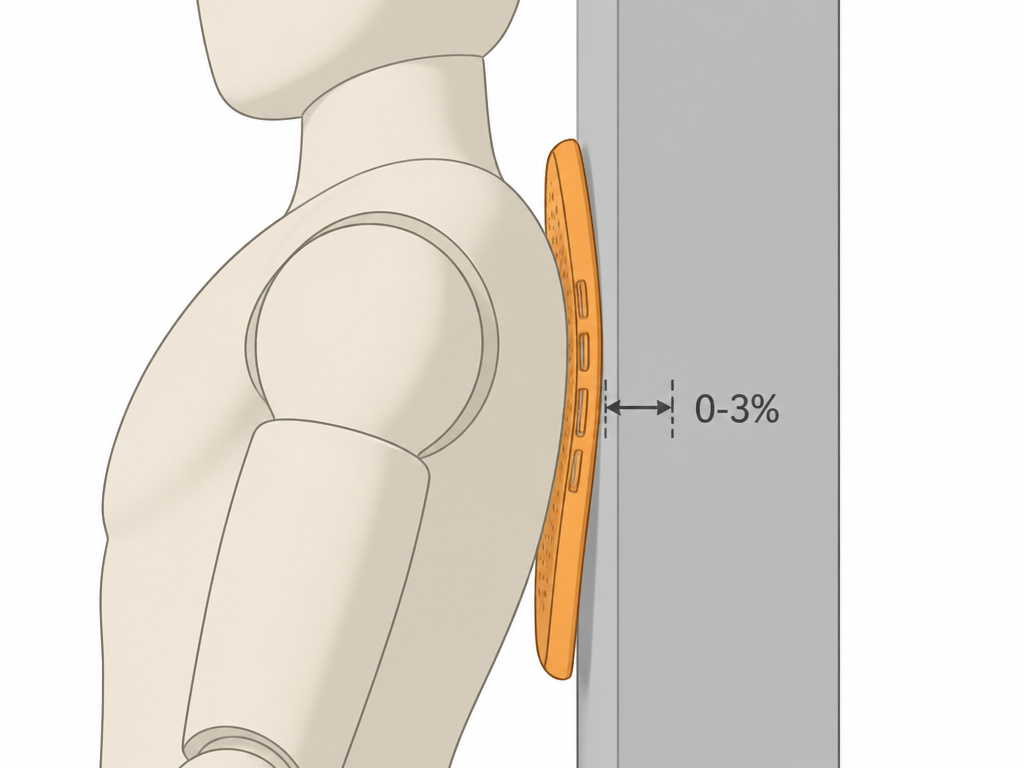
That IRCOBI conference number needs its own section because it changes the value proposition. If you mainly fear sliding into a broad, flat object, the data says your back protector is doing very little to protect your spine from compression.
The study’s models compared a back protector, an airbag vest, and a combination of both. For flat plate impacts, the airbag alone reduced spinal compression by 63-79%. The back protector alone reduced it by 0-3%. The airbag works by providing a large, compressible volume that decelerates your body over a longer distance and a larger area—a fundamentally different mechanism than a localized pad.
This doesn’t make the back protector worthless. It clarifies its role. Its strength is against the penetrative impact. Think of the corner of a curb, a jagged rock, or the edge of a car part. Here, the protector can concentrate its energy-absorbing material at the point of contact. For these scenarios, the study showed a 5-9% reduction in compression and a 16-19% reduction in intervertebral rotation.
So what’s the takeaway? Your risk profile matters. This is the core of understanding motorcycle armor types: matching the protection to the probable threat.
Back Protector vs. Airbag Vest: A Data-Driven Comparison
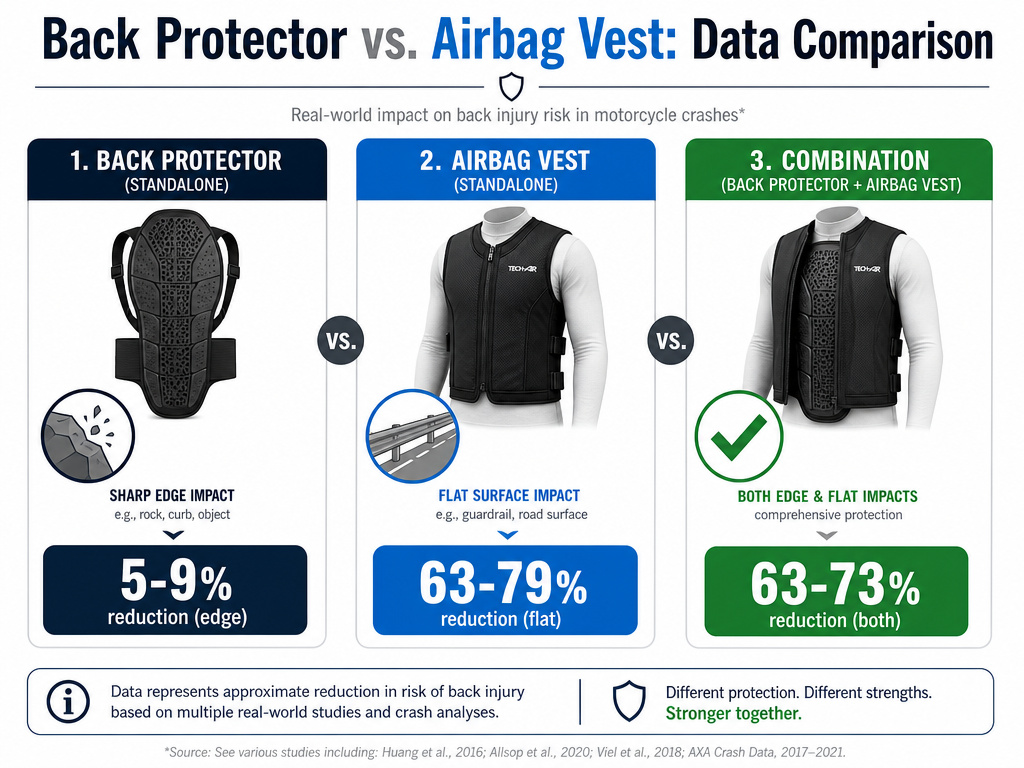
This is the modern question. Given the flat-impact data, is a traditional back protector obsolete compared to an airbag? Not exactly. They function differently and can even be combined.
The airbag’s supreme advantage is its coverage and compression reduction in broad, flat impacts. However, an airbag is a single-use device that must be serviced after deployment.
The back protector is always there, requires no activation, and is ready for multiple impacts. It’s also specifically designed to handle high-point loads from edges, which an airbag’s fabric might not disperse as effectively on its own.
The IRCOBI study found that coupling an airbag with a back protector provided the best overall results, with compression reductions between 63% and 73% across both flat and penetrative impacts.
| Feature | Standalone Back Protector | Standalone Airbag Vest | Combined System |
|---|---|---|---|
| Best For | Penetrative/edge impacts (curbs, rocks). | Broad, flat impacts (guardrails, car sides). | Comprehensive coverage for all impact types. |
| Compression Reduction (Flat Impact) | 0-3% | 63-79% | 63-73% |
| Compression Reduction (Edge Impact) | 5-9% | Not specified in fact sheet | 63-73% |
| Key Limitation | No bending/twisting protection; low flat-impact benefit. | Single-use; requires activation/service. | Bulkier; highest cost. |
For many riders, the pragmatic path is to use the back protector that came with their jacket and, when budget allows, add an airbag vest for rides where the higher level of protection is desired. Understanding the pros and cons of chest protectors is also key, as some integrated systems cover both.
Care, Cleaning, and When to Replace
A damaged or degraded protector is a placebo. The manuals are very clear on maintenance, but the advice isn’t uniform.
Cleaning is a point of disagreement. The Leatt manual says to use a damp cloth with tap water only, and never use cleaners or detergents. However, a Sport Conrad safety sheet for a different product says to use nothing but a dry cloth on the protector pad.
Storage is critical. Keep it away from direct sunlight and extreme temperatures. The Duell manufacturer declaration notes that temperature extremes can change the impact characteristics of the materials. Don’t leave it in a freezing garage or a boiling-hot trunk for extended periods. Don’t stack heavy gear on top of it.
When to replace it is the biggest question. Here, manufacturers disagree:
- Leatt Corporation recommends replacement every three years under normal use.
- Sport Conrad’s safety sheet says it should ultimately be replaced after 5 years.
The universal rule that overrides both: replace it immediately after any significant impact. You must also replace it if you see any visible damage—cracks in the shell, deep cuts, or compression marks that don’t rebound. The protective foam can fatigue over time with exposure to sweat, UV light, and temperature cycles. For options, consult our review of the best back protectors.
Types and styles of motorcycle back protectors
Back protectors come in different forms, each with trade-offs. Strap-on models are standalone and worn directly against your body or over a base layer, offering a consistent fit regardless of your jacket. Jacket inserts are built into a compatible pocket in your riding jacket, convenient but dependent on that jacket’s fit. The EN 1621-2:2014 standard defines three shapes: full back (FB), central back (CB), and lower back (LB). A central back protector provides no scapula protection, while a lumbar protector provides no upper back protection. Choose a shape that covers the areas you need. A protector that is too small does not provide sufficient coverage, while one that is too big may restrict movement or interfere with your helmet.
Choosing a back protector for track or street riding
The type of riding you do influences the protector you need. For high-speed track use, where impacts can be severe, a Level 2 certified protector that reduces transmitted force to a greater degree is often recommended. For general street riding, a Level 1 certified protector may be sufficient. Research indicates a back protector’s effect varies drastically with impact type. Its effect on back compression is very low for kerb stone impacts and almost nil for flat plate impacts. It offers better reductions in intervertebral rotation for edge impacts. Since street hazards can include both curbs and flat surfaces, understand that a back protector cannot guarantee protection against injuries caused by bending, twisting, or crushing forces common in accidents.
Ensuring your back protector fits your jacket
Compatibility between your back protector and your riding jacket is crucial for safety and comfort. If using a jacket with a dedicated protector pocket, you must select a protector of the correct shape and size to fit that pocket snugly. A loose protector can shift in a crash. Before riding, check the protector’s fit by carrying out physical actions typical of your riding style. Ensure it does not ride up and interfere with your helmet when you are in a riding position. Remember that comfort padding at the neck or lower back on some vests may not be compliant with safety standards and does not offer sufficient protection. The protector itself should be checked regularly for visible damage and replaced if any is found.
Frequently Asked Questions
Which is better, Level 1 or Level 2 back protector?
Level 2 is objectively better at reducing transmitted force (≤9 kN average vs. ≤18 kN for Level 1). However, it is thicker, heavier, and less flexible. For most street riders, the Level 1 protector included in a jacket is a good baseline. Track riders, adventure riders, or those seeking the highest certified protection should upgrade to a standalone Level 2 protector. The choice involves a trade-off between protection and comfort.
What is the best back protection for motorcycles?
There is no single “best.” It’s a hierarchy based on technology and certification:
- Base: A CE-certified Level 1 back protector (often included in jackets).
- Upgrade: A standalone CE Level 2 back protector from a brand like Knox or D3O.
- Advanced: A modern electronic or tethered airbag vest.
- Optimal (per 2023 research): An airbag vest worn over a Level 2 back protector.
Your best protection is the one you will wear consistently that fits your riding style and budget. Our guide on the best spine protectors explores these tiers in detail.
Can a back protector protect against spinal fractures?
It can reduce the risk of fractures from direct, concentrated impacts to the area it covers. It cannot protect against spinal fractures caused by bending, twisting, or axial loading (crushing). Its job is to manage blunt force trauma from an object hitting your back, not to stabilize your spine during complex crash dynamics.
How should a back protector fit?
It should sit centered on your spine. The top should not interfere with your helmet when you look over your shoulder. The bottom should cover down to your lumbar region without digging into your waist when you’re in a riding position. It needs to be snug enough that it does not shift if you move around on the bike, but not so tight it restricts breathing or movement. Always check the fit in a riding crouch before buying.
Do I need a back protector if I have an airbag vest?
The 2023 IRCOBI research indicates the combination provides the best results, as the back protector helps distribute force across the airbag. However, a modern airbag vest alone provides superior protection to a standalone back protector, especially for broad impacts. If you must choose one, the airbag vest is the more protective technology. But using both is the current gold standard for torso protection.
Before You Go
The value of a back protector isn’t a simple yes or no. It’s a tool with a specific, verified function and documented, significant limitations.
If you ride with one, understand its job: to absorb energy from a direct hit and save your skin in a slide. Don’t credit it with capabilities it doesn’t have. Pair it with a jacket that has CE-rated armor at the shoulders and elbows, as understanding armor construction matters for all your impact zones. For the highest risk reduction, consider it part of a system that includes an airbag vest.
Finally, maintain it. A five-year-old protector that’s been baking in a trunk and soaked with sweat is not the same product that left the factory. Whether you follow the three-year or five-year replacement guideline, inspect it before every season. Check for damage, make sure it’s seated correctly in its pocket, and ensure the straps or your jacket hold it firmly in place. Protection that isn’t positioned to work is just extra weight.
