
Motorcycle Cooling Vest Pros and Cons: Which Type Wins?
This post contains affiliate links. As an Amazon Associate, we earn from qualifying purchases.
Motorcycle cooling vest pros and cons come down to matching three things: your jacket type, your ride duration, and your local humidity. An evaporative vest soaked in water works with a breathable jacket but fails in high humidity or under a sealed leather coat. An ice pack or PCM (Phase Change Material) vest works anywhere but has a hard time limit, typically ranging from 1 to 4.5 hours depending on the type and conditions, before needing a recharge.
The choice isn’t about finding the “best” vest; it’s about understanding the motorcycle cooling vest pros and cons to find the vest that doesn’t quit on you at the wrong moment. A vest that works under a mesh jacket on a dry Arizona highway might leave you wet and warm under a rain shell in Florida.
What follows: a breakdown of how each type actually performs, the numbers on cooling duration straight from the test logs, and the one mistake that turns a cooling aid into a soggy burden.
Key Takeaways
- Your jacket decides the technology. An evaporative vest needs airflow from a mesh or ventilated jacket. For a sealed leather or waterproof jacket, you need a vest with PCM cooling elements.
- Cooling times are shorter than claimed. Manufacturer claims often cite ideal lab conditions. Real riding with a Fieldsheer Hydrologic vest showed ice packs lasting between about 1 and 3 hours, with user tests recording 2.5 hours under a jacket, and a soaked vest giving 2 to 4 hours depending on airflow.
- High humidity nullifies evaporation. In muggy conditions, an evaporative vest can’t release moisture into the already-saturated air. Your cooling effect drops to near zero, a fact noted by riders in Florida and by Canadian wildfire crews.
- PCM elements are not one-size-fits-all. Ergowerken offers five temperature variants, from 6.5°C to 29°C. Colder elements (6.5°C) work under thick gear but cool for only 2 hours; milder ones (29°C) last up to 4.5 hours.
- Fit and washability matter more than hype. A bulky vest under your jacket restricts movement and can compromise armor placement. Choose a snug, washable model you’ll actually wear.
How Do Motorcycle Cooling Vests Work? (The Two Flavors)
You have two fundamental approaches: stealing heat through evaporation, or absorbing it with a cold mass.
Evaporative vests use a super-absorbent fabric lining, often a Super Absorbent Polymer (SAP), to hold water close to your skin. As you ride, airflow through your jacket causes this moisture to evaporate, which draws heat away from your body. It’s a simple, electricity-free process, but it hinges entirely on that airflow and dry air to absorb the moisture.
The second method uses a cold source. This is either frozen ice packs you slip into pockets, or sealed PCM elements that change from solid to liquid at a specific temperature, absorbing heat as they melt. These work by direct conduction, the cold thing touches you, you feel cool. They don’t care about airflow or humidity, but they have a finite amount of “cool” to give before they warm up.
The real question isn’t how they work; it’s where each one stops working, a key part of the motorcycle cooling vest pros and cons.
The Pros: Why You Might Want a Cooling Vest
The benefit is straightforward: they lower your core temperature. When you’re cooler, you fatigue slower, your reaction times stay sharper, and you’re less tempted to ride in a t-shirt because your jacket feels like an oven.
They turn a miserable ride into a manageable one. On a 95°F day, the difference between stewing in your own heat and having a constant cool layer on your chest is the difference between cutting your ride short and actually enjoying the trip. Multiple testers, from WebBikeWorld to EV Rider, confirm the sensation is real and tangible.
They’re a safety tool, not a luxury. Heat stress impairs judgment. A vest that keeps your temperature in check helps you maintain focus. For touring riders or commuters stuck in traffic, that’s a direct investment in risk reduction.
Some offer built-in safety features. The INUTEQ Bodycool Hybrid, for example, carries ISO20471 / ANSI Class2 certification for high visibility, blending cooling with conspicuity.
They’re relatively low-tech and affordable. A basic evaporative vest like the Fieldsheer Mobile Cooling model retails for $44.99 to $49.99. You’re not dealing with batteries, pumps, or complex parts that can break.
The Cons and Limitations (Where They Fall Short)
The drawbacks aren’t minor inconveniences. They’re deal-breakers if your situation doesn’t match the vest’s design.
Duration is the biggest lie. Manufacturers love optimistic numbers. Alpinestars claims its Coolant Vest can keep you cool for 3 days. Reviews of other long-duration vests, like the BMW Cool Down vest, note the cooling effect can diminish after about 7 hours, requiring a re-wet. Real-world data is all over the map because conditions vary wildly.
| Vest Type | Claimed Duration | Real-World / Tested Duration | The Catch |
|---|---|---|---|
| Fieldsheer Hydrologic (Ice Packs) | 3 hours | 2.5 hours under a jacket | Packs melt; cooling fades as they do. |
| Fieldsheer Hydrologic (Soaked) | N/A | 2 to 4 hours | Depends on airflow; one tester got 2 hours in the open, another 4 hours under a jacket. |
| Harley-Davidson Hydrating (Soaked) | N/A | 2-3 hours | Requires re-soaking after this window. |
| PCM Elements (e.g., Ergowerken 21°C) | Up to 3 hours | 2 to 3 hours | Depends on element temperature, ambient heat, and body activity. |
Humidity is the evaporative vest’s enemy. This isn’t a small drop in performance. In high humidity, the air can’t hold more moisture, so evaporation slows to a crawl or stops. In humid conditions like Florida, the cooling effect of an evaporative vest can be significantly reduced because the air cannot absorb much additional moisture. A Canadian forest fire ranger on the V4 Muscle Bike Forum dismissed them for professional use in both high-humidity and very-dry environments, which contrasts with general advice that they work best in dry heat.
You will get wet. An evaporative vest is a damp layer against your skin. If it’s not wrung out thoroughly, it can saturate your base layer. Some vests, like the Alpinestars Coolant Vest, use a sealed system, while others may allow moisture to transfer more readily. Wet skin plus stopping for gas equals a quick chill.
They add bulk and complexity. A vest is another layer to put on, adjust, and pack. A PCM vest with elements has noticeable weight on the chest and back. A poorly fitting vest can pinch or make your regular jacket fit too tightly, potentially displacing back armor.
Recharging isn’t always convenient. Soaking a vest at a gas station is easy. Finding a freezer for ice packs or a fridge for PCM elements on a multi-day tour? That requires planning, a cooler, or spare sets of elements.
Which Cooling Vest for Which Jacket? (The Golden Rule)
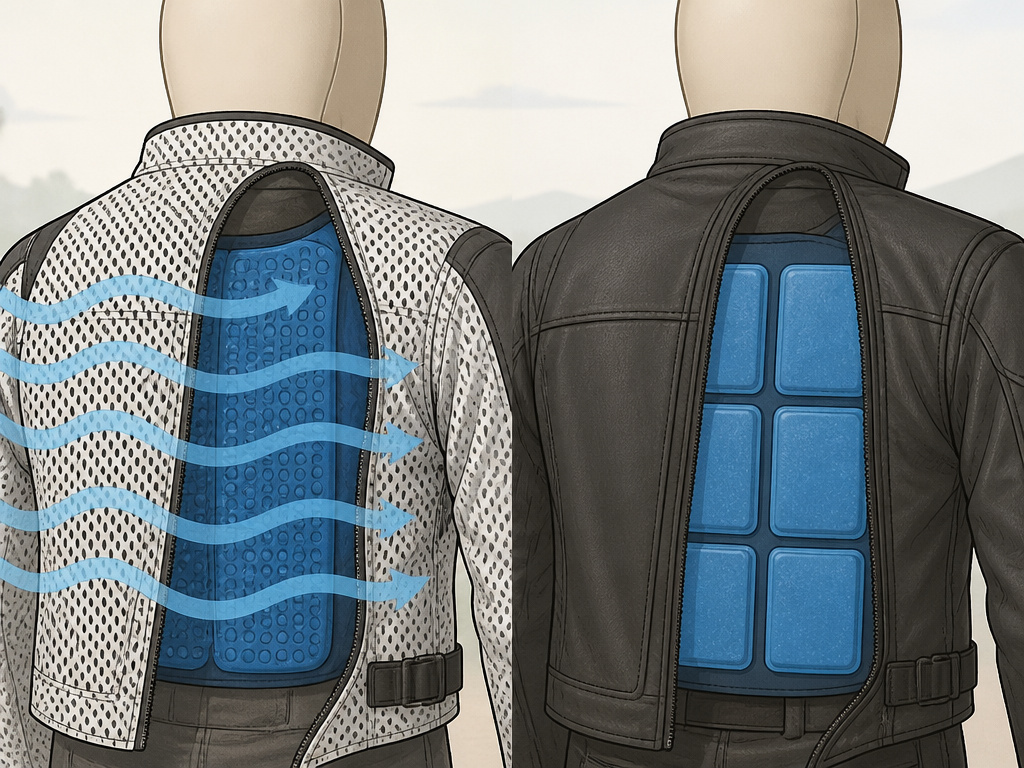
This is the single most important decision point, and most guides gloss over it.
Your jacket dictates the technology. If you wear a breathable mesh or ventilated textile jacket, you can use an evaporative vest. The airflow through the jacket powers the evaporation. If you wear a sealed jacket, like leather, a waterproof textile, or a rain shell, you must use a PCM or ice pack vest. No airflow means no evaporation.
I learned this the blunt way. I wore a soaked vest under a vintage leather jacket on a warm day, expecting a breeze. After an hour, I was just damp and warm, the leather blocked all the air the process needed. The vest was working as designed; my jacket choice broke it.
The specialist retailer Ergowerken states this rule plainly: evaporative vests only work with breathable/ventilated jackets; PCM element vests are required for sealed jackets. Ignoring this wastes your money.
The Mesh Jacket Match: Evaporative Vests
For a mesh motorcycle jacket, an evaporative vest like the Fieldsheer Hydrologic or an INUTEQ Bodycool Hybrid is a logical pick. You soak it, wring it, and let the wind do the work.
- Pro: Lightweight, simple, cheap to run (just water).
- Con: Useless in high humidity or under the wrong jacket.
The Sealed Jacket Match: PCM & Ice Pack Vests
For a leather jacket or waterproof shell, you need a vest that brings its own cold. That means a vest like the Alpinestars Coolant Vest (which is filled with water) or a vest designed for PCM Coolpac inserts, like those offered by Ergowerken. . Pro: Works independently of airflow and humidity.
- Con: Finite cooling duration, heavier, often more expensive.
How Long Does a Motorcycle Cooling Vest Last?
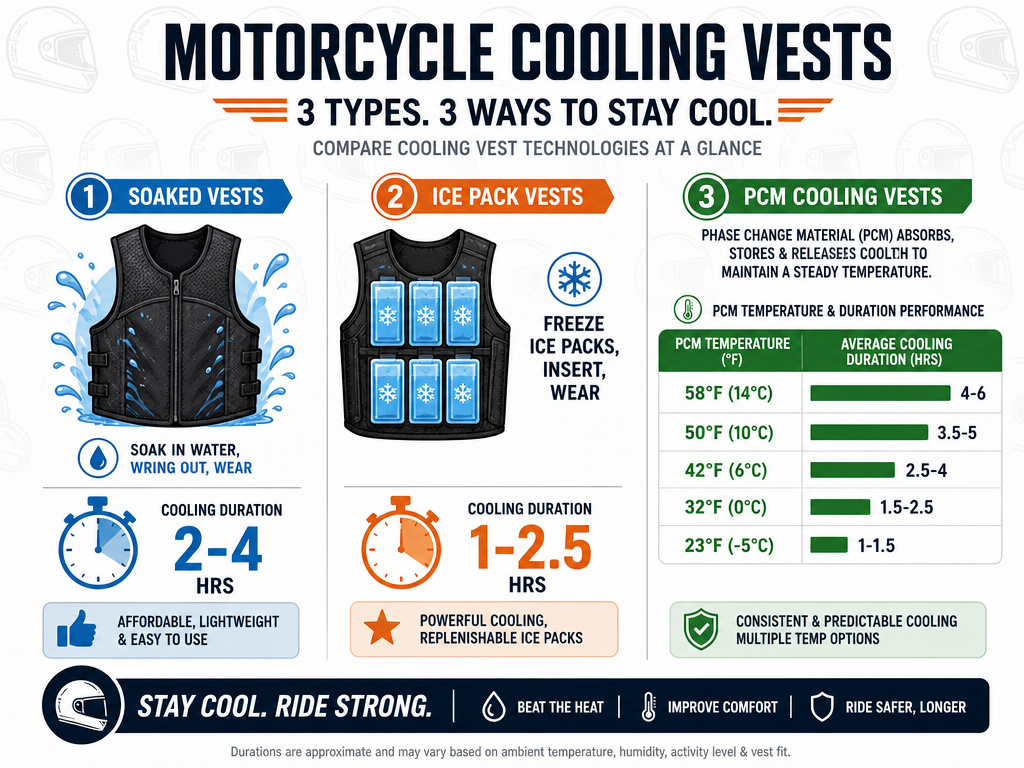
Forget the marketing copy. Here is the data from people who clocked it.
Evaporative (Soaked): Expect 2 to 4 hours. The massive spread comes down to airflow and climate. An Adventure Rider tester wearing a Fieldsheer vest openly in the slipstream got about two hours. A WebBikeWorld tester wearing it under a ventilated jacket got about 4 hours. The Harley-Davidson Hydrating Vest is reported to be good for only 2-3 hours of continuous riding.
Ice Packs: Expect 1 to 2.5 hours. The Fieldsheer ice packs are claimed to last 3 hours, but user testing recorded 2.5 hours under a riding jacket. One anecdotal test reported ice packs melting after about an hour.
PCM Elements: Duration is tied to the element’s phase-change temperature. Ergowerken’s data is the clearest here:
| PCM Temperature | Claimed Cooling Duration | Best For |
|---|---|---|
| 6.5°C | Up to 2 hours | Intense cooling under thick clothing. |
| 15°C | Up to 2.5 hours | Comfortable for most motorcyclists. |
| 21°C | Up to 3 hours | Comfortable for most motorcyclists. |
| 24°C | Up to 3.5 hours | Mild, long cooling. |
| 29°C | Up to 4.5 hours | Mild, long cooling. |
The actual duration will fall within a range of 2 to 4.5 hours, depending on the variant, ambient temperature, and how hard your body is working.
The Fit, Care, and Compatibility Details
A cooling vest is intimate gear. Get the details wrong and you won’t use it.
Fit is essential. It must be snug against your torso to transfer cold or moisture effectively, but not so bulky that it makes your protective jacket tight. A tight jacket can compress armor, reducing its safety performance. Try the vest on under your jacket before a long ride.
Wash it. Regularly. You’re sweating into this thing. A vest that isn’t easy to wash will develop odors that no amount of riding wind will clear. Check the care label before you buy.
Consider your other gear. Will this vest layer with your back protector or airbag vest? Some vests are slim enough; others will create a lumpy, uncomfortable mess. This is a critical gap in most discussions, cooling shouldn’t compromise protection.
Reactivation strategy. For a long tour, plan your rechargs. For an evaporative vest, that’s easy: pack a small towel and be ready to soak it at fuel stops. For PCM or ice vests, you need a cooler or a spare set of elements. The Ergowerken advice is practical: for a long ride, take a cool box or have a spare set of Coolpac inserts ready.
How do low-tech cooling methods compare?
Frequently Asked Questions
Do motorcycle cooling vests work?
Yes, but conditionally. They work if you match the technology to your jacket and climate. An evaporative vest works well under a mesh jacket in dry heat. It does not work under a leather jacket or in high humidity. Ice pack and PCM vests work in almost any situation, but only for their rated duration, usually 2 to 4 hours.
What is the 12-second rule for motorcycles?
The 12-second rule is a following-distance guideline for motorcyclists, recommending you maintain at least a 12-second gap between you and the vehicle ahead to improve reaction time. It’s unrelated to cooling vest performance, but both concepts address rider safety, one through space, the other through temperature management.
What are the rules for wearing biker vests?
This typically refers to cut or “club” vests, which have cultural and club protocols. For cooling vests, the “rules” are practical: wear it as a base layer directly against your skin or over a thin moisture-wicking shirt, underneath your protective motorcycle jacket. Ensure it doesn’t interfere with the fit or placement of your jacket’s armor.
Can you wear a cooling vest with an airbag vest?
It depends on the specific models. Some airbag vests are designed to be worn over a base layer and under a jacket, which could accommodate a thin cooling vest. Others are meant to be the innermost layer. The key is to try the combination while stationary to ensure neither system’s fit, sensors, or deployment is hindered. This is a crucial compatibility check most riders overlook.
Before You Go
The cooling vest question isn’t a yes-or-no. It’s a “if-then.”
If you ride with a mesh jacket in dry heat, try a simple evaporative vest like the Fieldsheer Hydrologic. Saturate it in water and see if its cooling duration fits your ride rhythm.
If you ride with a leather or waterproof jacket, or if you ride in humid climates, look straight to PCM vests. A 21°C element from a brand like Ergowerken offers a cooling duration of up to 3 hours.
Ignore the longest duration claim on the box. Plan for the shortest realistic runtime from the test data. Your body and your ride will thank you for the honesty.
One final thing: the best cooling vest is the one you’ll actually wear. A cheap, bulky, uncomfortable vest left in your saddlebag cools nothing but your regret. Fit first, cooling second.
