
How to Reproof Gore-Tex Motorcycle Gear: Step-by-Step
This post contains affiliate links. As an Amazon Associate, we earn from qualifying purchases.
To reproof Gore-Tex motorcycle gear, clean it with a technical detergent at 105°F, rinse twice, and tumble dry on warm for 20 minutes to reactivate the factory Durable Water Repellent (DWR). If water no longer beads after this heat cycle, apply a new wash-in or spray-on DWR treatment made for technical membranes. Never use fabric softener, bleach, or powder detergent.
That 20-minute tumble dry is the hinge. Skip it, and you’re just washing a jacket. Do it right, and you reset the coating that makes rain roll off instead of soak in. This is a key step in how to reproof Gore-Tex motorcycle gear.
The rest walks you through the two methods central to how to reproof gore-tex motorcycle gear: reviving the factory DWR with heat, and applying a new treatment when the old one is gone. We’ll cover jackets, gloves, and boots, point out the one membrane type you must never tumble dry, and show you how to test your work in five seconds.
Key Takeaways
- Reactivate the factory DWR coating first with a 20-minute warm tumble dry after cleaning; this fixes most “wetting out” issues without new chemicals.
- Use a liquid detergent suitable for technical fabrics, such as a technical wash like REV’IT! Textile Wash or Nikwax Tech Wash; avoid powder detergents, fabric softeners, and bleach which can clog the membrane.
- Test with a water bead check after the heat cycle. If drops soak in and darken the fabric, it’s time for a new DWR treatment.
- GORE-TEX SHAKEDRY™ garments cannot be tumble dried; follow the specific care label to avoid damaging the exposed membrane.
- Reproof gloves and boots separately with spray-on products; wash-in treatments are for jackets and pants where full immersion is safe.
Why DWR Fails and What “Reproofing” Actually Means
Your Gore-Tex jacket isn’t one piece of magic cloth. It’s a sandwich. The waterproof, breathable Gore-Tex membrane is in the middle, bonded to an outer fabric. That outer fabric gets a thin, invisible coating called Durable Water Repellent (DWR).
The DWR’s only job is to make water bead up and roll off the surface. This keeps the outer fabric from becoming a saturated sponge, which would block breathability and make you feel clammy even though the membrane underneath is still dry.
Common mistake: Assuming the entire jacket has lost its waterproofing when the outer fabric wets out. The Gore-Tex membrane is usually still fine; the DWR coating on top of it has just worn thin.
Dirt, body oils, sunscreen, bug spray, and campfire smoke act like detergent. They gradually degrade the DWR molecules. Each wash with the wrong soap can strip it faster. After a certain number of washes, depending on the gear and how you ride, the DWR can’t be revived by heat alone, which is a key moment in how to reproof gore-tex motorcycle gear. Sources suggest this point can be anywhere from 5 to 20 washes. That’s when you reproof: you clean the garment, reactivate any remaining DWR with heat, and if that fails, apply a fresh layer of DWR chemistry.
The Non-Negotiable Pre-Wash: Cleaning Your Gear
You cannot reproof over dirt. Grime blocks the new DWR from bonding to the fibers and accelerates its failure. This step isn’t optional.
First, prep the garment. Remove every detachable liner, all armor plates, and any inner warmth layers. Close all main zippers, vents, and hook-and-loop straps. This prevents snagging and protects other fabrics.
Now, the wash. The Gore-Tex Brand and major gear makers like REV’IT! are specific: machine wash on a warm, permanent-press cycle at 105°F (40°C).
| Do Use | Do NOT Use | Why It Matters |
|---|---|---|
| Liquid technical detergent (Nikwax Tech Wash, REV’IT! Textile Wash) | Powder detergent, regular household detergent | Powders and additives leave residues that clog the membrane and destroy DWR. |
| Small amount (follow bottle instructions) | Large amounts of any detergent | Excess soap is the #1 cause of residual foam that requires multiple rinses. |
| A second rinse cycle | Stopping after the first rinse | Ensures all detergent is flushed out; leftover soap causes wetting out. |
The detergent choice isn’t a minor detail. Sources disagree: Arc’teryx states directly: “Use a technical wash instead of regular detergent,” while the GORE-TEX Brand advises using a small amount of liquid detergent.
After the wash, dry the garment completely, either by line drying or tumble drying on a warm, gentle cycle. Line drying is gentler and saves energy. Line drying is recommended first. Once the garment is completely dry, a 20-minute tumble dry on a warm, gentle cycle is the step to reactivate the DWR.
The 20-Minute Tumble Dry Rule
This is the step most riders miss. Heat is what re-aligns the factory DWR molecules at a microscopic level, restoring their water-repellent stance.
The official instruction from both Gore-Tex and REV’IT! Is precise: once the garment is completely dry, tumble dry it on a warm, gentle setting for 20 minutes. Twenty.
The 20-minute tumble dry on warm is not about drying the garment. It’s a heat-treatment cycle to reactivate the factory DWR coating. Skip it, and you skip the most effective reproofing step.
Why does this work? Heat helps re-align the factory DWR molecules. Washing and regular drying misaligns its structure. That dedicated 20 minutes of consistent, moderate heat gives it the energy to “reset” into its original water-shedding form.
What if you don’t have a dryer? The Gore-Tex blog suggests an alternative: iron the dry garment on a low, no-steam setting with a cloth barrier between the iron and fabric. This provides the focused heat needed. Fair warning: REV’IT!’s instructions for motorcycle gear warn against using radiators or direct heat sources, but they don’t explicitly forbid ironing with a barrier. If your gear label says no ironing, don’t.
The Critical Exception: GORE-TEX SHAKEDRY™
This changes everything. GORE-TEX SHAKEDRY™ products have the membrane on the outside, with no outer fabric layer. There is no DWR coating to reactivate.
You must never tumble dry GORE-TEX SHAKEDRY™ garments. The care label will say so. Washing is fine, but drying is line-dry only. Putting SHAKEDRY in a dryer can damage the exposed membrane. This isn’t a suggestion, it’s a material limitation.
When to Reproof: The Water Bead Test
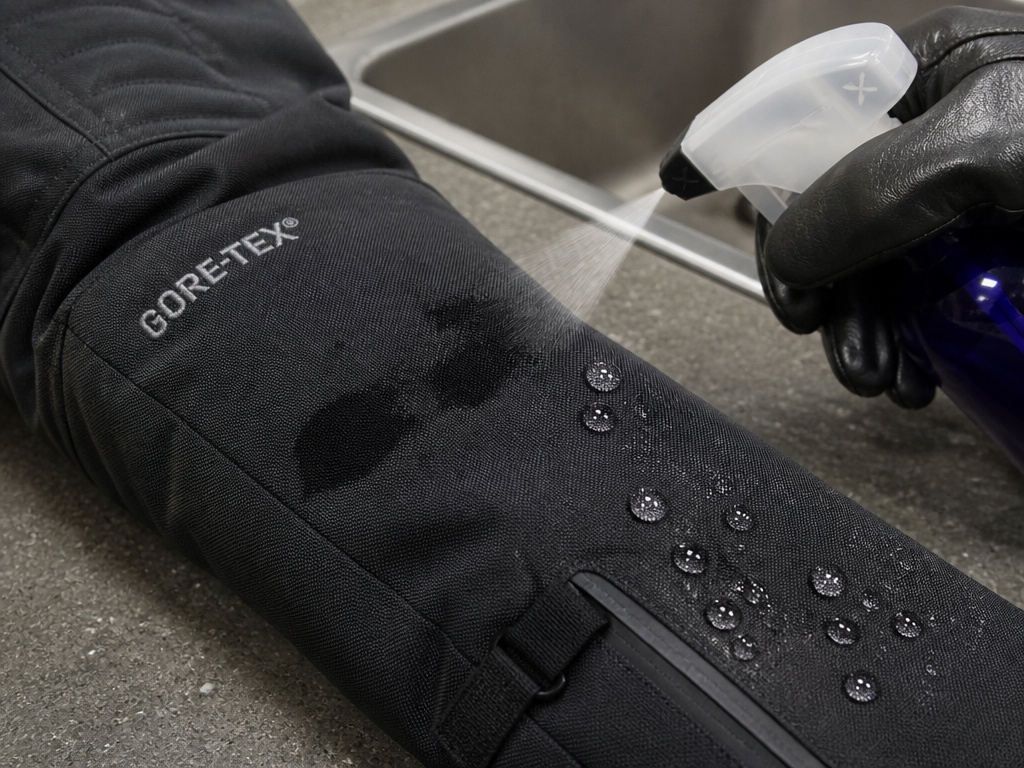
How do you know if the 20-minute heat cycle worked? You test it.
Wait for the gear to cool to room temperature. Then, take it to a sink or use a spray bottle. Sprinkle water on the sleeve, shoulder, and back.
| What You See | What It Means | Your Next Step |
|---|---|---|
| Water forms round beads that roll off quickly. | Factory DWR successfully reactivated. | You’re done. Gear is reproofed. |
| Water beads initially but then soaks in, leaving a dark spot. | DWR is weak and partially failed. | The heat reactivation wasn’t enough. Apply a new DWR treatment. |
| Water soaks in immediately with no beading. | DWR is fully depleted. | Definitely apply a new DWR treatment. |
The dark spot is the tell. It means the water is wicking into the outer fabric’s fibers instead of sitting on top. That’s “wetting out,” and it’s your signal to move beyond heat reactivation.
Applying a New DWR Treatment: Wash-In vs. Spray-On
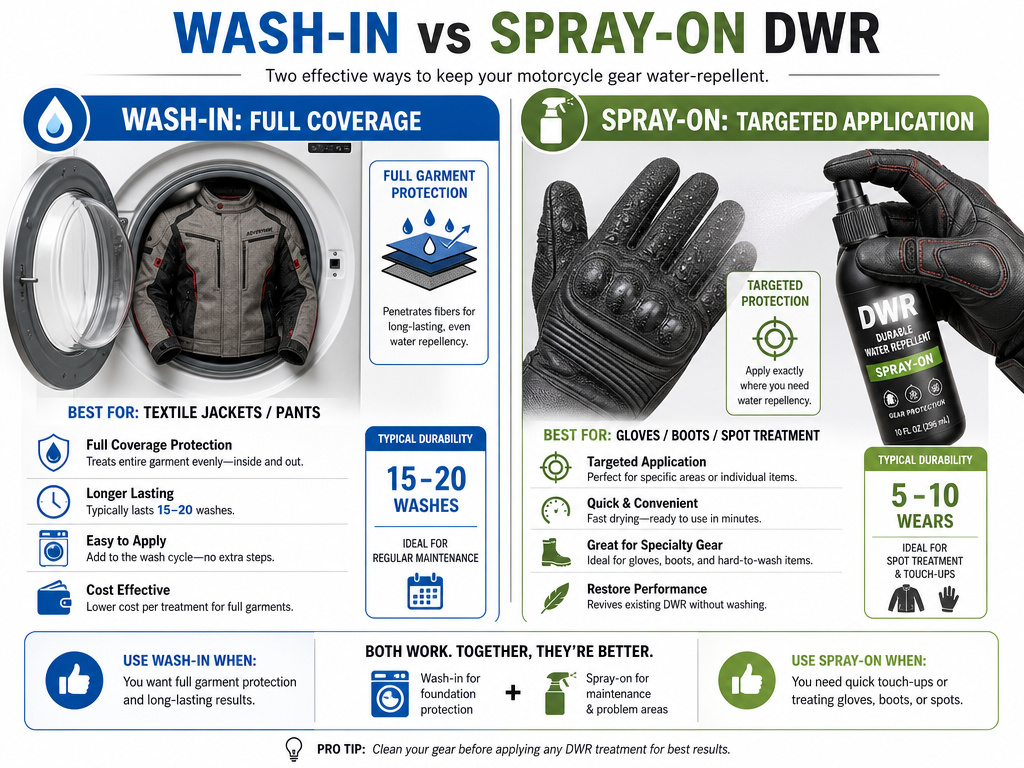
When the water bead test fails, you need to add new DWR chemistry. You have two delivery methods: wash-in and spray-on. Your gear type decides which is better.
Wash-In Treatments (like Nikwax TX.Direct Wash-In or REV’IT! Textile Waterproofing Wash-In) These go in the washing machine drum with your clean, dry gear. They coat the entire garment evenly, including hard-to-reach seams.
- Best for: Textile jackets and pants, where full coverage is ideal.
- Process: Run a clean gear through a warm cycle with the wash-in product, then tumble dry on warm for 20-40 minutes (per product instructions) to cure it.
- Duration: REV’IT! Notes its Textile Waterproofing Wash-In treatment typically lasts 5-10 laundry cycles before needing reapplication.
Spray-On Treatments (like Nikwax TX.Direct Spray-On or Revivex) These are applied directly to the dry, clean outer fabric.
- Best for: Gear with non-machine-washable components, motorcycle gloves, boots, leather/textile combos, and spot-treating high-wear areas.
- Process: Spray evenly from 6-8 inches away, let it dry, then tumble dry or iron with a cloth to cure. Use in a well ventilated area.
- Tip: Gore-Tex recommends pump-action sprays over aerosols to reduce environmental impact.
Where this goes sideways: Using a spray-on treatment on a sopping wet or dirty jacket. The DWR can’t bond to wet fibers or through a layer of grime. Always apply to clean, dry gear.
For gloves, the process is hand-specific. Clean the gloves first with a damp cloth and a neutral cleaner. Let them dry fully. Then, apply a spray-on DWR evenly over the outer fabric, avoiding saturation. Let them air dry, then gently tumble dry or use a hairdryer on low to cure the treatment. Never machine wash or dry gloves unless the label explicitly permits it.
Gear-Specific Considerations and Edge Cases
Not all Gore-Tex is the same. Membrane variants and gear construction change the rules.
Arc’teryx ePE GORE-TEX® is a newer, PFAS-free membrane. Arc’teryx recommends washing its ePE GORE-TEX garments every 3-5 days of heavy use or 5-10 days of light use to maintain performance, which is more specific than the GORE-TEX Brand’s general advice to wash as often as needed. Its DWR is also less oil-resistant, so consistent cleaning is even more critical.
Motorcycle Boots follow the spray-on path. Clean the outer textile with a technical wash and a soft brush, let dry completely, then apply spray-on DWR. Avoid spraying directly onto leather panels unless the product says it’s safe for leather.
What about dry-cleaning? The Gore-Tex Brand says dry-cleaning does not harm the membrane itself, but you must follow the garment’s care label. If you do dry-clean, you must request a specific process: a clear, distilled hydrocarbon solvent rinse and a spray-on/wash-in DWR treatment with heat reactivation afterward. Never dry-clean GORE-TEX SHAKEDRY™ garments.
Field Repairs are a separate issue. If you have a puncture or tear, a temporary field fix can be made with a GORE-TEX Fabric Repair Kit to keep water out until a professional repair is possible. This is not a substitute for reproofing the DWR.
Frequently Asked Questions
How do I make my Gore-Tex waterproof again?
First, wash it with a technical detergent at 105°F and rinse twice. Then, tumble dry it on warm for 20 minutes. This reactivates the existing DWR. If water still soaks in after this, apply a wash-in or spray-on DWR treatment made for technical fabrics.
What is the best Gore-Tex reproofer?
For motorcycle gear, products from Nikwax (TX.Direct) or REV’IT! (Textile Waterproofing) are reliable choices. The “best” depends on your gear type: use wash-in for full jackets and spray-on for gloves, boots, or spot treatments.
Is there a spray that can waterproof Gore-Tex?
Yes, spray-on DWR treatments like Nikwax TX.Direct Spray-On are designed to re-waterproof the outer fabric of Gore-Tex gear. They add a new DWR coating; they do not repair the underlying waterproof membrane.
Can Gore-Tex lose its waterproofing?
The Gore-Tex membrane itself is extremely durable and rarely fails. What you perceive as losing waterproofing is almost always the outer fabric’s DWR coating wearing out, causing “wetting out.” The membrane underneath is still keeping water out.
How often should I reproof my motorcycle jacket?
There’s no fixed schedule. Reproof only when the water bead test fails after you’ve cleaned and heat-reactivated the jacket. For some riders, that might be once a season; for others, every two years. Let the test, not the calendar, decide.
Before You Go
Reproofing isn’t a seasonal chore you mark on the calendar. It’s a response to a test. Keep it that simple: wash it right, dry it hot, sprinkle water on it. If the water beads, ride. If it soaks in, add DWR.
One rule that reframes the whole process: if your gear is wetting out after a wash and 20-minute tumble dry, the DWR is gone. Don’t try to reactivate it twice. Go straight to a new wash-in or spray-on treatment. Spending another cycle in the dryer on a dead coating just adds wear.
Gloves and boots need the spray. Jackets and pants take the wash-in. And if you own SHAKEDRY, remember the dryer is off-limits, the care label isn’t being cautious, it’s protecting a membrane that has no outer fabric to shield it.
Trust the water bead test. It doesn’t lie.
