
How to Clean a Motorcycle Leather Race Suit: Step-by-Step
This post contains affiliate links. As an Amazon Associate, we earn from qualifying purchases.
To clean a motorcycle leather race suit, follow the OEM’s specific instructions: use a soft, damp cloth with neutral soap and cold or lukewarm water, working in gentle circular motions on stains. Remove all armor and close all fasteners first, then air-dry the suit at room temperature, away from any direct heat source like a radiator or sunlight. The process is not universal. BMW Motorrad permits a soft brush for dirt, REV’IT! Permits a soft brush for its Adventure & Urban collections, while Dainese explicitly forbids it, and Dainese’s D-AIR airbag suits cannot be immersed in water at all.
The core rule is simple, but the contradictions between the brands that make your gear decide whether your cleaning routine preserves the leather or damages it. BMW says use a brush. Dainese says never use a brush. REV’IT! Says a toothbrush is fine for its Adventure suits. Following the wrong one for your suit is how you end up with a stiff, scratched hide, which is why it’s crucial to know exactly how to clean a motorcycle leather race suit.
What follows is the step-by-step pulled directly from the OEM manuals, a table mapping the three major brands’ conflicting advice on how to clean a motorcycle leather race suit, and the critical edge cases, airbag suits, vintage leather, and post-crash grime, that break the standard rules. If you own a Dainese or REV’IT! Suit, the one-page guide you need is below.
Key Takeaways
- Never use a washing machine, dryer, or harsh chemicals like solvents, petrol, or chlorine bleach. These break down the leather and can cause permanent stiffening.
- Dry your suit at room temperature, away from radiators and direct sun. Heat dries out the natural oils, causing the leather to crack and lose flexibility. A well-ventilated room on a hanger is the only safe method.
- For Dainese D-AIR airbag suits, prohibit immersion and running water. The official manual for the D-AIR RACING 1 I.P.S. Explicitly forbids it to protect the suit’s electronic airbag system.
- Remove armor, close all zips and fasteners before you start. This protects the removable protectors and prevents snagging delicate lining materials during cleaning.
- Test any cleaner on a discrete area first, like under the collar or inside a zipper flap. This verifies the product won’t discolor or damage your specific leather before you apply it everywhere.
The OEM Brush Debate: Yes or No?
The first place the manufacturer instructions diverge is on the use of a brush. This isn’t a minor detail, using a brush on a suit that forbids it can scrub off the protective topcoat.
BMW Motorrad’s care page states to “remove small amounts of dirt immediately with a suede/smooth leather brush.” It also says to “line dry clothing at room temperature before brushing it with a special suede/smooth leather brush.” Their stance is clear: a soft, dedicated leather brush is a correct tool for both initial cleaning and post-dry grooming.
REV’IT! Permits a brush for a specific line. For its Adventure & Urban collection leathers, the instructions say: “First, remove any surface dirt with a soft brush or toothbrush.”
Dainese says the opposite. Its FAQ is explicit: “Do not rub down the garment with a brush or abrasive materials or creams.” The brand’s position is that any brushing action, regardless of softness, risks damaging the finish.
Where this goes sideways: Using a stiff brush or scrubbing too hard. Even the pro-brush OEMs specify a soft suede or leather brush. A stiff nylon brush or excessive pressure will scratch the surface and leave a permanent, dull patch.
So, who do you follow when you compare a how to clean a motorcycle leather race suit? The rule is simple: follow the instructions for the brand of suit you own. If your suit is a Dainese, put the brush away. If it’s a BMW or a REV’IT! Adventure suit, a soft, clean brush dedicated to leather is your first tool for loose dirt. When in doubt, a soft cloth is a safe default.
| Brand | Brush Use | Type of Brush Specified | When to Use |
|---|---|---|---|
| BMW Motorrad | Yes | Suede/smooth leather brush | For removing small dirt; after line drying before storage. |
| Dainese | No | N/A – brushing is prohibited. | Never. Use a soft sponge or cloth only. |
| REV’IT! | Yes, for specific lines | Soft brush or toothbrush (Adventure & Urban only) | For initial surface dirt removal on Adventure/Urban collection leathers. |
The Step-by-Step for a Standard Suit (No Airbag)
This process synthesizes the common steps from BMW, Dainese, and REV’IT!, avoiding their contradictions. It’s the safe path for a traditional one-piece race suit without an integrated electronic airbag system.
1. Prep the Suit. Take out every piece of removable armor, back protector, shoulder, elbow, and knee pads. Close all main zippers, leg zippers, cuff zippers, hook-and-loop fasteners, and press studs. This protects the armor and prevents the lining from getting tangled or snagged.
2. Tackle Stains in Order. Work on one stain at a time. Dainese’s advice is to clean after every ride because “settled dirt has to be softened in stages.” For a fresh bug splat or grease spot, move to the next step. For dirt that’s been baked on for a season, you’ll need patience.
- For bugs and dust: Dainese says to “wipe the area with a soft sponge soaked in neutral soap and water.” It adds that organic spots from insects should be removed promptly because “the fluids they contain are quite aggressive on the leather.”
- For oil or grease: “Wash immediately with a soft damp cloth,” using gentle circular movements and avoiding harsh rubbing.
- For moderate, general dirt: BMW’s method is to “place a soft, damp cloth on the stain, leave it to soak and remove the dirt while applying gentle pressure (potentially repeat several times).”
3. Clean the Interior. Sweat and body oils break down leather from the inside. Dainese recommends cleaning the inside with neutral soap and water, using a cloth. For linings, the instructions vary: Dainese states “the lining must be washed separately in water at 40°C max,” using neutral soap, not abrasive detergent powder. However, BMW’s blanket rule is “leather clothing is not machine-washable,” which implies no washing of components. When your suit’s care label has a specific instruction, follow it over this general advice.
4. The Dry. This is Non-Negotiable. Every single OEM source says the same thing: air dry at room temperature, away from heat.
- BMW: “Line dry clothing at room temperature… Do not place on a radiator or dry in the sun– even after prolonged exposure to rain.”
- Dainese: “Dry the garment away from heat sources and in a well,ventilated place… On a hanger.
- REV’IT!: “Let the garment dry at room temperature, avoid direct heat sources or sunlight.”
Heat is the enemy. It cooks the moisture out too fast, making the leather stiff and brittle. A stiff suit is a suit that won’t move with you in a tuck.
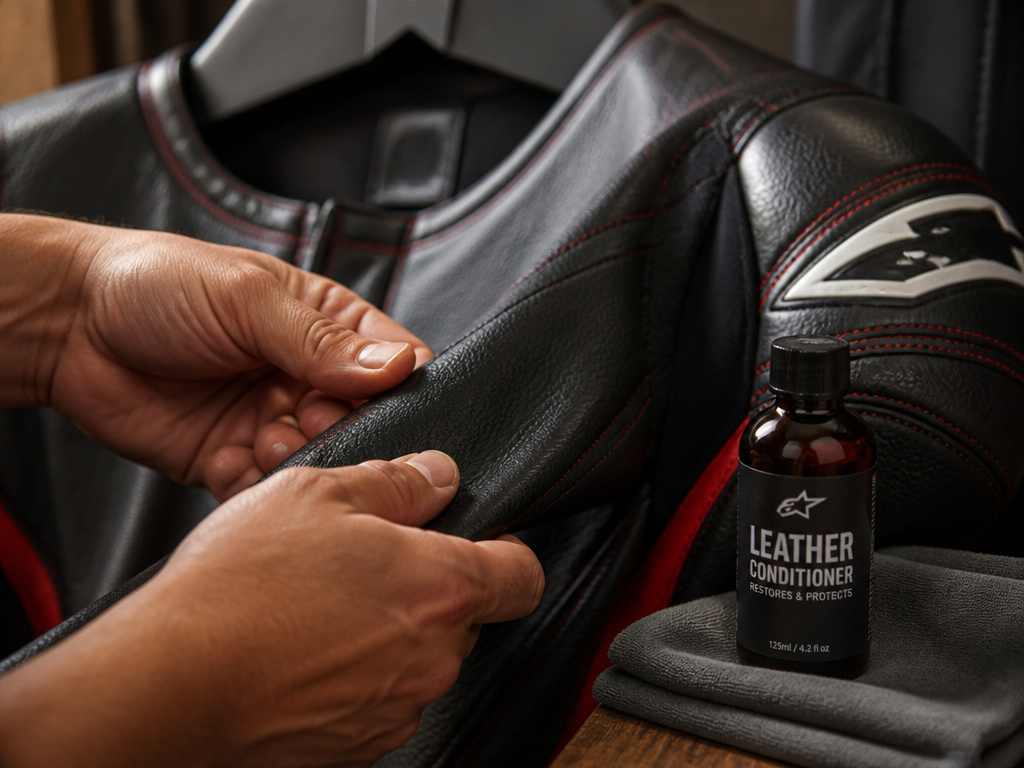
5. Condition (If Needed). Conditioning is not always required after every clean. It’s a nourishment step for dry leather. Dainese and REV’IT! Push their branded kits (Dainese Protection & Cleaning Kit, REV’IT! Leather Cleaner and Conditioner). BMW recommends its own waterproofing agents. The universal caution from REV’IT! Applies to all: “Before using any care product, try it on a discrete part of your garment (like the collar or inside/underneath the zipper) to see how the product reacts to the leather.”
The Edge Cases That Break the Rules
Some suits and situations void the standard guide. Here’s what to do instead.
Airbag Suits (Dainese D-AIR Systems)
If your suit has an integrated airbag system like the Dainese D-AIR RACING 1 I.P.S., the standard rules do not apply. The official manual for that suit contains a critical prohibition: it explicitly prohibits immersion in water or washing under running water.
The part nobody mentions: An airbag suit isn’t just leather and armor; it’s an electronic device. Water can damage the sensors, battery, or airbag inflator. You cannot soak it or spray it down.
Cleaning must be superficial and cautious. Use a barely damp cloth with a tiny amount of neutral soap, spot-cleaning stains with extreme care. Do not saturate any area. For the interior, avoid any significant moisture near the electronic components typically housed in the back or chest. When in doubt, contact the manufacturer or an authorized service center. Dainese offers a “Regenerate your Dainese leather garment” service in Europe for deep cleaning, which may be the only safe option for a heavily soiled airbag suit.
Vintage, Perforated, or “Critical” Leather
Specialty leathers have special needs. Dainese notes that its Vintage Leather requires “special treatment” and that items made with it (or with deep-penetrating stains like blood or mud) may be refused by their regeneration service.
Perforated leather is another edge case. Applying too much cleaner or conditioner can soak into the unprotected holes, potentially damaging the hide from the inside. The method here is minimalism: use less product, apply it carefully to the surface only, and avoid getting it into the perforations.
After a Crash or Slide
Cleaning a suit after a crash isn’t just about dirt; it’s about inspecting for damage. Abrasion marks need a gentle touch, don’t scrub a scuffed area aggressively, as you might remove more of the protective top layer. Embedded debris like asphalt or gravel should be picked out carefully, not rubbed in.
More importantly, a crash is the time for a professional inspection. The stitching and structural integrity of the suit are what matter most. While you can clean off the grime, have the suit checked by the manufacturer or a specialist leather laundry service to ensure its safety hasn’t been compromised. This is one area where the OEM advice to “have tough dirt and stains removed by a specialist leather laundry service” (per BMW) makes the most sense.
Branded Kits vs. Generic Cleaners: What the OEMs Actually Say

Should you buy the brand’s own cleaning kit or use a generic leather cleaner? The manufacturers have a stake in this, and their advice shows it.
- Dainese is the most prescriptive: “Use the Dainese ‘Protection & Cleaning Kit’ that you can find at any Dainese store.” It states that for more thorough cleaning, “nothing beats our Dainese kit.”
- REV’IT! also recommends its branded products: “Use our REV’IT! Leather Cleaner Conditioner to treat your gloves.”
- BMW Motorrad recommends its waterproofing agents but does not specify a cleaning kit, instead pointing riders to a “specialist leather laundry service” for tough jobs.
The underlying reason brands push their kits is compatibility. They formulate their cleaners and conditioners for their specific leather finishes and dyes. A third-party product might use oils or solvents that discolor or degrade their particular hide.
Common mistake: Using a household cleaner like dish soap or all-purpose spray. These often contain degreasers, alcohols, or other chemicals that strip the leather’s natural oils and leave it dry and cracked.
If you go generic, the OEM-approved substance is neutral soap. Dainese, REV’IT!, and BMW all mention it as a safe base. Pair that with a clean, white cotton cloth or soft sponge. And always, always test it on a hidden spot first.
How Often Should You Clean and Condition?
This isn’t about a schedule; it’s about state. Clean your suit when it’s dirty. Dainese’s blunt advice is to “clean your leather jacket after every ride (if you need to, of course).” The logic is sound: fresh dirt and bug guts wipe off easily. Dirt that sits for a season bonds to the finish and requires the multi-stage softening process.
Conditioning is different. You don’t condition after every clean. You condition when the leather feels dry, stiff, or looks dull. For a suit stored properly, a conditioning treatment might be needed less often. For a suit ridden frequently in all weather, conditioning may be needed more often. Your fingertips are the best gauge, if the leather doesn’t feel supple, it’s time.
Conditioning is also the final step before long-term storage. A light application of a conditioner like the Dainese kit or a tested third-party product will help keep the leather pliable while it hangs in the closet.
How to Condition and Protect a Leather Race Suit
After your suit is completely dry, applying a conditioner or protector restores flexibility and guards against the elements. Manufacturers recommend using products designed for motorcycle leather. For example, one brand suggests using their specific leather cleaner first, letting it dry, and then finishing with their leather conditioner. Another brand recommends their proprietary cleaning and protection kit to restore the leather’s initial characteristics if it appears dry or stiff after getting wet. Always test any product on a small, discrete area of the suit first, like inside a zipper flap, to check for any adverse reaction before treating the entire garment. Apply the product as directed, ensuring the leather is fully dry beforehand.
Frequently Asked Questions
What is the best leather cleaner for motorcycle leathers?
According to the OEMs, the “best” cleaner is the one they make for their specific leather. Dainese and REV’IT! Explicitly recommend their branded kits (Dainese Protection & Cleaning Kit, REV’IT! Leather Cleaner Conditioner). If you don’t use a brand kit, the universal safe agent is a neutral soap mixed with cold or lukewarm water. Always test any product on a discrete area first.
Can I use saddle soap or leather honey on my race suit?
You can, but with caution. Saddle soap is a mild cleaner often considered safe for leather. Products like Leather Honey are conditioners, not cleaners. The critical step is the discrete patch test recommended by REV’IT!. Apply a small amount to an area like the inside of a cuff or under a collar flap, let it dry, and check for discoloration or texture change before proceeding.
How do I get rid of mold or bad smells inside my suit?
For mold and odors, Dainese instructs to “clean the inside area of your leather jacket with neutral soap and water, rubbing with the help of a cloth.” Ensure the interior is completely dry before storage. For persistent smells, after cleaning, hang the suit in a well-ventilated area for several days. Never use chemical deodorizers or sprays, as they can damage the lining materials.
My suit got soaked in the rain. What do I do?
Follow the standard drying rule: away from heat. Hang the suit on a broad-shouldered hanger in a room with good air circulation. A fan can help, but do not point a heat gun or hair dryer at it. Dainese notes that leather may appear stiff after drying; using their Leather care KIT can help restore suppleness.
Should I wash the removable liner in my suit?
Check the care label inside the liner itself. Dainese states that removable liners in jackets “can be machine washed at a low temperature,” but to use liquid detergent, not abrasive powder. However, for a one-piece race suit, the liner is often not removable. In that case, spot-clean the interior with a damp cloth and neutral soap as described. Never assume a liner is machine-washable without verifying the manufacturer’s instruction.
Before You Go
The one rule that overrides all brand contradictions: when your suit’s care label has a specific instruction, follow it. The label sewn into your Dainese, Alpinestars, or REV’IT! Suit is the final authority for that particular model.
If your suit is a standard race suit without an airbag, the gentle hand-wash method with neutral soap and air-drying will preserve it for years. The moment you add an airbag system, vintage leather, or crash damage, the calculus shifts from maintenance to preservation, and often, that means professional help. A clean suit is a cared-for suit, but a suit cleaned wrong is a suit that’s one step closer to retirement. When the leather feels dry, a trusted leather conditioner is your next move, not another full wash.
