
Mesh Motorcycle Jacket Pros and Cons: The 500-Denier Rule
This post contains affiliate links. As an Amazon Associate, we earn from qualifying purchases.
Mesh motorcycle jackets trade abrasion seconds for airflow minutes. The pros are unmatched cooling in stop-and-go heat and a realistic way to stay geared up. The cons are a 3–4 second slide time for 600-denier mesh, wind chill below 18°C (65°F), and UV degradation that silently weakens the fabric within two years of sun exposure.
That slide-time number isn’t a guess. It comes from abrasion testing cited by one industry analyst, and it sits against 5–8 seconds for a 600-denier textile and 8–12+ seconds for 1.2mm leather according to the same source. Understanding the mesh motorcycle jacket pros and cons is key when evaluating these materials.
The rest of this guide walks the numbers that decide the trade: the 500-denier minimum from manufacturer guidance, the MotoCAP star-rating rule of thumb for your riding environment, and the weather conditions where mesh stops being the right tool, all central to the mesh motorcycle jacket pros and cons. By the end, you’ll know whether a mesh jacket fits your miles or if a vented textile or perforated leather is the safer hot-weather buy.
Key Takeaways
- Look for at least 500 denier in the mesh panels, per manufacturer guidance, though some performance-focused sources argue jackets below 600D offer ‘ventilation without meaningful abrasion resistance.’
- Mesh slides for 3–4 seconds at 60 mph (600-denier polyester), according to one source, while another states a 600-denier mesh is equivalent in abrasion time to a woven fabric of similar weight. The same source states a solid textile Cordura panel buys you 5–8 seconds, and leather buys 8–12+.
- Add a windproof liner below 18°C (65°F). Mesh flows so much air it causes wind chill, turning a cool evening miserable in ten minutes.
- Plan for a 2–3 year replacement if the jacket lives outdoors, based on analysis of UV degradation, though general marketing often implies a longer lifespan.
- Skip vents on the arms and shoulders. The Guide for Manufacturers warns against vents in Zone 1 or 2 areas, and MotoCAP specifically warns against ventilation points around the elbows and shoulders.
The Airflow Advantage: When Mesh Actually Cools
Mesh doesn’t just vent heat, it moves air directly through the fabric to your skin. In stop-and-go city traffic on a 35°C day, that’s the difference between arriving drenched and arriving functional.
The cooling works because of the open weave. But that same openness is why a mesh jacket with no liner has limited versatility for many riders. Many riders use windproof and waterproof liners to cover the evening ride home or a surprise weather shift.
Where this goes sideways: Choosing mesh for dry heat above roughly 40°C. At that point, moving air stops cooling you and starts dehydrating you. Some riders find a light-coloured, closely woven shell over a damp base layer manages heat better than open mesh in dry heat above 40°C.
Mesh makes it realistic to stay geared up. That’s its strongest pro in the mesh motorcycle jacket pros and cons, but it only counts if the jacket you pick carries real certification and armor.
The Abrasion Reality: Seconds, Denier, and Layering
According to one industry analysis, at 60 mph, 600-denier polyester mesh lasts 3–4 seconds, a woven 600-denier Cordura textile panel goes 5–8 seconds, and full-grain leather (1.2mm) buys 8–12+ seconds.
That gap isn’t academic. MotoCAP notes that chip seal is four and a half times more abrasive than asphalt.
The Guide for Manufacturers states a 600-denier mesh is equivalent in abrasion time to a woven fabric of similar weight, while other sources provide specific, lower abrasion times for mesh compared to woven textiles. . Guide for Manufacturers, December 2022
The official guidance says a single layer of polyester mesh for low-risk areas should be at least 500 denier. But some performance-focused sources draw the line higher, stating jackets below 600-denier polyester outer panels offer “ventilation without meaningful abrasion resistance.”
| Material & Denier | Abrasion Time at 60 mph | Best Use Case |
|---|---|---|
| Polyester Mesh (600D) | 3–4 seconds | Urban riding, stop-and-go heat |
| Textile Cordura (600D) | 5–8 seconds | Mixed environments, light touring |
| Leather (1.2mm) | 8–12+ seconds | High-speed riding, coarse surfaces |
Layering is the mesh maker’s secret. The same manufacturer guide notes that layering mesh fabrics provides substantially better abrasion protection than a single layer of greater weight. Look for jackets that use a double layer or a knitted protective liner in high-risk zones like shoulders and elbows.
This is where a model like the SPIDI Super Net Evo Jacket gets its AA-class EN 17092 rating. It uses polyester mesh reinforced at delicate points with “high-strength mesh or an additional internal mesh layer.” That layered construction is intended to improve abrasion protection.
Protection Beyond the Fabric: Seams, Armor, and Class C
The fabric is one thing. The seams, armor, and overall garment certification are what you’re actually buying.
Seam strength is essential. Mesh panels are joined to solid panels, and those joints are where failure starts. MotoCAP’s guidance asks for two or three rows of stitching on major seams with at least one row concealed.
MotoCAP warns against ventilation points on the arms, particularly around the elbows and shoulders, because they increase the risk of failure on impact. . Referenced in industry analysis
That’s why you should skip mesh jackets with vents placed on the arms or shoulders. The manufacturer guide is explicit: vents should never be placed in a Zone 1 or 2 area because they are weak points that may compromise protection if fasteners fail on impact.
Armor placement matters more in mesh. Don’t. Look for fixed, CE Level 2 shoulder and elbow protectors that don’t shift when you simulate a riding posture. Many mesh jackets ship with a basic foam back pad; a certified EN 1621-2 back protector is often a separate purchase.
There’s also a whole class of garment built just for impact. EN 17092-6:2020 specifies requirements for Class C garments. These are specialized non-shell pieces designed only to hold impact protectors. They don’t offer complete abrasion protection and are meant to be worn under or over a Class AAA, AA, A, or B jacket. Think of them as an armor carrier, not a standalone jacket.
Weather Limits and the 18°C Rule
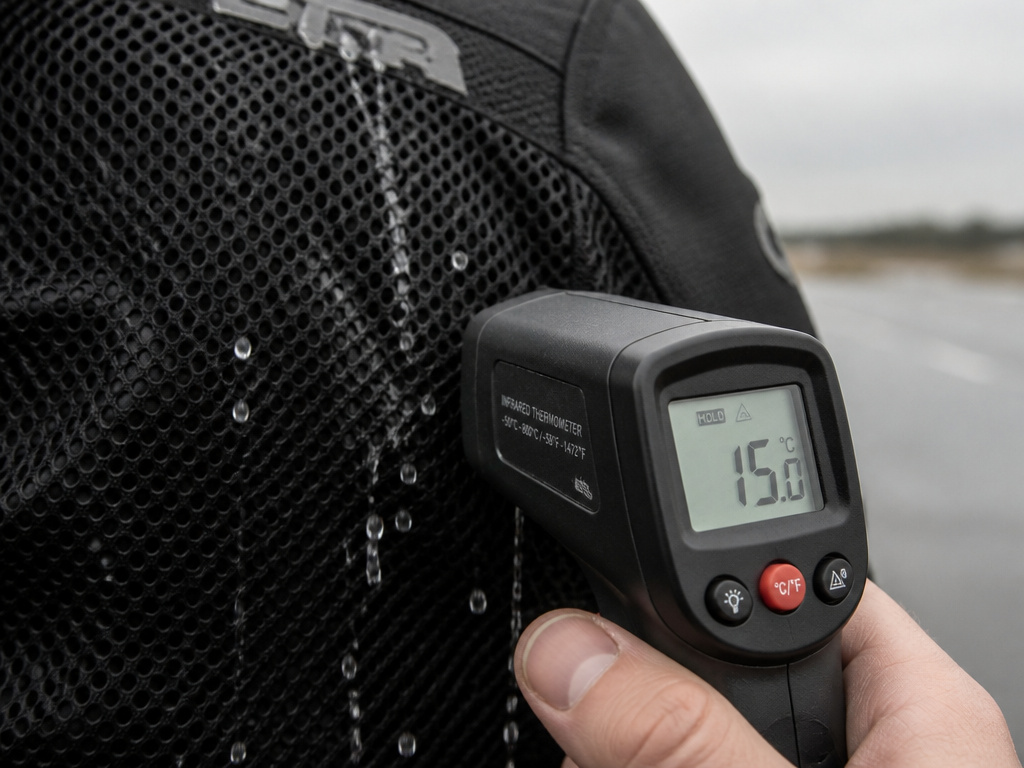
Mesh is amazing until it isn’t. The cutoff is sharper than most guides admit.
Below 18°C (65°F), mesh causes wind chill. That’s the point where, according to one source, mesh causes wind chill.
Rain goes straight through. Water passes straight through the open weave. A drop-in liner helps in a brief shower, but for real rain, you need a separate rain shell or a different jacket. An owner of the REVIT! Airflow reported the included “Hydratex” liner lost waterproofing after about six months, with water soaking through roughly 30% of its surface area.
Heat above 40°C is a different problem. In genuinely dry, extreme heat, mesh can accelerate dehydration. The moving air evaporates sweat too quickly. At that point, some riders prefer a light-coloured, solid shell that reflects heat.
This is why your choice for best hot weather gear isn’t always mesh. Sometimes a vented textile or a motorcycle cooling vest under a lighter shell is the smarter system.
Durability and the Invisible Clock: UV and Ageing
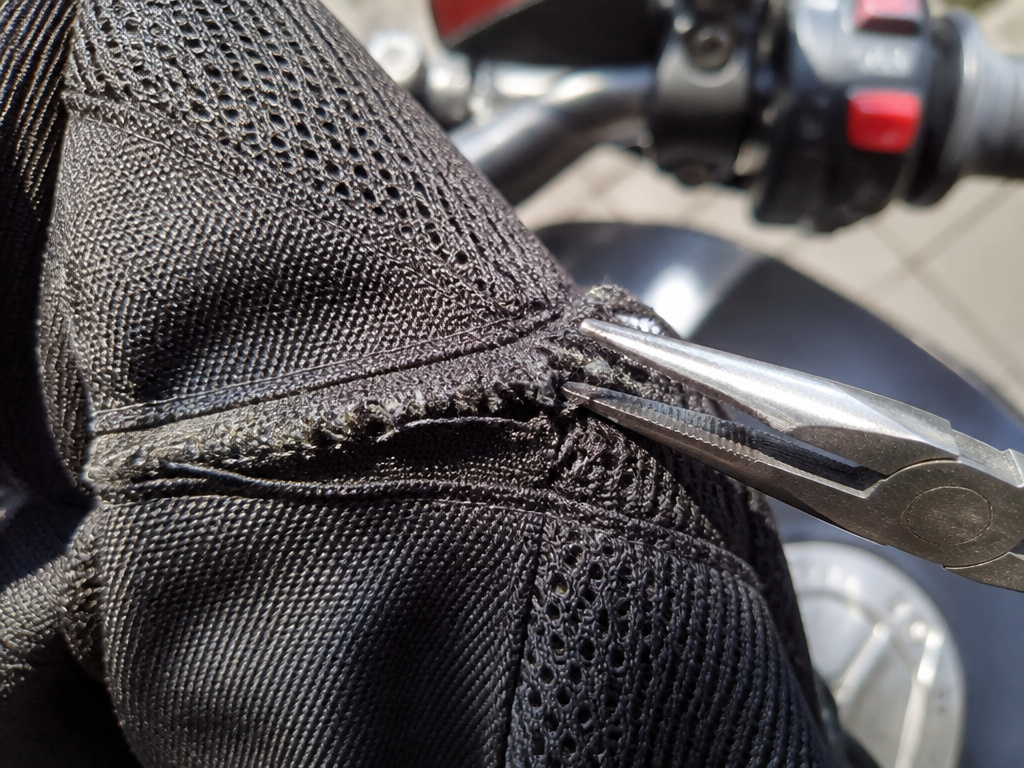
Mesh has a hidden lifespan. The fabric is a fine structure held in tension, and UV rays, sweat salts, and repeated washing degrade it faster than a heavy woven shell.
Industry analysis states that polyester mesh suffers from UV degradation, losing tensile strength after 18–24 months of direct sun exposure. The scary part is that seam strength drops before visible fabric failure. A jacket that looks fine might have weakened threads at every major join.
A study of accelerated ageing in commercial impact protectors, simulating three years of use, found every sample transmitted more force afterwards, with one dropping from Level 2 to Level 1. Your armor ages, too.
This leads to a practical replacement timeline. If your mesh jacket lives on a bike outdoors, plan to replace it every 2–3 years. That’s not what marketers say, but it’s what the material science suggests. A five-year-old mesh jacket that spent every summer in direct sun is not the garment that was tested.
Mesh vs. Textile vs. Perforated Leather: The Hot-Weather Hierarchy
When the temperature climbs, you have three main paths. Here’s how they stack up.
Mesh Jackets (e.g., REV’IT! Airflow, SPIDI Super Net Evo)
- Pros: Maximum airflow, light weight, often the coolest option in humid, stop-and-go conditions.
- Cons: Lowest abrasion resistance, requires liners for weather changes, susceptible to UV degradation.
- Buy it if: Your summer riding is mostly urban, you’re disciplined about adding layers, and you accept a 2–3 year lifespan.
Vented Textile Jackets (e.g., many summer riding jackets)
- Pros: Better abrasion reserve (5–8 seconds on 600D), often includes waterproof membranes, more versatile across seasons.
- Cons: Less airflow than mesh, can be warmer in peak heat, often heavier.
- Buy it if: Your rides mix city and highway, you encounter surprise weather, or you want one jacket to cover spring through fall.
Perforated Leather Jackets
- Pros: Superior abrasion protection (8–12+ seconds), perforations offer good airflow, long-lasting if maintained.
- Cons: Heaviest option, most expensive, requires regular upkeep, less airflow than mesh.
- Buy it if: You prioritize protection for fast or rural riding, ride in dry heat, and are willing to care for the leather.
The choice often comes down to your typical road surface. For urban asphalt, mesh’s 3–4 second slide time may be sufficient. For coarse rural chip seal, those extra seconds a textile or leather buys become a real safety margin.
How to Choose a Safe Mesh Jacket: A 5-Point Checklist
Don’t just buy the lightest or cheapest mesh jacket. Use this list to filter for the ones that offer real protection.
- Check the Denier: Look for a specification of at least 500 denier polyester mesh. Brands like REV’IT! Use patented 500-denier Cordura mesh. If it’s not listed, assume it’s lower and move on.
- Verify the Certification: Look for an EN 17092 garment class on the tag (AA or A). A Harley-Davidson product, for example, declares conformity to EN 17092-4:2020 for Class A. This tests the whole garment, not just a fabric swatch.
- Inspect the Armor: Ensure it has CE Level 1 or 2 shoulder and elbow protectors that are fixed or fit snugly in dedicated pockets. Foam pads don’t count.
- Examine the Seams: Look for double or triple stitching on major seams, especially around the shoulders, elbows, and back. Avoid jackets with lots of external seams or vents in those high-risk zones.
- Plan for the Liners: Make sure it comes with or has a pocket for a windproof liner. A waterproof liner is a bonus, but check if it has sealed seams.
Your goal is to get the airflow of mesh without dropping to the protection level of an unarmored hoodie. This checklist is how you do it.
How does a mesh jacket look and fit?
Mesh jackets offer a distinct technical and sporty appearance, often with a more fitted cut compared to bulkier textile options. The large mesh panels give them a perforated, almost industrial look that prioritizes function. While they can come in various colors, the material’s open structure means underlying armor or liners are sometimes visible, reinforcing their purpose-built aesthetic. Fit is crucial; a mesh jacket needs to be snug to keep protective armor in place during a slide, as a loose fit can compromise safety. The style is inherently casual and modern, suited more for sport or standard riding than classic cruiser looks, with the visual trade-off being a clear signal of its warm-weather ventilation focus.
Frequently Asked Questions
Are mesh motorcycle jackets safe for highway speeds?
High-quality mesh jacket with proper CE Level 2 armor, reinforced panels at impact zones, and a snug fit can be safe for highway speeds. The limitation is abrasion time: on coarse surfaces like chip seal, a mesh panel may fail several seconds sooner than a textile or leather one. For sustained high-speed rural riding, a vented textile or perforated leather jacket is often the safer choice.
What is the best mesh motorcycle jacket for hot weather?
The “best” mesh jacket balances airflow, certified protection, and features for real use. Look for models that specify a high-denier mesh (500D or 600D), an EN 17092 AA or A class rating, fixed CE Level 2 armor, and include a windproof liner. The SPIDI Super Net Evo Jacket is a strong example with its AA rating and reinforced mesh construction.
How long does a mesh motorcycle jacket last?
With regular summer use and outdoor storage, a polyester mesh jacket has a functional lifespan of about 2–3 years due to UV degradation weakening the fibers and seams. Even if it looks fine, the protective capacity diminishes after 18–24 months of direct sun exposure. For jackets stored indoors, the lifespan may extend, but the armor inside also ages and loses effectiveness over time.
Can you wear a mesh jacket in the rain?
Mesh jacket on its own offers no rain protection, water passes directly through the open weave. Most include a removable waterproof liner, but these are often emergency solutions without fully sealed seams. For regular riding in rain, a dedicated waterproof textile jacket or a separate rain shell worn over the mesh is a more reliable approach.
Is mesh or textile cooler?
In stop-and-go traffic and humid conditions, a mesh jacket is almost always cooler than a textile jacket because air flows through the fabric rather than just across it. At highway speeds, a well-vented textile jacket can approach similar cooling levels, but mesh generally maintains an airflow advantage. However, in dry heat above 40°C, a solid, light-coloured textile shell can be better at preventing dehydration.
The Bottom Line
Mesh motorcycle jackets solve a real problem: heat so intense it makes riders consider skipping gear. The pros, legitimate, life-saving cooling, are clear. The cons are specific numbers: 3–4 seconds of slide time, a wind-chill cutoff at 18°C, and a 2–3 year clock ticking from UV exposure.
Your decision comes down to two questions. First, what’s your typical road surface? If it’s urban asphalt, a well-built mesh jacket like the SPIDI Super Net Evo that meets the 500-denier rule can be a safe, cool choice. If it’s coarse rural chip seal, the abrasion gap is real, and you should lean toward a vented textile or perforated leather.
Second, are you willing to maintain a system? Mesh demands layering, a wind liner, a rain shell, a place to store them. If you want a single jacket you can zip up and forget, a leather vs textile comparison will lead you to a more versatile textile. But if you ride in hot city conditions and will use the layers, a mesh jacket provides a certified shell without overheating.
