
Motorcycle Gear Guide for Plus Size Riders
This post contains affiliate links. As an Amazon Associate, we earn from qualifying purchases.
Finding motorcycle gear as a plus-size rider means solving two problems at once: getting the right size and keeping the right protection. The answer is to start with certification, then filter for brands that publish extended size runs and tall variants, and never size up just for girth, a loose jacket moves the armor off your joints, which defeats the entire point of wearing gear.
The certification numbers tell you what a garment is actually rated to do. A jacket that fits but carries no real certification is a windbreaker that costs more. A jacket with the right certification but the wrong fit puts the shoulder pad on your collarbone. You need both, a principle central to any motorcycle gear guide for plus size riders.
What follows breaks down the European safety standards you’ll see on tags, the specific brands and models that publish size runs above 3XL, the crucial difference between “big” and “tall” fits, and the four-step check central to any motorcycle gear guide for plus size riders.
Key Takeaways
- Armor placement is critical. A jacket two sizes too big puts the elbow pad on your forearm. Look for adjustable armor pockets or tall variants, not just a bigger letter size.
- Certification is specific to each garment. A women’s version of a jacket needs its own EN 17092 label; the men’s certification does not carry over.
- Published size runs are your filter. Brands like Bering and Alpinestars publish specific Queen/King Size or 2XS–6XL ranges; if a maker doesn’t list your size, they likely don’t make it.
- “Tall” adds length, not width. A tall variant lengthens the torso and sleeves without widening the chest, the fix a 6’4″ rider needs, which a 4XL won’t solve.
- Fit is checked in riding position. A jacket that feels fine standing will pull across the shoulders and ride up when you reach for the handlebars.
Why Fit Is a Safety Spec, Not a Comfort Feature
A motorcycle jacket’s job is to hold certified armor over your shoulders, elbows, and back. If the garment is cut for a different frame, the armor migrates.
A shoulder protector sitting on your bicep or an elbow pad parked on your forearm will do very little in a slide, no matter what the certification says.
This is the structural problem with simply “sizing up.” The armor pockets are sewn into the jacket at fixed distances. Buy a 3XL when you need a 2XL Tall, and the shoulder pads drop two inches. They’ll sit on your upper arm. In a slide, that arm rotates, the pad twists away, and your shoulder takes the full impact. The certification was valid, but the protection was in the wrong zip code.
The fix is to find gear designed for your proportions, such as the best motorcycle jackets for big guys. That means looking for two specific things: extended size runs that are published by the manufacturer (not guessed by a retailer) and tall variants that add length without excessive width.
The Published Size Runs That Actually Exist
Most motorcycle gear catalogs quietly stop at 2XL or 3XL. For example, the Tourmaster Ridgecrest Mesh Jacket is published in sizes S–5XL, and the Alpinestars Andes v3 Drystar Pants are published in sizes 2XS–6XL. The brands that publish these ranges are the shortlist.
I rank gear by published size runs because that’s the only honest answer in a motorcycle gear guide for plus size riders. If a maker doesn’t list your size on their official spec sheet, they almost certainly don’t make it. “That runs large” is a retailer guess that puts you at risk of a bad fit.
Here are the models with published ranges that include larger sizes, along with their key certifications.
| Model | Published Size Run | Key Certifications | Notable Fit Feature |
|---|---|---|---|
| Bering Lady Tanaga Queen Size Jacket | Queen Size WT2 to WT7 | EN 17092-3 (Class AA), EN 1621-1 | Loose, protective cut for full-figured riders; includes CE Level 1 shoulder/elbow armor. |
| Bering Brazilia King Size Jacket | King Size range | EN 17092-3 (Class AA), EN 1621-1 | 3-in-1 design; height-adjustable elbow protector pockets. |
| Alpinestars Andes v3 Drystar Pants | 2XS–6XL | EN 17092 (Class A) | Adjustable waist with buckle and stretch material; removable bib braces. |
| Tourmaster Ridgecrest Mesh Jacket | S–5XL (Tall options separate) | Varies by model; check tag. | Separate tall size options published. |
| FLY Racing Terra Trek Pants | S–4XL (Regular & Tall inseams) | Varies by model; check tag. | Separate Regular and Tall inseam options published. |
These are not just bigger sizes. The Bering jackets are homologated, formally tested and certified, to EN 17092-3 AA, which is where most serious touring gear lands. The Alpinestars pants hit Class A and include an adjustable waist, which is critical for riders whose waist measurement doesn’t match their hip or thigh size.
Where this goes sideways: Buying a “big” size when you need a “tall” variant. A 4XL jacket adds width in the chest and waist, but the sleeves and torso stay stubby. A 6’4″ rider ends up with cuffs at the forearm and a cold lower back.
What Do the EN 17092 and EN 1621 Certifications Mean?

These codes are your guarantee. They are not marketing terms. EN 17092 rates the entire garment’s abrasion resistance and burst strength. EN 1621 rates the impact protectors inside it.
You need to check both labels on the exact item you’re buying.
EN 17092: The Garment’s Report Card
This standard has five performance classes, from AAA to C. For plus-size riders shopping for road gear, AA and A are the relevant tiers.
| Class | Protection Level | Typical Use |
|---|---|---|
| AAA | Highest abrasion/impact | Racing one-piece leathers |
| AA | High protection | Touring jackets & pants (most quality gear) |
| A | Good protection | Urban/commuter riding |
| B | Abrasion resistance only (no impact protectors) | Lightweight layers |
| C | Holder for protectors only (no abrasion resistance) | Base layers or armor shells |
The Bering Lady Tanaga is certified EN 17092-3 AA. The “-3” denotes a specific test method for tighter weave textiles, and AA tells you it’s built for road riding. The Alpinestars Andes v3 Drystar Pants are certified to EN 17092 Class A, suited for lighter duty.
EN 1621-1 & 2: The Armor’s Punch Card
The pads inside the garment have their own rating. EN 1621-1 covers limbs (shoulders, elbows, hips, knees). EN 1621-2 covers the back.
The number that matters is the force transmission, measured in kilonewtons (kN). A lower number is better.
- EN 1621-1 Level 1: Averages less than 35 kN of transmitted force.
- EN 1621-1 Level 2: Averages less than 20 kN.
- EN 1621-2 Level 1: Averages less than 18 kN.
- EN 1621-2 Level 2: Averages less than 9 kN.
Common mistake: Assuming a women’s jacket carries the same certification as the men’s model. It doesn’t. The women’s version is a separate product that must be tested and labeled on its own. Always check the tag on the exact item.
The 4-Step Fit Check for Plus-Size Riders
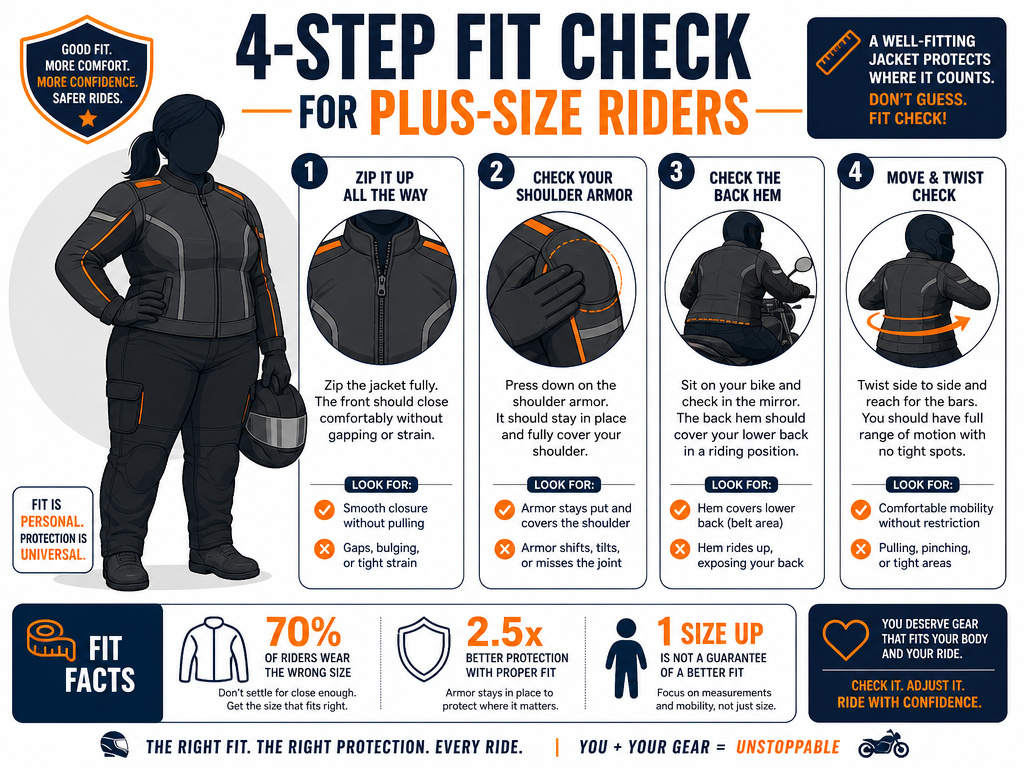
Trying on gear while standing in a shop is useless. You sit on a motorcycle. Your posture changes. This four-step check happens in the riding position.
- Zip and Close. Sit on a bike (or mimic the posture). The main zipper should close without pulling or gaping. If you have to suck in your stomach to zip it, the size is wrong. The jacket shouldn’t feel like a straightjacket across your chest or shoulders.
- Find the Armor. With your arms forward, press on the shoulder and elbow pads with your opposite hand. You should be pressing directly on a bony joint. If you’re pressing on muscle (bicep or forearm), the armor is out of position. This is the single most important check.
- Check the Hem. Have a friend look or use a mirror. The jacket should not ride up excessively and expose your lower back when you’re in riding position. A little movement is normal; a large gap is a draft and a safety risk.
- Move and Twist. Rotate your torso left and right, and look over your shoulder. The jacket should move with you without binding across the shoulders or chest. If the collar chokes you or the shoulders feel tight, the cut is wrong.
If it’s on your shin or thigh, the inseam is wrong. This is where seeking out tall inseam options (like the 33.5″ reported on Richa Infinity 2 Adventure Trousers) matters more than the waist size.
“Big and Tall” Are Different Problems. Solve the Right One.
This distinction saves you time and money. A “big” size (2XL, 3XL, 4XL) adds girth, chest, waist, hip circumference. A “tall” variant adds length in the torso, sleeve, and inseam without adding that same width.
- You need a TALL variant if: You’re over 6’2″, have a long torso, or have sleeve/inseam measurements that exceed standard sizes. Your build might be average, but everything is just longer.
- You need a BIG size if: Your chest, waist, or hip measurements exceed the standard size chart. You might be average height, but broader.
Makers who publish tall options are rare. Tourmaster does it for jackets. FLY Racing does it for pants with separate Regular and Tall inseams. Oxford’s ‘tall’ sizes are all 34” inseam. Most brands do neither, which is why the published size run is your first filter.
Sizing up to get a longer sleeve is the worst solution. You get a baggy chest, the armhole sags, and the armor floats. Look for the tall variant first. If it doesn’t exist, look for models with adjustable features, like the Alpinestars pants’ waist buckle or the Bering jacket’s adjustable elbow pockets, that let you fine-tune a standard-large size.
Gloves, Boots, and Helmets for Larger Proportions
A full kit means head to toe. The challenges here are width and circumference.
Gloves: Look for brands that offer numbered sizing (8, 9, 10, 11) instead of just S/M/L/XL. Palm circumference and finger length are the keys. A loose glove can twist in a slide, pulling off or exposing skin. EN 13594 is the glove safety standard, with Level 1 or 2 and a “KP” marking for certified knuckle protection.
Boots: The challenge is calf circumference and shaft height.
Helmets: Heads aren’t gendered, but they are shaped. Try on multiple brands to find the shape that matches yours without creating pressure points at the forehead or temples. The safety standard is ECE 22.06 (or DOT FMVSS 218 in the US). Size is secondary to shape.
For base layers and armor, companies like Bohn Body Armor specialize. They offer Men’s Big sizes 1X-4X and Women’s Plus sizes 1X-4X in their stretchable Airtex™ armor, designed to be worn under regular clothes. They’ve even noted plans to stock 6X sizes, with full stock expected by end of March 2026.
The Bottom Line
Start your search with the certification labels (EN 17092 AA or A, EN 1621-1), then apply the filter of published size runs. Ignore any brand that doesn’t explicitly list your size on their official site.
Fit the gear on a bike, not on your feet. Your final check is always armor placement. If the pads aren’t on your joints, nothing else about that jacket matters.
For a rider who needs one clear starting point: look at the Bering Lady Tanaga Queen Size jacket if you need a roomier cut with AA certification, and the Alpinestars Andes v3 Drystar pants if your priority is an incredibly wide, adjustable size range, as featured in our best motorcycle pants guide. They prove that extended sizes and proper protection can exist in the same garment. Your job is to verify the fit on your body.
Plus size motorcycle gear style and fashion
Finding stylish gear that fits well is about understanding your options. This means the gear looks and feels like it was made for your body, not just a larger version of a smaller design. Look for these specific size ranges when you shop. For example, the Tourmaster Ridgecrest Mesh Jacket is published in sizes S–5XL, and the Alpinestars Andes v3 Drystar Pants are published in sizes 2XS–6XL. The key is to seek out brands that publish these size runs, as they are actively designing for a plus-size fit.
Comfortable motorcycle gear with stretch materials
For all-day comfort on the bike, look for gear that incorporates stretch panels and adjustable features. For example, the Alpinestars Andes v3 Drystar Pants have an adjustable waist with buckle and stretch material. For example, the Alpinestars Andes v3 Drystar Pants have removable bib braces. For example, the Bering Brazilia King Size Jacket has height-adjustable elbow protector pockets. These design elements, often found in touring and adventure gear, make a significant difference in how gear feels during long rides.
Frequently Asked Questions
Is women’s plus-size gear just smaller men’s gear?
No. A real women’s pattern has different proportions in the shoulders, bust, waist, and hips. More importantly, the certification does not transfer. A women’s jacket must have its own EN 17092 label from testing the women’s specific pattern and size. Never assume the men’s rating applies.
Can I just buy a men’s jacket in a larger size?
You can, but it’s a compromise. Men’s cuts are straighter in the torso and narrower in the hip. The armor pockets will be spaced for a male frame, which often means wider shoulders and a longer torso relative to sleeve length. The armor may not align with your joints. Try it on in riding position and perform the armor placement check rigorously.
How do I find my size if brands have different charts?
Measure yourself with a soft tape measure: chest (fullest part), waist (natural), hips (fullest part), sleeve length (from spine, over shoulder, to wrist), and inseam. Compare these numbers only to the specific brand’s garment size chart for the model you want. Never use a generic “small, medium, large” conversion.
Are there affordable plus-size motorcycle gear options?
Yes, but verify the certifications. Some house brands or budget lines offer extended sizes, but they may only meet the minimum “A” or “B” class, or use basic Level 1 armor. The Tourmaster Ridgecrest Mesh Jacket (S-5XL) is an example of a jacket with published tall options. Protection should always trump price.
What if I need a size larger than 5XL?
The market thins out dramatically. Your best options are specialized companies like Bohn Body Armor for wearable armor under your clothes, or investigating custom gear from makers like Aerostich (which is a significant investment).
How important are “tall” sizes if I’m just big, not tall?
If your extra size is in width, not height, a tall variant might add unwanted length in the sleeves and torso. Focus on “big” sizes and look for adjustable features (waist, cuffs, armor pockets) to fine-tune the fit. The goal is to get the standard dimensions as close as possible, then adjust the rest.
