
Is Used Motorcycle Gear Safe to Wear? What You Must Know
This post contains affiliate links. As an Amazon Associate, we earn from qualifying purchases.
Is used motorcycle gear safe to wear? The answer is yes, but only if you can verify three things: the gear’s original certifications are still valid and untampered with, it shows zero hidden structural damage, and it hasn’t passed the manufacturer’s stated replacement interval, which can be as short as three years for some chest protectors. Buying used gear is a risk assessment, not a bargain hunt. Your inspection replaces the original owner’s maintenance history.
That three-year replacement rule from Leatt isn’t a suggestion. It’s a documented performance ceiling printed in their manuals. When you buy used, you’re inheriting someone else’s timeline, and you have no idea how many hours are left on that clock. The safety standards themselves create another trap: a used jacket sold as “protective” might only be a Class C garment under EN 17092-6, designed just to hold armor, not to resist abrasion on its own. You need to know what you’re actually looking at when you ask is used motorcycle gear safe to wear.
What follows is the inspection protocol we use before any used-gear purchase. It covers helmets (the hard no), jackets and pants (the maybe), gloves and boots (the sometimes), and the one type of gear you should never buy second-hand. You’ll learn how to read certification labels, spot telltale wear, and clean gear without wrecking its protective layers.
Key Takeaways
- Never buy a used helmet. The NHTSA has issued two separate recalls for the AGV Tourmodular model alone, one for a buckle defect, another for a chin guard plate that may break.
- Check the certification label first. A CE or DOT sticker alone isn’t enough; you must match it to the specific standard (e.g., EN 16211-3:2018 for chest protection) and ensure it hasn’t been painted over or removed.
- Assume the armor is expired. Manufacturers like Leatt Corporation recommend replacing chest protectors every three years for maximum performance; used gear is often sold past this mark.
- Class C garments are not standalone protection. Per EN 17092-6:2020, these items are only designed to hold impact protectors and must be worn under an abrasion-resistant jacket or pants.
- Inspect for dry rot and UV damage. Leather that feels stiff and crackly, or textile that crumbles when pinched, may indicate material degradation.
The Helmet Rule: Never Buy Used
You can’t inspect what you can’t see. A helmet’s foam liner is designed to compress once, a single impact, even a drop from a garage workbench, can compromise its structure without leaving a visible mark on the shell. That’s the commodity advice every article repeats. The non-commodity reason is documented recall timelines.
Take the AGV Tourmodular helmet. The National Highway Traffic Safety Administration (NHTSA) issued recall 24E-014 in February 2024 for helmets produced between February and December 2022. The defect? A micrometric buckle with out-of-tolerance parts that might not automatically latch. The rider might not hear the click. Then, in April 2025, NHTSA issued recall 25E-031 for the same helmet model produced between October 2021 and July 2023. This time, the chin guard plate could break over time. The agency’s own recall notice for the chin guard plate defect AGV Tourmodular helmet recall 25E-031 states users may see cracks in the mechanism prior to use.
Where this goes sideways: Buying a used helmet from within those date ranges. You’re buying a product the federal government has flagged for a latent, time-based failure. You cannot test for it.
Beyond recalls, helmets degrade with age. The glues and foams break down from sweat, UV exposure, and temperature cycles. Leatt Corporation instructs users not to drill holes, paint, cut, heat, bend, apply decals or stickers, or make any other modifications to its products. Used helmets often have stickers, touch-up paint, or cleaned interiors with harsh chemicals. There is no safe way to verify any of this.
The financial math also fails. A new, certified helmet is the single most important piece of gear you own. Saving $100 on a used lid isn’t a bargain; it’s betting your head on a complete unknown. Don’t do it.
How to Verify Certifications on Used Gear
The tag inside a jacket says “CE Certified.” That doesn’t mean what you think it does. CE marking is a declaration of conformity, but the critical information is the specific European Standard (EN) number it conforms to. This is where used gear sellers, often unknowingly, misrepresent what they’re selling.
You need to find the label. It’s usually sewn into a seam near the waist or collar. It will list something like “EN 1621-1:2012” for shoulder and elbow protectors. If it says “EN 17092-6:2020,” you’re holding a Class C garment. According to the official EN 17092-6:2020 standard, Class C garments are “designed only to hold one or more impact protectors in place” and “do not offer complete minimum abrasion protection.” They must be worn with a Class AAA, AA, A, or B outer garment.
| Certification Label | What It Actually Means | Risk If Missing/Misread |
|---|---|---|
| EN 17092-6:2020 | Class C garment. Holds armor only. Requires an abrasion-resistant outer layer. | Wearing it alone provides near-zero slide protection. |
| EN 1621-3:2018 | Certified chest protector (Level 1 or 2). Means the plate was tested to absorb kinetic energy. | Armor without this is likely a comfort pad, not an impact protector. |
| CE Mark (without EN #) | Manufacturer’s declaration of conformity. Tells you nothing about performance level. | Could be attached to a fashion jacket with no real testing. |
| DOT Sticker (Helmet) | Meets U.S. Dept. Of Transportation minimum standards. Easily counterfeited or removed. | A missing or peeling DOT sticker means the helmet is not legally road-worthy. |
If the label is cut out, faded, or painted over, walk away. Someone removed the traceable proof of what the gear was designed to do. Your inspection can’t replace that.
The 7-Point Field Inspection (What to Do Before You Pay)
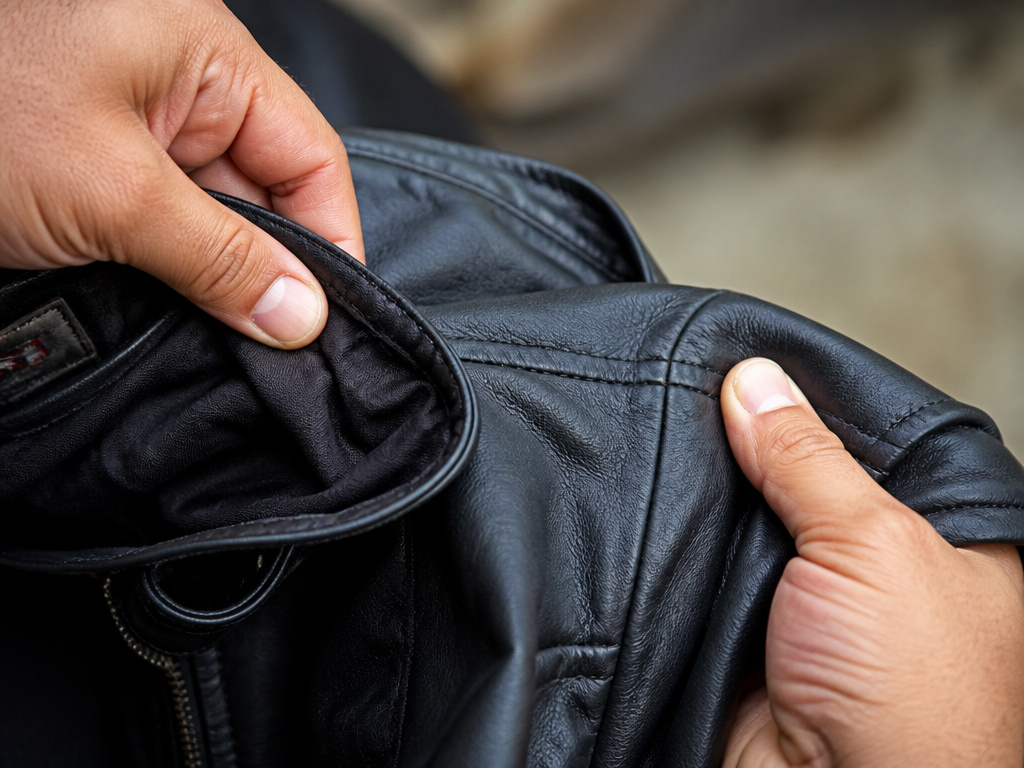
This is the hands-on part. You need to turn the gear inside out, feel every seam, and bend every plastic plate. Here’s the sequence, and what happens if you skip a step.
- Feel the fabric. Pinch a discreet spot, like the inside of a cuff or collar. Leather should be supple, not stiff or crackly. Textile should not feel brittle or powdery. Skip this: You miss dry rot, which turns a 500D Cordura shell into tissue paper on the first slide.
- Inspect every stitch. Look at the main seams, shoulders, sleeves, crotch, knees. The thread should be intact and tight, with no gaps, pulls, or repaired sections. Use your fingernail to gently tug at a stitch; it shouldn’t lift. Skip this: A blown seam unravels on impact, splitting the garment open.
- Remove and examine the armor. Take out every back, elbow, knee, and shoulder pad. Look for cracks, deep creases, or crumbling foam. Flex the plastic plates; they should spring back, not stay bent. Skip this: Compressed or cracked foam transmits force directly to your body, defeating its only purpose.
- Check the closures. Work every zipper up and down. It should move smoothly, with no missing teeth or sticky spots. Test all snaps, Velcro, and buckle straps. They should engage firmly and hold under a gentle pull. Skip this: A failed zipper means you can’t secure the gear, making it useless.
- Look for impact marks. On leather, look for polished, glossy scuffs or hard, shiny spots. On textile, look for pilling, matted fibers, or discolored patches. These are signs of a previous slide or impact. Skip this: You buy gear that’s already used up its protective capacity.
- Sniff it. Seriously. Gear stored in a damp basement or garage will smell musty, like mildew. That smell means moisture has penetrated the layers, potentially degrading glues and fabrics. Skip this: You inherit hidden mold and accelerated material breakdown.
- Verify sizing and fit. Try it on with the layers you’d actually ride in. You’re checking for two things: that it’s not so loose the armor shifts out of place, and that it’s not so tight it restricts movement or circulation. Skip this: Ill-fitting gear is unsafe gear. Armor that’s over an inch from your joint offers no protection.
I used to think a visual once-over was enough. After about three hours in steady rain in a used jacket I’d “checked,” I felt the dampness creep in at the cuffs. Now I know waterproof ratings don’t cover bad seams. You have to test the closures and feel the fabric.
What About Jackets and Pants?
Jackets and pants are the most common used gear purchase, and the risk varies wildly by material. You’re balancing two things: the known longevity of the fabric and the unknowable history of its impacts.
Leather: High-quality leather (cowhide or kangaroo) has incredible abrasion resistance, but it’s perishable. It dries out, cracks, and loses tensile strength. Inspect for:
- Color change: A whitish, hazy cast in the grain means the top coat is dried and failing.
- Stiffness: The jacket should drape, not stand up on its own. Armholes and elbows should flex easily.
- Previous repairs: Look for internal patches or re-stitching. A professional repair can be okay; a DIY glue job is a red flag.
Textile: Modern textiles like Cordura, Dyneema, or Ballistic Nylon are more resistant to dry rot but can suffer from UV degradation and seam failure. Inspect for:
- Fading: Severe fading, especially on the shoulders and back, indicates heavy sun exposure, which weakens fibers.
- Delamination: Pinch the outer shell and inner liner together. If they feel “puffy” or separate easily, the waterproof/breathable membrane is failing.
- Seam tape: Look inside at the tape covering seams. If it’s peeling, curling, or gone, water will pour through those stitches.
The armor is a separate, consumable item. Leatt Corporation’s manual is explicit: “Leatt Corporation recommends its chest protectors be replaced every three (3) years for maximum performance.” When you buy used, you are buying someone else’s calendar. Assume the armor is past its service life and budget for new inserts, that’s part of your true cost.
Gloves and Boots: The High-Wear Items
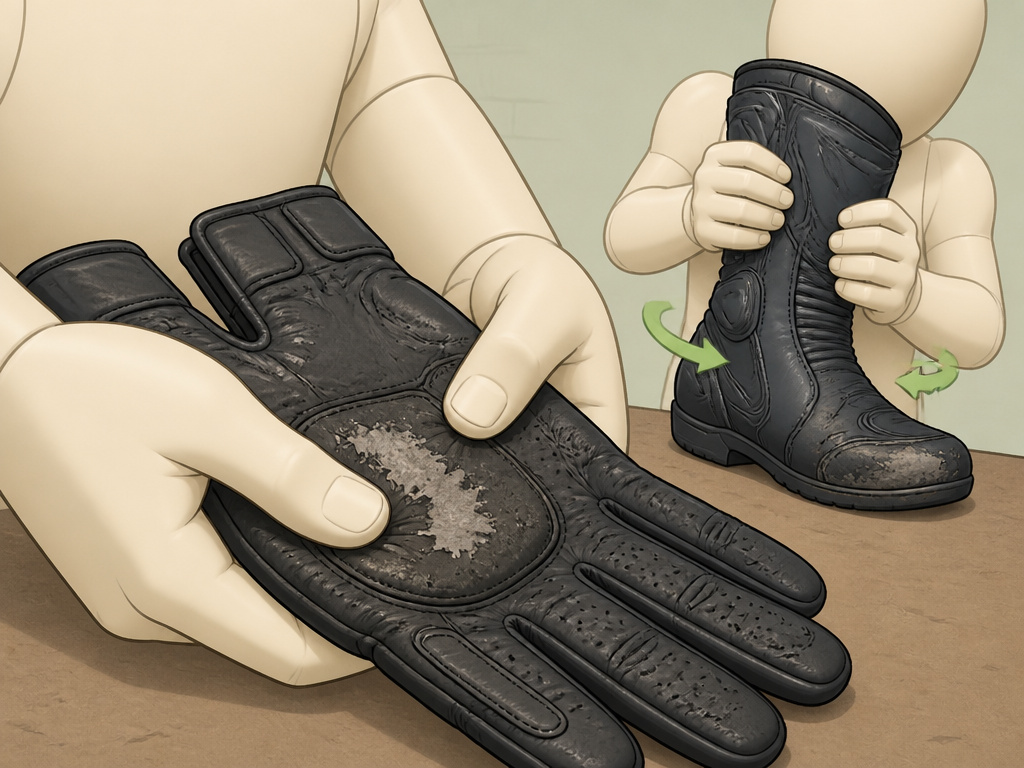
Gloves and boots take the most direct, constant abuse. They’re also the hardest to inspect thoroughly because damage hides in the lining and between layers.
Gloves: Your hands hit first in a fall. Palm sliders are the key.
- Palm Inspection: Lay the glove flat and rub your thumb over the palm slider material (usually a thick, rubbery plastic or leather patch). It should be firmly bonded. If it’s peeling up at the edges or feels thin, it’s worn out.
- Knuckle Protection: Push on the hard knuckle protectors from the inside. They should be solidly anchored. If they wiggle or pop out, the internal mounting is broken.
- Stitch Stress: Look at the stitching between the fingers and around the thumb. This area flexes thousands of times. Any fraying or thread wear here means a blowout is imminent.
Boots: The failure points are the ankle protection, the sole, and the zipper (if present).
- Ankle Twist: Hold the boot by the heel and the toe. Gently twist in opposite directions. There should be firm resistance from internal plastic cups. Excessive twist means that structure is compromised.
- Sole Separation: Check where the sole meets the upper, especially at the toe and heel. Any gap, lifting, or hardened, oozing glue is a sign the bond is failing.
- Internal Liner: Feel inside the boot. The lining should be intact, not torn or matted down. A worn-through liner over the ankle bone means the boot’s structure has collapsed from the inside.
Common mistake: Judging boots by the outside. The exterior leather can look great while the internal ankle cuff is shattered from a previous impact. You only find that by twisting them.
Cleaning used gloves and boots is a must, but be gentle. For leather, use a dedicated leather cleaner and conditioner, avoid household soaps that strip oils. For textile, a mild detergent in cold water, air-dried away from direct heat, is safest. Never machine dry armored gear; the tumbling can break armor mounts and melt adhesives.
The One Gear Type You Should Never Buy Second-Hand
Airbag vests and jackets. Just don’t. The Alpinestars Tech-Air 7x manual is a textbook example of why. The Alpinestars Tech-Air 7x system has a maximum recommended period between inspections of two years or 500 hours of functioning. After that, “there is the possibility that the System will not function inside the Envelope of Protection.”
Think about that. You are buying a complex electronic and pyrotechnic device with a finite recommended service interval. You have no access to its service history or internal condition. The manual also states, “Even if the System has been regularly maintained, there is the possibility that it doesn’t work after 10 years.” You are gambling that the previous owner followed the exact service schedule and that the system is still within its finite lifespan.
Furthermore, these systems are designed for use with specific garments. The Tech-Air 7x manual states it’s for use with garments “in accordance with EN 17092 parts 2, 3, 4 and 5.” The Tech-Air 7x is designed for use with specific garment types, and using it with non-compliant gear may affect its performance. The risks, financial, legal, and physical, are astronomically higher than any potential savings.
Where to Buy Used Gear Safely
The platform matters. It moves the risk from “total unknown” to “managed unknown.”
| Source | Pros | Cons & How to Mitigate |
|---|---|---|
| Trusted Riding Friend | Known history, likely honest about crashes. Can try on for fit. | Limited selection. Mitigation: Still perform the 7-point inspection. |
| Reputable Gear-Specific Forums/Marketplaces (e.g., ADVRider) | Community feedback, often enthusiast-owned gear with better care. Seller reputation is trackable. | Still a stranger. Mitigation: Ask for detailed photos of labels, seams, and armor. Use goods/services payment. |
| Consignment Shops at Dealerships | Gear is often inspected by staff before acceptance. Some offer short warranties. | Higher prices. Mitigation: Ask the shop what their intake inspection covers—get specifics. |
| General Marketplaces (e.g., Facebook, Craigslist) | Largest selection, lowest prices. | Highest risk of hidden damage, fraud, or stolen gear. Mitigation: Meet in person, do the full inspection, and walk away if anything feels off. Never buy shipped without exhaustive photos/video. |
The rule here is simple: if you can’t inspect it in person, you probably shouldn’t buy it. Photos hide too much. A video call where the seller shows you the labels, flexes the armor, and runs the zipper is the bare minimum for a remote purchase.
Frequently Asked Questions
Can you wash used motorcycle gear?
Yes, but carefully. For textile jackets/pants, remove all armor and liners, then wash cold on gentle with a tech-wash detergent (like Nikwax). Air dry completely. For leather, use a damp cloth with a dedicated leather cleaner. Never soak leather, never use a washing machine on armored items, and never apply direct heat to dry.
How old is too old for motorcycle gear?
There’s no universal expiration date, but manufacturer recommendations are your guide. Leatt recommends a 3-year replacement cycle for chest protectors. For garments, if the fabric is dry-rotted (stiff/crumbly), the seams are brittle, or the waterproof liner is delaminated, it’s too old, age is less important than condition.
Is it illegal to sell used motorcycle gear?
In the U.S., there is no federal law against selling used protective gear. However, selling a helmet that you know is damaged or has been in a crash could expose you to liability if the buyer is injured. Ethically, you should disclose any known history or impacts. Always remove certification labels from totaled gear before disposal so it can’t be resold.
What does “CE Certified” really mean on used gear?
By itself, not much. “CE” is a conformity mark. The crucial information is the specific EN standard number on the label (e.g., EN 1621-1:2012). This tells you what protection was actually tested. If the label is missing, you cannot verify the gear’s intended protection level.
Are used motorcycle boots safe?
They can be, if they pass a rigorous inspection. The critical points are sole adhesion (no separation), ankle structure (firm, not twisted), and internal liner integrity (no holes or compaction over pressure points). Boots with worn-down soles or compromised ankle support are unsafe.
What should I do if I find damage after buying used gear?
It depends on the damage and source. If from a friend or consignment shop, discuss it, they may not have known. If from an online marketplace, review the seller’s description and photos; you may have recourse if the damage was misrepresented. For critical damage (cracked armor, split seams), retire the gear. Don’t try to ride in it.
The Bottom Line
Used motorcycle gear is safe only under a microscope. Your job is to be that microscope. The process isn’t about finding a deal; it’s about conducting a forensic audit on a life-support system to answer is used motorcycle gear safe to wear.
Start with the label, the certification is the blueprint. Then put your hands on every seam, flex every plate, and smell the fabric. Assume every piece of armor is past its service life and that any “protective” jacket could be a shell-less Class C holder. Budget for new armor upfront; that’s your real cost.
Finally, know the hard lines. Helmets and airbag systems are never worth the unknown risk. The savings are a mirage. For everything else, if your inspection turns up a single doubt, a stiff spot in the leather, a fuzzy feeling in the textile, a missing certification, walk away. A gap in your gear closet is safer than a gap in your gear’s protection.
Fit first, features second. That goes for condition, too.
