
How to Choose Women’s Motorcycle Gear: Three-Step Fit
This post contains affiliate links. As an Amazon Associate, we earn from qualifying purchases.
To choose women’s motorcycle gear, you match three things: a garment’s CE certification class (AA for most road riding), the specific fit of a women’s-designed pattern, and how the gear feels in a riding position, not standing up. Fit first, features second. A snug mid-priced jacket with proper armor placement protects better than a loose premium one where the pads slide off your joints.
The industry’s old “shrink it and pink it” approach is a safety problem, not a style one. Armor only works when it sits on the joint it’s supposed to protect. This guide walks through the certifications that verify protection, the brands building real women’s patterns, and the physical try-on steps that reveal bad fit before you buy, which is a key part of how to choose women’s motorcycle gear.
What follows: the certification labels that matter, a material breakdown that goes beyond “leather vs. Textile,” and the exact way to test fit on a bike, which is the core of how to choose women’s motorcycle gear. By the end, you’ll know how to read a tag, spot a real women’s cut, and walk out with gear that works on the road.
Key Takeaways
- Prioritize CE AA-certified gear for road riding; it’s the class where most quality touring jackets and pants land, verified for abrasion and impact.
- Test fit in a riding position, not standing up; gear that feels fine in a shop mirror will ride up at the back and pull across the chest once you’re on the bike.
- Choose women’s-specific patterns, not smaller men’s sizes; brands like Alpinestars Stella and Klim Artemis build from different shoulder, bust, and hip proportions.
- Armor must sit on the joint; press on the shoulder, elbow, hip, and knee pads during try-on, if they’re beside the joint, the cut is wrong.
- Start with gloves and a helmet; your hands hit the ground first in a fall, and a properly fitted helmet is essential.
The CE Certification Decoder (EN 17092)
Every piece of protective gear has its own European standard, and the women’s version of a product needs its own label. Don’t assume the men’s certification carries over. Check the tag on the exact item you’re buying.
The EN 17092 standard rates the whole garment, not just the armor inside it. It has five classes, from AAA to C.
Jackets and pants certified to EN 17092 AA offer high protection for a broad range of road riding, and that’s where most quality touring gear lands. AAA is the highest class, traditionally for one-piece leathers, while Class A is for lighter urban riding.
Here is what each class means for your ride:
| EN 17092 Class | Protection Level | Best For | Risk If You Choose Wrong |
|---|---|---|---|
| AAA | Highest abrasion & impact resistance | Track days, performance riding | Overkill for commuting; often less comfortable and more expensive. |
| AA | High abrasion & impact resistance | Most road touring, commuting | The sweet spot. Skipping it for Class A on highways reduces slide protection. |
| A | Good abrasion resistance | Urban riding, lower speeds | May not hold up in a higher-speed slide on open roads. |
| B | Abrasion resistance only (no impact protectors) | Very low-risk use only | No protection from impact forces on joints—a major gap in safety. |
| C | Holder for protectors only (no abrasion protection) | Not recommended as outerwear | The garment itself offers no slide protection; it’s just a shell. |
For most riders, CE AA is the target. A jacket like the Klim Artemis adventure jacket is certified CE AA to EN 17092-3. The REV’IT! Sand 4 H2O Ladies jacket also carries an AA class rating. This is the baseline for gear you trust on highways.
Why “Women’s Specific” Is a Pattern, Not a Size
A real women’s cut is a different pattern, not a smaller size. That means different proportions between shoulders, bust, waist, and hips, plus armor pockets moved to match a woman’s anatomy.
Alpinestars describes its Stella line as patterns “built from the ground up around women’s anatomy.” The brand states that Stella garments and protectors are certified to the same CE standards as the rest of its range. Klim went further, labelling its Artemis jacket and pants as “designed for women by women.”
The classic misfits when a woman wears gear cut for a man’s frame are easy to spot:
- Shoulders too wide, so the armor drops onto the bicep.
- Sleeves too long, so the elbow pad lands on the forearm.
- A jacket that fits the hips but gaps at the waist.
- Pants where the knee armor ends up near the shin.
This isn’t about fashion. It’s about physics. If the armor isn’t on the joint, the certification on the tag is just a piece of paper. You can explore specific models in our guide to the best women’s motorcycle jackets.
Material Choices: From Leather to Dyneema

Motorcycle jackets and pants are generally made from leather or textile fabrics, each with different strengths. The American Motorcyclist Association notes that if you choose leather, ensure it is a minimum of 1.2mm thick.
Here is how the common materials stack up:
| Material | Best Trait | Compromise | Ideal Use |
|---|---|---|---|
| Leather (1.2mm+) | Superior abrasion resistance | Poor breathability; can be hot | Performance riding, cooler climates |
| Textile (Cordura) | Good breathability, often waterproof | Lower abrasion resistance than leather | Touring, commuting, variable weather |
| Kevlar Blends | Exceptional strength and tear-resistance | Can be stiff and less comfortable | Reinforcements in high-impact zones (knees, hips) |
| Dyneema | 15 times stronger than steel, lightweight and flexible | Highest cost | Premium adventure gear, where weight and protection are critical |
Dyneema is a newer high-tech fabric with an incredible strength-to-weight ratio. It offers the tear-resistance of Kevlar with the comfort of Cordura. For waterproofing, a bonded membrane like Gore-Tex offers reliable protection over longer rides compared to a coated fabric that wets out quickly.
Where this goes sideways: Choosing a mesh textile jacket for its cool feel without checking its EN 17092 class. Many are only Class A or B, sacrificing too much abrasion protection for airflow.
Your climate and ride style pick the material. A commuter in rainy Seattle needs a jacket with a bonded membrane for waterproofing. A canyon rider in Arizona needs leather’s slide protection. Your search for the right balance, a key step in how to choose women’s motorcycle gear, might include our review of the best summer motorcycle jackets for hot weather.
The Three-Step Try-On That Reveals Bad Fit
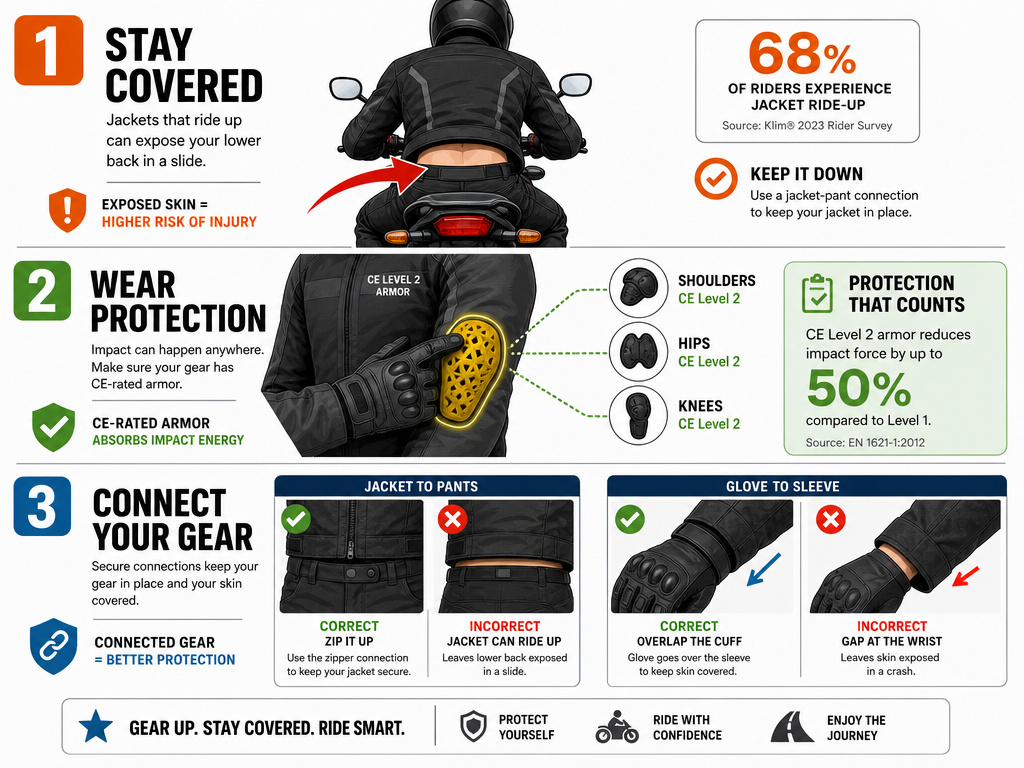
Gear should fit you comfortably when you’re in the riding position on your motorcycle, not when you’re walking around. This is the single most repeated, and most ignored, piece of advice from the American Motorcyclist Association, RevZilla, and LJ Moto Fashion.
Here is the sequence that works:
- Sit on a bike. If you’re in a shop, ask to climb on a floor model. Reach forward for the handlebars. Does the jacket ride up and expose your lower back? Do the sleeves pull back and tighten? This is the only fit that matters.
- Find the armor with your fingers. Press on the shoulder, elbow, hip, and knee pads. They should land directly on the joint, not beside it. If you can’t feel them easily, they’re not in the right spot.
- Check the connections. Zip a jacket to a pair of pants if they’re compatible. See how glove cuffs fit over or under sleeves. Ensure boots can fit under pant legs. Systems that don’t connect create gaps.
I used to think you could guess fit from a size chart. After watching riders struggle with sleeves that were always too long or too short, I now tell everyone to sit on the bike. The difference in how the back and arms feel is immediate.
Fit should be snug, more than normal clothing. It’s safety equipment, and it needs to stay in place. For riders with curvier proportions, where the difference between waist and hips can be eight to ten inches, finding the right pattern is crucial. Our gear for plus size riders guide addresses this specific challenge.
Armor and Helmet Standards: The Labels Inside the Gear
The armor inside your jacket and pants has its own rating, separate from the garment’s class. EN 1621-1 covers limb protectors (shoulders, elbows); EN 1621-2 covers back protectors.
Level 2 armor transmits less force than Level 1. For limb protectors, Level 1 must average under 35 kN of force transmission, while Level 2 must average under 20 kN. For back protectors, Level 1 is under 18 kN and Level 2 is under 9 kN. Many quality jackets, like the REV’IT! Sand 4 H2O Ladies, ship with Level 2 shoulder and elbow protectors.
Common mistake: Assuming the back protector is included. Many jackets, including the REV’IT! Sand 4 H2O, ship with an empty back protector pocket. You need to purchase a certified EN 1621-2 back protector separately.
For helmets, ECE 22.06 is the current European standard. It adds oblique impact tests that measure rotational acceleration, a major cause of brain injury. In the US, the legal standard is DOT FMVSS 218. The most common head shape is an intermediate oval, which is what most North American-market helmets are built around.
Pressure points at the forehead or temples mean the helmet shape is wrong, not that you need a bigger size. A perfect-fitting mid-priced lid beats a loose premium one every time. For a curated list, see our picks for the best women’s motorcycle helmets.
Building Your Kit: A Smart Purchase Order
New riders get overwhelmed by cost and choice. You don’t need to buy everything at once. Buy in order of what hits the ground first and what is hardest to replace.
- Helmet. Essential. Get professionally fitted. This is your most important piece of gear.
- Gloves. Your hands hit the ground first. The reflex to catch yourself is automatic. Look for gloves certified to EN 13594. Our guide to women’s motorcycle gloves details the fit and protection to look for.
- Jacket. Start with a versatile, CE AA-rated jacket. It’s your core torso protection.
- Boots. Protect your ankles and feet. Look for boots certified to EN 13634. Over-the-ankle height is the minimum for street riding. The best boots for women are built for this.
- Pants. Finally, get dedicated riding pants or CE-rated jeans. Regular denim provides almost no abrasion resistance. For options, check out motorcycle jeans for women or our broader pants recommendations for women.
This order balances immediate risk with budget. It’s better to have a full-face helmet, a jacket, and proper gloves than a head-to-toe matching set where every piece is a budget compromise.
How to choose a brand for women’s motorcycle gear
When selecting gear, focus on brands that design specifically for women’s anatomy. Some lines are built from the ground up around women’s bodies, while others are labelled as designed for women by women. These are separate products, so you must check their own labels for certification; don’t assume the men’s version’s rating applies. Look for the CE label on the exact item you are buying. For jackets, a CE AA rating with Level 2 protectors is a strong choice for most road riding. Always try gear on in your riding position to assess the fit, as patterns and cuts vary significantly between brands and even within a brand’s own lineup.
Choosing gear for different riding seasons and weather
Your gear needs to adapt to changing conditions. For waterproofing on longer rides, look for a jacket with a bonded membrane. To manage temperature, choose gear with zipped vents at the chest, underarms, and back. The fit is crucial for layering; gear should fit snugly, more than normal clothing, but allow for a base layer underneath. When trying on a jacket, do so in the way you will wear it most, such as without a liner if you plan to ride without it. Always test the fit while sitting in a riding position, not standing, to ensure it doesn’t ride up or become restrictive when you’re on the bike.
Frequently Asked Questions
Is women’s motorcycle gear just men’s gear in smaller sizes?
No. Real women-specific gear uses a different pattern with proportions reshaped for women’s shoulders, bust, waist, and hips. Brands like Alpinestars Stella and Klim Artemis build these patterns from the ground up. A smaller men’s size will have armor in the wrong places.
What certifications should women’s motorcycle gear have?
Look for CE certification on the garment itself (EN 17092, with AA being a solid target for road riding) and on the armor inside (EN 1621-1 for limbs, Level 2 is better). Helmets should meet ECE 22.06 or DOT FMVSS 218. Gloves are EN 13594, and boots are EN 13634. Always check the label on the women’s version.
How should women try on motorcycle gear?
Always try gear on while sitting on a motorcycle in a riding position. Reach for the bars. Check for the jacket riding up or sleeves pulling tight. Then, press on all the armor pads to ensure they are centered on your shoulders, elbows, hips, and knees. Fit should be snug.
Where can I find reliable information on gear standards?
For an authoritative, government-published overview of motorcycle protective equipment standards, you can consult the Australian road safety gear guide. It details the European EN standards that define certification.
The Bottom Line
The good news is you no longer have to settle. Real women-specific patterns with proper certifications exist across most brands and budgets. The process is straightforward: measure yourself, target CE AA gear, and test everything in a riding position.
Trust the labels, not the marketing. A jacket that fits your hips but gaps at the waist is a men’s cut. Armor that sits beside your knee is decoration. The gear that works is the gear you’ll wear every time you ride.
Start with your helmet and gloves. Then build out your kit using the certification and fit rules here. For a consolidated list of top-performing options that meet these criteria, our best women’s gear roundup is the next logical step. Looking good on the bike is a bonus. Walking away from a slide is the whole point.
