
Women’s vs Men’s Motorcycle Jacket Fit Differences
This post contains affiliate links. As an Amazon Associate, we earn from qualifying purchases.
Women’s vs men’s motorcycle jacket fit differences come down to three measurable pattern changes: a narrower shoulder seam, a waist that nips in 8–12 cm more than the chest, and sleeves cut for a longer reach relative to chest size. A genuine women’s jacket is a different block pattern, not a smaller men’s size, and the shoulder seam alone sits 3–5 cm narrower at the same chest circumference. For safety, this means armor stays over your joints; a unisex jacket on a smaller frame shifts the shoulder protector off the bone.
That gap between shoulder seams is where the whole safety argument lives. If the armor pocket isn’t over the joint, the certification on the tag is just paperwork. The rest is about how you verify a real women’s pattern versus a marketing label, and where the standard advice on leather break-in and sizing flips when you compare a women’s vs men’s motorcycle jacket fit differences for different body shapes.
What follows: the three pattern numbers, the four brands that actually re-cut, how to test any jacket’s fit in five minutes, and where the sizing arguments get loud.
Key Takeaways
- A genuine women’s pattern has a shoulder seam 3–5 cm narrower and a waist 8–12 cm smaller than the chest at the same size. If the chest and waist measurements are equal, it’s a unisex pattern.
- The armor only works if it stays put. A shoulder protector sitting 2–3 cm off the bone leaves the joint unprotected, regardless of the CE Level 2 rating.
- According to DMG Motorsports, leather doesn’t stretch to fit; it only softens and molds. Sizing up for break-in leaves you with a baggy, unsafe jacket after the leather breaks in.
- Brands like Alpinestars Stella and Dainese Lady build from a women’s block. Many budget “women’s” lines are just smaller unisex sizes with different colors.
- Always test fit in your riding position. A jacket that looks fine standing will ride up at the back and pull at the chest when you’re leaned forward.
What Makes a Jacket “Women’s-Specific”?
The label isn’t enough. I’ve pulled jackets off the rack marked “Ladies” that felt like wearing a borrowed hoodie. The difference is in the block pattern, the template the manufacturer uses to cut the fabric, which defines the women’s vs men’s motorcycle jacket fit differences.
A genuine women’s-specific motorcycle jacket pattern has a shoulder seam approximately 3–5 cm narrower at the same chest circumference than a unisex pattern. It also nips in at the natural waist, typically 8–12 cm narrower than the chest.
Those numbers come from REV’IT!’s own design documentation. They’re not suggestions; they’re the geometric signature of a jacket cut for a different skeleton.
Shoulder slope and width is the first fail point. The female shoulder is not just smaller, it attaches differently. A unisex jacket on a narrower frame places the shoulder armor outboard of the actual acromion bone. In a slide, that armor slides with the jacket, away from the point of impact.
The hourglass nip is what most repackaged “women’s” jackets miss. A unisex side seam runs straight down. A women’s pattern curves in at the waist, then back out for the hips. The Klim Altitude jacket, for example, uses adjustable side gussets that extend the hip circumference by 6 inches, that’s pattern engineering, not just an extra belt.
Sleeve length and armhole get re-proportioned. Women’s jackets typically have a longer sleeve relative to chest size, and a higher armhole. This accommodates the different torso-to-arm ratio and keeps the sleeve from riding up when you reach for the bars.
If you can’t find those three changes on the size chart or in the product description, you’re likely looking at a colorway, not a cut.
The Shoulder Seam: Where Safety Sits or Slides
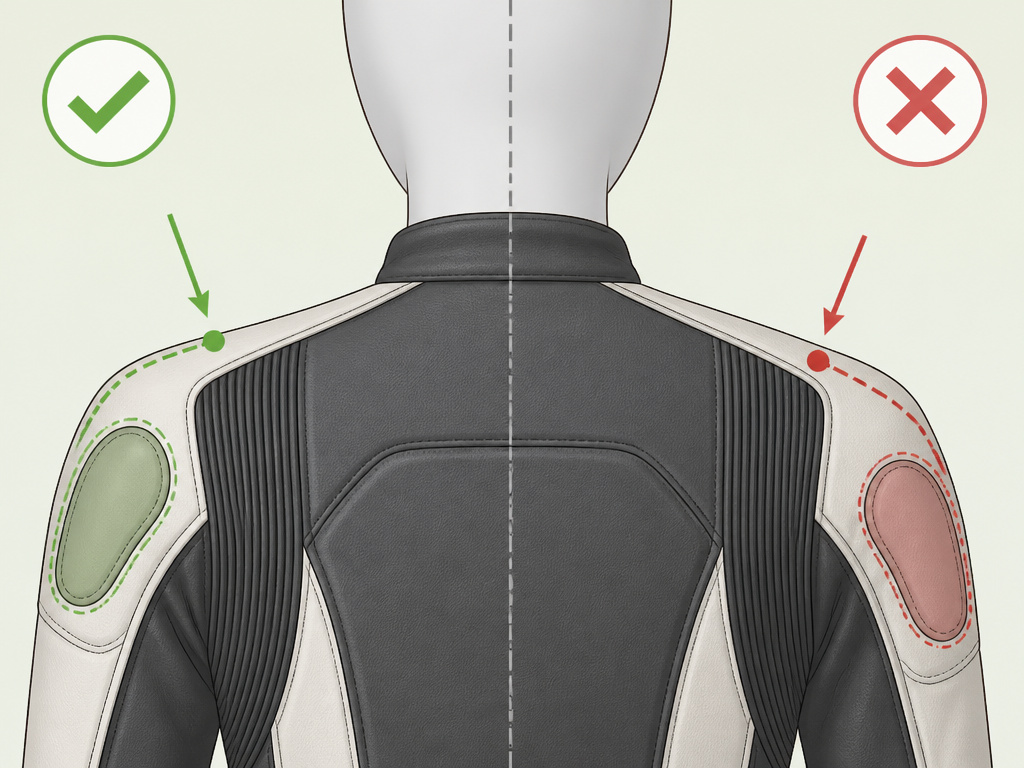
This is the essential requirement. I learned it the hard way with an early textile jacket. It fit in the chest, so I thought I was good. On the bike, reaching for the bars, I could feel the entire shoulder assembly shift forward. A quick check in the mirror showed the hard cap of the elbow protector sitting squarely on my forearm, not my elbow.
The shoulder is worse because you can’t see it. According to the EN 1621-1 standard, limb protectors must average under 35 kN of transmitted force to earn a Level 1 rating. That rating assumes the pad is over the joint. If it’s 5 cm off, the force goes into muscle and tendon, not the pad.
| Fit Scenario | Where Armor Sits | Consequence in a Slide |
|---|---|---|
| Proper Women’s Fit | Directly over shoulder bone & elbow point | Force is distributed through certified pad. |
| Loose Unisex Fit | On upper arm & mid-forearm | Joint takes full impact; armor is decorative. |
| Tight Chest, Wide Shoulders | Pulled forward off shoulder, elbow pad rotates | Armor may detach or miss the joint entirely. |
Fit first, features second. A $800 Gore-Tex jacket with misaligned armor is less protective than a $300 jacket where everything stays put. When you try on a jacket, press on the shoulder and elbow pads with your fingers. They should land directly on the bony protrusions. If you have to dig around to find them, the pattern is wrong for you.
Torso Shaping: The Waist and Hip Differential
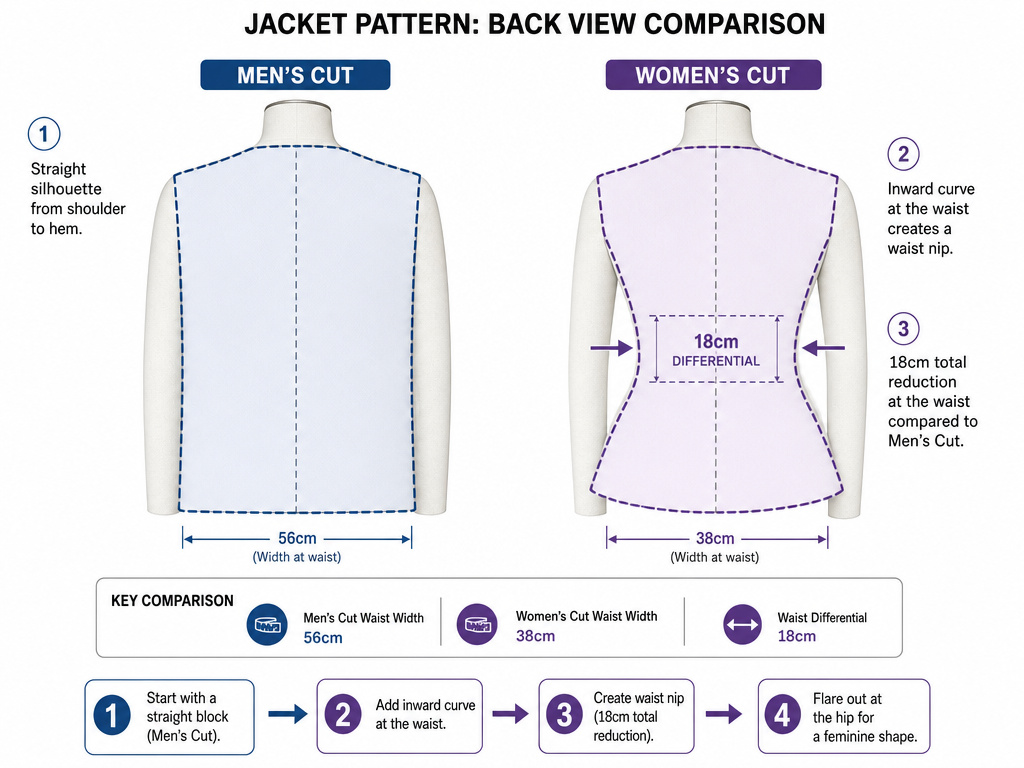
Men’s jackets are cut like a rectangle. Women’s jackets are cut like an hourglass. This isn’t about style; it’s about keeping the jacket from riding up and exposing your lower back.
Look at a Dainese women’s size chart. For Dainese women’s jackets, an EU 42 (US 4) has an 88 cm chest and a 70 cm waist, an 18 cm differential. For Dainese women’s jackets, an EU 38 (US 0) has an 80 cm chest and a 62 cm waist, the same 18 cm drop. For the Dainese sizes provided, the proportional nip is consistent. If a size chart shows the chest and waist as the same number, it lacks the 8–12 cm nip characteristic of a genuine women’s-specific pattern.
A jacket that’s straight from chest to hip will bunch at the waist when you cinch it. That creates pressure points and forces the jacket upward when you sit on the bike. The lower back gap isn’t just a draft; it’s a strip of unprotected spine.
Common mistake: Choosing a jacket that fits the hips but gaps at the waist. You’ll cinch the belt tight, the jacket will puff out above it, and the back will ride up an inch every time you get on the bike.
Textile jackets with stretch panels, like the Alpinestars ST-7 2L Gore-Tex Jacket, use “pre-curved arms and generous stretch panels” to accommodate shape. Leather is less forgiving. The Ducati Black Rider Jacket uses 0.9 mm buffalo leather with Flex Tenax inserts for pliability, but the underlying pattern still needs to match your shape.
How Material Changes the Gender-Fit Equation
Leather and textile behave differently, and that changes the sizing advice you often hear.
Leather’s “Break-In” Myth: A common thread in forums says to buy leather tight because it will stretch. DMG Motorsports, a retailer, states the opposite: “Quality leather jackets do not stretch, they only soften and mold over time.” Their advice is to buy for the fit you want now, not the fit you hope for. DMG Motorsports advises that sizing up for a leather jacket will lead to a too-large jacket after the leather breaks in.
Textile and Stretch: Textile jackets, especially those using stretch materials like the REV’IT! Trucker Ladies’ 13.5-oz stretch denim, may accommodate shape variations through fabric give. This can make a unisex-cut textile jacket more wearable for some women than a rigid leather one, but the armor placement issue remains. Stretch fabric won’t pull a shoulder pad back over your bone.
The safest path is to ignore the material hype and focus on the pattern. If the shoulders and waist align, the material choice becomes about climate and riding style, not making a bad fit work.
A 5-Step Checklist for Evaluating Any Jacket’s Fit
Forget the size on the tag. Use this on the floor of a shop or when reviewing an online size chart.
- Check the Size Chart Geometry: Find the chest, waist, and hip measurements. Is the waist 8–12 cm smaller than the chest? If not, it’s likely a unisex block.
- Test the Shoulder Seam: Put the jacket on. Have a friend mark the tip of your shoulder bone (acromion) on the jacket with a piece of tape. Is the seam within 1 cm of that mark? If it’s farther out, the armor will be off.
- Simulate the Riding Position: Sit on a bike or assume your riding stance. Reach forward. Does the jacket back stay down, covering your beltline? Do the sleeves still cover your wrist bones by 2–4 cm?
- Locate the Armor: Press firmly on the shoulder and elbow pads. They should be centered on the bony parts of your joint. You shouldn’t have to shift the jacket to make them line up.
- Check for Pressure When Cinched: Fasten all closures, main zipper, waist cinch, sleeve cuffs. Take a deep breath and move your arms. You should feel snug, secure pressure, not pinching or restriction across the chest or back.
This checklist works for any jacket, men’s or women’s. It moves you from “Does this size fit?” to “Does this pattern fit my body?”
Can You Cross-Shop? When a Unisex or Men’s Jacket Might Work
Sometimes. It’s about matching your specific proportions to a jacket’s cut.
If you have broader shoulders and a straighter waist, a men’s or unisex jacket in a smaller size might actually fit better than a women’s cut that assumes a pronounced hourglass. The Spidi EVORIDER LEATHER jacket, for example, for size 54 corresponds to a height of 173-185 cm and a chest of 108-112 cm.
Where this goes sideways: Assuming a “small” or “XS” is a women’s small. A men’s XS is cut for a man’s shoulders and waist. You might get the chest to zip, but the shoulders will be wide and the waist will billow.
Adventure-style jackets often have a roomier, more adjustable cut. The Klim Artemis jacket shows the disagreement: Adventure Motorcycle Magazine found it has ‘tight shoulders,’ while Mad or Nomad called the fit ‘excellent’ and ‘not restrictive.’ This variability means you must try it on.
The rule is simple: if the armor sits right and the jacket doesn’t move excessively when you do, the label is irrelevant. But for most women, a genuine women’s pattern is the direct route to that result.
Can Men and Women Wear Each Other’s Motorcycle Jackets?
Cross-shopping between men’s and women’s motorcycle jackets is generally not recommended due to fundamental pattern differences. A genuine women’s-specific pattern is cut with narrower shoulders and a more defined waist compared to a unisex or men’s pattern at the same chest size. Men trying a women’s jacket may find the shoulders and chest too tight, while women in a men’s jacket will often experience excess material in the shoulders and a boxy, loose fit through the torso. While some jackets from brands like Klim feature adjustable side gussets for a better hip fit, the core shoulder and chest proportions are fixed by the pattern. For safety and comfort, it is best to stick with gear designed for your body type, as a fit with a genuine women’s-specific pattern ensures armor stays in place during a ride.
Frequently Asked Questions
How can you tell if a jacket is for a man or woman?
Look at the size chart, not the color. A women’s size chart will list separate chest, waist, and hip measurements, with the waist being 8-18 cm smaller than the chest. A men’s chart often lists only chest, or has a waist measurement nearly equal to the chest. Also, read the product description; genuine women’s cuts use language like “patterned for women’s anatomy” or “reshaped shoulders and waist.”
Should I size up for a motorcycle jacket?
No, not to account for “break-in.” Buy the jacket that fits snugly but comfortably when new. Leather will soften and mold to your body, not stretch to a new size. Textile won’t stretch significantly. Sizing up creates excess material that can fold, catch, and allow armor to shift.
What if I’m taller or larger than the women’s size range?
The priority remains armor placement, don’t go so large that the shoulder seams are off your shoulders.
Do I need a different fit for sport riding vs. Touring?
Yes, but the gender-specific differences remain. A sport jacket like the Dainese Racing 5 is conceived for riders traveling in good weather and has a regular and sporty fit. A touring jacket like the Dainese Mangen is designed for long-distance travel on both road and dirt roads. Within each style, the women’s version will still have the narrower shoulders and shaped waist of its pattern.
The Bottom Line
The goal isn’t to find a women’s jacket. It’s to find a jacket that fits your body so well that you forget you’re wearing it. The numbers make it concrete: a 3-5 cm shoulder difference, an 8-12 cm waist nip. Those aren’t arbitrary; they’re the measurements that keep armor where it belongs.
Start with the brands that re-cut: Alpinestars Stella, Dainese Lady, REV’IT! Ladies, Klim Altitude/Artemis. Use the five-step checklist on anything you try. And trust the geometry over the label. A jacket that fits right is the one that disappears on the ride and only reminds you it’s there when everything goes wrong.
