
How Safe Is a Suction Cup Motorcycle Seat?
This post contains affiliate links. As an Amazon Associate, we earn from qualifying purchases.
A suction cup motorcycle seat is safe enough as a cosmetic fender pad and a poor bet for carrying a passenger. No maker in the sources I found publishes a load rating, the original patent gives no test data, and California requires passenger seats securely fastened with footrests.
That missing load rating is the whole story. A suction cup holds by air pressure, and nobody selling these pads has told you how much sideways shove that pressure survives with a person bouncing on top at speed.
What follows: how the cups hold, why the sellers contradict each other about passengers, the laws that matter, a pre-ride check, and what I’d bolt on instead.
Key Takeaways
- Treat a suction pad as fender trim first; the passenger claim rests on marketing copy and no published rating.
- Install it dry, on a clean fender, as the RevZilla listing for the Phantom Pad tells you to.
- California wants a passenger seat securely fastened with footrests, and Maine wants permanent seating.
- No pegs means no legal passenger in California, however well the cups grip.
- If someone rides with you more than now and then, bolt on a real seat.
What Actually Holds a Suction Pad to Your Fender?
Air pressure does all the holding. Flatten a cup against the paint, push the air out, and the outside air holds the rubber against the surface until air finds a way back under the rim.
US Patent 5,322,345, titled “Removable motorcycle fender seat,” describes three ways to hold a pad on a rear fender: a magnetic sheet plus suction cups, a magnetic sheet alone, or suction cups alone. The suction-cup layout places one cup at each corner and one near the geometric center of the seat bottom, five cups total.
The US Patent 5,322,345 record shows how the inventors thought about failure. They funneled the bores and kept the cups low to steady the seat “in an effort to prevent any shear slippage” with a second passenger aboard.
Shear is sideways force. A cup resists a straight pull well, because the rim stays pressed flat. A sideways shove slides the rim, opens a gap, and air rushes in. Braking, cornering and a passenger shifting their weight all push sideways.
What the patent leaves out is a number. No load rating. No test data.
| Patent embodiment | Holds with | What to watch |
|---|---|---|
| First | Magnetic sheet plus suction cups | Magnet needs a steel fender |
| Second | Magnetic sheet only | Useless on aluminum or fiberglass |
| Third | Suction cups only, glued into bores | The glue line in each bore |
That third version deserves a hard look. Claim 13 names glue as the thing holding the cup stems in their bores. Anyone who’s built furniture knows a joint fails at the glue line long before the wood gives up. Here the cup can grip the fender perfectly and still tear out of the base.
A sealed cup feels welded on. Tug the pad’s edge and the base flexes before the rubber budges. A cup that’s lost its seal lifts with a faint tick, or with no sound at all.
I’ll be straight with you: I haven’t load-tested one of these pads, and none of my sources did either. That’s the honest state of the evidence.
Passenger Seat or Fender Trim? The Sellers Can’t Agree
The companies behind these pads describe them two different ways, sometimes inside the same product line. Here’s who says what.
| Source | What it calls the product | Install or design note |
|---|---|---|
| Rider Magazine (Saddlemen buys Phantom Pad) | Removable suction cup passenger seats | Non-abrasive, dual cavity, quick tabs |
| US Patent 5,322,345 | Seat for a second passenger | Funneled bores against shear slippage |
| Saddlemen Dominator Pad 7 (SA1008) dealer page | Low-profile pillion for looks | Dual-cavity cups, no permanent changes |
| RevZilla, Phantom Pad Studded Pad | Rear pad that protects the fender | Install dry, cups and fender |
Rider Magazine’s coverage of the deal called Phantom Pad “the innovator of removable suction cup passenger seats.” The dealer copy for the Saddlemen Dominator Pad 7 pitches it to riders who want to dress up a solo seat. Same company. Two framings.
Research summaries also report “Cosmetic use only” and “Not for passengers” warnings on Saddlemen’s retail listing for the Dominator. The dealer page text available doesn’t show that line. Treat it as reported until you see it on the box yourself.
When the marketing and the fine print disagree, I side with the fine print. Every time. Same rule I use on jackets: the label that narrows the claim is the one somebody had to defend.
Rider comfort is a separate problem, by the way. A gel seat pad on your own saddle fixes sore miles for you. A suction pillion on the fender is trying to solve a passenger problem, and that’s where the questions start.
How Safe Is a Suction Cup Motorcycle Seat Under the Law?
Three pieces of law decide this, and none of them mentions suction cups. Read together, they leave a removable pad on weak legal footing for a passenger.
- California Vehicle Code 27800: a passenger rides only on a seat “securely fastened to the machine at the rear of the driver and provided with footrests,” or in a sidecar. Feet stay on the footrests while moving.
- Maine 29-A section 2062: a passenger may only ride on permanent seating, one per seat.
- FMVSS 123, S5.2.5: footrests for each designated seating position, and passenger footrests fold rearward and upward when not in use.
The wording of California Vehicle Code 27800 turns on “securely fastened.” A pad you can peel off in seconds is a hard fit for that phrase, and I wouldn’t want to argue the point at the roadside.
Maine Title 29-A section 2062 goes further with “permanent seating.” Removable and permanent don’t sit comfortably in the same sentence. The same section says the operator rides only on “the permanent and regular seat attached.”
Federal Motor Vehicle Safety Standard 123 is written for the companies that build motorcycles, and nothing in my research shows it governs aftermarket pads. It still tells you what the rulebook treats as a seat: a position with its own footrests.
If your bike has no passenger pegs, it has no passenger seat. A pad on the fender doesn’t change that.
Insurance is the question I can’t answer. No source here covers how an insurer treats a passenger on a removable pad after a crash. Call your agent and get the answer in writing.
I test gear for a living. Legal advice comes from a lawyer in your state.
The Pre-Ride Check I’d Run Every Single Time

You pull into a gas station, a friend wants a lift to the diner, and the pad has been rattling around in your saddlebag all week. The temptation is to slap it on and go. Ride it before you trust it, meaning a solo loop with the pad on before anyone sits there.
Before you start: A pad that peels off at speed takes your passenger’s seat with it, so test it solo first. Pegs left folded up put your passenger’s feet on hot pipes or a moving swingarm; fold them down and check the fit. Rubber softens with heat, so if the fender is hot to the touch after a ride, let it cool before you mount the pad.
- Clean the fender and cup faces, then let both dry. Skip it and grit sits under the rim; when the pad shifts, that grit grinds a dull gray ring into the clear coat.
- Install dry. The RevZilla listing for the Phantom Pad says not to wet the fender or the cups. Water under the rim acts like a lubricant, so a sideways push slides the cup instead of fighting it.
- Look at every cup for nicks, hardening, or a rim that won’t lie flat. A nicked rim leaks air from the first minute.
- Press each cup down, then tug the pad sideways, front to back and side to side. If it shifts in the parking lot, it shifts more with a person on it.
- Wiggle each cup stem where it meets the base. A loose stem means the glue has let go, and the pad can lift even with every cup stuck to the paint.
- Fold the pegs down and have your passenger find them before you roll.
- Re-check at every fuel stop. Quick hand on the pad. Done.
I already run a strap check on my helmet before every ride. This adds one more habit to the same moment, which is the only way a habit survives.
Fenders That Give a Cup a Fair Shot
A cup needs an unbroken ring of contact. Smooth gloss paint on a steady, gentle curve is the best case, because the rim lies flat all the way around. The pad’s base also needs to match the fender’s curve; a flat base on a tight curve leaves the corner cups half-seated.
Fenders I’d Write Off
No maker in my sources addresses textured or ribbed fenders, so this part is physics, not test data. Any ridge under the rim is an open channel for air.
- Ribbed or seamed fenders. A rib under the rim is a leak path. No amount of pressing fixes it.
- Wrinkle-finish or rough powder coat.
- Vinyl wraps, which can lift with the cup when you pull the pad off.
- Fenders with rivets, badges or light housings where a cup wants to land.
Rain, Heat, Luggage: When Does a Cup Seal Let Go?
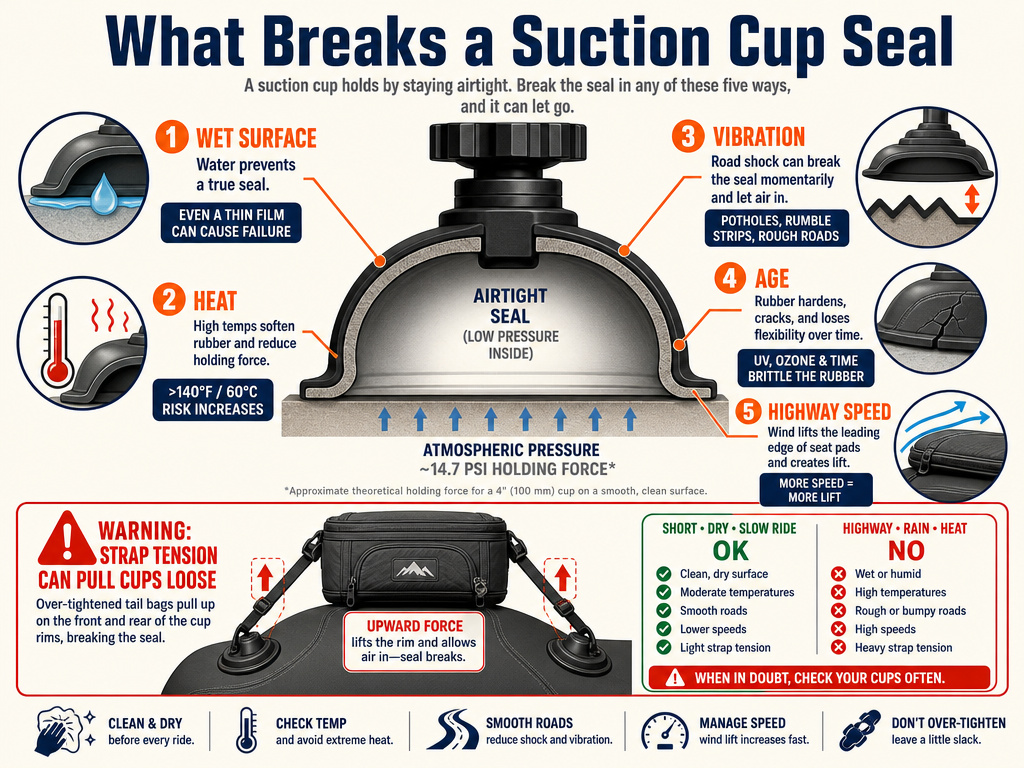
What breaks a cup seal on a moving bike? Air or water getting under the rim will do it, and so will anything that pushes the pad sideways.
The sources I found offer no published load rating or test data on how long these pads stay put in real-world use. I believe most of them. Few mention passenger weight, rain miles, or whether a bag ever rode on the pad, and those are the conditions that matter.
- Water. The dry-install instruction is your warning. A wet cup gives itself away with a thin bead of water trapped inside the rim, and the pad slides under your palm instead of resisting.
- Heat. Rubber softens as it warms. No source I found gives a temperature where these cups fail, so I can’t hand you a number.
- Vibration and potholes, because every jolt flexes the rim a little.
- Age. Old cups stiffen and stop conforming to the paint.
- Speed and highway wind, which tug at the pad’s leading edge for miles at a stretch.
Where this goes sideways: Strapping a tail bag or backpack to a suction pad. Strap tension pulls straight up on the cup rims and every bump adds a jerk, so the seal you tested in the driveway gets worked loose within one rough stretch of road.
I’d trust a suction pad for a short, dry, slow run across town with a light passenger who knows to hold on to me. Highway, rain, or a passenger who’s never ridden, and the pad stays in the garage. Same call I make on gear: I pick what I’d trust at the worst moment of the ride.
Fair warning on cheap pads, too. The glued-stem design from the patent puts the weak point inside the base, where you can’t see it.
Suction Pad vs Bolt-On Seat vs Cushion: Which to Buy
If someone rides with you more than now and then, bolt on a seat. The suction pad earns its place on a solo bike, and that’s a narrower job than the marketing suggests.
| Option | Best for | Weak spot |
|---|---|---|
| Suction pad (Phantom Pad, Dominator Pad 7) | Covering the fender on a solo bike | No published load rating |
| Bolt-on two-up seat | Regular passenger miles | Takes tools to swap |
| Rider seat cushion | Your own comfort on long days | Does nothing for a passenger |
Suction Pad vs Bolt-On Seat: Which Wins for a Passenger?
The bolt-on seat wins for a passenger, full stop. It’s fastened the way California’s statute describes, and rain doesn’t change how it holds. A two-up replacement seat takes more effort up front and none at every stop after that.
The suction pad wins on one thing: speed. The Dominator dealer listing says it installs in seconds, removes just as fast, and needs no permanent modification. For a bike you ride solo and want to look finished, that’s a fair trade.
Comfort: Memory Foam on a Fender vs a Real Seat
Rider Magazine reports every standard Phantom Pad carries a neoprene fender liner, an ABS base plate and orthopedic memory foam. That’s a sensible stack for a short hop. It’s still a thin pad on a curved fender, with nothing behind your passenger’s back.
If you’re the one getting sore, a motorcycle seat cushion on your own saddle is money better spent than any pillion.
My pick, if you want one answer: a Phantom Pad on a solo bike as fender trim, installed dry, and a bolted two-up seat the day you start carrying anyone regularly.
Do more suction cups mean a better grip on a motorcycle seat pad?
The sources don’t back up a clean answer on 6 versus 8 cups, and nothing in the material compares cup sizes either. What they do show is how a few designs are laid out. The patent describes five cups: one at each corner of the seat bottom and one near the geometric center. That spread makes sense, because corners resist lifting and rocking while the middle cup helps keep the pad flat.
Retail pads lean on cup design more than cup count. Phantom Pad is described with dual-cavity, multi-cavity cups and quick tabs, and the Saddlemen Dominator listing also names a dual-cavity system with a non-abrasive liner. None of these sources gives a holding force, a load rating or test data.
So treat the number on the box as a hint, not proof. Look for cups spread across the whole base, a clean and dry fender, and installation per the maker’s directions. Dry matters: RevZilla’s listing says neither the fender nor the cups should be wet. Then check the pad for movement before every ride.
Frequently Asked Questions
Do suction cup seats scratch fender paint?
Phantom Pad markets its cups as non-abrasive, and the Dominator listing says its liner protects the fender. The real risk is dirt trapped under a cup that slides. Clean and dry the fender every time you mount the pad.
Can I strap luggage to a suction cup pillion pad?
I wouldn’t. No source I found gives a weight rating for any pad, and strap tension pulls straight up on the cups. Use a rack or a bag built to mount to the bike.
Are suction grab bars safe?
They rely on the same physics as suction seats, and I found no load data for them either. A passenger yanking on a handhold under hard braking is exactly the sideways and upward pull that breaks a seal. I’d want a bolted handhold.
Do I need passenger footpegs with a suction pad?
In California, yes. The vehicle code requires footrests and says passengers keep their feet on them while moving. The federal standard also calls for footrests at every designated seating position.
What is the best cushion for a motorcycle seat?
Start with a cushion built for the rider’s saddle, sized to your seat. A fender pillion is a passenger accessory and won’t fix your own sore miles.
Before You Go
So, how safe is a suction cup motorcycle seat? Safe enough as trim. Thin on evidence as a passenger seat, because nobody has published the number that would settle it.
Here’s my line in the sand. The first time a passenger needs somewhere to put their feet, or the forecast shows rain, the pad stays home and the passenger rides on a bolted seat or not at all.
One thing to do this week: find your bike’s passenger pegs, fold them down, and read your own state’s passenger seat statute. If you have no pegs, you’ve got your answer already.
My testing lives in helmets, jackets, gloves and boots, so treat the load side of this as a reading of the sources, not lab data. Bottom line: buy a suction pad if you want a clean solo fender with a quick-swap pillion look, and skip it if you’re planning to carry a passenger on the highway.
