
Motorcycle Alarm Systems Explained: A Rider’s Guide
This post contains affiliate links. As an Amazon Associate, we earn from qualifying purchases.
Motorcycle alarm systems use sensors to detect unauthorized movement or tampering, then trigger a loud siren and/or disable the ignition. Factory and aftermarket systems arm passively after a delay ranging from seconds to nearly a minute. Aftermarket alarms offer wider customization but require professional installation. The core specs that matter are siren decibel rating, battery life, arming delay, and key fob range.
That split between factory and aftermarket is where the real decisions get made. One is built into your bike’s wiring and brain; the other is a box you add, with its own rules and failure points. This is the core of motorcycle alarm systems explained.
What follows: a walk through the factory specs you already own, the aftermarket options you can add, and the numbers, like a five-second arming delay versus a forty-five-second delay, that decide whether an alarm is useful or just annoying.
Key Takeaways
- Factory alarms from brands like Harley-Davidson arm automatically within five seconds of turning the ignition off, while others like BMW have a 50-second immobilizer activation phase. Aftermarket units like the Datatool S4 default to a 45-second delay.
- Siren loudness varies and sources disagree on the rating: a Harley accessory disc lock hits 120 dB, while a Meta System MT8 siren outputs 112 dB(A) at 1m.
- Key fob range varies by design; Harley specifies 1.5 meters (5 ft) for automatic disarming, and Indian requires the fob within 3 feet for authentication, while some aftermarket remotes like the Hawk MC01 have a range up to 10m.
- Battery life is a real cost: Indian key fobs last 1-2 years, and Harley’s siren disc lock uses a CR2 battery rated for 8-12 months with normal use.
- Forgetting to disarm a system with a motion sensor before moving your bike is the fastest way to trigger a false alarm.
How a Factory Alarm System Works (The 5-Second Rule)
Walk around any modern bike with a factory security system. The brain is a module tied into the main wiring harness, usually under the seat or tank. It listens for signals from a tilt sensor, the ignition circuit, and a little radio receiver waiting for your key fob.
When you turn the key off, a timer starts. This is the passive arming delay.
According to Harley-Davidson’s service information, the security system arms automatically within five seconds if no motion is detected after the ignition is turned to OFF or ACCESSORY. The indicator lamp in the speedometer face flashes every three seconds when armed.
That five-second window is the factory balance between convenience and security. Get outside the fob’s range before it expires, and the system is live. The system disarms automatically when the fob, with a range Harley says is 1.5 m (5 ft), comes back near the bike. When it disarms, that same indicator lamp lights solid for four seconds.
Other manufacturers use different clocks. BMW’s factory DWA alarm has a 50-second immobilizer activation phase after ignition-off. The point is the same: a short, predictable delay, then the bike looks after itself.
Where this goes sideways: Most riders don’t realize the motion sensor is already active during that arming delay. Bump the bike while putting it on the center stand during those five seconds, and you can trigger the alarm before it’s even officially “armed.” The sequence is listening from the moment you shut it down.
| Manufacturer | Passive Arming Delay (After Ignition Off) | Key Fob Range for Disarm | Siren Rating (if equipped) |
|---|---|---|---|
| Harley-Davidson | 5 seconds | 1.5 m (5 ft) | 120 dB (disc lock accessory) |
| Indian Motorcycle | System-specific (activate via fob) | Within 3 feet of VCM | Not specified in sourced docs |
| BMW | 50 seconds (immobilizer activation) | Not specified in sourced docs | Not specified in sourced docs |
| Ducati | Immobilizer system (2006-2018 models) | Transponder in key | Not specified in sourced docs |
The factory system is a sealed ecosystem. It works if you follow its simple rule: walk away with the fob. Its biggest weakness is also its simplicity, it can’t notify you remotely if it goes off three blocks away.
The Anatomy of an Alarm: Sensors, Sirens, and Immobilizers
An alarm is a simple machine. It needs to sense a threat, then react. The sensing happens through a few reliable methods.
The inclinometer or tilt sensor is the most common. It knows the bike’s angle. Lift it, wheelie it, or put it on a trailer, and the angle changes. That’s a trigger. The current sensor on the ignition circuit is another. Try to hot-wire the bike or turn the key without the fob, and it sees power where it shouldn’t. Some systems also have a voltage monitor on the battery. Cutting a wire or disconnecting the battery to disable the alarm is itself an alarm trigger.
The reaction is usually two-fold. First, the siren. This isn’t a polite beep. A Harley-Davidson accessory siren disc brake lock has a decibel rating of 120. When triggered by motion, it gives five medium beeps, then five loud beeps, then the 120 dB siren activates for 10 seconds.
Second, the immobilizer. This is often separate from the siren. It’s a relay that breaks the circuit to the fuel pump, ignition coil, or starter. Even if a thief silences the siren, the bike won’t start. This is what systems like the Ducati Immobilizer (for models from 2006-2018) specialize in.
Common mistake: Assuming a loud siren is the only defense. The immobilizer is the part that actually stops the theft. A siren might scare off an opportunist; an immobilizer stops a professional with a van.
The control unit ties it all together. A unit like the Meta System MT8 operates in a brutal temperature range, from -40°C to +125°C, and its siren outputs 112 dB(A) at 1m. It enters an ‘Energy Saving Mode’ 72 hours after arming to protect your motorcycle’s main battery.
The Aftermarket Alarm Ecosystem: Datatool, Meta System, and Hawk
Factory systems are not on every bike. For older models or riders who want more features, the aftermarket world steps in. Brands like Datatool, Meta System, and Hawk sell alarms as standalone kits.
These systems offer more control, but you trade plug-and-play for complexity. Installation is not a casual Saturday job. The Hawk MC01 manual warns installers to avoid “extremes of heat i.e. Exhaust engine” and to orient control wiring “down to avoid any water ingress.” Get that wrong, and you’re chasing electrical gremlins for months.
Their specs tell a different story than the factory sheets. The Datatool S4’s factory default for immobilizer-only arming is after 45 seconds, a world away from Harley’s five seconds. The Meta System MT8 is fully operational after a 40 second ‘Standby Time’. This longer delay can be programmed, but it highlights a different design philosophy.
Remote range is another differentiator. The Hawk MC01 remote control has a maximum operational range of 10m, compared to Harley’s intentional 1.5-meter limit. More range seems better, but it increases the risk of accidental disarming or interference.
The Datatool S4 manual states a crucial regional rule: ‘The inclusion of arm and disarm indication beeps is strictly forbidden in all EU countries.’ A feature in the U.S. Can be illegal in Europe. Your alarm’s behavior isn’t just engineering; it’s local law.
Here’s the core trade-off in a table:
| Aspect | Factory Alarm (e.g., Harley, Indian) | Aftermarket Alarm (e.g., Datatool, Meta) |
|---|---|---|
| Installation | Integrated at factory; no wiring hassle. | Requires professional or expert installation; risk of incorrect wiring. |
| Customization | Limited to OEM settings (chirp on/off, maybe sensitivity). | Highly programmable: arming delay, sensor sensitivity, siren patterns, often via a computer. |
| Integration | Deeply tied into bike’s CAN bus and diagnostics. | Taps into power and ignition lines; can be less integrated with other electronics. |
| Reliability | Engineered for the specific bike model; generally robust. | Depends heavily on install quality; more potential points of failure. |
| Cost | Included or offered as a factory accessory. | Additional purchase + installation labor cost. |
The aftermarket path is for the rider who wants a specific feature, like a longer-range remote or a programmable sleep mode, a crucial distinction when you compare a motorcycle alarm systems explained. It is not the simple choice.
Power and Failure: Batteries, Drain, and Sleep Modes
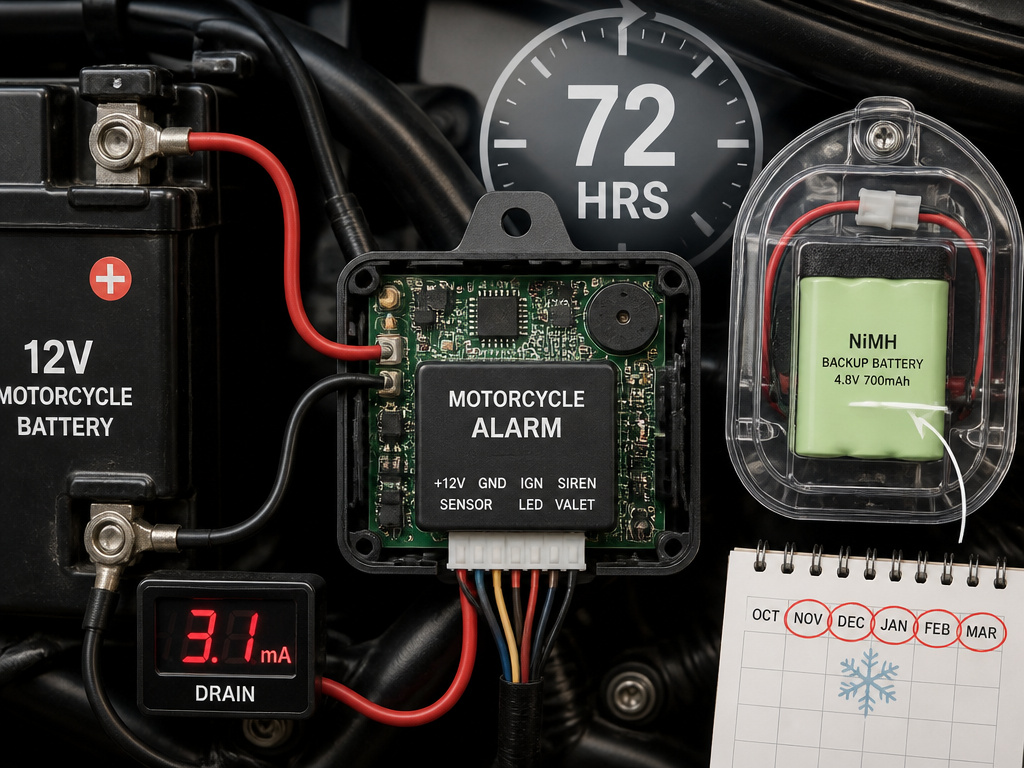
Every alarm is a parasite. It draws power from your motorcycle’s battery to watch over your motorcycle’s battery. Managing that drain is the central engineering challenge.
There are two batteries to think about: the bike’s main battery and the alarm’s own backup. The main battery feeds the system. An alarm like the Hawk MC01 consumes >3mA when armed. That seems tiny, but over weeks of storage, it adds up. This is why sleep modes exist.
The Meta System MT8 enters ‘Energy Saving Mode’ 72 hours after arming and 120 minutes after disarming. The BMW DWA alarm “deactivates itself automatically a certain number of days after being activated to protect the battery, but always remains active for at least 7 days.” These are failsafes to prevent you from coming back to a dead bike.
The backup battery is often in the siren itself. Its job is to power the siren if a thief cuts the main power. Harley-Davidson’s security sirens with NiMH batteries lose 1%-2% charge per day during storage. After a few months at room temperature, they are mostly discharged. That’s a hard shelf life. Their accessory siren disc lock uses a lithium (CR2) battery with a life of 8-12 months with normal use. The remote fob has its own cell; for 2014-2016 Indian Motorcycles, key fob battery life is 1-2 years.
Worth knowing before you start: If your bike will sit for more than a month, consider a maintenance charger. A flat main battery can sometimes corrupt an alarm’s memory or settings, leading to a headache when you return.
The lesson is calendar-based. Mark your fob battery life in your phone when you replace it. Assume any alarm with an internal NiMH backup will need attention after a long winter storage. The system’s job is to protect the bike, not to survive indefinite neglect.
The Owner’s Manual vs. Real-World Use

The manual gives you the theory. The driveway gives you the practice. The gap between them is where most frustration lives.
The factory procedure for disarming a Harley without the fob is a perfect example. You use a 5-digit PIN, entered by tapping the turn signal switches in a specific sequence. If the procedure fails, you must wait two minutes before trying again. Now, imagine doing this while your siren is blaring at 120 dB. It’s designed for security, not stress-free operation.
Indian’s manual notes that to activate the alarm on a 2016 model, you press the LOCK button on the Key Fob 2 times. If you move the bike upright from the sidestand and the fob isn’t detected within 5 seconds, the horn will sound repeatedly.
The real-world use is about habit. You develop a ritual: ignition off, stand down, walk away. You learn that excessive vibration or movement might set off the motion sensor. You discover that the 1.5-meter fob range means the fob in your jeans pocket might not disarm the bike if you’re standing on the opposite side.
The single best practice isn’t in any manual: after installing any alarm, test it. Arm the system, then gently rock the bike. Learn what the warning chirp sounds like versus the full siren. Know how long you have to cancel it. Do this on your terms, in your garage, not when a parking attendant is trying to move your bike.
TL;DR: Your alarm is a tool with specific tolerances. It works best when you know its rules, the five-second arm delay, the three-foot fob range, the 72-hour sleep timer, and build your habits around them.
How different motorcycle alarm systems compare
Factory systems from brands like Harley-Davidson and Indian Motorcycle are deeply integrated. Harley’s system arms automatically about five seconds after you turn the ignition off. Its key fob works within about five feet for automatic disarming. Indian’s system requires the fob to be within three feet for authentication. Aftermarket units like the Datatool S4 or Meta System MT8 have different timing, with standby periods of 45 and 40 seconds respectively before full arming. Siren loudness varies too; a Harley accessory disc lock siren hits 120 dB, while the Meta System MT8 siren is rated at 112 dB. Remote range also differs, with some aftermarket remotes claiming a range of up to 10 meters.
Frequently Asked Questions
What is the best alarm system for a motorcycle?
There isn’t one “best” system. For a new bike with a factory option, that’s usually the most integrated and reliable choice. For older bikes or added features, a professionally installed aftermarket unit from Datatool or Meta System is the way to go. The “best” system is the one that’s correctly installed and that you understand how to use.
What is the 12 second rule on a motorcycle?
The “12-second rule” isn’t a standard spec from any major manufacturer in our sourced documents. It may be a generic term from some aftermarket alarm guides or forums referring to a typical delay between a sensor trigger and the full siren activation, allowing time to disarm. Always refer to your specific system’s manual for its timers.
What are the four types of alarm systems?
The four main categories are: 1) Factory-Integrated Alarms (like Harley-Davidson H-DSS), 2) Aftermarket Hard-Wired Alarms (like Datatool S4), 3) Disc Lock Alarms (standalone, battery-powered locks with sirens), and 4) GPS Trackers with Alarm Features (devices that track location and can send tamper alerts). Each serves a different purpose in a layered security approach.
Why does my motorcycle alarm go off for no reason?
“False alarms” usually have a cause. Common culprits are: a low main battery causing voltage fluctuations, a failing backup battery in the siren, excessive vibration from wind or nearby traffic, a too-sensitive tilt sensor setting, or a key fob with a dying battery causing intermittent authentication failures. Systematic troubleshooting starts with checking battery voltages.
Can I install an aftermarket alarm myself?
You can, but you shouldn’t unless you are proficient in motorcycle electrical systems. Incorrect wiring can damage your bike’s ECU, cause constant battery drain, or render the alarm inoperative. The manuals themselves (like Hawk’s) warn about heat and water exposure during install. For reliability and insurance purposes, professional installation is strongly recommended.
Before You Go
An alarm is a single layer. It is not a force field. The most secure approach is always layered: a loud alarm, a physical lock like a heavy-duty chain or disc brake lock, and a hidden GPS tracker. The alarm is the noisy, attention-grabbing layer.
One final, sourced number to remember: if you ever need to use the manual PIN disarm on a Harley and you get it wrong, wait two minutes before your next attempt. The system imposes that cool-down period deliberately. That’s the kind of precise, unforgiving logic you’re dealing with. Respect the machine, learn its rhythms, and it will watch over your bike. Ignore its specifics, and it will become a source of dead batteries and neighborly complaints.
Fit the system to your actual riding life. A commuter bike might need that factory five-second arming. A weekend garage queen might be better served by a simple, loud disc lock alarm. Match the tool to the task, not the brochure to the dream.
