
Mesh vs Bluetooth Motorcycle Intercom: The Bottom Line
This post contains affiliate links. As an Amazon Associate, we earn from qualifying purchases.
Mesh intercoms create a self-healing web where every rider can talk to every other rider, supporting larger groups (9-15 riders) and automatically reconnecting drops. Bluetooth intercoms form a strict master-slave chain, typically limited to 2-4 riders, where a single break disrupts the line. Mesh wins for dynamic group riding, while Bluetooth is simpler and often sufficient for stable pairs or solo riders who prioritize music quality.
The technical distinction changes how you ride with others. Bluetooth’s chain is fragile if someone falls back; mesh’s web reforms around the gap. That difference decides whether your group chat survives a fuel stop or a canyon corner. Understanding the mesh vs bluetooth motorcycle intercom choice is therefore key.
What follows: the engineering that creates those limits, the real-world range numbers that matter, the audio you’ll actually hear at 70 mph, and the one pre-ride check that prevents a parking lot argument.
Key Takeaways
- Choose a mesh intercom (like Cardo Packtalk Edge or SENA 50S) if you regularly ride in a group larger than four, or if your riding style involves riders frequently dropping back and rejoining. Its self-healing network handles that.
- A Bluetooth intercom is the better tool for rider-passenger pairs or a fixed, small group that stays tightly together. Its simpler setup and lower cost fit that job.
- Ignore the advertised “5-mile range” claims for mesh. In real-world conditions with hills and trees, plan for a reliable 1-2 mile range. Bluetooth’s real-world range, according to owner reports, is frequently 300-500 meters or less.
- Check firmware updates before every group ride. Incompatible versions are the most common cause of a mesh unit refusing to join the network, a lesson learned at gas stations.
- On audio quality, sources disagree: some find mesh indistinguishable from Bluetooth, while others, like FortNine, note mesh’s packet-hopping can introduce a faint digital quality some notice, giving Bluetooth a slight edge for critical music listening.
How They Work: The Technical Core
The split concerns network architecture, not quality. One method is a chain, the other is a web.
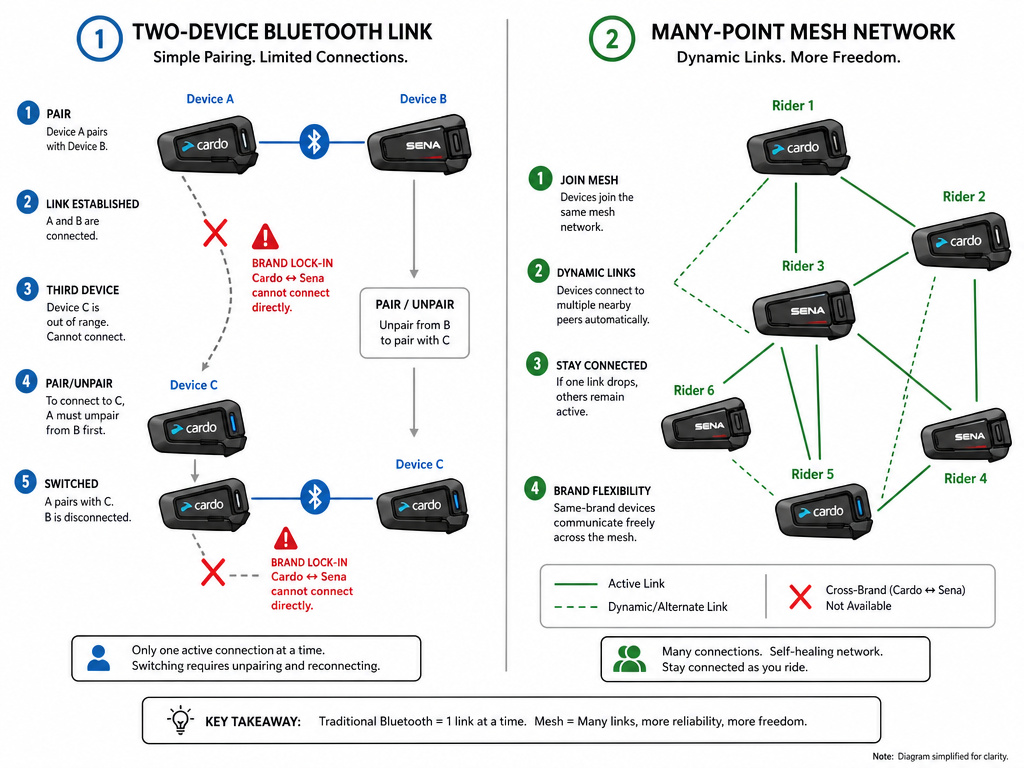
Bluetooth intercoms operate on a master-slave architecture. One unit (the master) pairs with a slave (your passenger), and that slave can pair with another slave, creating a daisy-chain. If the master unit drops out, the chain breaks. This design, using a frequency-hopping spread spectrum, is fundamentally limiting in mobile, multi-unit environments.
That’s the IEEE’s technical diagnosis for the frustration every rider in a Bluetooth group has felt. You’re the third bike, linked through the second bike to the leader. When the second bike ducks under an overpass, your connection to the leader dies. The chain snapped.
Mesh technology, like Cardo’s Dynamic Mesh Communication (DMC) or Sena’s Mesh Intercom, builds a web. Every device in the network can talk directly to every other device within range. There’s no single point of failure. If a rider peels off for gas and falls out of range, the network simply routes around them. When they re-enter range, the network automatically weaves them back in. This is the feature that matters on a real, messy ride, not a spec sheet.
The Range Reality Check
Manufacturers love big, open-field numbers. Riders live in a world with hills, trucks, and trees.
| Condition | Mesh Claimed Range | Mesh Real-World Range | Bluetooth Claimed Range | Bluetooth Real-World Range |
|---|---|---|---|---|
The “5-mile” claim for mesh comes from testing in ideal, line-of-sight conditions like salt flats. WebBikeWorld testing in open desert confirmed mesh maintains clearer audio beyond a mile where Bluetooth degrades. But the community consensus on forums like ADVrider highlights the disagreement, reporting that in varied terrain, reliable mesh range is typically 1-2 miles, far below the ideal-condition manufacturer claims of up to 5 miles. That’s still far superior to Bluetooth, but it’s not five.
Bluetooth’s limits are more severe. The SENA 50S Bluetooth Intercom spec lists a 1.2-mile range for communication with up to 4 riders. Owner reports consistently show a significant reduction from the claimed range. In practice, for clear, stable comms with a passenger or a single buddy, you often need to be within the effective real-world range, which owner reports frequently place at 300-500 meters or less. Beyond that, the audio gets choppy, then drops. This isn’t a product flaw—it’s the protocol hitting its design limits.
Group Size and Stability: Where Mesh Earns Its Keep
This is the single clearest dividing line. Your group’s size and discipline pick the technology for you.
For 2-4 Riders Who Stay Close: Advanced Bluetooth is adequate. RevZilla notes Bluetooth “works exceptionally well for rider-to-passenger or two-to-four riding buddies who typically stay within a few hundred yards.” The setup is straightforward: pair, and you’re done. There’s no network to manage. If your riding is predictable, the chain works.
For 5+ riders, the mesh vs bluetooth motorcycle intercom question is clear, but for smaller groups sources disagree: some advocate for mesh for future-proofing, while others, like Cycle World, find advanced Bluetooth sufficient for fixed, small groups. Motorcycle.com testing confirms mesh’s superior performance for groups over four, especially when riders join, drop, or fall out of sequence. The network’s ability to reconfigure automatically is the killer feature. The SENA 50S Mesh supports up to 9 riders; the Cardo Packtalk Edge’s DMC handles up to 15.
Stability involves both dropping out and rejoining. In a Bluetooth chain, reconnecting often requires stopping, parking, and manually re-pairing. With mesh, it happens as you roll back into range. That alone can save a group ride from a dozen annoying stops.
Audio Quality: Music, Calls, and the Digital Whisper
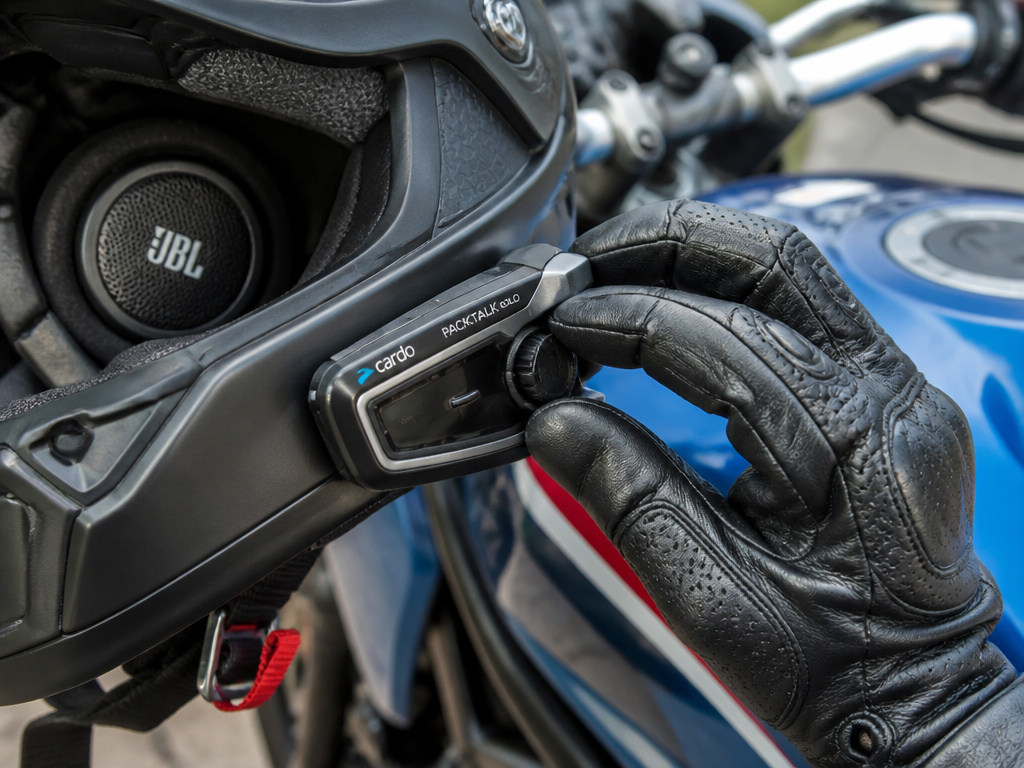
If your primary use is listening to music or taking phone calls, the mesh vs bluetooth motorcycle intercom decision matters. Here, the consensus fractures.
Some reviewers, like those at Motorcycle.com, find mesh audio “indistinguishable from high-end Bluetooth” in normal conditions. Others, like the technical deep-dive from FortNine, point out that mesh’s packet-hopping and inherent latency can introduce a very slight “digital” or “compressed” quality to the audio. It’s not a hiss or static—it’s a faint, thin texture some ears detect, especially in quieter moments or when listening to complex music.
Bluetooth, when dedicated to a single audio stream (like your phone’s music), can deliver a slightly fuller, more direct signal. WebBikeWorld highlighted the Cardo Packtalk Bold‘s “excellent” music and phone call quality when paired with its 40mm JBL speakers. For a solo rider or a pair that shares music infrequently, this difference might tip the scale.
For intercom chatter, the difference is negligible once you’re moving. Wind noise and engine sound overwhelm those subtle nuances. At highway speeds, clarity and reliability matter more than tonal perfection.
Setup, Compatibility, and Daily Hassles
Ease of use depends on the system working reliably with different riding partners, not just on its buttons.
Bluetooth Setup: Simpler, but rigid. You pair Device A to Device B. If you want to ride with Charlie today, you must unpair from Bob and pair with Charlie. Some models allow multi-pairing, but the master-slave chain still applies. Cross-brand pairing (a Sena to a Cardo) is possible using the Universal Intercom Protocol but often comes with reduced features and stability.
Mesh Setup: More powerful, but with quirks. Forming a mesh network is usually a one-button “join” process. However, you are now dealing with network software. Firmware mismatches will block connection, as I learned. Also, proprietary mesh tech means Cardo DMC cannot talk to Sena Mesh. You must all be on the same brand’s mesh system. This is a critical lock-in factor the marketing glosses over.
The physical install is identical for both: stick the module on your helmet, route the wires, and seat the speakers.
Durability and Power: Which System Is More Hungry?
These are electronic devices living on a helmet in the rain. Their toughness and battery life are part of the package.
| Model | Weight | Battery (Talk Time) | Waterproof Rating | Housing Material |
|---|---|---|---|---|
| Cardo Packtalk Edge | 4.4 oz (125g) | 13 hours | IP67 | Not Specified |
| SENA 50S | 4.6 oz (130g) | 14 hours | IP67 | Polycarbonate |
| UCLEAR Motion 6 | 4.2 oz (119g) | 15 hours | IP67 | Not Specified |
The IP67 rating (dust-tight, submersible to 1m for 30 minutes) is standard for premium units. Yet, community forums are filled with reports of water ingress, particularly for older Sena models like the 30K, despite the rating.
Battery life is a wash. You’ll get 13 to 15 hours of talk time from the models listed. The SENA 50S has a 1100mAh battery versus the Cardo Packtalk Edge’s 800mAh.
The Bottom Line
Stop looking for “the best.” Look for “the right tool.”
Get a mesh intercom system if you are the planner for group rides, if your crew is bigger than four, or if your rides involve splitting up and reforming. The Cardo Packtalk Edge’s higher rider count and DMC v5.2 make it the top pick for serious group riders. The SENA 50S is a solid, proven alternative.
Stick with a high-end Bluetooth intercom if you ride solo 80% of the time and want pristine music, or if you have a dedicated passenger or one riding buddy. The complexity and cost of mesh are overkill. A Cardo Packtalk Bold or Sena 30K will do everything you need.
The industry wants to sell you the future. Your actual riding habits should decide the purchase.
Frequently Asked Questions
Can Cardo mesh talk to Sena mesh?
No. Cardo’s Dynamic Mesh Communication (DMC) and Sena’s Mesh Intercom are proprietary technologies. They cannot directly interconnect in a mesh network. All riders in a mesh group must be using the same brand’s mesh system. They can connect via standard Bluetooth, but you’ll lose all mesh benefits like automatic reconnection and large group support.
Is the audio quality worse on mesh?
Not necessarily “worse,” but potentially different. In direct intercom chatter at riding speeds, you likely won’t notice. For dedicated music listening, some critical listeners report Bluetooth can provide a slightly more direct, uncompressed signal. Mesh’s audio is perfectly clear for communication, which is its primary job.
Can I upgrade my Bluetooth intercom to mesh?
No. Mesh capability requires specific hardware (a dedicated mesh radio and antenna) and software. It is not a firmware upgrade you can apply to a standard Bluetooth unit. Moving from Bluetooth to mesh means buying a new, mesh-capable device.
How many riders can use a mesh intercom?
It varies by brand and model. The Cardo Packtalk Edge supports up to 15 riders in its Dynamic Mesh Communication (DMC) network. The SENA 50S Mesh Intercom supports up to 9 riders. The UCLEAR Motion 6 Motion Mesh supports up to 10. These are network limits, not just pairing limits.
Which is better for a rider and passenger?
Bluetooth intercom is typically the better, simpler choice for a rider and passenger. It’s a dedicated, stable pair connection that’s easy to set up and often costs less. The advanced group features of mesh provide no benefit for this specific use case.
