
Motorcycle Dry Bag vs Duffel Bag: Which Is Right for You?
This post contains affiliate links. As an Amazon Associate, we earn from qualifying purchases.
The motorcycle dry bag vs duffel bag choice boils down to one spec: waterproofing. A dry bag uses a roll-top closure and welded seams to achieve a verified waterproof standard, some carry an IP66 or IP67 rating. A motorcycle-specific duffel bag prioritizes structured, easy access with a zippered closure, offering water resistance for lighter conditions. For gear that must stay bone-dry through all-day rain or a river crossing, the dry bag wins outright.
The difference between “waterproof” and “water-resistant” is measured in liters of failure. A wet sleeping bag ruins a trip; a soaked phone kills navigation. The choice you make in the motorcycle dry bag vs duffel bag question is a bet on the weather, the road, and how much you trust the bag’s seams.
What follows: we’ll walk through closure designs, the actual meaning of IP ratings, a documented disagreement on fabric durability, and the concrete steps to mount either bag so it stays put at 70 mph. By the end, you’ll know exactly which type belongs on your bike, and which brand’s construction claims hold water.
Key Takeaways
- Pick a dry bag with a verified IP rating (IP66/IP67) if you ride in heavy, sustained rain or plan river crossings, the roll-top and welded seams are built to keep water out under pressure.
- Choose a motorcycle-specific duffel bag for general travel and commuting where easy access matters more than submersion-level waterproofing; models like the Nelson-Rigg Hurricane use heavy-duty zippers and coatings for reliable water resistance.
- Understand the material durability split: brands like BFD Moto argue a dual-layer construction is essential to prevent abrasion holes in single-layer PVC/PU bags, a direct critique of products from Harley-Davidson, Touratech, and others.
- Always pack heavy items low and centered directly against the bike’s seat or rack, and secure the bag with a minimum of two cross-straps using D-rings or dedicated anchor points, never rely on a single bungee cord.
- Verify the warranty before buying; Verify the warranty before buying, as it can be a solid indicator of expected lifespan.
Waterproof Integrity: Roll-Top vs. Zippered Closure
When you compare a motorcycle dry bag vs duffel bag, this is the single biggest functional difference, and it’s not about preference. It’s about physics. A roll-top closure works by creating a long, serpentine seal. You fold the top of the bag over three to five times, then buckle or clip it. Water pressure must travel an inverted, convoluted path to get in, a task it usually fails. This is why dry bags from brands like Sea to Summit are trusted for kayaking and pack rafting.
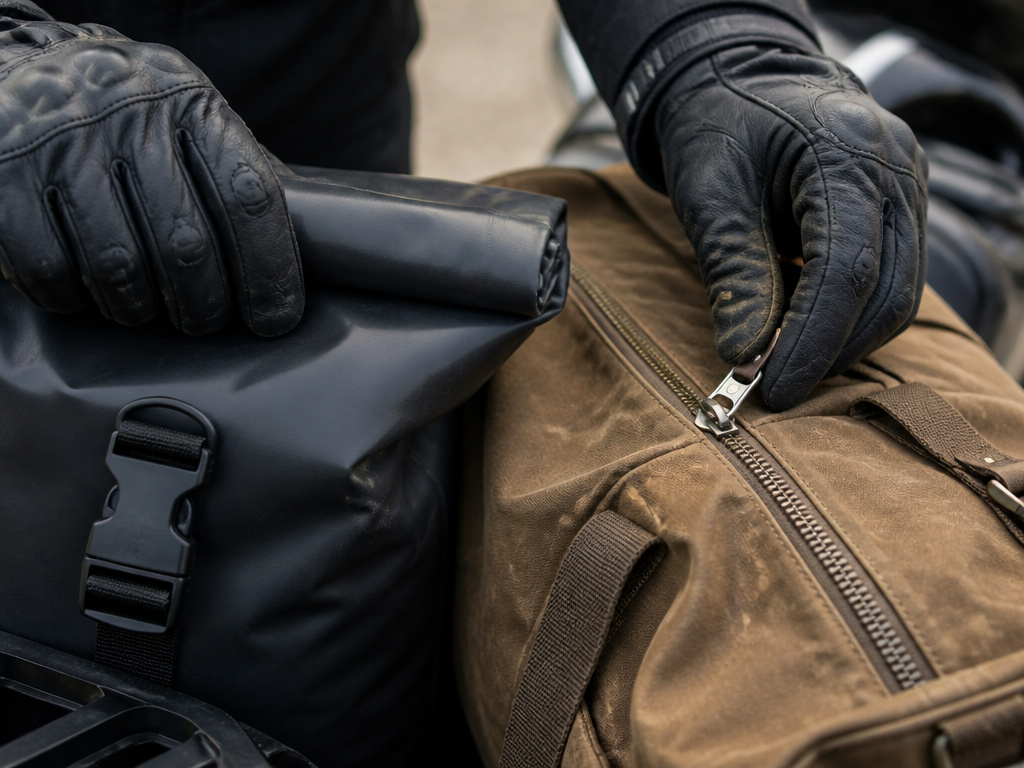
The zippered closure on a motorcycle duffel bag is a convenience and access champion. You can get to a specific item in seconds without unpacking the whole bag. The trade-off is the zipper itself, a mechanical seam. Even with waterproof coatings and flaps, a zipper is a linear weakness. High-end models like the Kuryakyn Torke 35L Dry Duffle use submersible IPX7-rated zippers, but that’s an exception, not the rule. Most zippered duffels are best described as highly water-resistant, not waterproof for prolonged submersion.
Before you start: Never trust a zippered closure to keep gear dry in a torrential, hours-long downpour without a separate waterproof liner bag inside. The water will find its way through the zipper teeth by the second hour, guaranteed.
The closure dictates your entire packing strategy. A roll-top bag requires you to think about access order, pack your tent at the bottom, your sleeping bag in the middle, and your rain layer on top. A duffel’s zipper lets you treat it more like a suitcase, which is why they’re popular for moto-camping trips where you’re setting up and breaking down camp daily.
Durability & Construction: The Fabric Debate
Here’s where the manufacturers disagree on a fundamental level. Open the spec sheet for the Harley-Davidson Adventure Duffel Bag and you’ll see 900D waterproof PU coated fabric. Some manufacturers use PVC tarpaulin or similar coated fabrics. Some manufacturers use PVC-coated polyester. The common thread is a single, tough outer layer with a waterproof coating, sealed with welded seams. They market this as rugged, and for most road use, it is.
Then you have BFD Moto. Their product page for the Turkana Duffalo doesn’t just promote their own bag; it directly criticizes the standard. They state: “The kryptonite of all the PU/PVC type duffels is that they get holes and eventually tears… Abrasion, continuous shaving, and sharp objects have a way to damage those bags.” Their solution is a dual-layer construction with a separate inner liner.
This isn’t marketing fluff. It’s a documented engineering disagreement. Does a single layer of thick, coated fabric resist abrasion from tie-downs, bike frames, and gravel spray for years? Harley-Davidson, Nelson Rigg, and Touratech say yes. BFD Moto says no, and that a sacrificial outer shell with a protected inner bladder is the only way to guarantee long-term waterproof integrity. For the rider, this means your decision hinges on how much abrasion your bag will see. Strapped to the outside of an adventure bike for off-road use? The dual-layer argument carries weight. Secured neatly on a rear rack for highway commuting? A single-layer bag from a brand like Nelson-Rigg is likely perfectly sufficient.
| Construction Type | Brand Example | Claimed Advantage | Potential Vulnerability |
|---|---|---|---|
| Single-Layer Coated Fabric | Nelson-Rigg Sahara, Harley-Davidson Adventure Duffel | High abrasion resistance, simpler repair, lower weight | Point abrasion can wear through coating to fabric base |
| Dual-Layer Shell + Bladder | BFD Moto Turkana Duffalo | Outer shell takes abrasion; inner bladder guarantees waterproofing | More complex, heavier, potentially more expensive |
| RF-Welded Seam Fabric | Giant Loop Tillamook | Seam integrity matches fabric strength; no stitched needle holes | Seam welding requires precise calibration; poor welds fail |
Capacity, Mounting, and Shape on the Bike
A bag’s volume is just a number until you try to strap it to your motorcycle. The Giant Loop Tillamook Dry Bag has a maximum capacity of 48L and can be compressed down to 30L, which is clever. You can roll it down tight for a weekend trip or open it up for a longer haul. What matters more is the shape and where that volume lives.
A tall, cylindrical dry bag strapped upright on a passenger seat acts like a sail. It catches crosswinds and can push the bike around at highway speeds. A lower, wider duffel bag that sits flat across the seat or rack presents a smaller profile to the wind.
Mounting systems are where motorcycle-specific bags earn their keep. Look for D-rings, lashing points, and integrated anchor straps. The cheap, universal dry bag from a big-box store will have flimsy plastic clips and thin webbing. Motorcycle-specific dry bags like those reviewed as the best motorcycle dry bags use heavy-duty hardware designed to handle the vibration and forces of riding.
The part nobody mentions: The bag’s own straps are often not enough. You must use your own ROK Straps or high-quality cam straps to create a redundant, cross-linked tie-down system. The bag’s straps secure it to itself; your straps secure the whole package to the bike. Skipping this step is how luggage ends up on the highway.
Step-by-Step Packing & Securing Guide
- Pack the Bag: Place the heaviest items (tools, cook kit) at the bottom, centered left-to-right. Place medium-weight items (clothes) around them. Place light, bulky items (sleeping bag) on top. This keeps the weight low and centered over the bike.
- Close and Compress: For a dry bag, roll the top down at least three full rolls, then buckle it. For a duffel, zip it shut, then use the bag’s own compression straps to squeeze out dead air and create a dense, stable package. Loose contents shift and destabilize the bike.
- Position on the Bike: Set the bag directly on the passenger seat or a rear rack. Ensure it’s centered side-to-side and fore-aft. It should not contact the exhaust, the rear fender, or any moving parts.
- Secure with Cross-Straps: Use two straps (like ROK straps). Hook one to the left side of the bike’s frame or subframe, run it over the bag, and hook it to the right side. Do the same with a second strap, forming an “X” over the bag. Tighten until the bag has no room to shift or bounce.
- Final Check: Grab the bag and try to move it forcefully in every direction, forward, back, left, right, and up. If it moves more than an inch, tighten the straps. Do a low-speed test ride in a parking lot before hitting the open road.
Hybrids and Best-Fit Use Cases
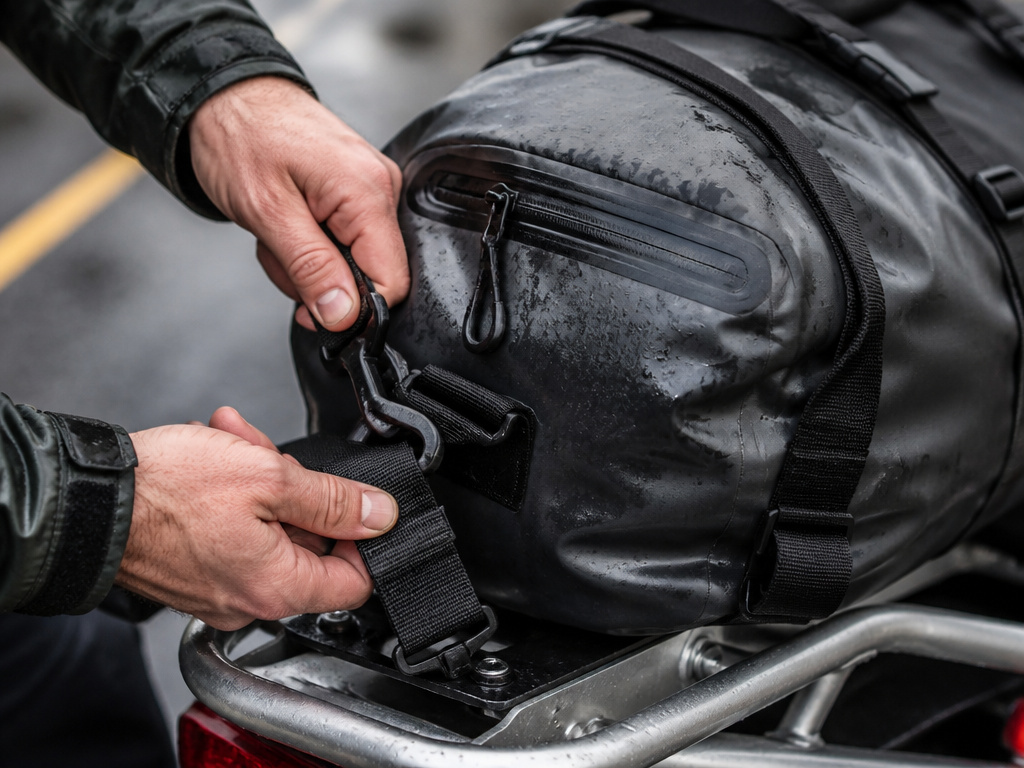
The market isn’t just dry bags versus duffels anymore. The “dry duffel” or “waterproof duffel” category is a direct hybrid. The Nelson-Rigg Hurricane Dry Duffle is a prime example. It has the structured shape and easy-access zipper of a duffel, but uses a tarpaulin PVC construction with heat-welded seams and a waterproof zipper cover. It’s built to motorcycle specs with D-rings and reflective panels. This is the sweet spot for riders who face unpredictable weather but don’t plan on fording rivers.
Your use case decides everything.
- Adventure/Off-Road Touring: You need a dry bag. The Giant Loop Tillamook or a Sea to Summit Big River bag is built for this. The roll-top guarantees waterproofing when you’re hours from shelter, and the tough fabric handles brush and tip-overs. As noted in a professional review, large bags like the 49L Touratech are made for “hard external use” as a primary, rugged roll bag.
- Sport Touring / Sport Riding: A sleek, low-profile motorcycle-specific duffel bag is better. Aerodynamics matter at speed, and you’re more likely to be on paved roads where sudden downpours are the main threat. A bag from the Dainese Explorer line fits this niche.
- Commuting / Weekend Trips: This is where the hybrid dry duffel shines. The convenience of a zipper for your laptop or change of clothes, coupled with enough waterproofing for a rainy commute, makes it the most practical choice for most riders. Hybrid dry duffels like the Nelson-Rigg Hurricane can be a practical choice for larger bikes and weekend or longer trips.
- Ultimate Redundancy (The “Belt and Braces” Approach): For critical gear like your sleeping bag or electronics, use a lightweight dry sack liner inside your main luggage. A professional guide on Bikes and Bays advocates this exact approach, stating it “beats one big bag.” A Sea to Summit Ultra-Sil dry sack inside your duffel or pannier adds a final, foolproof layer of protection for a few ounces of weight.
Price & Value Comparison
Motorcycle-specific dry bags and duffels represent a significant investment over generic luggage. The value comes from specialized construction: waterproof materials, welded seams, and designs that resist damage if the bike tips over. A higher upfront cost typically buys more durable fabric and more reliable waterproofing systems, like roll-top closures and waterproof zippers. For hard external use as a primary bag, this investment is justified. To maximize value, consider using lightweight dry sacks as liners inside your existing panniers for critical gear, a belt-and-braces approach that can be more economical than buying one large, expensive external bag.
Specific Brand Recommendations (e.g., SW-Motech, Nelson Rigg, Ortlieb)
When selecting a brand, focus on their construction philosophy for waterproof motorcycle luggage. Some manufacturers promote the durability and waterproof integrity of single-layer, welded coated fabrics. Others argue that a dual-layer construction is a must for resisting abrasion and tears from hard external use. Look for bags designed specifically for motorcycle use, with features like reinforced materials to handle a tip-over and reflective elements for visibility.
Frequently Asked Questions
Can I wear a duffel bag as a backpack while riding?
You can, but you absolutely should not. A duffel worn as a backpack sits high on your back, raising your center of gravity and affecting balance. The straps can loosen and flap, and the bag itself becomes a large, blunt object on your spine in the event of a fall. Always mount luggage to the bike, not your body.
What is the best dry bag for motorcycles?
“Best” depends on your primary use. For maximum waterproof assurance, choose a bag with a formal IP66 or IP67 rating like some BFD Moto models. For a balance of capacity, toughness, and motorcycle-specific features, the Giant Loop Tillamook with its variable capacity and integrated anchor straps is a top contender. For a budget-friendly but reliable option, the Nelson-Rigg Sahara Dry Duffle offers solid performance.
What are the disadvantages of using a duffel bag?
The main disadvantages are the closure vulnerability and shape. A zippered closure is less waterproof than a roll-top. The typical rectangular duffel shape can be less aerodynamic than a tapered dry bag, potentially affecting handling at high speed or in strong winds. Cheaper duffels also lack robust motorcycle mounting points, forcing you to rely on aftermarket straps and creative tie-downs.
Do I need a dry bag if I have hard panniers?
You might. Hard panniers are generally water-resistant, but seals can fail, and lids can leak in a heavy, driving rain. Using a dry bag or dry sack as a liner inside your hard pannier is a cheap, lightweight insurance policy for your most sensitive gear. It’s the difference between a damp change of clothes and a sopping wet one.
The Bottom Line
If your riding regularly involves weather where “waterproof” is an essential requirement, all-day rain, river crossings, coastal fog, buy a dedicated dry bag with a verified IP rating. The engineering is unambiguous on this point.
For many riders doing road trips, commuting, and fair-weather camping, a motorcycle-specific dry duffel bag is the more practical tool. You trade the absolute waterproofing of a roll-top for the significant convenience of a zipper and a shape that’s easier to pack and live with.
Ignore the generic marketing. Check for the specific seam construction (RF-welded or heat-welded), verify a formal IP rating, and buy based on the straps and D-rings as much as the fabric. The best bag is the one that keeps your gear dry and stays securely on your bike for the entire ride. Fit for purpose beats any brand name.
