
Motorcycle Top Case Pros and Cons: How to Choose
This post contains affiliate links. As an Amazon Associate, we earn from qualifying purchases.
Motorcycle top cases offer convenient, lockable storage that can hold a helmet, but they shift weight rearward and raise the bike’s center of gravity. This trade-off affects handling, lane-splitting width, and wind stability. The pros are easy access and security; the cons are added mass aloft and potential subframe stress.
That weight shift is mechanical, not just a feeling. A full discussion of motorcycle top case pros and cons must include this physical reality. A case full of gear acts as a lever, changing how the bike transitions into a turn and settles after a bump. It’s a change you feel in your wrists and seat.
What follows breaks down that trade-off with the numbers manufacturers actually publish, the failure modes they’ve been forced to recall, and the one loading rule that has nothing to do with the box’s size.
Key Takeaways
- A top case changes a bike’s balance by moving weight up and back, which can slow steering response and amplify wobble if the load isn’t centered and secured.
- The weight limit is set by the motorcycle’s rear subframe and rack, not the case’s volume—a case’s limit depends on the specific motorcycle model.
- Official recalls exist for locking mechanisms that fail while appearing secure, a defect that can detach the case at speed—always verify engagement with a tug.
- Material dictates durability: plastic cases can crack at mounting points on rough roads; aluminum cases resist impacts but can transmit more vibration to the rack.
- For commuting, a top case beats a backpack; for serious touring, weight distribution favors low-mounted panniers or soft luggage to keep mass centered.
The Handling Equation: More Than Just “It Feels Weird”
You notice it on the first sweeping freeway on-ramp. The bike leans in a little slower, requiring a firmer press on the bar. Then on a bumpy backroad, the rear feels like it’s settling a beat behind the front. This isn’t in your head. You’ve raised the center of gravity and extended the wheelbase’s effective length.
The weight is now perched behind the rear axle. In a corner, that mass wants to stay upright, fighting the lean. The effect is subtle on a light bike with a light load, but strap 15 pounds of groceries up there and the steering goes from flickable to deliberate.
Wind is the other variable. A large top case acts as a sail. A strong crosswind will push the tail, requiring a constant steering correction. You’ll feel it as a low-speed weave or a high-speed stability issue, especially on lighter motorcycles.
Where this goes sideways: Loading the case off-center. A heavy laptop bag shoved to one side creates a persistent left or right pull. The fix is simple—center the weight every time you pack.
Convenience and Security: The Daily Rider’s Trade-Off
For commuting, the math is simple when you compare a motorcycle top case pros and cons. A top case means you never ride with a backpack again. Your back stays cool, your jacket doesn’t bunch, and your helmet has a home when you park. The locking lid is a legitimate theft deterrent for your lunch, laptop, or rain gear.
The convenience is real. Pull up, pop the lid, drop your helmet in, and walk away. No straps, no sore shoulders. It turns the motorcycle into a practical daily tool.
But that security has limits. The locks on most factory cases are deterrents, not vaults. A determined thief with a pry bar can defeat them in seconds. The real value is in opportunistic theft prevention—keeping a passerby from casually lifting your gloves.
Common mistake: Assuming “locked” means “secure.” Always give the case a firm upward tug after closing it to confirm the latch is fully engaged. A failed mechanism feels solid until it doesn’t.
For passenger comfort, a top case with a backrest pad makes a major difference. It gives your passenger a defined stopping point, increasing their confidence on longer rides. Just make sure the pad is removable for solo trips when you want to use the full interior space.
The 22-Pound Rule That Isn’t About Your Case
Look up the spec sheet for any top case. You’ll find a volume in liters and a weight limit. Here’s the surprise: the limit is almost never about the box. It’s about what your bike’s tail section can hold.
Harley-Davidson’s official warning is explicit: do not exceed 22 lbs (10 kg) total weight per bag and never exceed the motorcycle’s Gross Vehicle Weight Rating. This limit comes from the mounting points on the frame, not the plastic of the case.
The 72L box holds nearly 50% more volume than the 47L box but has the same weight rating. The motorcycle’s subframe is the bottleneck. Exceeding these limits stresses welds, cracks racks, and can lead to catastrophic failure. It’s the difference between carrying a weekend’s clothes and trying to haul a toolkit for a shop.
Periodically recheck the load. What you pack at home feels different after 200 miles of vibration. Things settle, and an off-center shift becomes a handling headache.
Lane Splitting, Parking, and the “Pizza Box” Effect
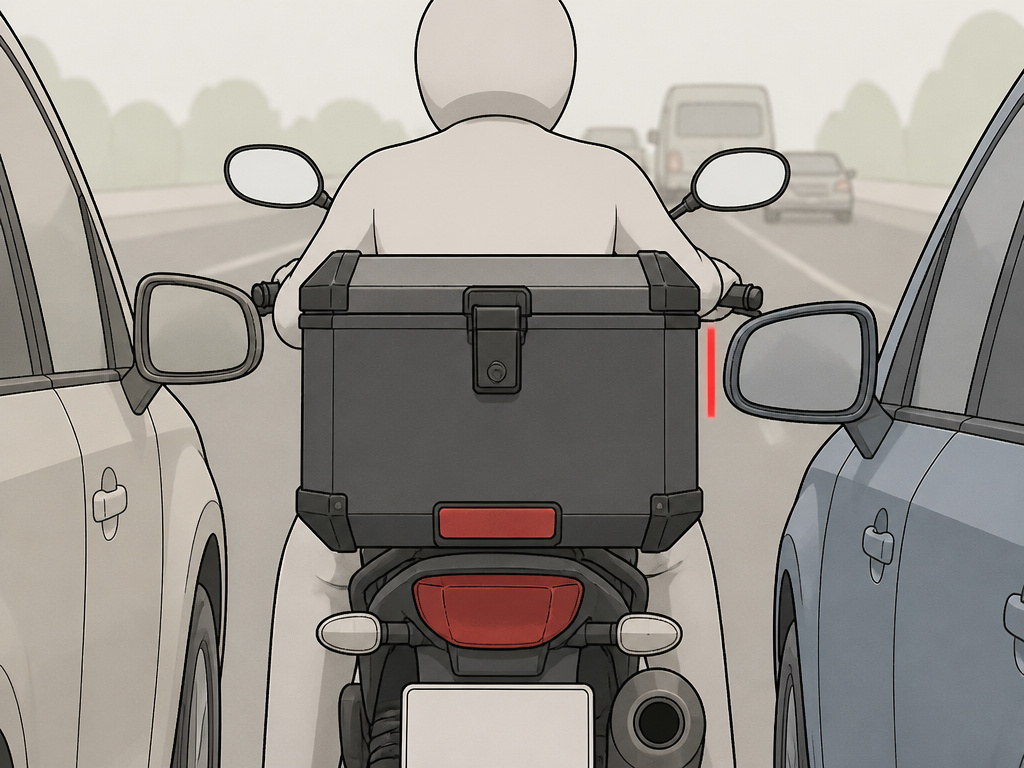
A top case adds inches to your bike’s width at the worst possible spot—at handlebar or mirror height. In places where lane splitting or filtering is legal, that extra width matters. A 28L case might be fine; a 49L case could be the difference between clearing a mirror and taking it off.
Parking gets harder in tight garages or crowded bike bays. You can’t squeeze the bike as close to a wall or another motorcycle. That rearward width is always there, turning simple maneuvers into multi-point backups.
Then there’s the look. Critics call it the “pizza delivery” or “tour bus” effect. Aesthetics are subjective, but a large top case fundamentally changes a motorcycle’s profile from sleek to utilitarian. For some riders, that’s a deal-breaker. For others, the pure function outweighs the form. There’s no right answer, but you should know the box changes how the bike is perceived.
Material Choices and Known Failure Points
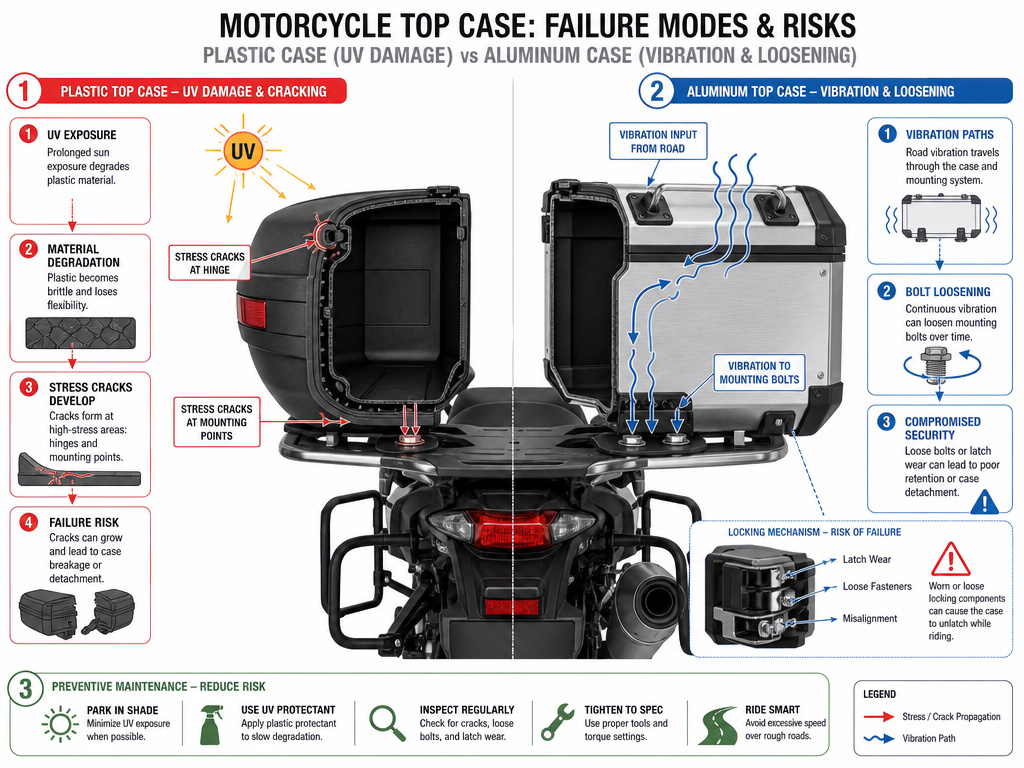
Top cases come in two main materials: molded plastic (ABS, polypropylene) and aluminum. Your choice dictates how it fails.
Plastic cases are lighter and cheaper. They’re also prone to stress cracking, especially at the mounting points where the base meets the lid hinge. Plastic cases can be prone to stress cracking at mounting points, especially under hard use on rough roads. Plastic can also fade and become brittle with UV exposure over years.
Aluminum cases, like those from Touratech or Givi’s Trekker line, are vastly more durable against impacts and crushing. The trade-off is weight, cost, and vibration. Aluminum transmits every shock directly into the mounting rack, which can loosen fasteners over time. You’ll need to check those bolts more often.
The locking mechanism is a universal weak point. The recall for the BMW Vario Top Case (Part No. 77 43 9 443 542) is a perfect example. BMW states the locking flap may appear closed but allow key removal, potentially causing detachment. That’s an engineered part failing in a specific, dangerous way.
The fix was a warranty replacement. The lesson: mechanisms are precise. Don’t modify or lubricate them unless the manual explicitly says to.
Installation and Compatibility: More Than Just Bolting It On
Putting on a top case isn’t just about the case. You need a rack, a mounting plate, and often a specific adapter kit for your bike model. Skipping this research leaves you with a expensive box you can’t use.
The installation torque matters. Harley-Davidson specifies 9.5–11 N·m (7.0–8.1 ft-lbs) for the top plate flat nuts and 5.4–6.6 N·m (48–58 in-lbs) for the latch screws. Over-tightening strips threads in the plastic base; under-tightening lets the plate shift and wear out. Use a torque wrench.
Compatibility is a minefield. Kawasaki explicitly states its 47L Top Case is not compatible with panniers on the Ninja 1000 SX. Other large cases can block side case lids from opening. You must check your specific motorcycle model and existing luggage before buying.
The quick-release systems on brands like Givi (Monokey/Monolock) and Shad are brilliant for taking the case with you. But they add another set of moving parts and potential wear points. The mechanism needs to be kept clean and occasionally checked for play.
Pros and Cons vs. Side Cases (Panniers)
This is the core luggage decision when evaluating motorcycle top case pros and cons. A top case is a single, high-volume box mounted centrally. Panniers are two lower-profile cases mounted on either side of the rear wheel.
Top Case Pros:
- Easier to pack and access (one lid vs. Two).
- Can often hold a full-face helmet.
- Provides a passenger backrest.
- Usually easier to remove and carry.
Top Case Cons:
- Raises center of gravity.
- Can hurt handling and wind stability.
- Adds significant rear-end width.
- Stresses the rear subframe directly.
Pannier Pros:
- Keep weight low and centered, aiding stability.
- Slimmer profile aids lane splitting.
- Distribute weight across a wider area of the frame.
- Often have a lower combined volume but better weight distribution.
Pannier Cons:
- Require dismounting to access both sides.
- Can be tricky to pack evenly.
- Increase overall bike width significantly at the rear axle.
For touring, some riders prefer panniers or soft luggage to keep weight lower and more centered. For daily commuting and errands, the top case’s convenience is hard to beat. Many riders end up with both, using the top case for daily items and adding panniers for multi-day trips.
Hard vs. Soft Luggage Context
Choosing between a hard top case and soft luggage is about more than just looks. A hard case offers security and weather protection but comes with a rigid structure that adds weight high up on the bike, which can affect handling. Manufacturers have issued recalls for specific hard cases where a locking flaw could allow the case to detach, highlighting that a secure mount is critical. Soft bags are generally lighter and more flexible, but they lack the same lockable security. In some cases, a manufacturer’s compensation for a recalled hard case system could even be applied toward substitute items like soft bags, presenting a practical alternative.
Frequently Asked Questions
Does a top case affect motorcycle handling?
Yes, significantly. It moves weight up and behind the rear axle, raising the center of gravity. This can slow steering initiation, increase low-speed wobble, and make the bike more susceptible to crosswinds. The effect is proportional to the weight you load.
What is the best motorcycle top case?
There is no single “best.” For urban commuting, a streamlined 30-40L plastic case like a Givi V or Shad SH is ideal. For adventure touring, a durable aluminum case like a Touratech Zega or Givi Trekker holds up to rough roads. The best case is the one that fits your bike, your load needs, and your budget. Our guide to the best motorcycle luggage compares top picks.
Can a top case break off?
Yes. Failures can occur from defective latches (as seen in the recall for the BMW Vario Top Case), from overloading the rack, or from material fatigue. Always use the case within its rated weight limit, ensure it’s securely latched before riding, and periodically inspect the mounting hardware for tightness.
How much weight can a motorcycle top case hold?
It depends entirely on your motorcycle’s rack and subframe, not the case. Common limits range from 11 lbs (5 kg) to 22 lbs (10 kg). Always consult your motorcycle’s owner’s manual or the luggage manufacturer’s fitment chart for the exact limit for your model. Never guess.
Are top cases waterproof?
Most factory-designed hard cases are water-resistant, not waterproof. They use a rubber gasket on the lid that can degrade over time. Aftermarket cases from brands like Givi often have better sealing. For critical items, always use an internal dry bag or waterproof liner, especially in heavy, prolonged rain.
The Bottom Line
A top case is a tool, not an accessory. Its job is to carry stuff securely. If your riding is mostly short trips, commuting, and errands, the convenience outweighs the handling penalty. Buy a case that meets the manufacturer’s specifications, install it correctly, and never exceed its weight limit.
If you prioritize canyon carving or long-distance touring comfort, that high, rearward weight is a constant compromise. Your money and luggage capacity are better spent on a set of low-mounted panniers or a robust soft luggage system that keeps the mass centered.
One final rule: before any trip with a loaded case, take a five-minute ride on a familiar road. Feel how the bike transitions, brakes, and handles bumps. That real-world test tells you more about your load than any spec sheet ever will.
