
Spoked vs Cast Motorcycle Wheels: Which Is Right for You?
This post contains affiliate links. As an Amazon Associate, we earn from qualifying purchases.
In the spoked vs cast motorcycle wheels debate, spoked wheels win for off-road and adventure riding because they flex on impact and can be field-repaired, while cast wheels win for on-road use due to lower maintenance, easier cleaning, and better compatibility with tubeless tires. The choice isn’t about which is universally stronger, but which fails more gracefully under the impacts your riding style actually delivers.
That distinction is central to the spoked vs cast motorcycle wheels debate, where most online advice gets hazy. A lab test can show one type holding more weight, but a rock on a trail tells a different story about how the wheel absorbs a sudden, localized shock. This guide walks through the numbers, the maintenance realities, and the riding scenarios where the textbook answer flips.
What follows: the physics of a hit, the maintenance you actually sign up for, the tubeless tire question, and a final table that matches wheel type to your garage and your map.
Key Takeaways
- Spoked wheels for off-road and adventure motorcycles typically use extruded aluminum rims (6061/7005-series), per Cycle World; cast wheels use a more brittle alloy that can crack and fail catastrophically from the same hit.
- You must check spoke tension periodically, a loose spoke sounds like a dull ping when tapped with a wrench, and ignoring it leads to a wobbly wheel.
- The QC/T 818-2009 industry standard requires spoked wheels to survive over 500,000 revolutions in a radial load fatigue test, proving their engineered durability isn’t just tradition.
- For pure street riding, cast wheels are the default; the maintenance savings and tubeless convenience outweigh the remote chance of an impact severe enough to crack them.
- Tubeless conversions for spoked wheels exist but require sealed rims and special spoke nipples, a significant cost over standard laced wheels.
The Physics of Failure: Impact Resistance Explained
Hit a sharp rock at speed. The sound is a hollow clang you feel in your hands. With a spoked wheel, you might ride away with a dent. With a cast wheel, that same impact can spider-web into a crack that leaks air instantly.
How Spoked Wheels Distribute Load: Under a sharp, localized impact, the tension from numerous spokes (each under up to 1,500 pounds of force, per Buchanan’s Spoke and Rim) pulls the deformed section of the rim back toward round. The load transfers around the wheel’s circumference, engaging dozens of spokes to absorb the shock.
This is the core engineering argument from sources like Cycle World. A spoked wheel is a tensioned system. A cast wheel is a monolithic structure. The cast wheel’s material is less malleable. When force concentrates on a small area, like directly over one of the wheel’s own cast spokes, there’s no give. It either holds or it fractures.
Where the Lab Data and Real-World Experience Diverge
A published mechanical study from Universitas Syiah Kuala presents a counterpoint. It found cast wheel rims could withstand a higher static compressive load (3 tonnes) than spoked wheel rims (2 tonnes). The study also recorded a higher average hardness for the spoke wheel rim (HRB 99.3) versus the cast wheel (HRB 76.5).
| Test Metric | Spoked Wheel Rim | Cast Wheel Rim | What It Means for Riding |
|---|---|---|---|
| Average Hardness (HRB) | 99.3 | 76.5 | The spoked rim’s extruded aluminum is harder, but hardness doesn’t equal impact toughness. |
| Compressive Load to Failure | 2 tonnes (20,000 N) | 3 tonnes (30,000 N) | In a slow, even press, the cast wheel supports more weight. This is a static load test. |
| Ultimate Tensile Stress | 66.04 MPa | 45.84 MPa | The spoked rim material can withstand more tensile stress before breaking. |
| Likely Failure Mode from Sharp Impact | Dent, bend | Crack, fracture | This is the rider’s reality, according to ADVMoto Magazine, though Honda notes that in regions with rough roads, many riders prefer cast wheels due to concerns about more frequent spoke inspections. |
The takeaway from the spoked vs cast motorcycle wheels data isn’t that one study is wrong. It’s that static load capacity and dynamic impact resistance are different engineering problems. For the rider, the dynamic result matters more. A bent rim can often be straightened, or at least gets you home. A cracked rim is a ride-ender.
The Maintenance Reality Check
Cast wheels are easier to clean. That’s the commodity answer. The real maintenance gap is in inspection and correction.
A cast wheel needs a visual check for cracks, especially after a hard hit. Run your fingers along the rim edge and spokes, feeling for irregularities. A hairline crack might show up as a faint line. If you find one, the wheel is done.
A spoked wheel needs a tactile and auditory check. Here’s the basic sequence you won’t find in most manuals:
- Tap Test: Lightly tap each spoke nipple with a box-end wrench or screwdriver. A properly tensioned spoke makes a bright, high-pitched ping. A loose spoke sounds dull and flat.
- Squeeze Test: Grip parallel pairs of spokes and squeeze. They should have similar, firm resistance. A noticeably looser pair flags a problem.
- Visual Check: Look for spokes that appear slack or sit at a different angle than their neighbors.
Common mistake: Assuming all spokes should be “tight.” Spokes need even, high tension. One overly loose spoke shifts load to its neighbors, starting a cycle of fatigue and failure that leads to a wobbly wheel.
Honda’s global aftersales guide explicitly notes that in regions with many rough roads, many riders prefer cast wheels due to concerns about more frequent spoke inspections. This is a practical, not technical, preference. If you won’t do the five-minute tap test every few rides, the spoked wheel’s theoretical advantage is null. For a detailed guide on keeping either type presentable, see our article on how to clean motorcycle wheels.
Tubeless vs. Tubed: The Convenience Trade-Off
This is the single biggest practical advantage for cast wheels. They are inherently airtight, designed from the start for tubeless tires.
The benefits are real: fewer punctures cause immediate deflation, and roadside repairs are often as simple as plugging the hole. The seal between tire bead and machined rim channel is reliable.
Traditional spoked wheels are not airtight. The spoke nipples thread into dimpled holes in the rim, leaving dozens of potential leak paths. They require an inner tube. A puncture usually means a flat tire, and repairing it involves breaking the tire bead to access and patch the tube, a messier job trailside.
The Modern Exception: Tubeless Spoked Systems
Systems like those from Alpina or sealed rims from Excel exist. They use a special rim profile with a channel, sealed spoke nipples, and often a rim band or internal sealant. They work, but they add cost and complexity. They’re also not field-serviceable in the same way, a damaged sealed nipple requires disassembling the wheel.
For most riders weighing this choice, the question is simple: Is the off-road impact resilience of spokes worth the hassle of tubes? For adventure riders going remote, the answer is often yes. For street riders, the convenience of tubeless tips the scale toward cast. Understand the full debate in our comparison of tubeless vs tube tires.
Weight, Cost, and the “But It Looks Cool” Factor

We can separate the measurable from the subjective.
Weight: The claim that cast wheels are always lighter is a half-truth. ADVMoto Magazine notes they can be somewhat lighter. A simple, thin-spoked cast wheel on a sportbike often is. A heavy-duty spoked wheel with a thick Excel rim and brass nipples is not. The difference for most bikes is a pound or two per wheel, noticeable on a track, irrelevant on a dirt road.
Cost:
- Manufacturing: Cast wheels are cheaper to produce at scale. That’s why they’re the default on budget street bikes.
- Repair: This is where the equation flips. A bent spoked rim can often be straightened for a fraction of the cost of a new wheel. A cracked cast wheel is a replacement-only item. A new OEM cast wheel can be a significant expense, not including the tire mount and balance.
- Aftermarket: The world of custom aftermarket wheels is vast for both types. Premium forged aluminum or billet fat spoke wheels for Harley command high prices for style and performance.
Aesthetics: This isn’t trivial. Spoked wheels have a classic, mechanical honesty many riders love. Cast wheels offer a modern, clean look that’s easier to keep shiny. If you value a showroom finish, a cast wheel polished with a dedicated aluminum polishing routine will gleam with less effort than cleaning 36 individual spokes.
Matching the Wheel to Your Riding
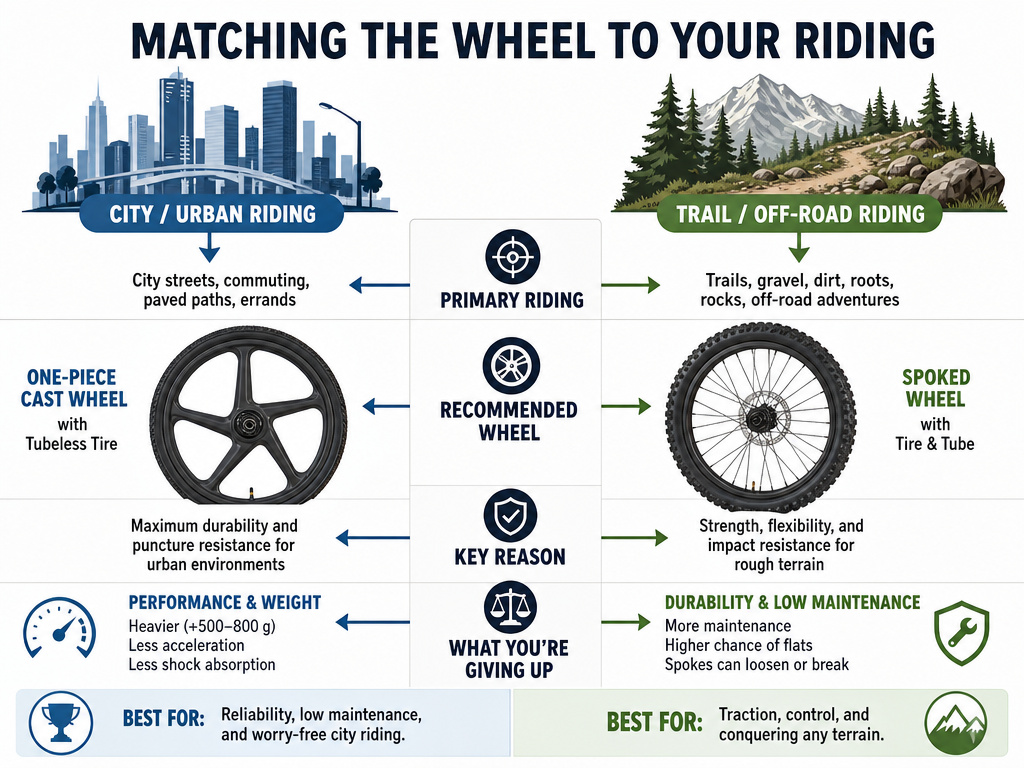
The final decision isn’t about a spec sheet. It’s about your garage, your local roads, and your honesty about maintenance.
| Your Primary Riding | Recommended Wheel Type | Key Reason | What You’re Giving Up |
|---|---|---|---|
| Street & Commuting | Cast | Minimal maintenance, tubeless tire convenience, easier cleaning. | Off-road impact resilience; field repairability. |
| Adventure / Dual-Sport | Spoked | Ability to absorb rock hits and be repaired or straightened in the field. | Tubeless convenience; the 5-minute spoke check ritual. |
| Off-Road / Motocross | Spoked (heavily built) | Maximum impact resistance; uses heavy-duty rims and thicker spokes. | Light weight; any pretense of being a low-maintenance part. |
| Cruiser / Classic | Your choice | Authenticity often calls for spoked wheels; modern performance may favor cast. | Spokes: cleaning time. Cast: may clash with the bike’s style. |
If you’re building a bike for looks or performance, the best aftermarket wheels come in both flavors. Just remember that any new wheel, spoked or cast, will need proper balancing. A good motorcycle wheel balancer is a wise investment for anyone mounting tires at home.
Rigidity vs. Flex (handling characteristics)
A cast wheel is a highly rigid, single piece. This stiffness translates directly to the bike, providing a precise and stable feel during aggressive cornering on smooth pavement. A spoked wheel, in contrast, is a tensioned system. Under a hard impact, it will flex a bit. This controlled give is a key handling trait off-road, allowing the wheel to absorb sharp hits from rocks or potholes without transmitting a jarring shock to the rider. The trade-off is that this same flex can introduce a slight sensation of vagueness during high-speed, on-road maneuvers compared to the unwavering solidity of a cast wheel.
Frequently Asked Questions
Are spoked wheels better than cast?
For off-road and adventure riding, yes, because they’re more likely to dent than crack from an impact, and a dent can often be repaired. For on-road riding, cast wheels are generally better due to easier maintenance and tubeless tire compatibility. “Better” depends entirely on the type of abuse the wheel will see.
What are the downsides of spoked wheels?
They require periodic tension checks, are harder to clean, and traditionally require inner tubes (which complicate puncture repairs). Ignoring spoke maintenance is the fastest way to cause a wobbly, unsafe wheel.
What is the benefit of having spoked wheels on a motorcycle?
The main benefit is impact resistance and repairability. The tensioned spoke system allows the wheel to flex and absorb sharp hits that could crack a solid cast wheel. This makes them the preferred choice for any riding that involves unpaved or rough roads.
Why do adventure bikes use spoke wheels?
Adventure bikes are built for terrain where hitting rocks, potholes, and ledges is expected. Spoked wheels provide a margin of safety and practicality that cast wheels cannot match in those conditions, they are the component least likely to leave you stranded after a hard impact.
How often should I check my spoke tension?
Check spoke tension periodically. For off-road or adventure use, frequent inspection is critical.
Before You Go
One rule cuts through the noise: if your riding includes impacts sharp enough to crack a cast wheel, you already know you need spokes. If you’re questioning it, you’re probably a street rider, and cast wheels are the right, low-hassle choice.
The data shows a cast wheel can hold more weight in a slow press. Your tire meeting a granite ledge at 30 mph is not a slow press. That’s where the spoked wheel’s ability to transfer load and dent, not shatter, pays for itself. Choose for the hit you expect, not the test you read about. And whatever you pick, check the tension or check for cracks. That part’s not optional.
