
Motorcycle Paddock Stand vs Center Stand: Key Differences
This post contains affiliate links. As an Amazon Associate, we earn from qualifying purchases.
A motorcycle center stand lifts the bike at its center of gravity, suspending both wheels for stable storage and full access. A paddock stand lifts only the front or rear wheel via the fork or swingarm, ideal for wheel-specific maintenance. For most riders who work on their own bikes, a paddock stand is the essential first purchase—but a center stand is the single best tool for long-term winter storage.
The 300 kg max load of a ConStands Power Evo and its 17 kg weight including castors aren’t just specs. They define which jobs each stand can actually handle without turning a simple oil change into a tipping hazard, a key consideration in the motorcycle paddock stand vs center stand choice. The wrong stand choice complicates every task you’ll ever do in your garage.
What follows: the mechanical difference that decides stability, a step-by-step safety guide most riders skip, the specific bike features that block a stand from fitting, and the one rule for preventing flat spots over the winter. By the end, you’ll know whether to buy one, the other, or both.
Key Takeaways
- A center stand lifts both wheels, making it stable for storage and full-bike work, but it adds permanent weight and can reduce ground clearance.
- Paddock stands lift one wheel, exposing the chain, sprocket, or fork for maintenance, but they require a level surface and careful balancing.
- The 5–15 cm wheel ground clearance on a center stand like the ConStands Power Evo is the critical spec for clearing the ground on lowered or standard bikes.
- Model-specific compatibility is essential; a stand for a Ducati Multistrada V4, for example, often will not fit models with a quickshifter or crash bars.
- For long-term winter storage, a center stand is superior because it unloads both tires and the suspension, preventing flat spots and seal dry-out.
The Core Mechanical Difference (and Why It Matters)
This isn’t about two ways to lift a bike. It’s about two different points of contact with the motorcycle’s structure, and each point dictates what you can and cannot do safely.
A center stand, like the ConStands Power Evo, uses the bike’s own frame or a dedicated mounting point near the center of gravity. You lever the bike onto it, and the stand’s arms cradle the machine. Both wheels come off the ground. A paddock stand contacts the bike at its extremities—either the swingarm spools or the fork tubes—lifting only one end at a time.
A center stand supports the motorcycle at or near its center of mass, providing a stable, four-point base that resists tipping. A paddock stand supports one axle, creating a pivot point that requires the bike to be kept upright and balanced during the lift.
The stability difference is physical, not theoretical. With both wheels up on a center stand, you can push the bike sideways on its castors. You can remove both wheels. You can walk away for a month. A bike on a rear paddock stand is a balanced equation; bump the handlebars wrong and the equation tips over. That’s the part most guides mention but don’t quantify.
It means the stand’s steel tubing and locking mechanisms are rated for that stress. A 200 kg adventure bike on a center stand is well within spec. That same bike on a single-sided paddock stand concentrates all that weight on two small swingarm spools. The stand might hold, but the spool mounts on your swingarm become the weak link. That’s a calculation your bike’s manufacturer didn’t make.
Step-by-Step Safety Guide for Each Stand
You can own the best stand made and still drop your bike. The drop happens in the first and last three inches of travel. Here is how to avoid it.
Using a Center Stand (ConStands Power Evo/Classic)
- Position the stand directly under the mounting points. For model-specific stands like the ConStands Power Classic for a Yamaha MT-10, this means aligning the stand’s arms with the bike’s built-in plates or bobbins. The stand should sit flat; rock it to check.
- Engage the stand’s lever and lift with your legs, not your back. The angled lever arm on the Power Evo is designed to reduce jamming. Pull straight up and back until you feel the bike’s weight transfer onto the stand. You’ll hear a solid thunk when both legs are fully engaged.
- Lock the height adjustment. The Power Evo features a self-locking mechanism. Double-check it. On the Power Classic, you manually secure the lock. Skip this, and the stand can collapse under vibration.
- Test stability before letting go. Gently rock the bike side-to-side. It should feel planted. If it wobbles, the stand isn’t fully seated or the ground is uneven. Lower it and reposition.
Where this goes sideways: Lifting on uneven garage flooring. A center stand needs a level surface. A slope of just a few degrees can cause the stand to skid as you apply leverage, dropping the bike onto its side.
Using a Paddock Stand
- Position the stand’s arms under the swingarm spools or fork tubes. For spool-type stands, ensure the hooks fully cup the spools. For fork-lift stands, use adapters with thick rubber coating to prevent marring.
- Hold the bike perfectly upright with one hand on the handlebars. Your other hand operates the stand. The bike must be vertical. If it leans, the stand arms will miss their target.
- Lift smoothly and slowly. Use the stand’s handle to raise the bike. Watch the contact points. The moment the wheel leaves the ground, stop and re-check everything.
- Never work on a bike supported only by a front paddock stand. The rear wheel must be chocked or on the ground. A bike on a front stand alone is a seesaw waiting to happen.
The part nobody mentions: The bike will settle. After you lift it, the suspension will compress slightly and the stand’s feet may shift a millimeter as they take full weight. Wait ten seconds after lifting, then re-check the stability. That initial settle is when most near-misses happen.
Which Stand for Which Job? A Task Comparison
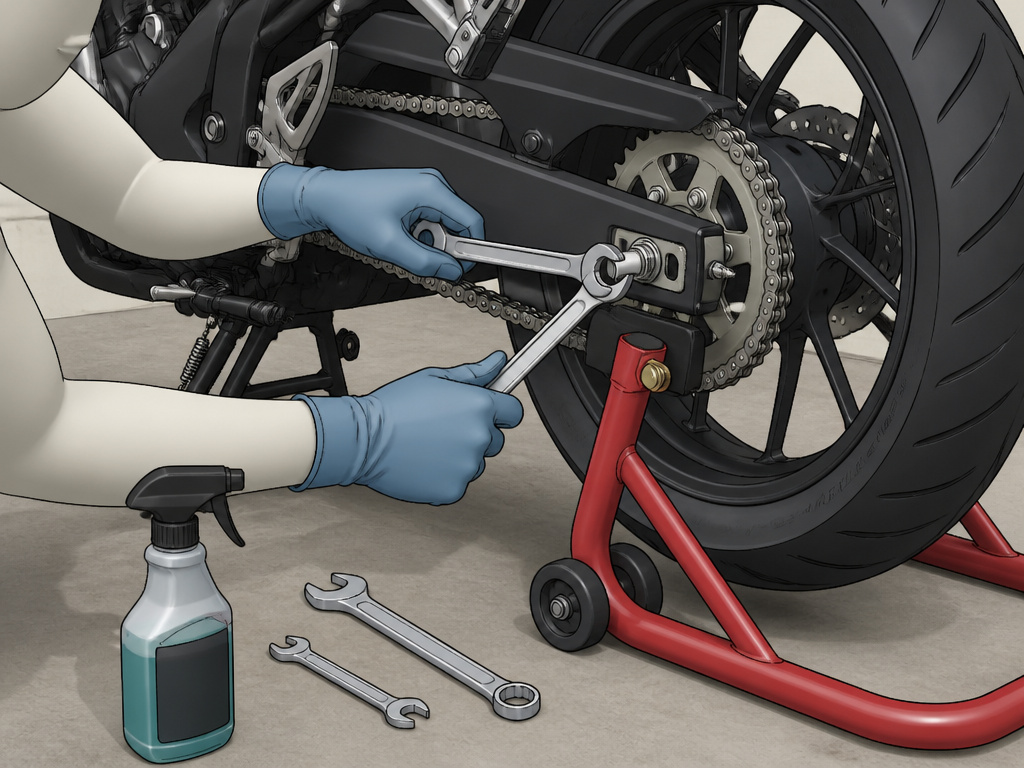
Your project list decides which stand you need. This table breaks down which tool enables which job without creating extra steps or danger.
| Maintenance Task | Center Stand | Rear Paddock Stand | Why the Difference |
|---|---|---|---|
| Chain Cleaning & Adjustment | Possible, but rear wheel is loaded | Ideal – wheel spins freely | A center stand keeps the rear suspension loaded, changing alignment. A paddock stand unloads it for accurate adjustment. |
| Wheel Removal (Rear) | Excellent – stable, both wheels up | Excellent – easy axle access | Both work well. The center stand wins if you need to remove both wheels at once. |
| Wheel Removal (Front) | Excellent – stable, both wheels up | Requires a separate front stand | A center stand does this alone. For paddock stands, you need a second stand type. |
| Long-Term Storage (Winter) | Superior – unloads both tires & suspension | Acceptable, but front tire remains loaded | A center stand prevents tire flat spots on both wheels and keeps suspension components from being compressed. |
| Oil Change / Fluid Service | Superior – bike is level and stable | Risky – bike is tilted | A level bike ensures accurate oil level checks. A bike on a rear stand tilts forward. |
| Brake Service | Good for system bleeding | Better for caliper removal | The elevated wheel on a paddock stand gives clearer access to caliper bolts and pads. |
For the rider who does their own basic maintenance and is weighing a motorcycle paddock stand vs center stand, the rear paddock stand is the workhorse. It’s the fastest way to get the rear wheel up for chain care, which is the most frequent job. But if you park your bike for months, the calculus flips. The center stand’s ability to get both tires off the ground is the only right answer for storage.
The Hidden Deal-Breakers: Compatibility and Fit
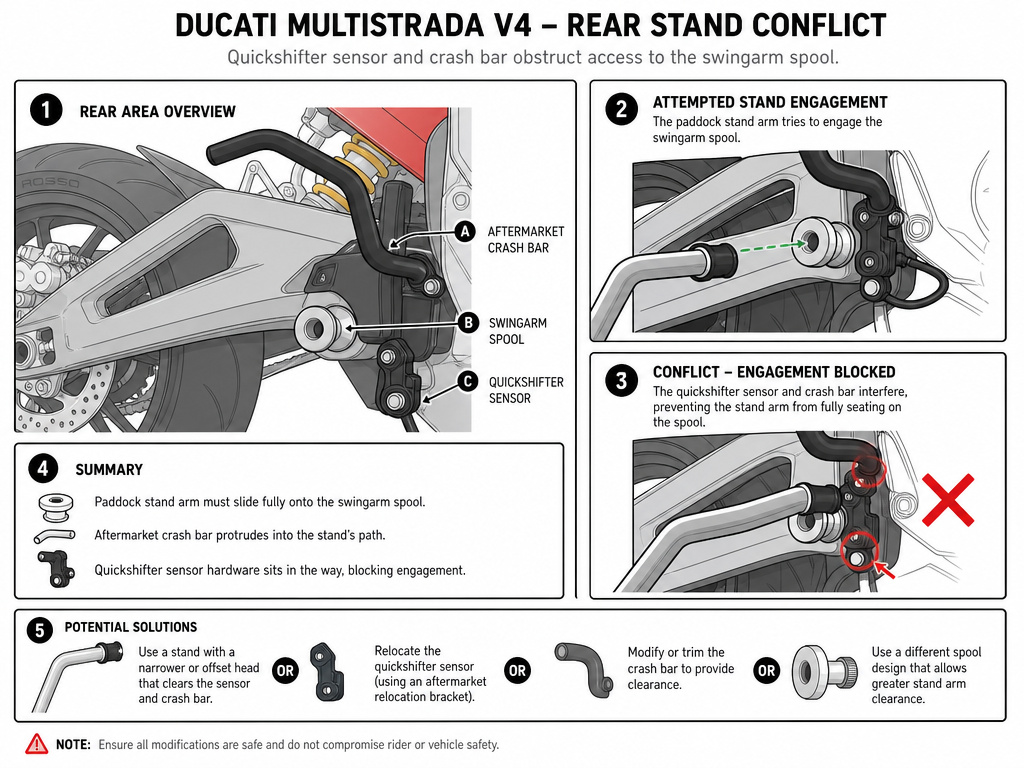
You cannot assume a stand will fit your bike. The product listings for model-specific stands like the ConStands Power Classic are a masterclass in fine print that matters.
Consider the Ducati Multistrada V4. The ConStands Power Evo for this model has a glaring restriction: it is only suitable for models without a quickshifter. It also excludes the V4 S and Pikes Peak variants. Why? The stand’s mounting hardware likely interferes with the quickshifter’s sensor or linkage. Crash bars or modified footrests can also prevent the stand from engaging properly.
Common mistake: Buying a universal stand without checking swingarm access. The ConStands Center Pro, for example, is designed for models with “freely accessible swingarm mounting.” If your bike has bulky exhaust headers, rear cowls, or luggage mounts in the way, a universal stand is useless.
Here is a quick checklist before you buy any stand:
- Check the model year range. The ConStands Power Classic for the Honda CB 125 R lists compatibility for model years 18–25, though there is a note that the included adapter plate is for model years 18–24. That one-year gap could leave you with un-mountable hardware.
- Identify your bike’s mounting points. Does it have swingarm spools? If not, you need a stand with adjustable arms or fork adapters.
- Account for aftermarket parts. The manufacturer warnings are clear: the Power Evo is designed for the original footrest system. Aftermarket rearsets, crash bars, or exhaust systems can completely block the stand’s arms.
This level of specificity is why a generic “one-size-fits-most” stand is often a waste of money. The right stand is a precision tool for your specific machine.
Center Stand vs Paddock Stand: The Garage Reality
Moving past theory. In a real garage, with limited space and a finite budget, which stand makes sense?
The Case for a Paddock Stand:
It’s the specialist. For the rider who commutes and does weekend chain maintenance, a rear stand is all you need. It stores easily against a wall (the ConStands Power Classic folds to 78 × 54 × 17.5 cm). It gets the job done in seconds. If you need to work on the front end, you can add a front stand later. For sportbike and naked bike owners, this is the default path. The learning curve is about five minutes.
The Case for a Center Stand:
It’s the multi-tool. For the adventure rider, tourer, or anyone in a climate with a real winter, a center stand is a quality-of-life upgrade. It allows you to park the bike upright in a tight garage. It enables tire changes on the road (with the included 1/2 inch mounting bolts for the Center Pro, you could theoretically secure it elsewhere). Most importantly, it’s the correct tool for hibernation. The manufacturer states these stands are “ideally suited for overwintering.” They relieve pressure on tires and suspension—something a paddock stand can only do for one end.
What about owning both?
This is the professional setup, and it’s not overkill for an avid home mechanic. Use the center stand for storage, oil changes, and washing. Use the paddock stand for chain and brake work. They complement each other. The combined cost is significant, but so is the capability.
Long-Term Storage: The Stand That Beats Flat Spots
Leaving a bike sitting for months damages it. Tires develop flat spots. Suspension seals can dry out in a compressed state. This is where the center stand proves its value beyond mere convenience.
A bike on a center stand has its suspension fully extended and its tires off the ground. No weight, no flat spots. A bike on a rear paddock stand still has the front tire loaded and the fork compressed. Over a full winter, that difference can mean the difference between fresh tires and a new pair.
The ConStands Power Evo provides 5–15 cm of wheel ground clearance, which is enough for most street tires to hang free. For long-term parking, that’s the spec that matters more than anything else. If you store your bike, a center stand isn’t an accessory. It’s insurance.
Cost comparison (center stand often more expensive)
In general, a dedicated center stand tends to be a more expensive investment than a basic paddock stand. This is due to its more complex engineering, heavier construction, and model-specific design requirements. While the initial cost is higher, a center stand offers unique benefits for long-term storage and complete maintenance that a single paddock stand cannot. Consider your primary use case; if you need stable, two-wheel-off-the-ground support for winter storage or major repairs, the center stand’s cost may be justified.
Lifting front wheel (methods with each stand)
Lifting the front wheel requires different approaches depending on your stand type. With a center stand, the entire motorcycle is already elevated with both wheels off the ground, providing direct access to the front end for tasks like fork service. To lift only the front wheel, you would typically need a separate front wheel stand or a specialized adapter that interfaces with the bike’s steering stem or fork tubes. A standard rear paddock stand leaves the front wheel on the ground. To lift the front, you must use a dedicated front paddock stand, often with pins or cups that fit under the fork legs or a head-lift style that engages the steering head. Always ensure any front stand is compatible with your motorcycle’s specific fork design.
Brand/model recommendations (e.g., Pit Bull, ABBA)
Choosing a stand requires matching it precisely to your motorcycle’s make, model, and year. For instance, ConStands offers model-specific options like the Power Classic for a Honda CB 125 R (model years 18–25), a Yamaha MT-10 (16–25), or a Ducati Multistrada 1260 (18–20). Their Power Evo model is designed for the original footrest system and may not work with aftermarket footrests; for specific models like the Ducati Multistrada V4, crash bars can also prevent stand use. Always verify compatibility details, as some stands are only suitable for specific variants; a ConStands Power Evo for a Ducati Multistrada V4, for example, is not suitable for the V4 S or Pikes Peak models. The right stand ensures safe lifting and prevents damage to your bike.
Frequently Asked Questions
Is a motorcycle center stand worth it?
For riders who store their bikes over winter or who frequently need to work on both wheels, yes, a center stand is absolutely worth the investment. It provides unmatched stability for storage and full-bike access for maintenance. For a rider who only performs chain maintenance, a paddock stand is sufficient.
Is it okay to leave a motorcycle on a paddock stand?
Yes, it is generally safe to leave a motorcycle on a paddock stand for extended periods, provided the stand is on a level surface and correctly positioned. However, for true long-term storage (months), a center stand is better as it unloads both tires and the suspension, preventing flat spots and seal compression.
When should you use a motorcycle center stand?
Use a center stand whenever you need the bike level and rock-solid stable: for oil changes, washing, detailing, long-term storage, or when removing both wheels. It’s also ideal for parking in a tight garage space, as it takes up less room than a bike on its side stand.
What is the 12-second rule on a motorcycle?
This isn’t a widely recognized rule for stand use. It may be a misunderstanding of a safety check. A practice is to wait 10-15 seconds after lifting a bike on any stand to let the suspension settle and the stand feet find their final position, then re-check stability before walking away.
The Bottom Line
Your first stand should match your most frequent task in the motorcycle paddock stand vs center stand decision. If that’s chain care, buy a paddock stand. If that’s winter storage or full-service projects, buy a center stand.
But here’s the garage truth most riders learn too late: the best setup is both. Use the center stand for parking and storage—its 300 kg capacity and castors make it a mobile garage lift. Use the paddock stand for quick, focused repairs. Trying to make one stand do every job is how you spend more time stabilizing the bike than working on it.
Skip universal stands unless your bike has perfectly accessible, standard swingarms. The model-specific fit of a ConStands Power Classic or the features of a Power Evo are worth the extra search. Fit beats price tag every time, because a stand that almost fits is a bike that definitely falls.
