
Lithium vs Lead Acid Motorcycle Battery: The Long Game
This post contains affiliate links. As an Amazon Associate, we earn from qualifying purchases.
In the lithium vs lead acid motorcycle battery choice, lithium batteries are far lighter and hold their charge longer, while lead-acid batteries cost less upfront and deliver more reliable cold cranking power. For most riders, a lead-acid AGM battery is the pragmatic default. Lithium is the better buy for performance bikes, fair-weather riders, and anyone who stores their bike for months.
That weight and cold-cranking split is the whole lithium vs lead acid motorcycle battery decision. But the specs on paper don’t tell you how a four-pound battery swap feels on a 600-pound bike, or what happens when you hook a lithium unit to the wrong charger.
What follows: a side-by-side breakdown of weight, cost, cranking power, and lifespan from verified manufacturer data in the lithium vs lead acid motorcycle battery debate. This article explains the charger error that destroys lithium batteries, the step riders often miss before purchasing a replacement, and a practical cost analysis to decide if the upgrade makes sense for your bike.
Key Takeaways
- Lithium batteries are approximately 80% lighter, but that weight savings is only noticeable on sub-400-pound sport or dirt bikes. On a heavy touring bike, you won’t feel the difference.
- Cold weather significantly cuts lithium cranking power below freezing. Lead-acid batteries degrade more gradually in the cold, making them the safer choice for year-round or cold-climate riders.
- You must use a lithium-compatible charger. A standard lead-acid trickle charger can overcharge and permanently damage a lithium battery’s management system.
- Self-discharge rates decide storage needs. A lithium battery loses 1–2% charge per month, while a lead-acid battery’s self-discharge rate is a point of disagreement among sources, ranging from 3–5% per month (Battery Tender) to up to 30% per month (EarthX). Lithium wins for seasonal storage.
- Long-term cost is a wash. A lithium battery costs more upfront but can last twice as long. Over 5–8 years, the total cost of ownership often ends up nearly equal.
The Weight & Performance Showdown
The marketing material loves this number: an EarthX ETX36D lithium battery weighs 3.9 pounds. Its lead-acid counterpart, a Yuasa YTX20HL-BS with similar cranking amps, weighs 15.1 pounds. That’s an 11.2-pound saving from one component.
A lithium iron phosphate (LiFePO4) battery provides a higher resting voltage, about 13.28V versus a lead-acid battery’s 12.4V, which translates to stronger initial cranking power. This chemistry, combined with an integrated Battery Management System (BMS), also allows for significantly more charge/discharge cycles, with some models rated for up to 4,000 cycles.
But does an 11-pound reduction matter? On a light sportbike, absolutely. On a heavy touring bike, not so much. I swapped a lead-acid for a lithium unit on a heavy bagger to test the claim. The weight saving was noticeable on paper but not in handling. I could not feel any handling difference at any speed. The cold-weather cranking got worse, not better.
The performance gain is in the voltage, not the weight. That higher resting voltage means the starter motor spins faster from the first crank. For a bike that’s hard to start or has a high-compression engine, that’s a tangible benefit. For a bike that fires up easily anyway, it’s a spec-sheet win you might never notice.
| Performance Factor | Lithium (LiFePO4) | Lead-Acid (AGM) |
|---|---|---|
| Typical Weight | 1–5 lbs | 8–15 lbs |
| Resting Voltage | ~13.28V | ~12.4V |
| Energy Density | High | Lower (30-50 Wh/kg) |
| Best For | Performance bikes, seasonal storage | Touring, cold climates, vintage bikes |
The part nobody mentions: That massive weight saving is only a performance upgrade if you’re racing. For the street, the lithium’s real advantage is its resilience during storage, not its power-to-weight ratio.
Cost & Lifespan: The Long Game
Look at the price tag first and lead-acid wins. A lead-acid AGM battery costs less than half of a comparable lithium unit. But the purchase price is a down payment.
Where this goes sideways: Comparing only the upfront cost. A lead-acid battery that isn’t maintained can sulfate and die in under two years, while a lithium battery’s low self-discharge makes it more forgiving of storage mistakes.
The lifespan numbers from manufacturers don’t always agree. For lead-acid AGM, the consensus is 2–4 years with good maintenance. Real-world owner reports on forums show both types can fall short or exceed these ranges based on care.
The math works out like this: if you buy one $180 lithium battery that lasts six years, your cost is $30 per year. If you buy two $90 AGM batteries over the same period (replacing at year three), your cost is also $30 per year. The long-term cost is often a wash.
Lithium’s financial edge comes from reducing replacement failures. Its ultra-low self-discharge rate means it’s less likely to be killed by sitting disconnected in a garage over winter. A lead-acid battery left uncharged will sulfate, losing capacity permanently.
Cold Weather: The Great Equalizer
This is where the glossy lithium brochure meets pavement. Cold temperatures slow the chemical reactions inside any battery. Lithium chemistry is particularly sensitive to it.
According to Battery Tender, below 32°F (0°C), a lithium battery may deliver only 50–70% of its rated cold cranking amps (CCA). Below 0°F (-18°C), some can lose up to 80% of their cranking power. Lead-acid batteries also lose power in the cold, but the drop is more gradual, and they often retain a higher percentage of their rated CCA at extreme temperatures.
Common mistake: Assuming a lithium battery with a higher CCA rating will always start your bike faster in winter. The chemistry’s cold limitation can erase that paper advantage.
There’s a workaround. Many lithium batteries, like those from EarthX, have a BMS that includes a “wake-up” procedure. You briefly engage the starter switch (without cranking) to allow the BMS to warm the cells internally before delivering the full starting current. It adds a step that lead-acid batteries don’t need.
If you ride year-round in a climate with freezing winters, a lead-acid AGM battery is the simpler, more reliable choice. If you live in a temperate climate and store the bike for winter, lithium’s cold-crank weakness is a non-issue.
Charging & Maintenance: Compatibility is Key

You cannot treat these two battery types the same. This is the most frequent source of dead lithium batteries.
A standard lead-acid battery charger or tender uses a charging algorithm that can overcharge a lithium battery. Worse, some chargers have a “de-sulfating” or “pulse” mode that can fry a lithium battery’s internal Battery Management System (BMS) in one session. EarthX explicitly warns: Never use a de-sulfating or pulse charger on an EarthX battery.
I learned this the hard way with a cheap trickle charger. It didn’t have a proper float mode and cooked an AGM battery over a winter. The case swelled slightly and it never held a full charge again. Lithium is even less forgiving.
You need a charger that either is designed for lithium chemistry or has a selectable mode for it. A charger like the Battery Tender Junior Selectable Chemistry model handles both types correctly. Using the wrong charger voids warranties and turns an expensive battery into a paperweight.
Maintenance is different, too. Lead-acid batteries require periodic voltage checks and timely recharging to prevent sulfation. Lithium batteries require almost no routine maintenance, but they demand compatibility. You must check that your bike’s charging system output (usually 13.5V to 14.8V) is within the lithium battery’s safe operating range.
Storage & Self-Discharge: The Forgotten Factor
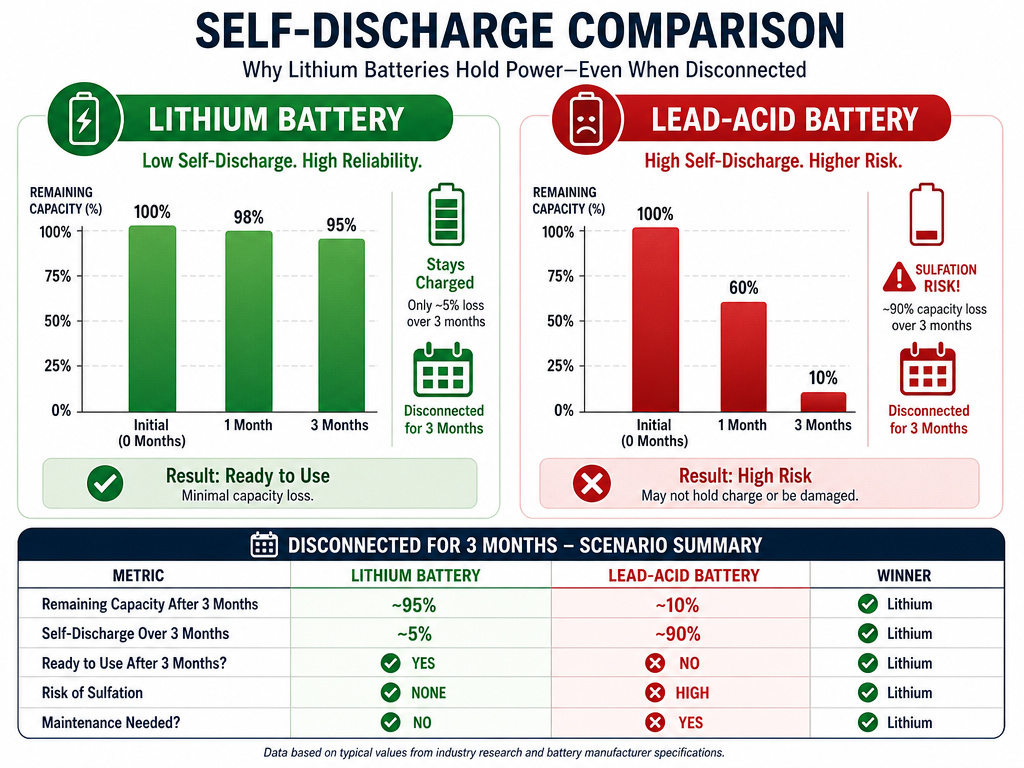
How often do you ride? If your bike sits for weeks or months, the battery’s self-discharge rate becomes its most important spec.
Here the data shows a clear winner. According to Battery Tender, a lead-acid AGM battery’s self-discharge rate is 3–5% per month, while EarthX states a lead-acid battery can lose up to 30% per month. This disparity is why lithium batteries are legendary for seasonal storage.
| Storage Scenario | Lithium Battery | Lead-Acid Battery |
|---|---|---|
| Disconnected for 3 Months | Loses ~3-6% charge. Likely to start. | Loses 9-90% charge. May be dead or sulfated. |
| Connected (with parasitic drain) | BMS may cut off to protect cells. Requires specific charger to revive. | Will drain and sulfate, often causing permanent damage. |
| Recommended Maintenance | Charge every 6 months if disconnected. Use lithium-mode tender. | Connect a smart tender like a Battery Tender Plus before storage. |
The rule is simple: for a bike that sits all winter, a lithium battery is far more likely to wake up in the spring. But you still can’t just ignore it. EarthX recommends charging a stored lithium battery every six months. For a lead-acid battery, a smart battery tender is not just recommended; it’s essential to prevent sulfation and extend its short lifespan.
Safety, Fit, and the Practical Swap
The next step is installing the battery in your motorcycle. Safety is the priority. Safety first.
Before you start: Disconnect the negative terminal first, then the positive. When installing, connect positive first, then negative. This prevents a short circuit if your wrench touches the frame. Wear safety glasses, battery acid can spray.
Physical fit is critical. While many lithium batteries are marketed as direct replacements, their smaller size can lead to rattling in the stock battery box. You often need to use the included foam spacers or fabricate a simple shim to secure it. A loose battery will vibrate, damaging terminals and shortening its life.
Identifying your old battery is the first step. Identify the label with a model number (like YTX12A-BS or ETX12). This code tells you the terminal layout, dimensions, and voltage. Match this to the spec sheet of your new battery, whether lead-acid or lithium. Don’t guess.
The electrical swap is straightforward: like-for-like terminals. The crucial follow-up is to test your charging system. Use a multimeter to check the voltage at the battery terminals with the bike running at 3,000–5,000 RPM. You should see between 13.5V and 14.8V. A voltage outside this range, either too high or too low, will kill any new battery, lithium or lead-acid, in short order. This is the step most riders skip, and it’s the reason many new batteries fail prematurely.
Environmental Impact of Lithium vs Lead Acid Motorcycle Batteries
The environmental comparison centers on longevity and resource use. A lithium battery can last two to three times longer than a lead-acid battery. This extended lifespan means fewer battery replacements over the life of a motorcycle, reducing the overall waste stream. Lead-acid batteries are heavier and contain lead, a toxic heavy metal, while lithium batteries use different materials. The longer service life of a lithium unit, coupled with its significantly lighter weight, suggests a different environmental footprint over the long term, though both types require responsible recycling at end of life.
Frequently Asked Questions
Are lithium motorcycle batteries better than lead-acid?
“Better” depends on your priority. Lithium is better for weight savings and long-term storage. Lead-acid is better for cold-weather starting, upfront cost, and charging system compatibility. For most daily riders, a modern AGM lead-acid battery is the more practical and reliable choice.
What is the biggest disadvantage of a lithium-ion motorcycle battery?
The two main disadvantages are cold-weather performance and charger compatibility. Lithium batteries can lose over half their cranking power in freezing temperatures, and they require a specific charger to avoid being damaged during charging. Their higher initial cost is a secondary factor.
Can I use a lithium battery in my old motorcycle?
You can, but you must check two things. First, ensure your bike’s charging system voltage is regulated and doesn’t spike above 15V, as this can damage the lithium battery’s BMS. Second, older bikes with permanent magnet alternators may not provide enough voltage at idle to properly charge a lithium battery. When in doubt, stick with an AGM lead-acid battery for vintage machines.
How long can a motorcycle sit with a lithium battery?
Disconnected lithium motorcycle battery can sit for many months and still retain enough charge to start the bike, thanks to its very low self-discharge rate of 1–2% per month. However, if left connected to the bike with even a small parasitic drain (like a clock or alarm), the battery management system may disconnect it to prevent deep discharge, requiring a specific charger to wake it up.
Do I need a special charger for a lithium motorcycle battery?
Yes. You must use a charger that is compatible with lithium iron phosphate (LiFePO4) chemistry. Many modern “smart” chargers have a selectable mode for this. Never use a standard lead-acid charger, especially one with “de-sulfating” or “pulse” modes, as it will damage the battery.
The Bottom Line
Here is what actually held up after looking at the data and the real-world reports. For most riders, commuters, tourers, weekend canyon carvers, a quality AGM lead-acid battery is the default pick. It starts in the cold, works with any charger, and when paired with a smart battery tender, it will last for years without drama or surprise.
Choose a lithium battery if you race, if you ride a sub-400-pound bike where every pound counts, or if your bike hibernates in a garage for six months every winter. Just budget for a lithium-compatible charger like the Battery Tender Junior Selectable Chemistry model.
Skip the lithium hype if you just want a battery that works. The weight savings on a heavy bike is academic, and the cold-weather penalty is real. Buy an AGM battery, plug in a tender when you’re not riding, and spend the money you saved on gas.
