
Sintered vs Organic Motorcycle Brake Pads: How to Choose
This post contains affiliate links. As an Amazon Associate, we earn from qualifying purchases.
Sintered brake pads are made by fusing metal particles under extreme heat (>800°C) and pressure, offering stronger initial bite, outstanding heat resistance (up to 1000°C), and longer life, but they increase rotor wear by 30-50%. Organic pads, made from fibers bonded with resin, provide smoother, quieter braking and are gentler on rotors, but wear faster and lose most stopping power in wet conditions or above 300°C.
For most modern motorcycles and riders, sintered pads are the better buy. They handle the heat of aggressive riding, work consistently in rain, and last longer, justifying their higher upfront cost. The debate over sintered vs organic motorcycle brake pads often comes down to intended use. Organic pads are a solid, budget-friendly choice for lightweight bikes used in dry, casual riding where rotor longevity and lever feel are priorities over ultimate performance.
This guide walks you through the sintered vs organic motorcycle brake pads choice by the numbers, stopping power, wear rates, and the specific riding scenarios where each type wins or loses. By the last section, you’ll know exactly which compound belongs on your bike, and why the standard advice sometimes gets it wrong.
Key Takeaways
- Sintered pads increase rotor wear by 30-50% but can withstand temperatures up to 1000°C before fading, making them highly recommended for aggressive or wet-weather riding.
- Organic pads lose 81% of their friction coefficient when wet and fade above 300°C, but they are significantly gentler on your brake discs.
- The UK legal minimum pad thickness is 1.5mm; check front and rear pads every thousand miles for wear, noise, or dust.
- According to the JHMIM technical guide, many riders put organic pads up front and sintered ones in the back to get the best performance.
- Never mix sintered and organic pads in the same caliper, as different friction rates can cause uneven braking and instability.
The Material Science: What They’re Made Of
The manufacturing process defines everything about a brake pad’s character. Sintered pads are an exercise in metallurgy. Metallic powders, copper, iron, bronze, are mixed with solid lubricants like graphite and fused together under heat exceeding 800°C and intense pressure. This sintering process creates a dense, porous matrix. The particle sizes in this mix range from 30 to 355 micrometers, which is key to the pad’s abrasive nature and heat management.
Sintered pads are created by fusing metallic powders under heat >800°C and pressure. Particle sizes range from 30μm to 355μm, and their thermal conductivity is 30-35 W/m·K, allowing them to pull heat away from the rotor surface efficiently.
Organic pads, often labeled NAO (Non-Asbestos Organic), are a composite material. Think of them as a sophisticated fiberglass mat. They’re made from a blend of materials like cellulose, aramid (Kevlar), glass, rubber, and carbon compounds, all held together with a phenolic resin binder. They are softer by design.
The sintered vs organic motorcycle brake pads difference in feel starts here. The metallic matrix of a sintered pad is inherently harder and more conductive. The organic pad’s fibrous structure is compliant and insulating. One is a chisel, the other is a eraser. Your brake rotors will know the difference within a few thousand miles.
Sintered vs Organic: The Core Differences
This isn’t an academic choice. It’s a trade-off you feel at the lever and see in your wallet at replacement time. The right answer depends on which trade-offs you’re willing to live with.
| Feature | Sintered Brake Pads | Organic Brake Pads |
|---|---|---|
| Primary Composition | Fused metallic powders (copper, iron) & graphite. | Fibers (aramid, glass) bonded with resin. |
| Initial Bite & Feel | Aggressive, immediate grab. Can feel abrupt on light bikes. | Smoother, progressive build-up of force. Preferred for low-speed control. |
| Heat Resistance & Fade | Exceptional. Withstands temps to 1000°C. Minimal fade under repeated hard braking. | Moderate. Effectiveness drops above 300°C. Prone to fade on long descents or aggressive use. |
| Wet Weather Performance | Excellent. Friction coefficient drops only ~30% from dry to wet. | Poor. Can lose up to 81% of friction coefficient when wet. |
| Pad Lifespan | Long. Metallic compound is highly wear-resistant. | Shorter. Softer materials wear down more quickly. |
| Rotor Wear | High. Increases rotor wear by 30-50% due to abrasive properties. | Low. Softer material is much gentler on brake discs. |
| Noise & Dust | Can be noisy (squeal) and produce more metallic dust. | Typically quieter and produce less dust. |
| Best For… | Sport riding, heavy bikes, touring, wet climates, aggressive street use. | Lightweight bikes, casual commuting, dry conditions, vintage bikes, riders prioritizing rotor life. |
The Initial Bite Debate
Here’s where owner reports clash. Most technical reviews, like the one from MotoGearsPro, state organic pads deliver a “gentler initial bite.” Yet, the MotoRadds blog cites riders who switched to organic pads and felt more initial bite.
Both can be true. The sensation of “bite” is subjective. A sintered pad’s engagement is sharp and binary, it’s on. An organic pad’s engagement is more progressive; you pull the lever and the force builds linearly. Some riders interpret that predictable, linear build as a confident “bite,” while others find the sintered pad’s immediacy unsettling, especially on a lightweight motorcycle.
The Rotor Wear Trade-Off, Quantified
This is the single biggest cost-of-ownership factor most guides gloss over. It’s not just “sintered pads wear rotors more.” The JHMIM technical guide puts a number on it: sintered pads increase rotor wear by 30-50%. Your rotors are a wear item, but with sintered pads, you’re committing to replacing them more frequently. Organic pads are famously easy on discs. That gentleness is a major reason riders choose them for classic or low-mileage bikes.
Performance Where It Counts: Heat, Water, and Wear
Heat is the Enemy
Brake fade isn’t just annoying; it’s dangerous. It’s the feeling of the lever coming back to the grip with little to no stopping power. Heat causes it. Sintered pads are heat sinks. With a thermal conductivity of 30-35 W/m·K, they pull heat away from the rotor surface and distribute it through their metallic structure. This allows them to keep a stable friction coefficient up to 1000°C. For a rider carving canyons or a tourer descending a mountain pass, this consistency is everything.
Organic pads insulate. That same soft, fibrous structure that makes them quiet also traps heat at the rotor surface. Once that interface exceeds 300°C, the resin can start to break down, and the pad’s friction falls off a cliff. If your riding involves repeated hard stops, organic pads will tell you their limits.
The Wet Weather Reality Check
Riding in the rain tests brake compounds ruthlessly. Water is a lubricant and it also cools the rotor, changing the friction equation. Sintered pads shrug it off. Their metallic surface and porous structure don’t trap water, leading to only a 30% reduction in friction from dry to wet. You get consistent, predictable braking in a downpour.
Organic pads lose most of their stopping power in moisture, with an 81% drop in friction coefficient. A damp road can turn a confident stop into a long, anxious slide.
This is the most compelling safety argument for sintered pads if you ride in variable climates. An organic pad’s performance in the wet is its greatest weakness.
Longevity and the 1.5mm Rule
How long do they last? It depends entirely on your right hand. A track-day rider will cook through a set of pads in a weekend, while a commuter might get years. The rule of thumb is simple: sintered pads last longer. Their harder, metallic composition is more resistant to abrasion. Organic pads wear faster because they’re designed to be the sacrificial material, protecting the more expensive rotor.
The law is simpler. In the UK, the Driver and Vehicle Standards Agency (DVSA) sets the legal minimum wear thickness at 1.5mm. Many manufacturers recommend replacement at 2.0mm for a safety margin. Check your front and rear pads every thousand miles. Look through the caliper at the pad material, if it looks thin, measure it.
The warning signs are physical: a high-pitched squeal (often a wear indicator tab scraping), a lever that feels spongy, or intermittent braking performance. Excessive brake dust is another clue. Don’t wait for the metal backing plate to score your rotor.
How to Choose: Bike Weight, Riding Style & Environment
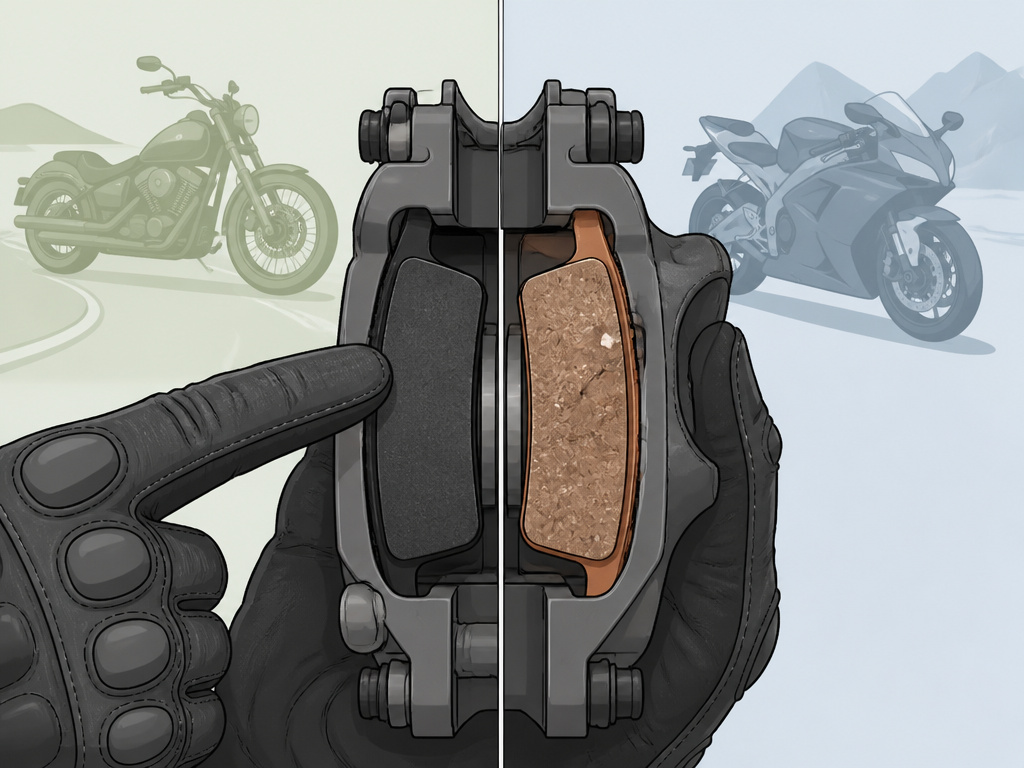
Forget the one-size-fits-all recommendation. Your bike and your habits decide.
- You ride a heavy sport bike, adventure tourer, or frequently carry a passenger. Sintered pads are not an upgrade; they’re a requirement. The added mass and higher speeds generate more heat. You need the fade resistance and consistent bite.
- Your riding is aggressive, canyon runs, track days, or fast street riding. Same answer. Sintered. The thermal capacity is essential. The initial bite provides confidence for late braking.
- You commute daily, rain or shine. Sintered. The wet-weather performance alone justifies the choice. Long-term value favors them too.
- You ride a lightweight standard, cruiser, or vintage bike for weekend pleasure in fair weather. Organic pads are a fantastic choice. They offer smoother control that suits these bikes’ character, they’re quiet, and they preserve your rotors.
- You’re on a tight budget and your riding is mild. Organic pads are the affordable entry point. Just be hyper-aware of their limits in the wet and under heavy braking.
The Smart Hybrid Setup
You don’t have to run the same pad at both ends. A popular and effective setup for street riders is organic pads in the front caliper and sintered pads in the rear. The logic is sound. Following a hybrid setup logic, some riders use organic pads on the front for smoother modulation, as the front brake does most of the stopping work. The rear brake is used more for stability and low-speed control, and it’s prone to contamination from road spray. A sintered pad on the rear provides durable, weather-resistant bite for that role.
Never mix different materials in the same caliper. The different friction rates can cause the caliper to twist or apply uneven pressure, leading to erratic braking and accelerated wear.
What About Semi-Sintered Pads?
This is the “best of both worlds” option the 24MX guide mentions. Semi-sintered (or semi-metallic) pads blend metallic and organic materials. They aim to offer better heat resistance and longevity than pure organics, with less rotor wear and noise than full sintered pads. They’re a great middle ground for the rider who wants a step up from organic without committing to the rotor wear and harshness of a full sintered pad. Some manufacturers offer semi-sintered pads as a middle-ground option.
Installation, Bed-In, and Compatibility Checks
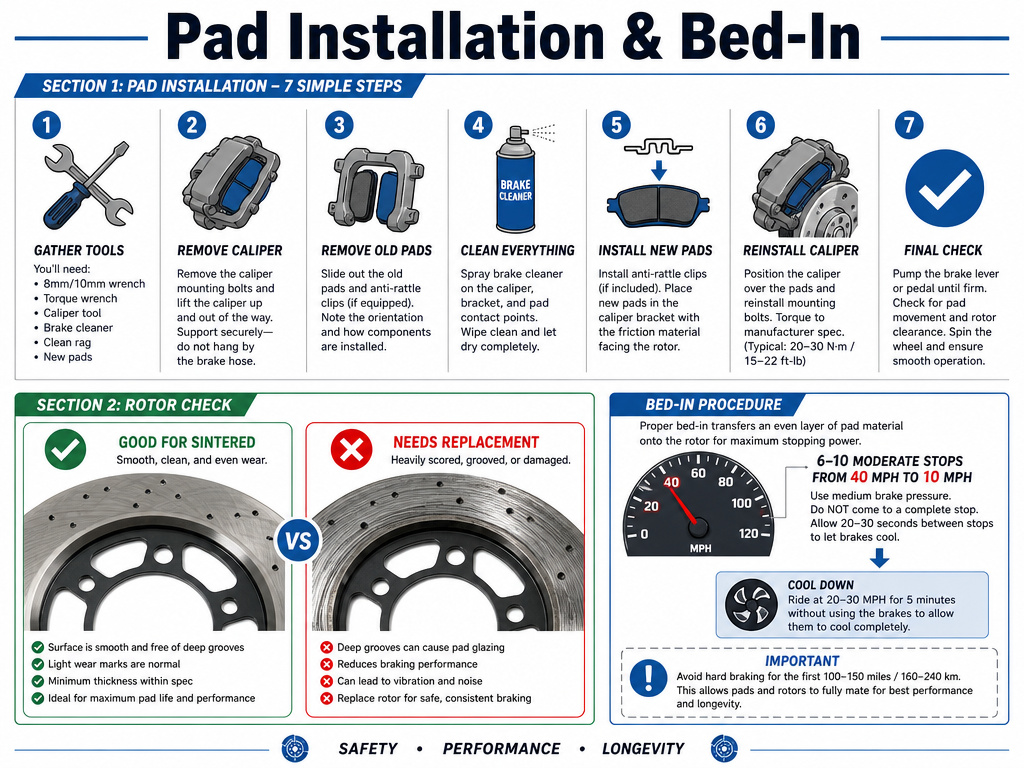
Choosing the right pad is half the job. Installing it correctly is the other half. The process is straightforward but exact.
Tools You’ll Need:
- Hex keys or sockets for caliper bolts
- A flat-head screwdriver or piston spreader tool
- Brake cleaner
- A wire brush
- New pad retaining pins or clips (if required)
- Torque wrench (critical)
Before you start: Support the bike securely on a stand. Never let the brake lever be pulled while the caliper is off, as it will shoot the pistons out. Have a method to contain brake fluid if you need to push pistons back.
- Remove the caliper. Unbolt it from the fork leg or swingarm. Hang it with a zip-tie, don’t let it dangle by the brake hose.
- Push the pistons back. You’ll need to create room for the new, thicker pads. Use a dedicated spreader tool or a flat screwdriver gently between the old pads. This may cause the brake fluid level in the master cylinder to rise; siphon some out if needed.
- Remove the old pads. Take out the retaining pin or clip, then slide the pads out. Note their orientation.
- Clean the caliper. Use brake cleaner and a wire brush to remove all dust and corrosion from the caliper bracket, pin holes, and any sliding surfaces. This is the step that prevents sticky pads and uneven wear.
- Install the new pads. Slide them into place, ensuring any shims or anti-squeal clips are positioned as the old ones were. Insert the retaining hardware.
- Re-mount the caliper. Bolt it back to the bike, tightening the bolts to the manufacturer’s specified torque. A torque wrench is required here. Overtightening can strip threads or distort the caliper.
- Bed them in. New pads won’t work properly until they’ve transferred a layer of material evenly onto the rotor. Find a safe, empty road. Accelerate to 40 mph, then brake gently down to 10 mph. Repeat this 10-15 times, allowing a minute between cycles for cooling. Avoid coming to a complete stop during the process. This creates a uniform transfer layer for optimal friction and prevents glazing.
Rotor Compatibility
Always inspect your rotors when changing pads. If you’re switching from organic to sintered, ensure your rotors are in good condition. Sintered pads work best with clean, smooth rotors. If your old rotors are heavily grooved or scored, the hard sintered material will not bed in properly and may cause vibration and noise. For the best performance with sintered pads, ensure your rotors are in good condition and designed for motorcycle use.
How to bed in sintered vs organic brake pads
The bed-in process is crucial for both pad types, but their different materials mean they transfer material to the rotor in distinct ways. Sintered pads perform at their best once they’ve been heated up, so their bedding often involves a series of moderate to firm stops from increasing speeds to build a consistent transfer layer. Organic pads, made from fibers bonded with resin, typically require a gentler, more gradual break-in to avoid glazing. For both types, the goal is an even transfer of pad material onto the rotor surface. The fact sheet recommends breaking pads in and applying your brakes evenly.
Frequently Asked Questions
Are sintered brake pads better for motorcycles?
For most riders and most modern motorcycles, yes. They offer superior heat resistance, consistent wet-weather performance, and longer life. However, “better” depends on the bike and use. For a lightweight bike used gently in dry conditions, organic pads can be the better choice for their smoother feel and rotor-friendly nature.
Should I get sintered or organic brake pads?
Match the pad to your dominant riding. If you ride hard, in the wet, or on a heavy bike: get sintered. If you ride a light bike gently in fair weather and want to minimize long-term rotor costs: get organic. For a balanced approach on a street bike, consider semi-sintered or a hybrid setup (organic front, sintered rear).
What is the downside of buying organic brake pads?
The two major downsides are poor wet-weather performance (up to 81% loss of friction) and lower heat tolerance (fade above 300°C). They also wear out faster than sintered pads. You trade ultimate performance and safety margin for cost, smoothness, and rotor longevity.
What is the best material for motorcycle brake pads?
There is no single “best” material. Sintered metallic material is best for high-performance, heat-intensive, and wet-weather riding. Organic material is best for low-aggression, dry-weather riding where noise, smoothness, and rotor life are top concerns. The best material is the one correctly matched to your motorcycle and your real-world riding habits.
Can I mix sintered and organic pads?
You can use different compounds on the front and rear brakes (a common tactic), but you must never mix sintered and organic pads in the same caliper. The different friction rates and expansion properties will cause uneven pad contact, unpredictable braking, and potentially dangerous handling issues.
The Bottom Line
Here is what actually held up after looking at the lab data and real-world reports: sintered pads win on paper and for the majority of street riders. Their ability to handle heat, weather, and abuse makes them the safer, more consistent choice. The increased rotor wear is a real cost, but it’s the price of that performance.
But the paper doesn’t always match the pavement. If you ride a sub-500cc bike on sunny weekends, the aggressive bite of a sintered pad can feel out of place. The organic pad’s gentle, predictable progression might be the right tool for that job. It’s not a downgrade; it’s a different tool.
My default pick for anyone asking for one answer: get a set of sintered pads. Bed them in properly, check your pad thickness with the 1.5mm rule in mind every thousand miles, and accept that you’ll be buying rotors a bit sooner. That setup covers the largest spread of real-world riding conditions without compromise.
For the rider who knows they’ll never push those limits, an organic or semi-sintered pad is a perfectly rational, budget-friendly choice. Just promise yourself you’ll never test its wet-weather limits in an emergency. Your brakes are the one system you buy hoping you never need their full potential. Buy for that potential.
