
O Ring vs X Ring vs Non Sealed Motorcycle Chain
This post contains affiliate links. As an Amazon Associate, we earn from qualifying purchases.
O-ring, X-ring, and non-sealed motorcycle chains differ in sealing, friction, lifespan, and maintenance. An O-ring chain uses a round rubber seal to trap grease, offering good durability for general street use. An X-ring chain uses an X-shaped seal for lower friction and better longevity, making it the benchmark for sport and adventure riding. A non-sealed chain has no internal seals, offers the least friction and weight, but requires frequent lubrication and is best for racing where chains are replaced often.
The real choice isn’t about which technology is “best.” It’s about matching a chain’s physical trade-offs to the conditions you actually ride in and the maintenance you’re willing to do. Understanding the differences in an o ring vs x ring vs non sealed motorcycle chain is key. A chain that’s perfect for a weekend track bike is a terrible, short-lived choice for a daily commuter, and vice-versa.
What follows is a breakdown of the specs that matter, the real-world friction numbers from dyno tests, the maintenance each type demands, and a straightforward guide to picking the right one for your garage.
Key Takeaways
- For most street riders, an X-ring chain is the default pick. It balances the longevity of a sealed design with the lower friction needed for modern high-performance engines.
- Non-sealed chains sacrifice lifespan for minimal drag. They belong on race bikes where chains are treated as consumables, replaced every few race weekends.
- Seal width is a physical clearance issue. An X-ring chain is wider than an O-ring chain, which itself is wider than a non-sealed chain. Check your bike’s swingarm clearance before buying.
- Cleaning methods are not interchangeable. Sources disagree on the best cleaner: classic manuals advise petrol/kerosene, while modern race teams warn petrol can damage sintered bushings and recommend paraffin-based cleaners instead.
- Always replace chain and sprockets as a matched set. Installing a new chain on worn sprockets accelerates wear on both parts, wasting your investment within weeks.
The Core Difference: Sealed vs. Non-Sealed
Look at the side plates of any chain. The space between the inner and outer plate is where the pin rotates inside the bushing. This joint needs lubrication to prevent metal-on-metal wear. How that lube is kept in and dirt kept out defines the entire category.
A sealed chain has rubber rings pressed into grooves on the inner link plates, creating a physical barrier that encapsulates factory grease. A non-sealed (or “standard”) chain has no such seals, leaving the pin and bushing exposed.
This is a major detail that dictates everything about the chain’s lifespan, required care, and where it should be used in the o ring vs x ring vs non sealed motorcycle chain comparison. A sealed chain is a closed system. The grease inside is meant to last for thousands of miles, protected from the elements. A non-sealed chain is an open system. It relies entirely on the external lubricant you apply, which gets flung off and contaminated quickly.
That sealed system comes with a physical cost: width and friction. Adding rubber seals between the plates makes the chain wider. The seals themselves create drag as the chain articulates around the sprockets. This drag, often called “parasitic loss,” is why the horsepower debate exists.
So, which is right for you? If your riding involves rain, road grime, or off-road mud, a sealed chain is mandatory. The research backs this up. Dirt Rider Magazine found non-sealed chains wear “exponentially faster” in wet, muddy environments. For clean, dry track use where performance is measured in hundredths of a second and chains are replaced frequently, the non-sealed chain’s lack of drag is the overriding concern.
O-Ring vs. X-Ring: It’s About the Seal’s Shape
All sealed chains work on the same principle, but the seal’s cross-section changes the game. An O-ring is round. An X-ring has a flattened, X-shaped profile.
Where this goes sideways: Assuming an X-ring is just a marketing gimmick. The shape change alters how the seal contacts the chain plate, directly reducing friction and improving sealing pressure.
Think of it like a gasket. A round O-ring wants to roll in its groove as the chain flexes. This rolling motion creates friction. An X-ring, with its four contact points, is designed to twist in place instead of roll. Manufacturers claim this reduces friction significantly. D.I.D. States its X-ring design cuts friction by “over 50%” compared to its standard O-rings.
Independent testing puts a real number on it. One dyno comparison measured a 0.3–0.6 horsepower difference at the rear wheel between a new premium non-sealed chain and a new premium X-ring chain on the same bike. That’s the tangible cost of the seal’s drag. For a 100-horsepower sportbike, that’s a small fraction of its output. For a 50-horsepower commuter, it represents a slightly larger relative loss. Whether that matters is your call.
The X-ring’s shape also tends to maintain better sealing pressure as it wears, which is why Adventure Rider Magazine calls them the “benchmark for modern adventure bikes.” They hold up better under the sustained punishment of dirt, water, and high load.
| Seal Type | Best For | The Trade-Off |
|---|---|---|
| O-Ring | General street riding, commuting, budget-conscious buyers. | Proven durability, but with higher friction than an X-ring. |
| X-Ring | Sport riding, touring, adventure, and high-performance street bikes. | Lower friction and often longer life, at a higher price point. |
| Non-Sealed | Motocross, road racing, any application where minimal drag is critical. | Maximum performance and lightest weight, with very high maintenance. |
Decoding the Specs: What the Numbers Actually Mean
You’ll see three key numbers on any chain spec sheet: pitch, inner width, and tensile strength. These are dimensional standards and engineering limits, not marketing fluff.
- Pitch: The distance between the chain’s pins, measured in millimeters. A “520” chain has a 15.875 mm pitch (which is 5/8 of an inch). This number must match your bike’s sprockets. You cannot fit a 525 chain on 520 sprockets.
- Inner Width: The distance between the inner link plates. This determines if the chain will fit between your bike’s sprocket teeth and swingarm. The JIS D 9417 standard for a 520 chain specifies an inner width of 6.35 mm (1/4″), but manufacturers sometimes deviate from this to accommodate their seals. This is where things get tricky.
- Tensile Strength: The amount of straight-pull force, in pounds or kilograms, required to break the chain. Higher is generally better, but it’s not the only measure of quality. A chain with excellent sealing but lower tensile strength may outlast a weaker-sealed, higher-strength chain in harsh conditions.
Manufacturers sometimes deviate from the standard inner width to accommodate their seals. For example, the EK MVXZ 530 chain lists an inner width of 9.525 mm, much wider than the standard for its pitch. This is why checking physical clearance on your specific bike is an essential step. A chain that’s too wide will grind against your swingarm or chain guard.
The tensile strength figures in your spec sheet are also a direct window into construction quality. Compare two top-tier 520 chains: the RK GB520GXW (XW-Ring) is rated for 9,600 lbs, while the D.I.D. 520VX3 (X-Ring) is rated for 9,040 lbs (or 8,930 lbs, depending on the source document, a disagreement we’ll address). Both are massively strong. The difference comes down to plate hardening, pin treatment, and seal design.
The Maintenance Reality: Three Different Jobs
Maintenance is where owner habits make or break a chain. The procedure isn’t the same for all three types. Getting it wrong doesn’t just shorten life, it can cause immediate damage.
For Sealed (O-Ring & X-Ring) Chains:
Your job is to clean and protect the exterior. The critical seals and factory grease are inside, between the plates.
- Clean with a dedicated chain cleaner or kerosene to remove grime from the rollers and side plates.
- Apply an external chain lube designed for sealed chains. This lube protects the O-rings/X-rings from ozone cracking and keeps the rollers moving freely on the sprockets.
- Never use a pressure washer or a stiff wire brush directly on the seals. You’ll force water past them or tear the rubber.
For Non-Sealed Chains:
Your job is to constantly replenish the lubrication at the pin/bushing interface, which has no internal reserve.
- Clean frequently with a solvent that won’t damage the metal. This is a key source disagreement.
- Lube immediately after every ride or every few hundred miles with a light, penetrating oil. The lube must work its way into the microscopic gaps between the pin and bushing.
- Expect to do this often. A non-sealed chain in daily use requires very frequent lubrication. Let it run dry, and you’ll hear a dry, rasping sound from the drivetrain within a single ride.
Common mistake: Spraying lube on a dirty chain. All you’re doing is creating an abrasive grinding paste that accelerates wear. Clean first, every time.
The difference in effort is stark. A sealed chain can go much longer between lubrications than a non-sealed chain. A non-sealed chain demands attention an order of magnitude more frequently. That’s the practical cost of its performance advantage.
The Horsepower Debate: What Dynos and Riders Actually Feel
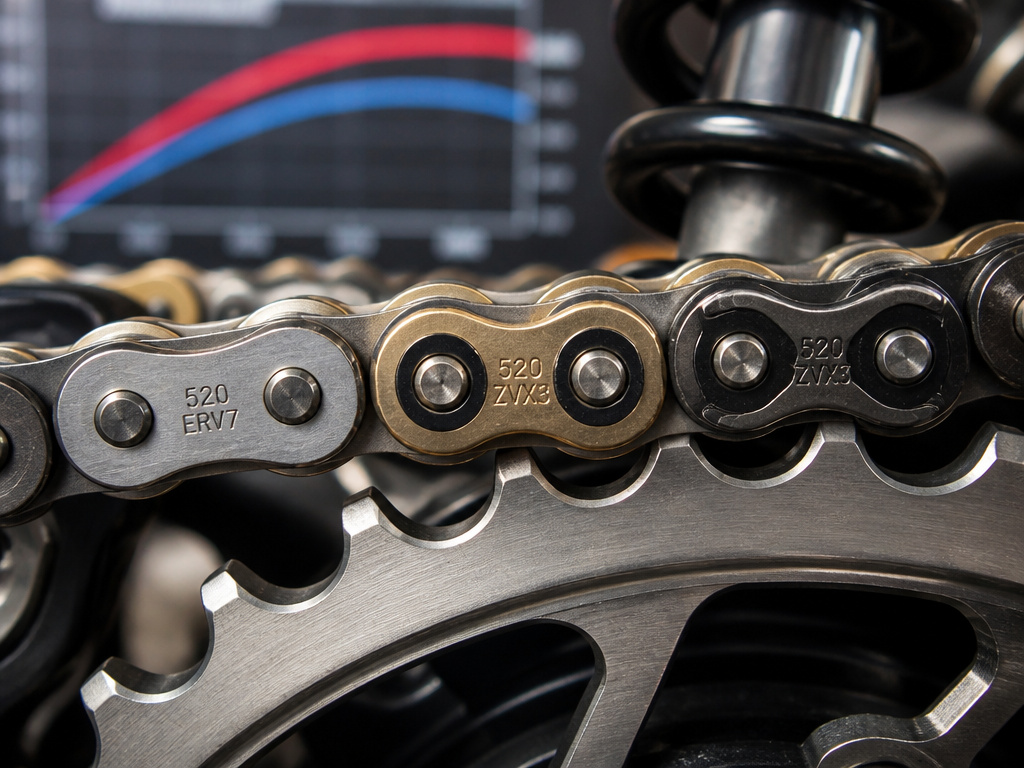
“Does a sealed chain rob horsepower?” Yes. The question is: how much, and do you care?
The manufacturer claim (over 50% friction reduction for X-ring over O-ring) and the independent dyno result (0.3–0.6 hp difference between non-sealed and X-ring) seem to tell different stories. They don’t. The first is a percentage of seal drag. The second is the net effect on rear-wheel power. Both are correct, and both are small in the grand scheme.
Motorcycle Consumer News concluded that for typical street riding, the difference is “academic” and outweighed by the durability benefit. On a 150-horsepower liter bike, half a horsepower is a rounding error on the dyno. You will not feel it.
But context flips the argument. In MotoGP, where teams chase thousandths of a second, they use custom non-sealed chains and replace them every race weekend. For a club racer, that 0.6 hp might be the difference between a podium finish and fifth place. For a commuter, it’s irrelevant noise drowned out by tire choice and wind resistance.
The feel is subtler. Some racers on forums like WERA report a perceptible difference in throttle response with a premium non-sealed chain, a slightly more “direct” connection. That’s likely the elimination of seal drag’s dampening effect. For street riding, you’re far more likely to notice the smooth, quiet operation of a well-lubricated X-ring chain over the occasional whirr and need for adjustment of a non-sealed unit.
How to Choose: A Flowchart for the Real World
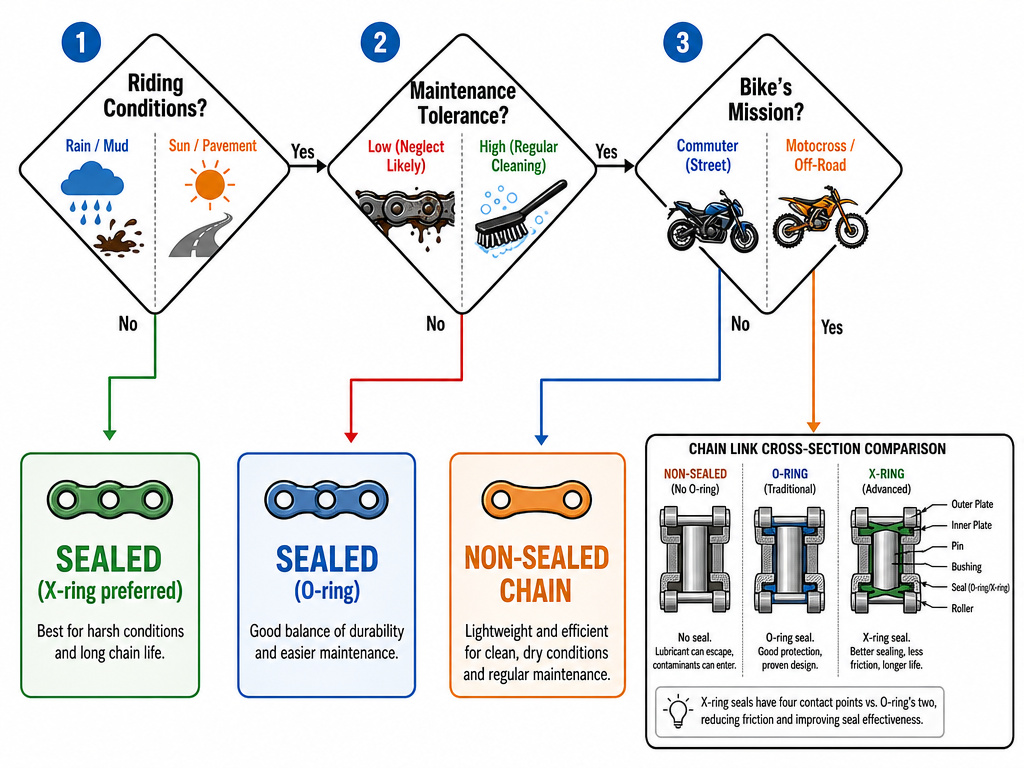
Forget “which is best.” Answer these three questions in order.
1. What are your riding conditions?
- Mud, rain, winter roads, off-road: Your choice is made. You need a sealed chain. The external filth will destroy a non-sealed chain in short order. Proceed to question 2.
- Dry pavement, fair-weather riding, track days: You have a choice. A sealed chain offers set-and-forget convenience. A non-sealed chain offers peak performance for a price of constant upkeep.
2. What is your maintenance tolerance?
- “I lube it when I remember, maybe once a season”: You must buy a sealed chain (X-ring preferred). A non-sealed chain will be destroyed by neglect.
- “I clean and lube religiously every few hundred miles”: You can run either. Your choice now hinges on performance vs. Longevity.
3. What is the bike’s primary mission?
- Daily commuting, touring, sport riding: The longevity and corrosion resistance of a sealed chain provides real value. The D.I.D. 520VX3 was a tester’s “first choice for a streetbike” in a Sport Rider Magazine comparison for exactly this reason.
- Motocross, club racing, drag racing: Here, the non-sealed chain’s weight and friction advantages are the entire point. As Motorcyclist Magazine notes, they are the “overwhelming choice for motocross/supercross.” Lifespan is measured in hours, not miles.
If you’ve answered those and landed on “sealed chain,” the final step is budget. An O-ring chain like a Regina 525 ORN6 is a robust, cost-effective choice. Stepping up to an X-ring chain like the RK GB520GXW or D.I.D. 520VX3 buys you lower friction and, in many tests, longer life. It’s the upgrade that pays for itself if you keep the bike.
What riders say about chain lifespan and value
User experiences often align with the intended use case. For street and adventure riders, sealed chains are praised for their longevity. In one magazine test, an X-ring chain was singled out for incredible longevity and called a first choice for a streetbike, especially for all-weather commuting and sport riding. Many riders report getting tens of thousands of miles from a single sealed chain with basic cleaning, which they see as excellent value despite the higher initial cost. For pure racing applications like motocross or supercross, the consensus among competitive riders is different. They overwhelmingly choose non-sealed chains for the performance gain, accepting a much shorter lifespan that may only last a race weekend. The value calculation here is purely about winning, not miles.
Frequently Asked Questions
Are X-ring chains better than O-ring chains?
They reduce friction and often improve seal longevity, yes. An X-ring’s design creates less drag than a traditional O-ring, which can translate to marginally better fuel economy and throttle response. For most riders, the upgrade cost from an O-ring to an X-ring chain is worth it for the extended service intervals and performance benefit.
How long does an X-ring chain last?
Lifespan varies wildly with maintenance, riding style, and conditions. With proper care, an X-ring chain on a street bike can last for many thousands of miles. For a detailed guide, see our article on how to check chain wear. Neglect, high horsepower, or off-road abuse can cut that lifespan by two-thirds.
Do you need an O-ring or X-ring on a motorcycle chain?
No, it’s not a need, but for the vast majority of riders, it’s a strong recommendation. A non-sealed chain works perfectly if you are committed to its intensive maintenance schedule. For the convenience, durability, and real-world performance balance, a sealed chain (O-ring or X-ring) is the appropriate choice for the vast majority of motorcycles on the road.
What’s the difference between an O-ring and an X-ring?
The difference is the shape of the rubber seal between the chain’s side plates. An O-ring is round. An X-ring has an X-shaped cross-section. This shape allows the X-ring to twist rather than roll in its groove, reducing friction. It also often provides more consistent sealing pressure over the chain’s life. The result is a chain that retains its factory grease slightly better and saps less engine power.
Can I use a non-sealed chain on the street?
You can, but you’ll be signing up for a part-time job. It requires cleaning and lubrication every few hundred miles to prevent rapid wear. In wet or dirty conditions, it will deteriorate quickly. For a street bike, the minimal performance gain is almost never worth the drastic increase in maintenance frequency and decrease in overall lifespan.
The Bottom Line
Stop looking for a universal winner. The right chain is the one that matches your actual riding life.
If you ride in the real world, where roads are wet, bikes get dirty, and weekends are for riding, not wrenching, the o ring vs x ring vs non sealed motorcycle chain debate points you to a high-quality X-ring chain. The RK GB520GXW or D.I.D. 520VX3 are where you should look first. The slight premium over an O-ring buys meaningful friction reduction and peace of mind.
If your bike is a dedicated race machine, where performance is measured in stopwatches and parts are consumables, the choice is equally clear: a premium non-sealed chain. Accept the short lifespan and intense maintenance as the cost of doing business.
For everyone else, the rule is simple. A sealed chain you maintain beats an expensive chain you ignore. Your chain and sprockets are a matched wear system. Replace them together, keep them clean, and set the tension right. That routine matters more than the brand name stamped on the side plate.
