
Carbon Fiber Motorcycle Helmet Pros and Cons
This post contains affiliate links. As an Amazon Associate, we earn from qualifying purchases.
Carbon fiber motorcycle helmets are lighter and stronger than fiberglass or polycarbonate ones, but they cost significantly more and require careful handling to avoid damage. The real choice is between paying a premium for reduced neck fatigue and a premium feel versus accepting the lower cost and greater durability of other shell materials.
That strength-to-weight ratio is the whole pitch. A full carbon helmet weighs between 38.8 and 45.9 ounces. Your neck feels that difference after the first hour. The trade is a price tag that starts high and climbs fast, plus a shell that doesn’t forgive drops the way a polycarbonate one might. Understanding the carbon fiber motorcycle helmet pros and cons is key.
What follows is a breakdown of where that money goes, the engineering, the feel, the hidden costs, and the carbon fiber motorcycle helmet pros and cons. We’ll look at the numbers from actual helmet manuals and recall reports, not marketing copy. By the end, you’ll know whether a carbon lid fits your riding and your budget.
Key Takeaways
- Carbon fiber’s main advantage is its strength-to-weight ratio, offering high-impact protection in a shell that can be 25% lighter than fiberglass.
- The biggest drawback is high cost, with prices ranging significantly higher than other materials, alongside special care requirements to prevent damage.
- Manufacturers like BMW Motorrad and Schuberth explicitly state replacement timelines, often five years or after any impact, which adds to the long-term cost.
- Bluetooth system integration is a major pro, but it must be approved for your specific helmet model to avoid voiding its safety certification.
- Always verify the certification standard (ECE 22.06 vs. DOT FMVSS No. 218) for your region, as the same helmet model may have different legal approvals.
The Core Carbon Helmet Trade-Offs
The debate isn’t about safety, a well-made helmet in any material meets the standard. It’s about the carbon fiber motorcycle helmet pros and cons and what you trade for less weight on your shoulders. A carbon one stays planted. But that precision construction has a brittle side.
You get two things for your money: less mass and more stiffness. A carbon fiber strand is 5–10 microns thick, woven and cured under pressure. This creates a shell that disperses impact energy efficiently without adding bulk. The Schuberth C5 Carbon‘s full carbon shell is handmade by technicians who manufacture Formula 1 helmets, using manual lamination and autoclave curing.
A carbon helmet’s shell is a composite matrix of woven carbon fibers set in epoxy resin, cured under heat and pressure in an autoclave. This process maximizes the material’s innate strength-to-weight ratio, creating a rigid structure that manages impact forces across a broader area than less rigid materials.
The flip side is cost and care. The price range is wide for a reason. You’re paying for a labor-intensive layup process. You’re also buying a product that demands respect. A polycarbonate helmet can bounce off a garage floor. A carbon one might not show a crack, but the resin matrix can fracture internally. That’s why every manual in our research states the same rule: replace it after any impact.
Where the Weight Savings Actually Matter
Weight matters most where you feel it least, on long rides. Three hours into a highway day, the difference between a 45-ounce helmet and a 55-ounce one translates directly to neck stiffness. It’s a fatigue multiplier.
A lighter helmet is always nicer, but the value proposition changes with mileage.
This is why any serious look at helmet weight should start with your typical ride duration. Our guide on how helmet weight affects you breaks down the fatigue math.
The Cost Equation Beyond the Sticker Price
The initial price is just the entry fee. Full carbon helmets range from 600 to 2,500 USD. You are also committing to a more delicate ownership cycle.
Consider the replacement clock. BMW Motorrad recommends replacing the System 7 Evo Carbon helmet after five years. Schuberth’s warranty for the E2 Carbon is valid for five years if registered within six months of purchase. This isn’t planned obsolescence; it’s a material reality.
| Cost Factor | Carbon Fiber Helmet | Standard Fiberglass Helmet |
|---|---|---|
| Initial Purchase | High ($600 – $2,500+) | Moderate ($200 – $700) |
| Replacement Cycle | ~5 years (per mfg. Guidance) | ~5-7 years (common practice) |
| Impact Tolerance | Low (replace after any drop) | Moderate (inspect after minor drop) |
| Long-term Value | High if used heavily for lifespan | Higher if replaced more frequently |
You can explore this further in our fiberglass and polycarbonate helmet shell comparison.
Construction, Certification, and Real-World Complexities
The word “carbon” on the box doesn’t guarantee a single thing about how the helmet is built or where it’s legal to use. The manufacturing process defines performance, and the certification label defines where you can ride with it.
There are three main shell constructions that use carbon fiber, and the differences matter:
- Full Carbon: Every ply of the shell is carbon fiber. This is the lightest, stiffest, and most expensive option. The Schuberth C5 Carbon is an example.
- Carbon-Kevlar Hybrid: Carbon outer plies are reinforced with Kevlar. This can add slight weight but retains some weight savings.
- Carbon-Fiberglass Blend: Layers of carbon are mixed with fiberglass. This is a cost-reduction step that retains some weight savings.
Common mistake: Assuming a “carbon” helmet is a monocoque of pure carbon weave. Many are blends, which affects both weight savings and cost. The product data sheet, not the marketing name, tells you the truth.
The certification mess is worse. Take the Schuberth C5 Carbon. The ECE 22.06 version of the helmet “respects the severe ECE 22.06 standard” and has P/J double homologation. The DOT version of the same helmet model “conforms to DOT FMVSS No. 218” and explicitly “does not conform to any other regulations or standards.” They are legally different products. Buying the wrong one for your region could mean your helmet isn’t street legal.
The Bluetooth Integration Trap
Modern carbon helmets often come pre-wired for communication systems. This is a huge convenience. It’s also a potential certification killer.
The Schuberth E2 Carbon manual states it clearly: any communication system must be tested and approved in line with the ECE-R 22.06 standard for that specific helmet model. Otherwise, the helmet’s approval becomes invalid. You can’t just screw any third-party Bluetooth unit into a $1,500 helmet and assume you’re still protected. Stick with systems the manufacturer has approved and integrated.
A Recall Case Study: The AGV Carbon Modular
Real-world failures teach more than specs. The AGV Carbon Modular helmet (AGV 580) was recalled in 2018. The official NHTSA motorcycle helmet recall report details why.
The chin guard assembly used M4 and M6 screws. Cyanoacrylate glue applied to screws could contact the polycarbonate chin base, causing a chemical reaction. During installation, this glue could contact the polycarbonate chin base, causing a chemical reaction that deteriorated the material over time. A consumer reported squeaking and deterioration on January 6, 2018. Dainese tested three helmets from the batch, confirmed the issue, and issued a recall on January 17.
The remedy was to use an epoxy glue that wouldn’t cause the reaction. When you add moving parts to a carbon shell, you add potential problems. This is a key consideration in the full face vs modular debate.
Maintenance and the 5-Year Rule
A carbon helmet isn’t a “buy it and forget it” item. The care guidelines are specific, and the lifespan is explicitly shorter than many riders assume.
First, storage. Keep it in its bag, in a dry, stable place. Don’t leave it on a sun-baked passenger seat or dangling from a mirror. The resins are sensitive to UV and heat. Don’t toss it onto a hard surface. The shell may look fine, but the internal structure could be compromised.
Second, cleaning. Use a soft cloth, cold water, and mild soap. No solvents, no abrasive pastes, no harsh chemicals. The same goes for the visor.
Where this goes sideways: Using a generic cleaner on a carbon helmet’s visor or shell. Stick to water and mild soap.
Now, the lifespan. This isn’t a suggestion. BMW Motorrad recommends replacing the System 7 Evo Carbon after five years. Schuberth and Shark offer a 5-year warranty, which functionally marks the end of the period they guarantee the materials will perform as tested. After a crash or any impact, the rule is absolute: replace the helmet. As the BMW manual notes, damage may be undetectable.
- Inspect regularly: Look for chips, cracks, or deep scratches in the clear coat. Feel for any unusual soft spots or flex.
- Check the interior: Over time, the EPS liner compresses and the cheek pads break down. This affects fit, which affects safety.
This disciplined approach is part of owning any premium gear. For a broader view of top-tier options, see our review of the best motorcycle helmets.
Are Carbon Fiber Helmets Worth It?
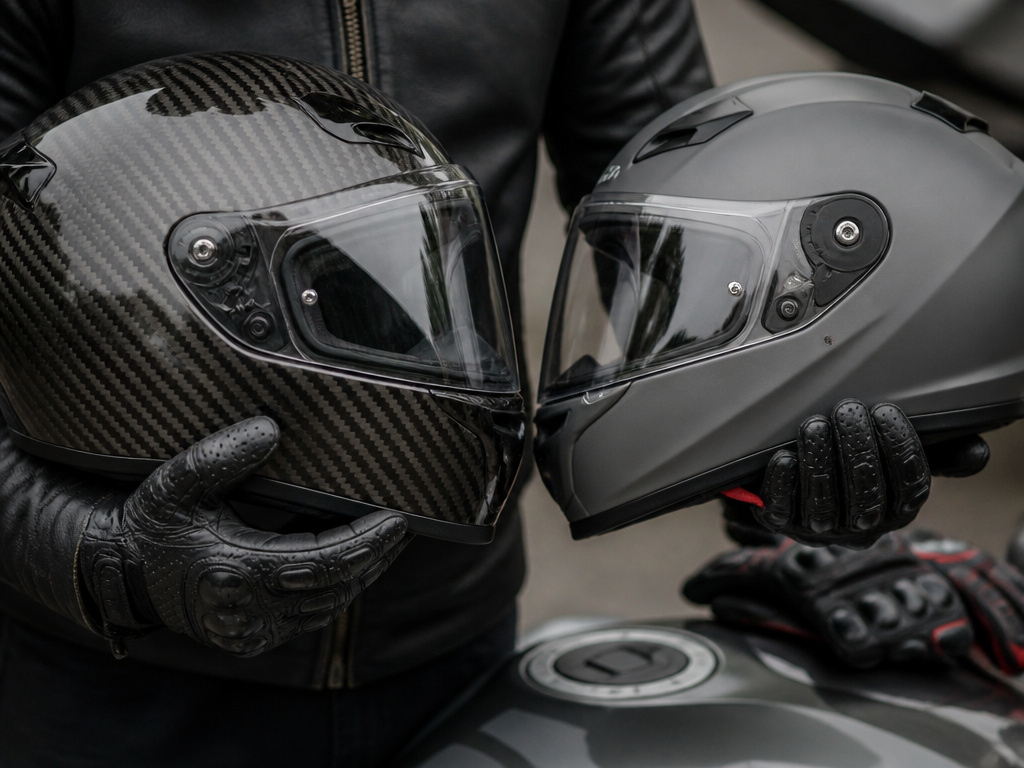
It depends on your riding profile. The weight savings are real, the finish is premium, and the integration with modern communication systems is seamless.
A high-quality fiberglass or polycarbonate helmet will provide excellent protection at a fraction of the cost. The money saved could go toward a better riding jacket, a pair of real riding boots, or higher-quality gloves.
Get your fit dialed with a mid-range model first. Once you know that, you can appreciate what a premium carbon lid offers. Our guide to the best lightweight motorcycle helmets includes excellent non-carbon options that prioritize weight savings.
Bottom line: Carbon is the best material for combining low weight and high strength. But “best” doesn’t mean “necessary for everyone.” Buy one if you ride enough to feel the weight difference and you treat your gear as essential safety equipment, not just an accessory.
How Are Carbon Fiber Motorcycle Helmets Made?
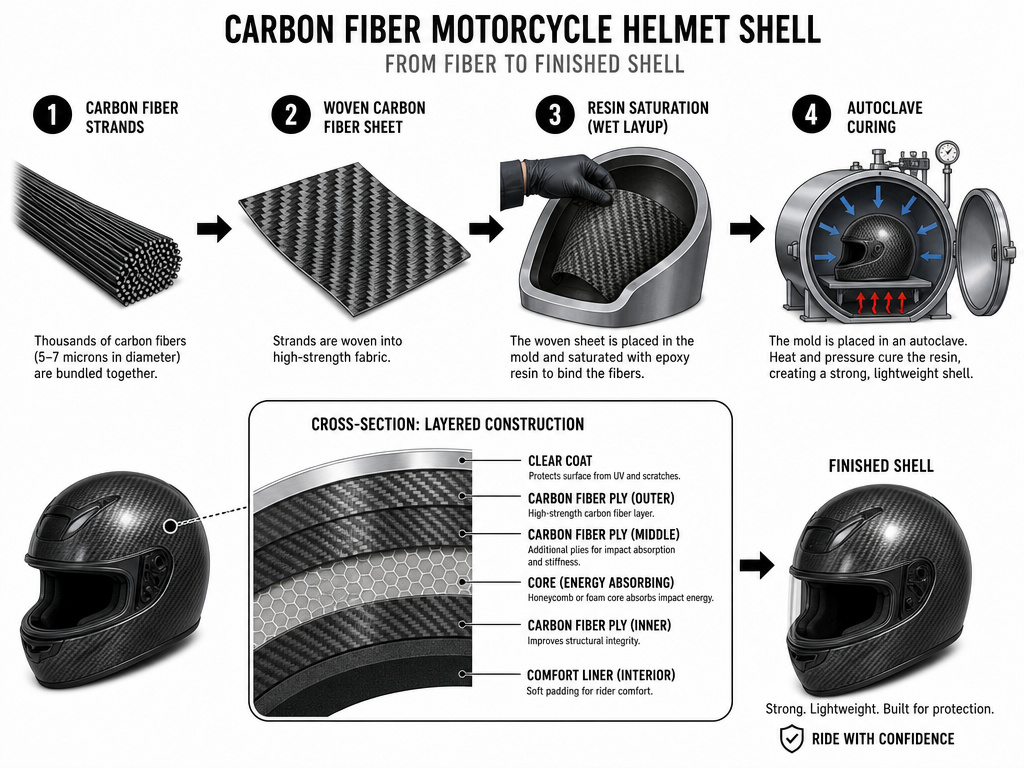
The process starts with carbon fiber strands that are thinner than a human hair. These strands are woven into sheets and then layered by hand into a mold, a technique used by technicians who also make Formula 1 helmets. The layers are saturated with resin and then cured under high pressure and heat in an autoclave. This creates a single, rigid shell that is incredibly strong for its weight. The precision required means the construction is more labor-intensive than for polycarbonate helmets, which is a key factor in the higher cost.
What Are Some Good Carbon Fiber Helmet Models?
When evaluating models, look at the specific construction and manufacturer guidance. For instance, the Schuberth C5 Carbon features a full carbon shell made with manual lamination and autoclave curing, and it meets stringent safety standards. The AGV Carbon Modular helmet, however, was subject to a recall due to a chemical reaction from an incorrect adhesive on its chin guard screws, which highlights the importance of proper manufacturing. Always check a helmet’s certification, whether it’s ECE 22.06 or DOT, and follow the maker’s replacement guidelines after any impact, as damage can be invisible.
Frequently Asked Questions
What is the biggest downside of a carbon fiber helmet?
The cost is the most immediate drawback, but the more nuanced downside is care and lifespan. They are more susceptible to damage from drops and improper storage, and manufacturers explicitly recommend replacement after about five years. This makes the total cost of ownership higher than the sticker price suggests.
Are carbon fiber helmets safer than fiberglass?
Both materials, when used in a well-constructed helmet that meets rigorous safety standards (like ECE 22.06 or DOT), provide excellent protection. Carbon fiber isn’t inherently “safer”; it provides comparable safety at a significantly lower weight. The safety depends more on the helmet’s overall design, fit, and certification than on the shell material alone.
How long does a carbon fiber helmet actually last?
Most manufacturers imply a functional lifespan of around five years. BMW Motorrad explicitly recommends replacing their System 7 Evo Carbon after five years. Warranties from Schuberth and Shark are also valid for five years. This timeline accounts for material degradation from UV exposure, temperature cycles, and general use. Any significant impact immediately ends the helmet’s service life, regardless of age.
Can you add a Bluetooth system to any carbon helmet?
No, and doing so incorrectly can void the helmet’s safety certification. Manufacturers like Schuberth state that any communication system must be specifically tested and approved for use with that exact helmet model to comply with standards like ECE 22.06. Using a non-approved system technically invalidates the helmet’s approval. It’s safest to use a system the helmet maker has pre-integrated or explicitly endorses.
Is a carbon fiber helmet good for everyday use?
It can be, if you are diligent about care. For an everyday commuter, the weight savings are a genuine comfort benefit. However, the risk of damage from frequent handling, being stored on a bike, or exposed to the elements increases. An everyday rider might get more practical value from a durable, high-quality polycarbonate helmet and save the carbon for longer pleasure rides.
Before You Go
The carbon fiber decision isn’t a yes/no. It’s a match. If your riding involves hours in the saddle where fatigue is the enemy, and you have the budget for both the purchase and the disciplined upkeep, the premium is worth it. Look at the Schuberth C5 Carbon or similar models from our list of the best carbon fiber motorcycle helmets.
If you’re weighing cost, or if your helmet tends to live a hard life, step down to a premium fiberglass composite. The protection is still outstanding, and the guilt over a minor scratch is far less. A great-fitting mid-range helmet always beats an ill-fitting or misused exotic one.
Finally, no matter the material, fit is essential. A carbon helmet a size too big will roar with wind noise and compromise safety just as badly as a polycarbonate one. Try before you buy. Your head will tell you what works.
