
How to Protect Your Eyes on a Motorcycle Without a Visor
This post contains affiliate links. As an Amazon Associate, we earn from qualifying purchases.
Protect your eyes on a motorcycle without a visor by wearing certified goggles or approved glasses that meet specific legal standards for impact resistance, retention, and optical clarity. A windshield is not a legal substitute in most places, and ordinary sunglasses or prescription glasses fail the safety test.
The law isn’t vague about this. It names the standards, the certifications, and the exact performance thresholds your gear has to hit. A windshield might block some wind, but it won’t stop a rock or a hornet, and relying on it can still get you a ticket depending on where you ride. This is why learning how to protect your eyes on a motorcycle without a visor is critical.
What follows is the breakdown of what those standards actually require, the three gear paths that satisfy them, and the specific pitfalls, like tinted lenses at night or scratched shields, that turn legal gear into a hazard.
Key Takeaways
- In Washington, you must wear approved eye protection unless your motorcycle has a windshield. In Florida, the law requires an approved eye-protective device with no explicit exemption for a windshield.
- Certified motorcycle goggles meeting standards like DIN EN 1938 or UNECE 22.05 offer the closest protection to a full-face helmet visor and are the default recommendation.
- The Washington DOL warns that standard eyeglasses or sunglasses typically don’t provide enough protection, as most are not shatter resistant, and they may come off at highway speeds.
- Scratched or tinted lenses compromise safety and legality, deep scratches weaken impact resistance, and Sources disagree on the minimum luminous transmittance for night driving: the DIN EN 1938 standard specifies at least 75%, while UK road-use rules require any visor or goggle to transmit more than 50% of visible light.
- Always check for a certification mark (like a UN “E” mark with “05” or “06”) on goggles or glasses; this is your proof of compliance, not marketing claims.
The Legal Baseline: What the Rulebooks Actually Say
You can’t choose gear that meets the legal requirements if you don’t know the rules, especially for the how to protect your eyes on a motorcycle without a visor question. And the rules are written in manuals and statutes, not forum posts.
The Washington State DOL manual is blunt: state law requires wearing eye protection on public roadways, “unless your motorcycle is equipped with a windshield.” It follows that warning with another: goggles or a windshield “may not protect against environmental elements or road debris.” The message is clear, use a shield, but don’t trust it completely. The manual explicitly warns that standard eyeglasses or sunglasses “typically don’t provide enough protection either, as most are not shatter resistant, and they may come off when turning your head at highway speeds.”
Florida law takes a different, stricter angle. The statute says a person may not operate a motorcycle “unless the person is wearing an eye-protective device over his or her eyes of a type approved by the department.” There’s no explicit exemption for a windshield here. Florida does have a famous helmet exemption for riders over 21 with sufficient medical insurance, but that clause does not remove the eye protection mandate.
Where this goes sideways: Assuming a windshield makes you legal everywhere. In Florida, you need approved eyewear regardless. In Washington, you need it if you have no windshield. Check your state’s actual language, not the rumor at the bike meet.
Internationally, standards get specific. The UK’s Motor Cycles (Eye Protectors) Regulations 1999 prescribe compliance with British Standard BS 4110:1979 for visors or a European directive for goggles. For a visor to be legal on a UK road, it must be marked with a UN ‘E’ mark where the first two digits are “05” or “06”, indicating approval to UNECE Regulation 22.05 or 22.06.
The U.S. Federal Motorcycle Vehicle Safety Standard 218 (FMVSS No. 218) mandates that a helmet provide a peripheral vision clearance of at least 105° to each side.
Your 3 Main Options (And What Makes Them Legal)

Once you know the rules, your choices narrow to three paths. Only one is a true substitute for a visor.
1. Certified Motorcycle Goggles
This is the gold standard for open-face or half-helmets when you compare a how to protect your eyes on a motorcycle without a visor. Real motorcycle goggles are engineered as safety devices, not fashion accessories.
A motorcycle goggle must be certified to a standard like DIN EN 1938 or UNECE Regulation 22.05/22.06, which test for impact resistance, retention, and optical quality. Critically, it must be certified. Look for markings indicating compliance with DIN EN 1938 (the European standard for motorcycle goggles) or the UNECE regulations. These certifications verify the lens is impact-resistant, the frame is durable, and the strap retention is strong enough to stay on.
I’ve tested goggles that fogged at the first stoplight on a cold, damp morning. The fix was usually a better facial seal or an anti-fog insert, not a cheaper pair. You plan for it when the weather turns.
Goggles also address the retention problem the Washington manual highlights. A wide, adjustable elastic strap ensures they stay put, unlike glasses which rely on tight temple arms. For a deep dive on styles and fits, our guide on choosing riding glasses covers the nuances.
2. Approved Protective Glasses
These are not your gas station sunglasses. “Approved” means they are manufactured and tested to meet a recognized safety standard for impact and retention.
| Feature | Certified Safety Glasses | Standard Sunglasses |
|---|---|---|
| Lens Material | Polycarbonate or Trivex (impact-resistant) | Often glass or acrylic (can shatter) |
| Retention | Wraparound design and/or secure temple grip | Minimal grip; rely on nose pads |
| Marking | May have “Z87.1” (ANSI) or specific motorcycle standard marks | No safety markings |
| Legal Status | Likely compliant if marked for vehicular use | Not compliant |
The key is the marking. While an ANSI Z87.1 rating (common for industrial safety glasses) indicates impact resistance, it doesn’t specifically account for high-speed wind pressure or the unique impacts of road debris. Glasses marketed as motorcycle eyewear are designed for this use case. Models like the Bobster Switchback or Oakley Radar EV are built with a secure wraparound fit and high-quality polycarbonate lenses.
3. The Windshield (A Partial Shield, Not a Solution)
A windshield manages wind blast and comfort, not safety. As the Washington manual notes, it “may not protect against environmental elements or road debris.” A pebble, a large insect, or road spray can easily arc over or around a windshield.
Legally, it’s a risky sole reliance. Washington law allows a windshield to replace other eye protection, while Florida law does not have an explicit exemption for a windshield. In most jurisdictions, the law requires a device over your eyes. A windshield in front of your bike doesn’t meet that definition. Relying on it is an invitation for a citation, or worse, a corneal abrasion.
The Standards Decoder: Z87, DIN, and E-Marks
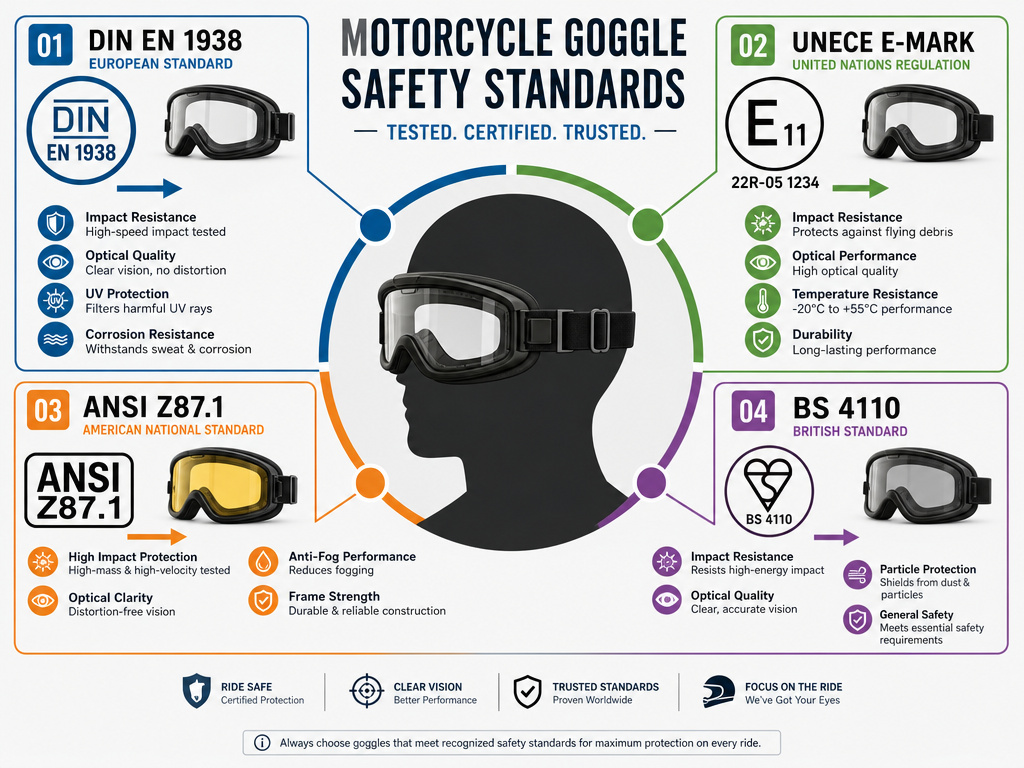
Certification marks are your guarantee. Here’s what to look for.
- DIN EN 1938: This is the go-to European standard for motorcycle and moped goggles. It tests for optical quality, field of vision, resistance to impact, and durability. A goggle with this mark has passed a battery of tests simulating riding conditions.
- UNECE Regulation 22.05/22.06: Often found on helmet visors, this mark is also for goggles. The “E” mark followed by a number indicates the country of certification, and the digits “05” or “06” refer to the regulation version. This is a common legal requirement in Europe and a strong indicator of quality.
- ANSI Z87.1: An American National Standard for occupational safety glasses. It signifies impact resistance, though it is not designed specifically for motorcycles. This standard provides a baseline, but for riding, a product also designed for vehicular use is better.
- BS 4110:1979: The British Standard referenced in UK law for visors. It includes grades (X, XA, YA, ZA) for different levels of protection.
Common mistake: Buying “motorcycle-style” glasses with no certification marks. The style means nothing; the stamp of approval from a testing body means everything. That’s the difference between costume gear and protective equipment.
The 4 Non-Negotiables for Any Eye Protection
Whether you pick goggles or glasses, these four checks are mandatory before every ride.
- No Scratches. The Washington DOL manual states protection must be “free of scratches” to be effective. A deep scratch is a stress point that can cause the lens to crack or shatter on impact. It also distorts vision. Clean lenses with a microfiber cloth and store them in a soft pouch.
- Secure Retention. Your eyewear must stay on your head during a sudden head turn, a gust of wind, or in a crash. Goggles should have a tight, adjustable strap. Glasses need a secure, wraparound fit. If they slip down your nose when you look down, they’re not secure enough.
- Adequate Field of View. Your gear must not block your vision. Remember the 105° peripheral vision requirement from Federal Motorcycle Helmet Standard 218. Bulky frames or small lenses can create blind spots. Test this by wearing your eyewear and turning your head side to side, you should not see the frame in your central or peripheral sightlines.
- Correct Lens Tint for Conditions. This is where sources disagree, and getting it wrong has real consequences. The UK rule states any visor/goggle used on the road must transmit more than 50% of visible light. However, the European standard DIN EN 1938:2010 specifies a minimum 75% luminous transmittance for night driving. If you ride at night with dark tinted lenses, you are dangerously reducing your vision. Sources disagree on the legal minimum: the DIN EN 1938 standard requires at least 75% transmittance for night driving, while UK rules require any road-use visor/goggle to transmit more than 50% of light.
| Symptom | Likely Cause | Immediate Action |
|---|---|---|
| Rapid fogging at stops | Poor ventilation, humidity trapped inside | Crack open visor/goggles slightly; apply anti-fog treatment. |
| Eyes watering constantly | Wind getting behind lenses | Ensure tighter seal or gasket; switch to more enclosed goggles. |
| Glasses slipping forward | Ill-fitting temple arms or nose pads | Adjust arms; consider a sports strap that secures to the back of your head. |
| Distorted or blurry vision | Scratched lens or incorrect prescription | Replace the lens. Do not ride with compromised optics. |
Special Scenarios & Edge Cases
The law has carve-outs. Knowing them keeps you legal in odd situations.
- The Prescription Rider: You need corrected vision to ride. Options include OTG (Over-The-Glass) goggles, prescription inserts for goggles, or prescription safety glasses made with polycarbonate lenses. Don’t just wear your everyday specs underneath, they aren’t impact-rated and the double layer can cause fogging.
- The “Grandfathered” Gear: UK law has a specific clause: “Eye protectors first used before 1 April 1989” with certain properties (transmit 50%+ light, don’t fragment) are still legal. This is a rare exception for vintage equipment, not an excuse to use old, degraded gear.
- The Florida Insurance Exemption: A rider over 21 in Florida can legally ride without a helmet if they carry $10,000 in medical benefits insurance. This does not exempt them from the eye protection law. You could be legal with just goggles and no helmet, but never the reverse.
- Off-Road vs. On-Road: The DIN EN 1938 standard was updated in 2010 to include goggles for off-road use. The DIN EN 1938 standard applies to motorcycle and moped goggles, including for off-road use. An on-road specific model is often the better choice.
What are AA and AAA gear ratings?
The Safety Helmet Assessment and Ratings Programme (SHARP) is a consumer information scheme that uses a 1 to 5 star rating scale to indicate the level of protection a helmet can provide. This is a separate rating from the legal approval standards. For eye protection itself, such as visors or goggles, you must look for specific approval markings. In the case of visors, look for approval to UNECE Regulation 22.05 or UNECE Regulation 22.06. The visor will be marked with a UN ‘E’ mark and the first two digits of the approval number will be 05 or 06. These markings confirm the gear meets a defined standard for resistance to penetration and other safety factors, which is the critical measure for legal use on the road.
When should you choose AA versus AAA rated gear?
Your primary concern should always be selecting gear that is legally approved for road use. For visors and goggles, this means they must be approved to a recognized standard, such as UNECE Regulation 22.05, UNECE Regulation 22.06, or an equivalent level of protection. The SHARP star rating for helmets is a separate assessment of the helmet’s protective capabilities in an accident. A higher SHARP rating indicates a helmet that can provide a greater level of protection for your head. Therefore, when choosing gear, ensure your eye protector carries the correct legal approval marking, and for your helmet, consult the SHARP ratings to understand its comparative impact protection.
Frequently Asked Questions
Can I just wear my regular sunglasses?
No. Most sunglasses are not shatter-resistant and are not designed to stay on securely against high-speed wind pressure. The Washington DOL manual explicitly warns against this. You need purpose-built, certified motorcycle sunglasses or safety glasses.
Are goggles better than glasses for wind protection?
Yes, unequivocally. Goggles provide a sealed or semi-sealed environment that blocks wind from swirling behind the lens and drying out your eyes. They also offer superior protection from particles and insects. For pure wind protection, goggles are the top tier.
What does the “Daytime Use Only” marking mean?
This marking, required on some visors and goggles in the UK, means the lens tint is too dark for safe night riding. Using them at night reduces light transmission below legal and safe limits. Always carry a clear or high-transmission lens for night rides.
How do I stop my goggles or glasses from fogging?
Fogging happens when warm, moist air from your face hits a cold lens. Solutions include wearing a breath-deflecting mask, using an anti-fog spray or insert (like a Pinlock), ensuring your gear has adequate ventilation ports, and simply cracking the seal slightly at low speeds or stops.
Is a windshield enough eye protection?
Rarely, and it’s a legal gamble. Physically, windshields don’t stop all debris. Legally, most statutes require a device worn over the eyes. A windshield is not worn. Unless your state law explicitly says a windshield suffices (as Washington’s does, with caveats), it is not a legal substitute.
Before You Go
The right choice is about a standard, not style. Don’t buy motorcycle eyewear that lacks a verifiable certification mark for impact and retention. Your eyes don’t get a second chance in a crash or a debris strike.
If you ride an open-face helmet, motorcycle goggles meeting DIN EN 1938 are the default, no-compromise answer. If you prefer glasses, choose a pair of certified riding glasses designed for the task, not generic safety glasses. And always, always check the tint before a night ride; that 75% light transmission rule is a critical requirement that determines whether you see an obstacle or hit it.
